EN — English
 TR — Türkçe
 DE — Deutsch
 RU — Русский
 FR — Français
 ES — Español
 AR — العربية
 SR — Српски

Ethiopia Crushed Sand for Better Concrete: Crushing and Screening Plant 90-180 TPH
Ask a concrete plant operator in Ethiopia about problems on the pour and the answer usually ends up in the same place: the slump will not hold, a mix that performed well one week gives lower cube strengths the next, and slabs show shrinkage cracks. Cement and admixtures generally come from known sources; the variable is the sand. Natural sand trucked in from riverbeds and lake shores carries a silt and clay content that changes from load to load, and its grading depends on exactly where it was dug. Yet the Ethiopian highlands are covered with volcanic rock that crushes well, and crushed sand made under control at the quarry lets the concrete laboratory receive the same material every day. This article designs a crushing and screening plant for 90-180 TPH of crushed sand backwards from what concrete needs: first what the laboratory expects from sand, then the machines, settings and configurations that answer those expectations.
Five properties the concrete lab expects from sand
Concrete quality is not decided by tonnage but by whether the five properties below repeat day after day. Limit values come from the project specification and the applicable standard (ASTM C33, EN 12620 or the client's own specification).
- Grading and fineness modulus: Fine and coarse grains must be balanced. If the fineness modulus drifts from day to day, the batching operator has to readjust water and admixture for every batch. In crushed sand this value is managed through screen meshes and crusher settings.
- Material passing 75 microns: Basalt rock dust created by crushing and clay coming from the quarry face are not the same thing. Up to a certain level rock dust fills voids; clay absorbs water and admixture. A Methylene Blue (MBV) or Sand Equivalent (SE) test shows which is present and how much.
- Particle shape: Flaky and elongated grains need more cement paste for the same workability. Cubical grains improve pumpability and surface finish.
- Cleanliness: Organic matter and soil lumps reduce strength; the overburden layer on the face must stay out of the plant.
- Moisture stability: If sand moisture varies during the day, the water/cement ratio shifts. In washed sand, dewatering and stockpile management are therefore as important as the crusher.
With natural sand, none of these five properties is under the producer's control. With crushed sand each of them can be tied to a machine or a setting: particle shape to the sand crusher, grading to the screen, fines to the washer or screen setting, cleanliness to pre-screening, moisture to stockpile practice. The following sections make that link under Ethiopian conditions.
Sand feedstock in Ethiopia: basalt highlands and limestone regions
Most of the Ethiopian highlands consist of thick basalt flows and related volcanic rocks such as ignimbrite and trachyte; most quarries around Addis Ababa work in these rocks. Basalt is hard and abrasive, and crushed with the right machine it gives concrete a sound, cubical sand. Even on the same plateau, however, the rock is not uniform: alongside massive basalt there are vesicular, scoriaceous or weathered levels. Sand from a vesicular level absorbs more water. Which level of the quarry will be worked must therefore be decided before the sand plant is drawn.
In the east and south-east of the country, and on some valley floors, limestone and sandstone formations are also quarried. Limestone is softer and less abrasive, and a different crusher logic applies to sand production there. In both cases the decision is made with abrasiveness, compressive strength, water absorption and clay content tests on samples taken from the quarry face.
As a concrete reference in the country, General Makina has a 150 t/h basalt crushing and screening project in Jijiga, Ethiopia. It is a real example of Ethiopian basalt being processed on a line that starts with a primary jaw crusher; sand production is planned by adding a fine crushing and shaping stage behind such a line.
Building the 90-180 TPH sand line stage by stage
A sand crusher needs small, steady feed, which depends on correctly sizing the stages in front of it.
Feeding, scalping and primary crushing
This step matters more for sand quality than is often assumed: if soil and weathered fines from the face are not separated on the grizzly and sent to a separate stockpile, clay travels straight into the sand fraction. For primary crushing of basalt, the compression-type GNRK series jaw crusher is the right choice; in the 90-180 TPH range the GNRK 90 (900×650 mm opening, 60–225 t/h, 75/90 kW) covers this duty. A cone crusher then reduces the material to the size the sand crusher will accept. Model-specific capacity tables for the cone crusher are issued per project after rock testing.
Sand stage: VSI for basalt, tertiary impact for limestone
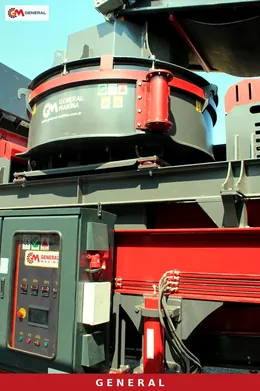
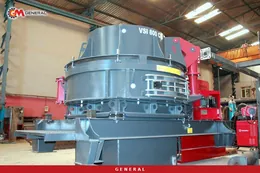
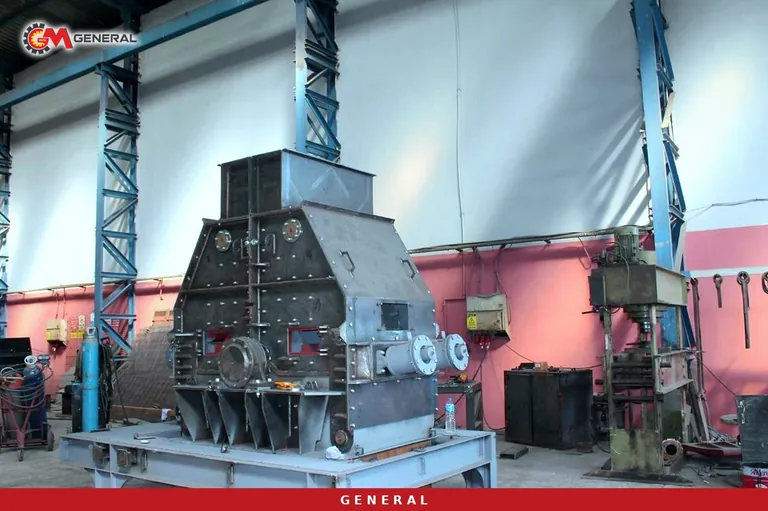
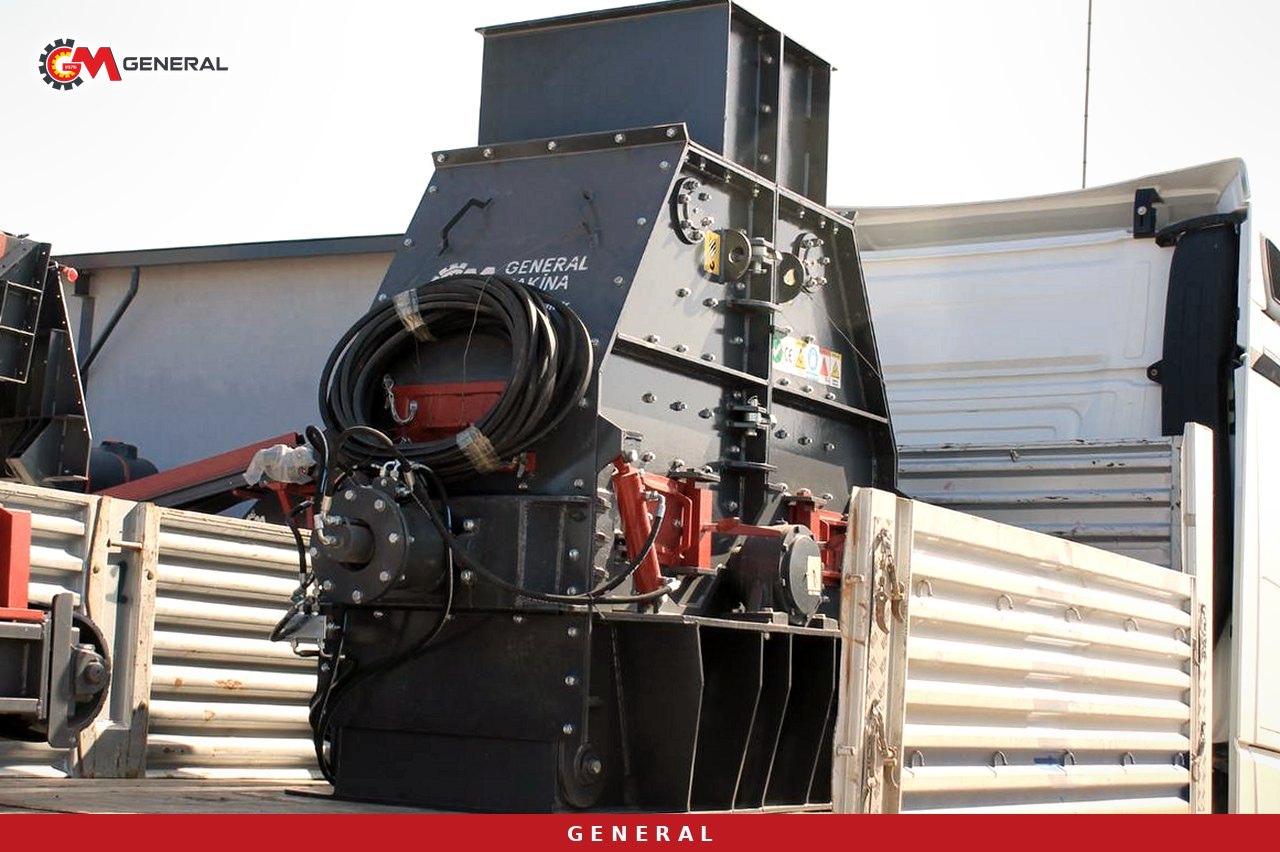
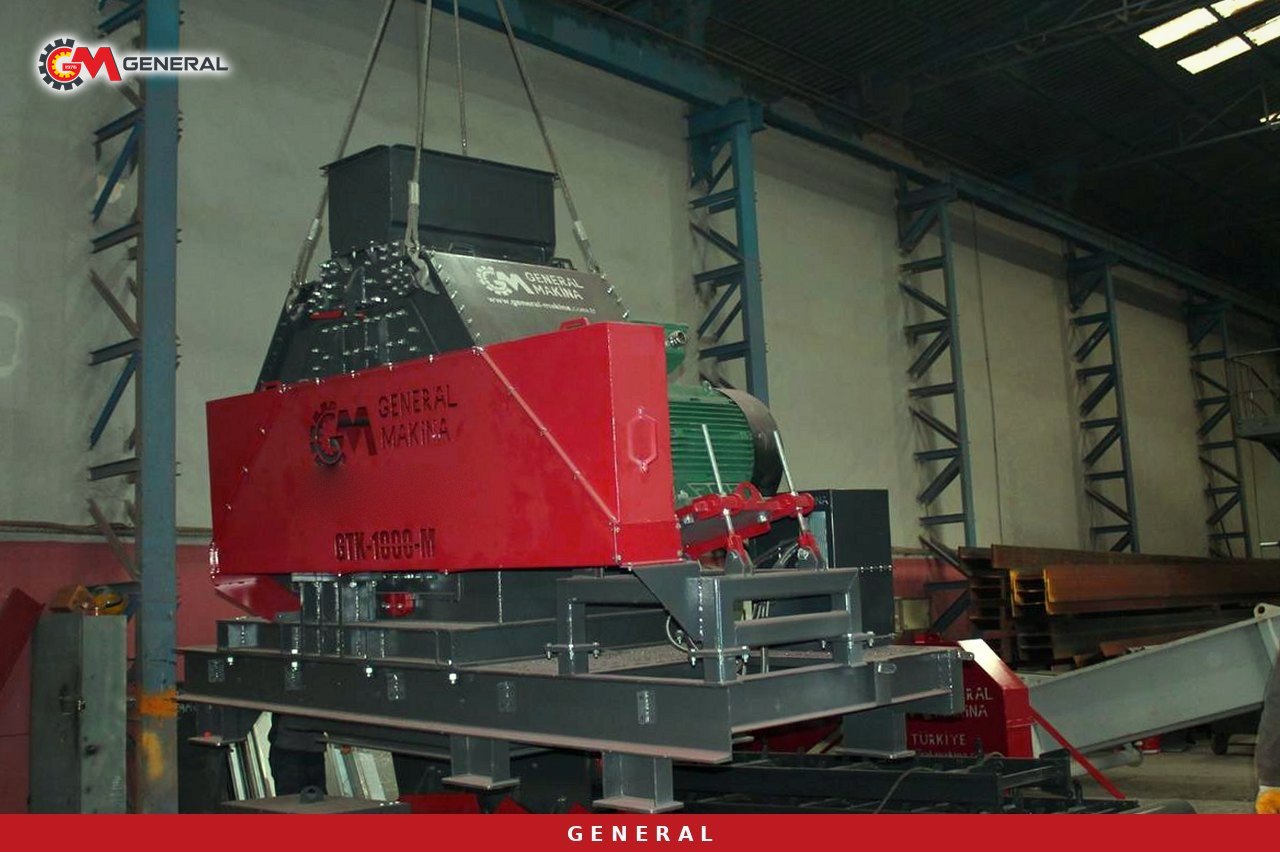
For siliceous, abrasive rock like basalt, the right sand-making machine is the GNR series VSI vertical shaft crusher. When the vertical rotor accelerates the material and throws it onto its own rock bed, grains break at their corners and become cubical; with less metal contact, wear cost stays under control. For concrete, the gain is better particle shape and a grading that can be steered through rotor speed and feed setting. The GNR 900 covers the whole target range in a single machine with 80–210 t/h; its feed is limited to 50–55 mm and it uses a 2×200 kW drive. If the saleable sand target sits in the lower part of the range, the GNR 800 (55–160 t/h, 40–50 mm feed, 132–160 kW) may be sufficient with less installed power.
On limestone quarries the GNR series tertiary crusher is the more economical route. It accepts feed up to 150 mm and produces 0–5 mm crushed sand together with fine chippings; the GNR 100 (90–160 t/h, 160 kW) and GNR 130 (130–200 t/h, 200 kW) are the two models that fit this range. This machine is not recommended on basalt: in high-silica rock the impact parts wear fast and the cost per ton rises above that of a VSI. Wet, clayey limestone also blocks a tertiary crusher; on such a site washing is planned ahead of the crusher.
Screening: splitting the sand to suit concrete
The product leaving the sand crusher is split into fractions on the screen and the oversize returns to the crusher. This is where the real adjustment for concrete quality happens: the mesh setting the top size of the 0–5 mm sand is chosen, and if needed two sand fractions such as 0–2 and 2–5 mm are stockpiled separately and blended at the batching plant in the required ratio. The fineness modulus can thus be held with a precision natural sand never allows. The 1600×5000 mm GNR 1650 (15 kW) or the 2000×6000 mm GNR 2060 (18.5 kW) circular vibrating screens are sizes worth considering at this capacity.
Three sand line options for Ethiopian quarries
The table below places the layouts possible for the 90-180 TPH sand range side by side using manufacturer data. The capacity column refers to the machine in the sand stage; cone crusher and screen selection are finalised after rock testing.
| Option | Main machines | Sand stage capacity (t/h) | Sand stage feed | Sand stage power | Suitable feedstock |
|---|---|---|---|---|---|
| A – Stationary basalt line | GNRK 90 + cone + GNR 900 VSI + screen | 80–210 | 50–55 mm | 2×200 kW | Basalt, ignimbrite, trachyte |
| A′ – Lower range | GNRK 90 + cone + GNR 800 VSI + screen | 55–160 | 40–50 mm | 132–160 kW | Basalt, ignimbrite, trachyte |
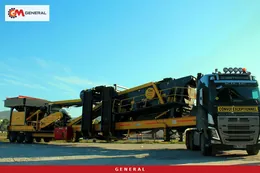
| B – Mobile sand stage on an existing line | Existing primary/secondary + GNR-MVSI 900 | 90–180 | 50 mm | 850 kVA generator | Pre-crushed hard rock |
| C – Limestone line | GNRK 90 + GNR 130 tertiary + screen | 130–200 | 150 mm | 200 kW | Limestone, low-to-medium abrasive rock |
| D – Limestone, lower range | GNRK 90 + GNR 100 tertiary + screen | 90–160 | 150 mm | 160 kW | Limestone |
| Cone crusher (A, A′) | Model per rock test | — | — | — | Basalt, granite |
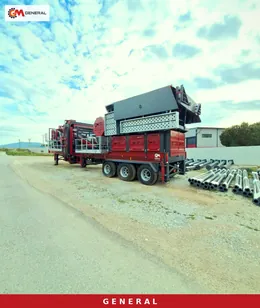
Option A is the most controlled route for a long-life basalt quarry that runs its own batching plant; the line sits on foundations and sand and chippings come from the same flow. For the components of a fixed line, see the stationary crushing and screening plants page. Option B suits a quarry that produces chippings but does not use its sand fraction: the GNR-MVSI 900 carries the VSI 900 crusher, a 1600×5000 mm three-deck screen and an 850 kVA generator on one wheeled chassis and splits the product into 0–3, 3–5 and 5–12 mm. With a weight of 42,000 kg and its own power, it lets quarries with a weak grid connection start sand production without waiting for foundation works. C and D are for limestone only; on a basalt quarry these two layouts should be avoided.
Fines and washing: making the sand ready for concrete
The most common disappointment with crushed sand is a perfectly shaped sand that still demands too much water in concrete. The cause is usually the material below 75 microns. If basalt's own rock dust exceeds a certain level, or clay from the face gets mixed in, the mix design suffers no matter how good the crusher is. The solution is one of two routes.
If the rock is clean and the grizzly scalping removes the soil, sand can be produced dry; the fines content is limited by screen setting and VSI rotor speed. If there are clay bands, weathered levels or red soil contamination, washing is needed. Among the sand washing machines the typical choice for sand is the screw washer: with 0–50 mm feed and 50–250 t/h capacity it removes clay and excess rock dust over the overflow weir. Sand leaves the screw washer at a typical moisture of 15–30%; with a hydrocyclone and dewatering screen added it drops to 8–20%. For the batching plant this means less frequent water correction.
A washing line should not be built without a water plan. The adequacy of the water source in the dry season, a settling pond and recycled water must appear in the first plant layout drawing. In the rainy season (kiremt), moisture and clay load of the material from the face increase; scalping and washing capacity are chosen with that period in mind.
Site preparation: power, transport and the quotation file
Ethiopia is landlocked; machines usually reach the highlands via the port of Djibouti by road or along the rail corridor. Transport dimensions of stationary plant components and mobile chassis must therefore be clarified at quotation stage; for example the GNR-MVSI 900 has a transport size of 4100 × 16200 × 4500 mm. On sites without a grid or with frequent outages, generator capacity is set according to the plant's total connected load. In the dry season wind blows the fine part of sand stockpiles away and stresses screens and motors; enclosed transfer points, water-spray dust suppression and regular filter maintenance are measures that can be selected per project.
Having the following information ready when requesting a quote lets the right configuration emerge in the first round:
- Abrasiveness, compressive strength, water absorption and MBV/SE results for samples from at least three points on the quarry face.
- Saleable sand target in tons per hour and the required fractions; chipping sizes to be produced alongside the sand.
- Concrete classes the sand will be used for and the standard to be met; on public works the sand specification should be confirmed with the relevant authority.
- Models and capacities of any existing primary, secondary and screen.
- Grid capacity or generator requirement.
- Water source and the area available for washing and settling.
- Distance from quarry to batching plant and size of the sand stockpile area.
Frequently asked questions
Is concrete made with crushed sand stronger than concrete with natural sand?
Strength is the result of the mix design, not of the sand alone. The advantage of crushed sand is that clean, cubical grains allow the same mix to be repeated every day with the same result. When switching from natural to crushed sand, the mix must be readjusted in a concrete laboratory.
Is washing basalt sand mandatory?
No. If the rock is clean, scalping is effective and MBV/SE results meet the specification, dry production may be sufficient. If there are clay bands or weathered levels, a screw washer is added.
I already have a chippings line; what should I add for sand?
If your secondary product can be brought below 50 mm, a sand stage can be added with the GNR-MVSI 900 or a stationary GNR VSI crusher. Whether the existing screen has enough decks and suitable mesh openings to separate the sand fraction is checked separately.
What are the warranty and certificates?
The machines are manufactured with ISO 9001 and CE certification and carry a 1-year warranty; wear parts are excluded. Spare parts and after-sales support scope are defined per machine in the quotation.
Conclusion
In Ethiopia, the shortest way to raise concrete quality is to replace variable natural sand with crushed sand produced under control at the quarry. On basalt-dominated sites the machine for this is the VSI: a GNR 900 on a stationary line or a GNR-MVSI 900 on an existing chippings line covers the 90-180 TPH range. On limestone sites the GNR tertiary crusher does the same job with a shorter chain. Sample tests and the concrete laboratory's expectations should drive the decision. Send your sample results and target capacity through our contact page and we will prepare the configuration and quotation that fit your quarry.
Definitions of technical terms: Glossary