EN — English
 TR — Türkçe
 DE — Deutsch
 RU — Русский
 FR — Français
 ES — Español
 AR — العربية
 SR — Српски

Uganda Crushed Sand Tertiary Crushing and Screening Plant 80-150 TPH
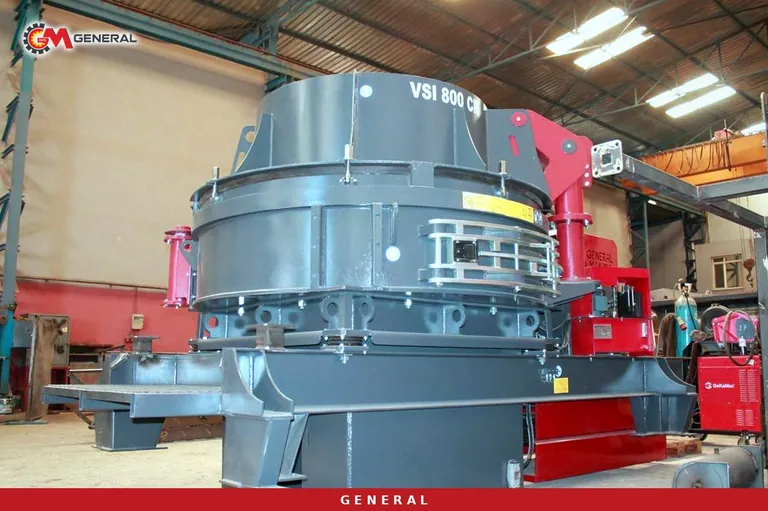
Building sites around Kampala, Mukono, Wakiso and Jinja still take a large share of their sand from the Lake Victoria shoreline, wetland margins and river beds. That sand looks cheap, yet the grading changes from truck to truck and it arrives with silt, organic matter and clay lumps. The batching plant ends up correcting water content for every batch. For a quarry operator the answer is a controlled crushed sand made from the quarry's own rock. This article explains, using our catalogue data, which machine should form the tertiary stage of an 80-150 TPH crushed sand line in Uganda, how rock type changes the choice, and what to plan for when bringing equipment to an inland site.
From lakeshore sand to quarry sand
Uganda is landlocked. Much of its construction material has to be produced locally, which turns sand from a logistics question into a quality question. The weakness of natural sand is not quantity but consistency: two loads from the same pit can differ clearly in fines content. The ready-mix producer compensates with cement and carries that cost himself.
Crushed sand removes the variation. When the quarry runs the same rock through the same crusher and the same screen aperture, the grading curve comes out the same every day. In many granite quarries a pile of 0-5 mm material is already building up under the cone crusher; the right tertiary stage turns that stockpile into saleable sand. Permits for lakeshore and wetland sand extraction are a separate matter; confirm your site's status with the competent environmental authority.
The quarry rock picks the machine
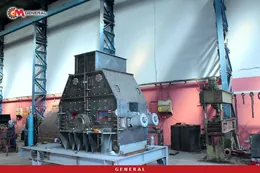
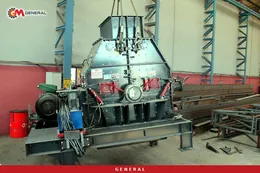
"Tertiary crusher" describes a stage, not one machine. In our range two different principles work at this stage: the horizontal-rotor GNR series tertiary impact crusher and the vertical-rotor GNR series VSI crusher. Both make sand, but on abrasive rock the metal they consume per tonne differs widely. Most of Uganda sits on Precambrian basement rock; granite, gneiss and quartzite are the most common quarry stones. Volcanic rock occurs in the east and west, and limestone and carbonate deposits in limited areas. No model is final until your rock's silica content and abrasion index have been measured in a laboratory.
VSI for granite, gneiss and quartzite
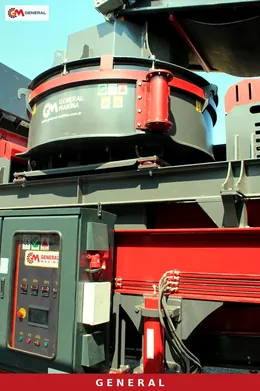
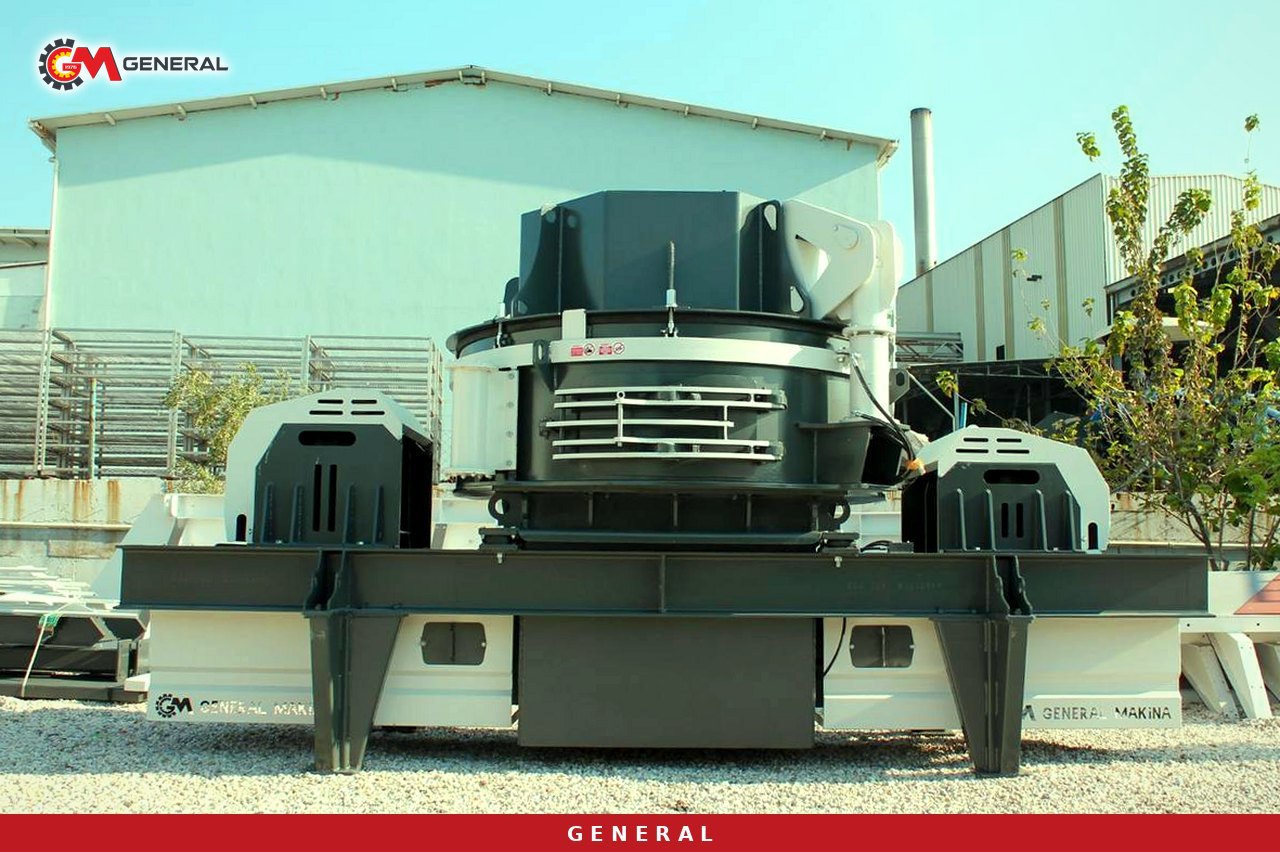
On rock with a high free quartz content a VSI is the cheaper option to run. The rotor accelerates material to about 80 m/s and throws it against its own rock bed (rock-on-rock). In this mode the bed takes the wear instead of metal, so rotor tips, wear plates and the anvil last longer. On high-silica material, ceramic or tungsten-carbide reinforced tips are used. The VSI's real job is shaping more than size reduction: cubical grains, a low flakiness index and the rounded-edge sand that concrete and asphalt require.
GNR tertiary for limestone and low-abrasion rock
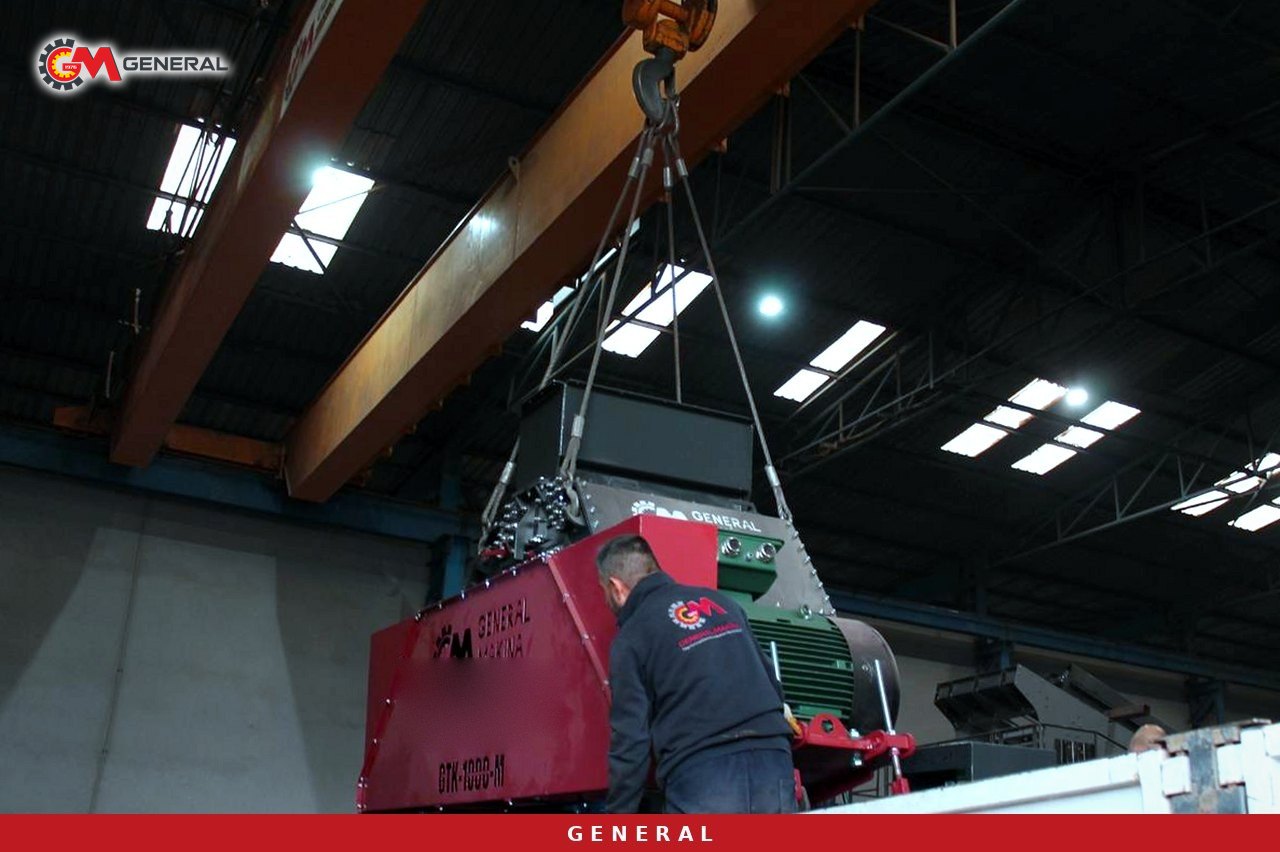
If you process limestone or a low-to-medium abrasive rock, the GNR tertiary impact crusher gives a simpler line. Its main advantage is feed size: the whole series accepts material up to 150 mm. That means it can take secondary crusher product directly, without an intermediate screening step. Run the same machine on granite and the high rotor speed raises part consumption; high-chrome or ceramic-reinforced parts are then needed. Wet clayey feed clogs the rotor, so such material has to be washed before the crusher.
Real models for 80-150 TPH
The table below sets the models that cover the target range side by side with their catalogue values. Capacity ranges vary with material, moisture and screen aperture; the table is a matching tool, not a guaranteed output.
| Model | Principle | Rotor (mm) | Max. feed (mm) | Capacity (t/h) | Power |
|---|---|---|---|---|---|
| GNR 65 tertiary | Horizontal-rotor impact | 1200×650 | 150 | 70-130 | 132 kW |
| GNR 100 tertiary | Horizontal-rotor impact | 1200×1000 | 150 | 90-160 | 160 kW |
| GNR 800 VSI | Vertical rotor, rock-on-rock / anvil | 800 | 40-50 | 55-160 | 132-160 kW |
| GNR 900 VSI | Vertical rotor, rock-on-rock / anvil | 900 | 50-55 | 80-210 | 2×200 kW |
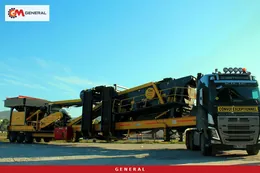
| GNR-MVSI 900 (wheeled) | VSI 900 + triple-deck screen | — | 50 | 90-180 | 850 kVA generator |
For a granite or gneiss quarry at 80-150 TPH our first candidate is the GNR 800 VSI; it covers the whole range with a reasonable power demand. If you want headroom at the top or plan to expand later, the GNR 900 comes into the picture. In a limestone quarry the GNR 100 tertiary fits this range, and if the target stays around 80-120 TPH the GNR 65 may be enough. If your quarry is not yet set up, or you plan to produce at more than one site, the GNR-MVSI 900 wheeled VSI sand and shaping plant works without a foundation; it weighs 42,000 kg and its transport dimensions are 4100 × 16200 × 4500 mm.
Stage layout: from secondary crusher to sand screen
A tertiary machine does not make sand on its own; the equipment before and after it decides the result. A typical granite line runs jaw primary, cone secondary, VSI tertiary and a closed-circuit sand screen. Because the VSI accepts no more than 50-55 mm, the cone product is screened first and the oversize returns to the cone. In a limestone line the GNR tertiary takes material up to 150 mm, so this intermediate screening becomes simpler.
Screen size is chosen together with tonnage. The GNR 1650 circular-motion screen is 1600×5000 mm with 15 kW; in a sand circuit near 150 TPH, depending on moisture and deck count, the GNR 2060 (2000×6000 mm, 18.5 kW) runs more comfortably. Each extra deck cuts screen capacity by roughly 10%, so if three fractions are needed the screen area should be generous. The GNR-MVSI 900 does this with its own 1600×5000 mm triple-deck screen and splits the product into 0-3, 3-5 and 5-12 mm.
Find out by testing, not guessing, how much material the tertiary stage needs. Hypothetical example: if a sample test shows that the crusher turns 0.5 of its feed into 0-5 mm per pass, about 200 t/h must enter the circuit for 100 t/h of sand; the rest is either sold as coarse aggregate or recirculated. The ratio depends on the rock, and only a test on your own sample gives the real value.
When washing is needed
In weathered granite and in quarries under laterite overburden, crushed sand can carry dust and clay. Concrete producers ask for the clay to be measured with the methylene blue value (MBV) or sand equivalent (SE) test. If these exceed the limit, a fine material screw washer is added to the line. The washers work at 50-250 t/h on 0-50 mm feed; the single GNR 800 (800×8000 mm, 11 kW) or, for stronger scrubbing, the twin GNR 600 (2×7.5 kW) suits this tonnage. Screw washer discharge moisture is usually 15-30%; with a hydrocyclone and dewatering screen it drops to 8-20%. Other washing machines are listed in the washers category.
Inland from Mombasa or Dar es Salaam
A machine leaving Türkiye usually reaches Uganda through Mombasa (Kenya) or Dar es Salaam (Tanzania) and then by road. That route forces two decisions. The first is packing: a stationary tertiary crusher, screen and conveyors travel in parts and need a concrete foundation and steel structure on site. The wheeled GNR-MVSI 900 is towed as one chassis, but because of its length and weight the bridge and bend limits on the route have to be checked in advance.
The second is energy. A stationary line near the grid runs on mains power; the GNR 100 tertiary draws 160 kW, the GNR 800 VSI 132-160 kW and the GNR 900 VSI 2×200 kW, with screen and washer motors on top. On an off-grid site every motor is fed by a generator, sized for total installed power and starting currents. The 850 kVA generator of the GNR-MVSI 900 puts that calculation inside the machine. The two rainy seasons and the dust of the dry period under an equatorial climate also enter the plan: in the wet months the feed gets damp and screen blinding increases, in the dry months engine and generator air filters need changing more often. Covered conveyors and dust-suppression sprays can be selected per project.
Checklist for the quotation file
To work out the right configuration we only need the following information in one message:
- Rock type and, if possible, the lab result: silica content, abrasion index, clay and moisture.
- The size of the material entering the tertiary stage and the model of your current secondary crusher.
- Target product: 0-3, 0-4 or 0-5 mm sand plus any extra chip fractions.
- Hourly and daily output target, number of shifts.
- Who buys the sand: ready-mix, block making, asphalt or plaster.
- Whether there is grid power on site and the flow of the water source.
- Whether you prefer a stationary or wheeled set-up, and how long the site will be used.
- The specification the product must meet; for a road or building project, the technical specification of the relevant authority.
For a closer look at how the stages are arranged in a line, see our article on the role of primary, secondary and tertiary crushers. The full crusher family is listed in the crushers category.
Frequently asked questions
Can I use the GNR tertiary impact crusher in a granite quarry?
You can, but on high-silica rock the rotor parts wear fast and the cost per tonne rises. On granite, gneiss and quartzite the VSI's rock-on-rock mode makes the same sand with far less metal.
Can I feed quarry run rock straight into the tertiary stage?
No. The GNR tertiary series accepts at most 150 mm, the VSI models 40-55 mm and the GNR-MVSI 900 50 mm. Primary and secondary crushing must come first.
Can crushed sand replace lake sand in concrete?
When grain shape and grading are set correctly, and the sand is washed where needed, it meets ASTM and EN specifications. Check the limits in your own project specification and have a trial mix made.
What warranty and certificates apply?
Our machines are built with ISO 9001 and CE certification and carry a 1-year warranty, wear parts excluded. We have been manufacturing in Izmir since 1976.
Decision and next step
For 80-150 TPH of crushed sand in Uganda the choice depends first on the rock: GNR 800 or GNR 900 VSI for granite and gneiss, GNR 65 or GNR 100 tertiary impact crusher for limestone, and the GNR-MVSI 900 when you need flexibility beyond one quarry. Send your rock sample data, target grading and site details through our contact page and we will prepare a project-specific configuration and quotation.
Definitions of technical terms: Glossary