EN — English
 TR — Türkçe
 DE — Deutsch
 RU — Русский
 FR — Français
 ES — Español
 AR — العربية
 SR — Српски

Zambia Lusaka Dolomite Impact Aggregate Crusher Plant 150-250 TPH
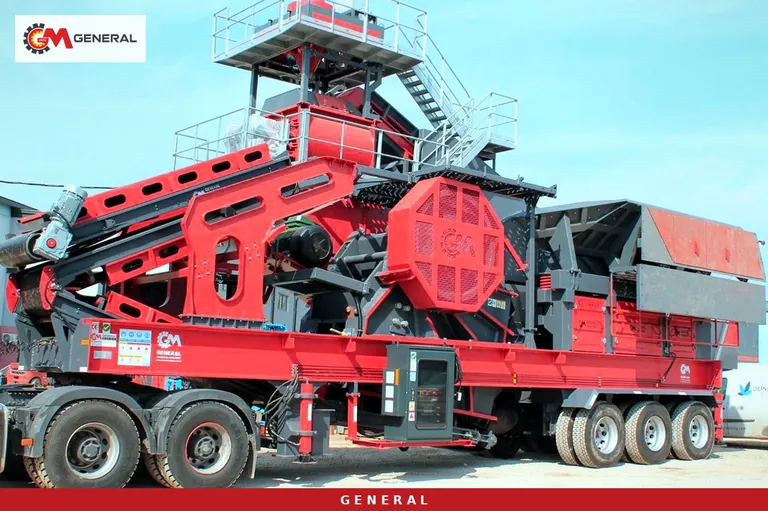
Most of the aggregate quarries opened around Lusaka work the same family of rock: the carbonate beds that underlie the capital and spread across a wide area around it, known in the geological literature as the "Lusaka Dolomite". As the city grows, demand for crushed stone and concrete aggregate for housing, roads and commercial buildings falls squarely on these quarries. Dolomite is far less abrasive than granite or basalt, which makes it a good candidate for impact crushing; however, its karst structure, clay-filled cavities and occasional silicified bands mean that not every dolomite quarry can carry the same machine. In this article we explain how to design an impact crushing line that processes 150-250 tons of dolomite per hour under Lusaka conditions, which real models fit this range, and which data should be collected from the quarry before any decision is made.
All model figures in this article come from the catalog data on our product pages. We do not provide information about any specific quarry, tender or construction project in Zambia; we recommend confirming the aggregate requirements in your specification with the client or the relevant authority.
Why Lusaka dolomite suits an impact crusher, and where the limits are
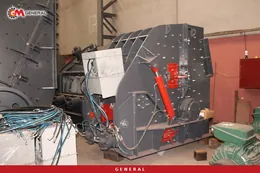
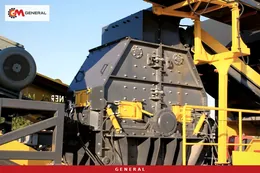
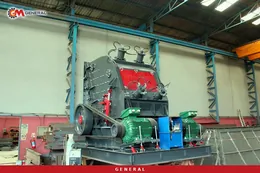
An impact crusher does not break rock by squeezing it. Instead, the blow bars on a fast-spinning rotor strike the stone and hurl it against the impact plates, where it shatters. With brittle, low-silica carbonate rock this principle delivers two concrete advantages: a high reduction ratio in a single stage and a cubical grain shape. The angular, low-flakiness chippings that concrete and asphalt producers want need less additional processing than the slabby particles that come out of a jaw crusher. Our product page lists a reduction ratio of up to 20:1 in limestone for the primary impact crusher, and dolomite appears on the same list of suitable materials.
The limit begins with the silica content of the rock. In pure dolomite the blow bars last a long time; as quartz veins, chert nodules or silicified layers increase, wear accelerates quickly. For hard, abrasive rock such as granite and basalt, a jaw crusher as the primary stage followed by a cone crusher or a vertical shaft (cubitzer) secondary crusher is the better choice. Around Lusaka it is quite possible to find clean dolomite alongside transitions into schist or quartzite in the same quarry face. That is why taking samples from several points of the face and having abrasiveness and compressive strength tested at an independent laboratory before choosing a machine is the cheapest insurance you can buy for the investment.
Karst cavities and clay pockets
Over time, dolomite slowly dissolves in water and leaves cavities inside the rock that fill up with red-brown clay. After blasting, this clay arrives at the hopper together with the large blocks. During the rainy season the wet clay blinds the grizzly openings, sticks inside the crusher and causes carry-back losses on the conveyors. On an impact line the solution is to separate it before the crusher: a grizzly feeder sends the fine, soil-laden fraction through a bypass to a separate stockpile, so that only clean, coarse stone enters the crusher. This separated material can often be sold as fill or sub-base.
Block size coming from the blast
The largest stone a primary impact crusher will accept is a direct result of the drilling and blasting pattern. Our mobile primary impact unit accepts a 0-1200 mm feed; for the stationary GPS-1413 this value is 800 mm. If the proportion of oversize blocks after blasting is high, bridging and stoppages start at the crusher inlet; either the blast pattern must be tightened or a model with a wider feed opening must be selected. When the quarry owner measures the typical block size together with the drilling crew, the discussion about models becomes much shorter.
Three impact crushing configurations that cover 150-250 TPH
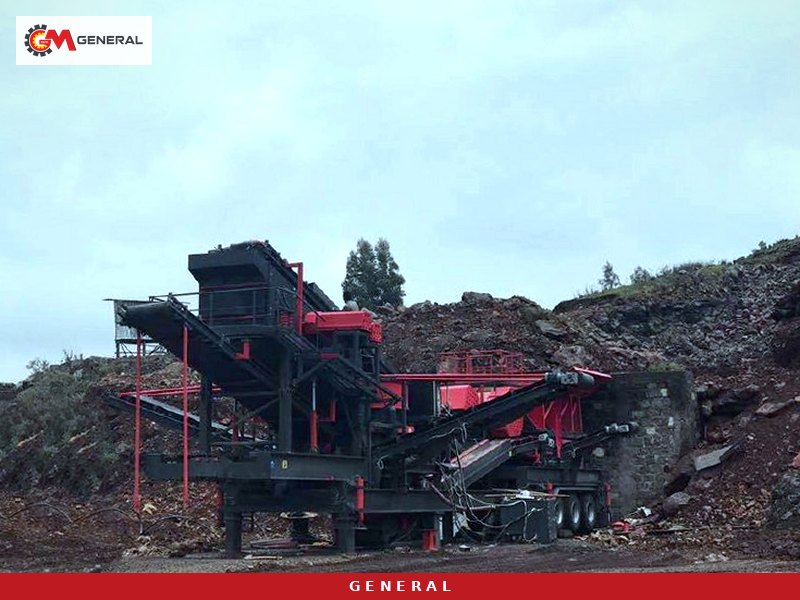
The 150-250 TPH in the title is a target range, not the rating plate of a single machine. The three configurations below reach this range with real models from our product catalog. The values shown in the table are the capacity of each individual model; the actual output of the line will vary with feed size, moisture and clay content, and the required product curve.
| Unit | Role | Capacity (t/h) | Feed (mm) | Motor (kW) | Weight (kg) |
|---|---|---|---|---|---|
| M-PDK02 mobile primary impact crusher | Configuration 1, primary crushing | 200-300 | 0-1200 | 250 | 45,000 |
| Mobile Pre-Screen DMK | Configuration 1, secondary crushing | 40-300 | 0-100 | — | — |
| GPS-1413 (stationary, two stages in one body) | Configuration 2 | 125-320 | 800 | 250 | — |
| GNR PDK02 stationary primary impact crusher | Configuration 3, primary crushing | 200-300 | 900 | 200 | — |
| GNR DMK02 stationary secondary impact crusher | Configuration 3, secondary crushing | 170-250 | 800 | 200 | — |
Configuration 1: two mobile units close to the quarry face
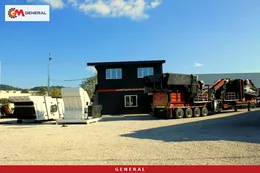
The M-PDK02 mobile primary impact crusher with its 1200×4750 mm feeder, works in the 200-300 TPH range and produces a cubical 0-70 mm product. The Mobile Pre-Screen DMK connected behind it takes the 0-100 mm feed, removes material that is already at final size with its vibrating pre-screen, and reduces only the oversize to 0-30 mm in two crushing chambers. With a 150-250 TPH target, this pre-screen arrangement keeps the secondary crusher from being loaded unnecessarily. The configuration makes sense for operators who want to move the whole line forward as the quarry face advances, or whose land permits are not yet settled in the first years of operation. All single-chassis units are listed on our mobile crushers page.
Configuration 2: two stages in one body, stationary line
The GPS series impact crusher performs primary and secondary crushing in the same body. The GPS-1413, with its 1400×1250 mm rotor and 250 kW motor, delivers 125-320 TPH. One machine means one set of wear parts and one foundation; with fewer crushers in the line, the conveyor and screen layout also becomes simpler. For quarries that produce larger blocks, the GPS-1415 (150-400 TPH, 315 kW), which accepts a 1000 mm feed, is the next step up. This configuration suits a quarry whose reserves will last for many years and where a grid power connection can be planned.
Configuration 3: separate primary and secondary, stationary line
The GNR PDK02 (900 mm feed, 200-300 TPH) handles primary crushing, while the GNR DMK02 (170-250 TPH, 200 kW) takes care of secondary crushing. Separating the two stages allows the apron setting of the secondary crusher to be adjusted independently according to the product curve, which gives flexibility to producers who frequently change the ratio of chippings to sand. Stationary line components and typical layouts are shown on our stationary crushing and screening plants page.
Products the Lusaka market wants, and the screening decision
Just as important as the choice of crusher is the number of fractions that will come out at the end of the line. Ready-mix concrete, concrete block and asphalt producers in and around the capital usually ask for chippings in several different sizes, while road construction calls for base material with a controlled grading. The exact fractions should always be taken from the buyers' specifications. When deciding on the screen, keep the following points in mind:
- Number of products: a four-deck screen separates four distinct size groups; an additional product requires a second screen or a change of settings.
- Screen size: in the GNR series of vibrating screens, models such as 2000×6000 mm (GNR 2060) and 2400×6000 mm (GNR 2460) are preferred for high-tonnage lines; the size is chosen so that the screen can handle the full crusher output.
- Clay load: if there is a concrete aggregate requirement that calls for washing, wet screening with a sand screw should be considered instead of dry screening.
- Return conveyor: sending the oversize from the screen back to the secondary crusher keeps the product curve stable through closed-circuit production.
- Stockpile area: a separate pile for each fraction, along with room for loader traffic, should be planned from the start.
If you are considering producing sand from dolomite, the proportion of fines generated by the impact crusher and the sand's compliance with the fines limit in the concrete specification should be checked in a laboratory.
Shipping to a landlocked country, power supply and installation
Zambia has no coastline; a line leaving Izmir reaches the ports of neighbouring countries by sea and is then transported to Lusaka by road. Dar es Salaam, Walvis Bay, Durban and Beira are the ports most often used on these corridors. The route, border crossings and load dimensions are planned together with the freight forwarder for every shipment. The weight of the mobile units is a decisive factor in this planning: the M-PDK02 weighs 45,000 kg and the M-PDK01 weighs 50,000 kg. A stationary line, on the other hand, is shipped dismantled in containers and on flat-rack platforms, and on site it requires concrete foundations, a steel structure and cabling.
On the power side there are two questions. The first is the grid: most of Zambia's electricity comes from hydropower, and scheduled outages can occur during droughts. Even for a grid-connected stationary line, backup generator capacity should be considered. The second is altitude: Lusaka sits on a high plateau, and the output of diesel generators drops as altitude increases. The generator should be selected by taking into account the combined power of the crusher, feeder, screen and conveyor motors together with the generator manufacturer's altitude derating. Sizing based only on the crusher motor leads to a shutdown on the first busy day.
Operating settings that keep the line running in the rainy and dry seasons
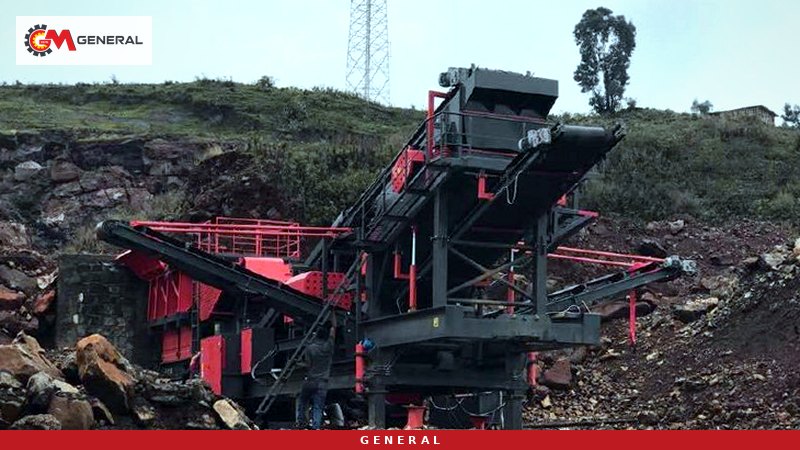
The year in Lusaka is clearly divided into a rainy season and a dry season, and the same line behaves as if it were processing two different materials. In the wet months the clay becomes saturated, and blinding of the feeder grizzly and build-up on the belts increase. During this period, widening the grizzly gap, raising the bypass ratio and checking the belt scrapers frequently all reduce production losses. In the dry months the problem is dust: water-spray dust suppression at transfer points and conveyor covers are measures that can be added depending on the project.
The wear cost of an impact crusher depends on the blow bar alloy. According to the general rule on our product pages, high-chrome white cast iron is preferred for clean, abrasive material, while tough manganese or martensitic alloys are preferred in quarries where there is a risk of metal pieces arriving from the blast. The blow bars of the Mobile Pre-Screen DMK are reversible, and its housing opens hydraulically, so turning and replacing the blow bars takes less time. Recording blow bar measurements every month in a dolomite quarry means spare parts can be ordered on the basis of data rather than guesswork.
The apron setting is the quickest way to change the product curve. As the gap is reduced, the proportion of fines rises and capacity falls. If market demand for sand increases, closing the apron may be enough; if demand for chippings increases, opening it may do the job. After every change, however, the screen output should be weighed to check the balance.
Information to collect from the quarry before requesting a quote
An accurate quote comes from accurate data. If you fill in the list below and send it to us, our model recommendation will be based on calculation rather than estimation:
- Laboratory results for samples taken from different points of the face: compressive strength, abrasiveness and silica content.
- Typical and maximum block size after blasting.
- Clay and soil content of the material, and its moisture condition during the rainy season.
- Target hourly capacity and daily operating hours.
- Required fractions and the approximate share of each.
- Power source: grid connection, generator or both.
- Site layout: direction of face advance, stockpile area and truck route.
- Preferred port and delivery terms.
Frequently asked questions
Why do you recommend an impact crusher rather than a jaw crusher for dolomite?
In dolomite with low silica content, an impact crusher gives a higher reduction ratio in a single stage and a more cubical grain. If sample testing shows high silica or abrasiveness, we change our recommendation to a jaw crusher as the primary stage with a cone crusher or cubitzer as the secondary.
Is a mobile or a stationary configuration more suitable?
If the face moves frequently or land permits are not long term, two mobile units provide flexibility. If the reserves will last for many years and a grid connection can be planned, a stationary line built around the GPS-1413, or the PDK02 together with the DMK02, offers simpler operation.
What warranty and certifications do you offer?
Our machines come with a 1-year warranty; wear parts are not covered by the warranty. Our production is ISO 9001 and CE certified. General Makina has been manufacturing in Izmir since 1976.
What determines the cost of the plant?
The cost depends on whether the configuration is mobile or stationary, the crusher and screen models, the number of conveyors, the need for a generator, options such as dust suppression, and the method of shipment. Once these details are clear, we prepare a quote tailored to the project.
Conclusion
Lusaka dolomite is a raw material well suited to efficient, cubical aggregate production with an impact crusher. The keys to success are measuring clay and silica bands in advance, protecting the crusher with grizzly pre-screening, and planning the power supply around altitude and grid outages. For a 150-250 TPH target, the options are two mobile units, a single-body GPS line, or a stationary line with separate primary and secondary crushers. For our broader experience with limestone and other carbonate rocks, take a look at our article on mobile crusher solutions for limestone. Send us your sample results and target products through our contact page and we will work out the right configuration for your quarry together.
Definitions of technical terms: Glossary