EN — English
 TR — Türkçe
 DE — Deutsch
 RU — Русский
 FR — Français
 ES — Español
 AR — العربية
 SR — Српски

Johannesburg Road Projects Mobile Aggregate Crusher Plant 200-300 TPH
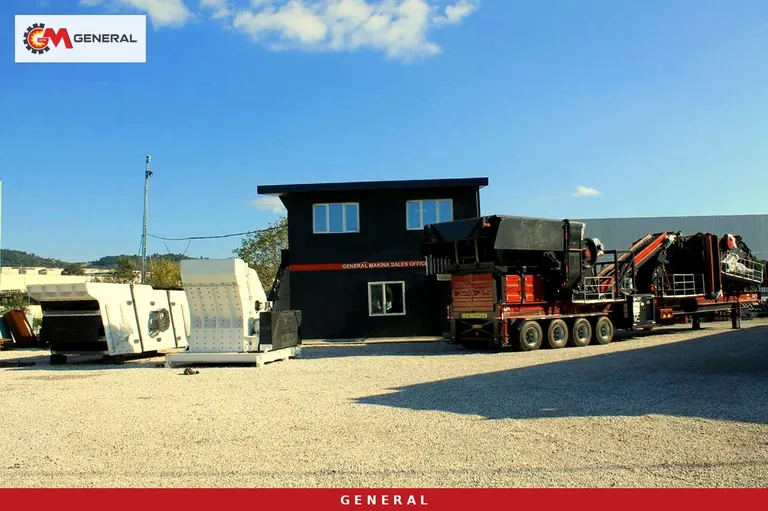
Around Johannesburg, road work rarely runs along one long, empty alignment. Freeway widening, interchange upgrades, new link roads on the urban fringe and the rehabilitation of failed pavements all progress on separate sections that sit close to each other. That pattern shapes aggregate supply: the plant moves every few months, dust and truck traffic have to be planned from day one because of the neighbours, and the product list runs from crushed-stone base to asphalt chips. This article turns a 200-300 TPH target into real model options, matched to the rock variety of Gauteng, the shipping route from Durban up to the Highveld and the need for frequent relocation. Every technical value used here comes from the specification tables on our product pages; the material specification of your own project must always be confirmed with the road authority concerned.
The aggregate calendar of a Gauteng road contractor
On a road contract on the edge of the city, material demand rises and falls with the programme. During earthworks and subbase, daily tonnage is high and tolerances are wide. Once the job moves to crushed-stone base and asphalt, tonnage drops while grading, particle shape and cleanliness requirements tighten. South African road practice classifies crushed-stone base layers with grades such as G1-G3, and the upper grades call for a narrow grading envelope and cubical particles. Obtain in writing which grade is required for which layer from the specification of the national agency, such as SANRAL, or of the provincial and municipal roads departments; plant design starts with that document.
For this reason a 200-300 TPH plant should be seen not as a single tonnage figure but as two operating modes. The first is near-full-capacity production of coarse, wide-band material during the subbase phase. The second is lower-tonnage, tightly graded production during the base and asphalt phases, run in closed circuit with frequent screen checks. The selected machine has to stay efficient in both modes. The models with a 4-deck screen on our product pages split 0-5 / 5-12 / 12-19 / 19-40 mm fractions in a single pass; the 3-deck models work with 0-5 / 5-12 / 12-19 mm. The blend required for a base layer is usually obtained by proportioning these fractions.
Rock types in the Witwatersrand basin and crusher choice
Johannesburg and its surroundings are geologically varied; within the same province, rocks that behave very differently are crushed. The criterion that decides the crusher type is less the hardness of the rock than its abrasiveness, in other words its silica content. The groups below are commonly found in the region. The actual values of the quarry you choose must be established by laboratory tests on samples.
Quartzite and granite: the abrasive group
The quartzites of the Witwatersrand ridges and the granite bodies north of the city contain a lot of silica. In this rock the hammers and plates of an impact crusher wear quickly and part consumption becomes unpredictable. Crushers working on the compression principle are the better fit: a jaw at the primary stage, a cone at the secondary stage. The General 944 uses exactly this layout: GPJ 90 jaw primary and GM430 cone secondary, 800 mm feed size and 120-180 t/h capacity.
Dolerite and dolomite: two rocks that behave differently
Dolerite, found in the region as dykes and sills, is hard and tough; it is difficult to break but not as abrasive as quartzite. A jaw primary followed by an impact secondary gives a good cubical product in this rock; the GPJ 90 jaw + DMK01 impact layout of the General 950 is an option designed for this job. Dolomite, common on the West Rand and towards Centurion, is less abrasive. Here the high reduction ratio of a primary impact crusher becomes an advantage and a single-crusher line stays economical. Keep in mind that dolomite quarries may contain clay and soil as fissure fill, which can make pre-screening necessary.
Real models that cover the 200-300 TPH band
Our range includes two models that meet the headline range with a single plant; the second route is to run two 120-180 t/h units together. The values below are taken verbatim from the specification tables on the product pages.
| Option | Crushing stages | Capacity | Max. feed | Screen | Generator | Weight |
|---|---|---|---|---|---|---|
| GNR-MC110 (twin chassis) | GPJ 110 jaw + DMK03 impact | 200-300 t/h | 900 mm | 2000×6000 mm, 4-deck | 750 kVA | 55,000 kg + 55,000 kg |
| General 02 | GPS 1413 primary impact | 250-300 t/h | 1000 mm | 2000×5000 mm, 4-deck | 660 kVA | 76,000 kg |
| 2 × General 944 | GPJ 90 jaw + GM430 cone | 2 × 120-180 t/h | 800 mm | 1600×5000 mm, 3-deck | 550 kVA (each) | 70,000 kg (each) |
| General 944 + General 950 | Jaw + cone / jaw + impact | 2 × 120-180 t/h | 800 mm | 1600×5000 mm, 3-deck | 550 kVA / 600 kVA | 70,000 kg (each) |
A single-plant solution: GNR-MC110 and General 02
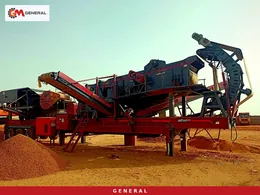
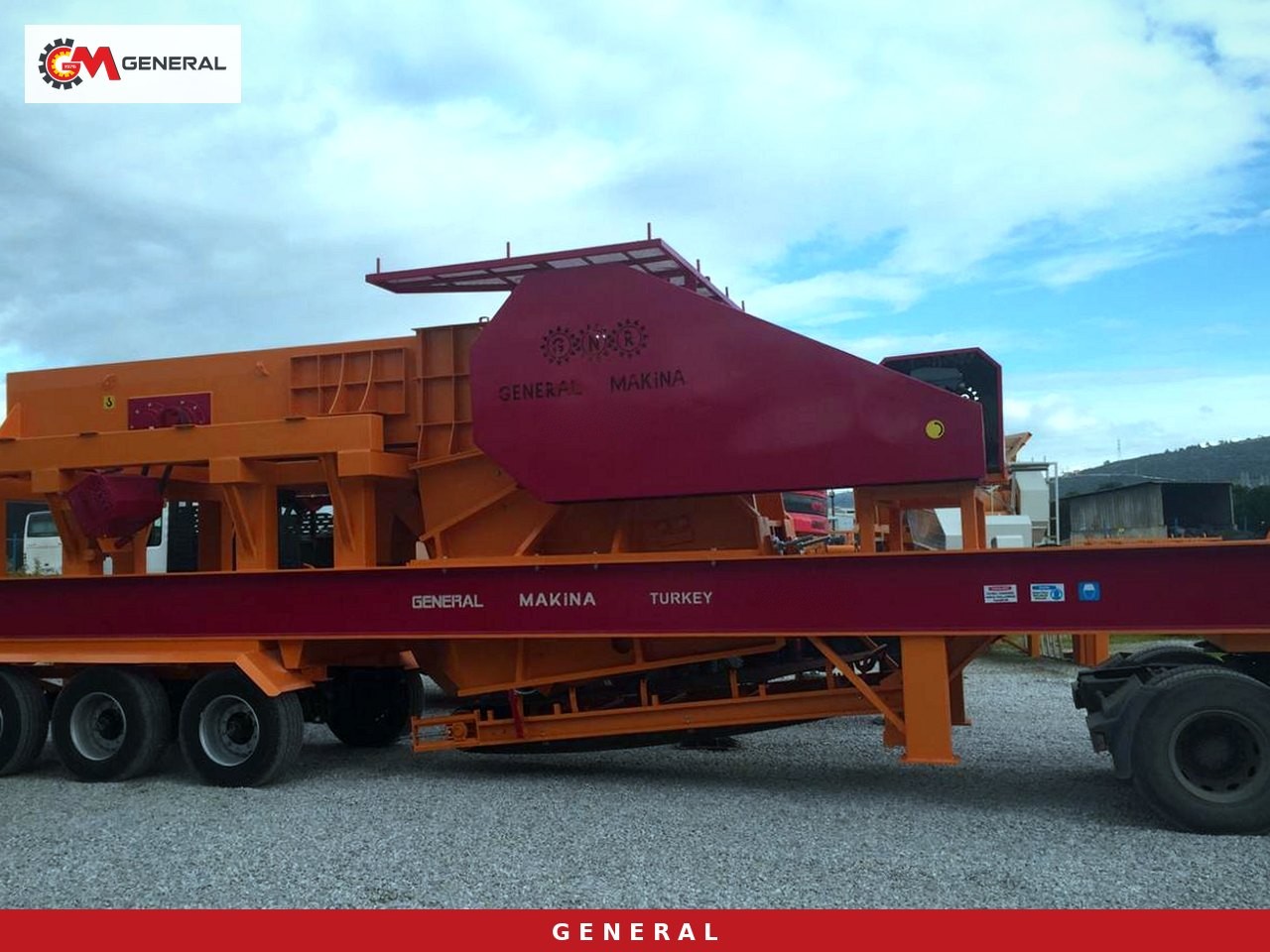
The GNR-MC110 splits the primary and secondary groups across two separate chassis. The primary chassis measures 3000 × 13500 mm, the secondary chassis 4200 × 18300 mm, and each weighs 55,000 kg. This split spreads the load over two tractor units and allows the primary group to run on its own. During the subbase phase you can produce coarse material with the jaw primary alone, then bring in the secondary when moving to base and asphalt. In quartzite and granite quarries a jaw primary is a safer starting point than a primary impactor.
The General 02 is a single-chassis unit; its 1000 mm feed opening takes large blocks directly and it works in closed circuit. With dimensions of 4340 × 20600 × 4500 mm and a weight of 76,000 kg it travels in one piece and needs fewer connections on site. Because it is a primary impactor, however, it makes sense in dolomite and similar low-abrasion rock; in a quartzite-dominated quarry, wear-part consumption weakens this choice.
The two-unit set-up: redundancy and two separate sources
Two 120-180 t/h units give a combined band of 240-360 t/h and cover the headline target from above. The real value of this set-up shows in urban road work: while one unit is under maintenance the other keeps producing, and when needed the two can be split between two sections or two quarries. For example, a General 944 can work the quartzite quarry while a General 950 handles a dolerite or dolomite source. The price is two generators, two crews and two separate stockpile layouts.
Site layout on the urban fringe: dust, traffic and stockpiles
A plant set up near a road section around Johannesburg often has housing, commercial premises or a busy road as neighbours. That fact decides the layout before the crusher does. Truck access should use the shortest and safest connection to the main road, and the routes of trucks bringing feed and taking product away should not cross. Stockpiles should be placed on the side away from neighbouring buildings, taking the prevailing wind into account.
For dust, water-spray suppression at crusher discharge points and conveyor transfers, belt covers and watering of haul roads are measures that can be chosen per project; they should be defined separately at the quotation stage according to the environmental conditions of the contract. On rehabilitation jobs part of the mixed excavated material can be reused; screening it before it reaches the crusher protects the crusher from soil. For dry screening, the GNR ME2060 works in the same tonnage band with its 200-350 t/h capacity, 20 m³ hopper and 100 mm grizzly above the hopper, and can be powered by a generator or the grid. If the material is clayey or wet, a dry screen blinds and a washing screen is needed; both options are compared on the mobile washing and dry screening plants page.
On the Highveld, rain falls in summer, mostly as afternoon thunderstorms. Wet fines blind the screen meshes and turn the 0-5 mm stockpile into mud. A drained, slightly sloped stockpile floor and storing fine product on a raised, sheltered area reduce lost production.
From Durban to the Highveld: shipping, altitude and power
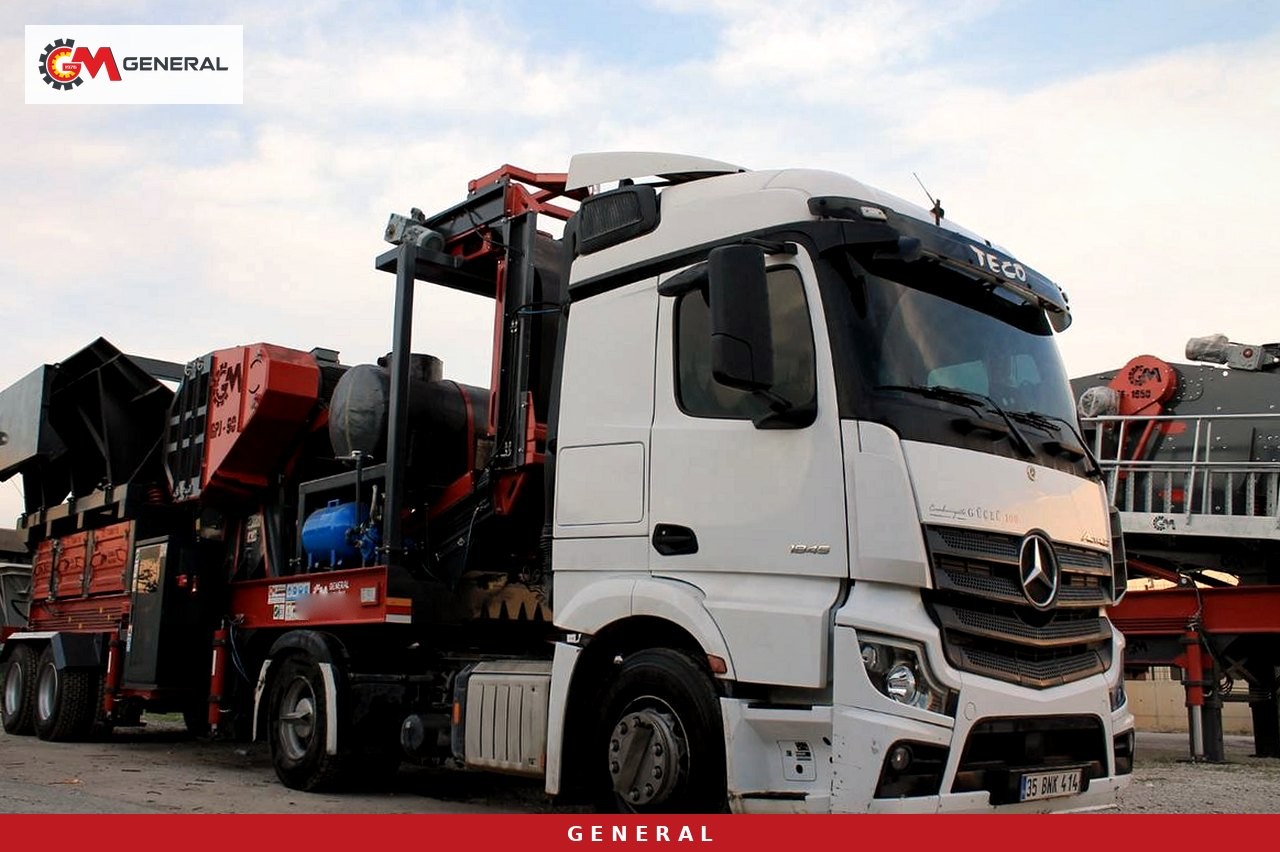
A mobile plant shipped from Türkiye reaches South Africa by sea; the nearest major port to Gauteng is Durban, from where the plant travels inland by road. This is where a wheeled chassis pays off: the plant is towed on its own axles and no separate carrier platform is needed. Height, width and axle-load limits along the route, together with abnormal-load permit conditions, must still be confirmed in advance with the road authority. The weights and dimensions in the table are the basic input for that application; splitting the MC110 into two chassis means two separate movements instead of one heavy load.
Johannesburg sits on the high plateau known as the Highveld. As altitude rises, air thins and diesel engines may not deliver their sea-level rated output. When choosing the generator (750 kVA for the MC110 and 660 kVA for the General 02 according to the product pages), always ask the manufacturer for the altitude derating and, if needed, consider the next power class up. A grid connection may look attractive on urban-fringe sites, but periods of interrupted supply are a known risk; setting up the crushing line independently on a generator protects the production schedule.
The site file to prepare before requesting a quotation
For an accurate technical offer, gather the following information in one file:
- Quarry or source material: rock type, sample photos, laboratory results if available (abrasion value, silica content).
- Largest block size and the blasting or ripping method.
- Product list in the specification: layer name, grade (e.g. G1-G3), grading envelope and particle-shape requirement.
- Daily and total tonnage per product; duration of the subbase and base phases.
- How many times the plant will relocate and the distance between sections.
- Power source (generator or grid) and site altitude.
- Neighbourhood and environmental conditions: dust, noise, working-hour restrictions.
- Port of delivery and inland transport route.
Once this file is ready, the factors that set the price also become clear: crusher combination, number of screen decks, generator rating, extra equipment such as dust suppression, the spare wear-part package and the shipping method. Our plants are ISO 9001 and CE certified and carry a 1-year warranty excluding wear parts; we have been manufacturing in İzmir since 1976.
Frequently asked questions
Which set-up is safer for a quartzite quarry?
In high-silica quartzite, the General 944 with jaw primary and cone secondary makes wear costs more predictable. If 200-300 TPH is needed from one plant, the jaw-primary GNR-MC110 is the candidate; two 944 units give a 240-360 t/h band plus redundancy.
Can the same plant produce both base material and asphalt chips?
Yes. The 4-deck GNR-MC110 and General 02 split four fractions in one pass. For the particle-shape requirement of asphalt aggregate, a second crushing stage and closed circuit matter; final compliance must be verified on samples against the specification.
Can I run the plant on grid power?
The crushing plants are defined by generator rating on the product pages, while the ME series screening plants can run on a generator or the grid. If grid power is considered, connection capacity and outage risk should be assessed at the start and the decision made together at the quotation stage.
How do I find out the delivery time and price?
Both depend on the selected configuration and extra equipment. When you write to us with the site file above, a technical offer specific to your project is prepared.
Conclusion
For road work around Johannesburg, the right 200-300 TPH plant is chosen by rock abrasiveness, the need for frequent relocation and urban site conditions. A jaw-primary layout leads in quartzite and granite, a single-chassis primary impactor in dolomite, and two units for the contractor who wants flexibility. For other capacity options see the wheeled mobile crushing and screening plants page, and for crusher selection in hard rock read our basalt and granite guide. Send your site file through our contact page and we will finalise the configuration together.
Definitions of technical terms: Glossary