EN — English
 TR — Türkçe
 DE — Deutsch
 RU — Русский
 FR — Français
 ES — Español
 AR — العربية
 SR — Српски
High-Efficiency Mobile Crusher Solutions for Limestone
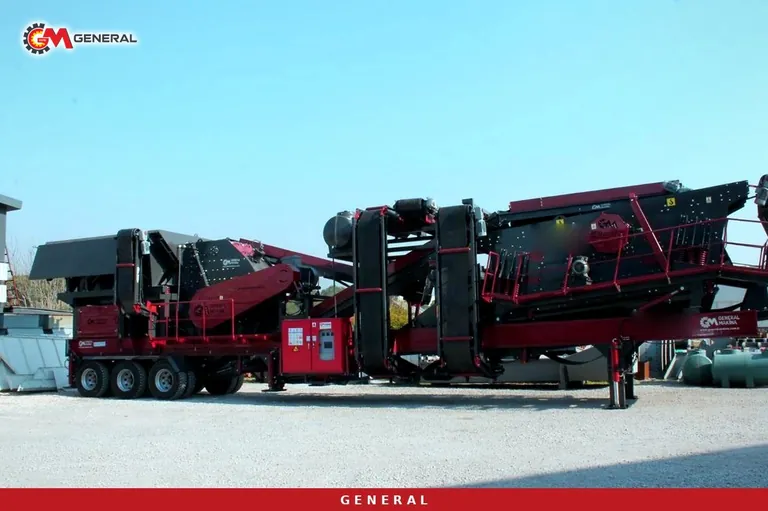
When a limestone quarry operator complains about output, the problem is rarely crusher power. The machine breaks the rock; the real losses show up elsewhere: soil that never needed crushing passes through the rotor, blow bars in the wrong alloy wear out early, and dust is produced instead of the target fraction. Limestone's low abrasiveness makes it one of the rocks best suited to impact crushing. Turning that advantage into saleable product, though, depends on a chain of correct decisions from the feeder to the screen deck. This article goes through where efficiency is gained when choosing and running a mobile crusher for limestone, and where it is quietly lost.
Limestone: one rock type, very different quarries
Limestone is a calcite-based sedimentary rock, but no two limestone quarries are alike. The differences that affect efficiency lie in what is actually loaded from the face into the truck, not in the rock's name. Before any machine is discussed, four variables should be clear:
- Silica and quartz veins: General Makina's crusher pages give a Bond abrasion index (Ai) of roughly 0.001–0.03 for limestone. Material with more than 10% silica or an Ai above 0.15 can wear out the blow bars of an impact crusher within hours. If the quarry has a siliceous band, sample that band as well; an averaged sample hides the risk.
- Clay and soil content: Overburden and fissure fill arrive in the hopper together with run-of-mine rock. These fines do not need crushing, but if they pass through the crusher they take up rotor capacity.
- Moisture: Dry or moderately moist limestone flows freely over a grizzly; clayey limestone in the rainy season plugs the grizzly gaps.
- Dolomite transitions: Like limestone, dolomite is low-abrasive and suits the same crusher type; the product pages list both under the same application group.
If you need a comparison with hard, abrasive rock such as granite and basalt, the jaw vs impact crusher comparison for hard rock gives a detailed framework. With limestone the question is no longer "jaw or impact?" but how to feed and set up the impact crusher.
How do you measure a "high-efficiency" limestone line?
"High efficiency" in the title should be read as indicators you can track in the quarry, not as a catalogue promise. No manufacturer can guarantee a fixed efficiency gain for a quarry whose material it has not seen; the gain depends on the rock composition, the feed pattern and how the existing line is set up. Four indicators matter in a limestone line:
- Saleable product ratio: tonnes of saleable product ÷ total tonnes passed through the crusher. Every tonne that goes through the crusher without becoming a saleable fraction is wasted energy and wear.
- Wear cost per tonne: cost of one set of blow bars ÷ total tonnes crushed with that set. This ratio shows whether the alloy suits the quarry.
- Single-stage reduction: according to the product pages, a primary impact crusher reaches a reduction ratio of up to 20:1 in limestone, with 4:1–6:1 as a general typical value. The more reduction is done in one stage, the shorter the line and the fewer transfer points and conveyors you need.
- Stability within a shift: the time the crusher runs empty or overloaded creates the gap between capacity on paper and tonnes on the stockpile.
If these indicators are measured the same way before and after a change, the comparison is meaningful. At the quotation stage the better question to a manufacturer is not "how many tonnes per hour?" but "which equipment improves these indicators with my material?"
Half of the efficiency is won before the crusher: grizzly feeding and by-pass
In a limestone quarry part of the run-of-mine material already arrives fine and soil-laden. Once inside the crusher it does three kinds of damage: it occupies rotor capacity, consumes unnecessary crushing energy and contaminates the fine product with clay. The solution is to separate it before the crusher.
A vibrating grizzly feeder uses the grizzly section at the end of the pan to send fines and soil past the crusher straight to a conveyor or screen, while the large rock flows steadily over the bars into the crusher inlet. In the GNR rock feeder series, capacity ranges from 75~100 t/h for the GNR 60 to 350~600 t/h for the GNR 140; across the series the hopper holds 15-100 m³ and the maximum feed size is 1500 mm. A steady flow keeps the crusher inlet choke-fed, which improves both capacity and cubical grain shape. You can compare the feeder types in the vibrating feeders category.
In clayey, rainy quarries a fixed grizzly can blind. This is where the Wobbler feeder comes in: synchronised shafts with elliptical discs screen out sticky fines while carrying the large rock to the crusher, and the rotating motion keeps them self-cleaning. The GWB1136 model has 18.5 kW motor power and a feed capacity of 75-600 t/h. If the clay share in your quarry changes with the season, base the feeder decision on the worst sampled period, not the average.
Three adjustment levers for limestone in an impact crusher
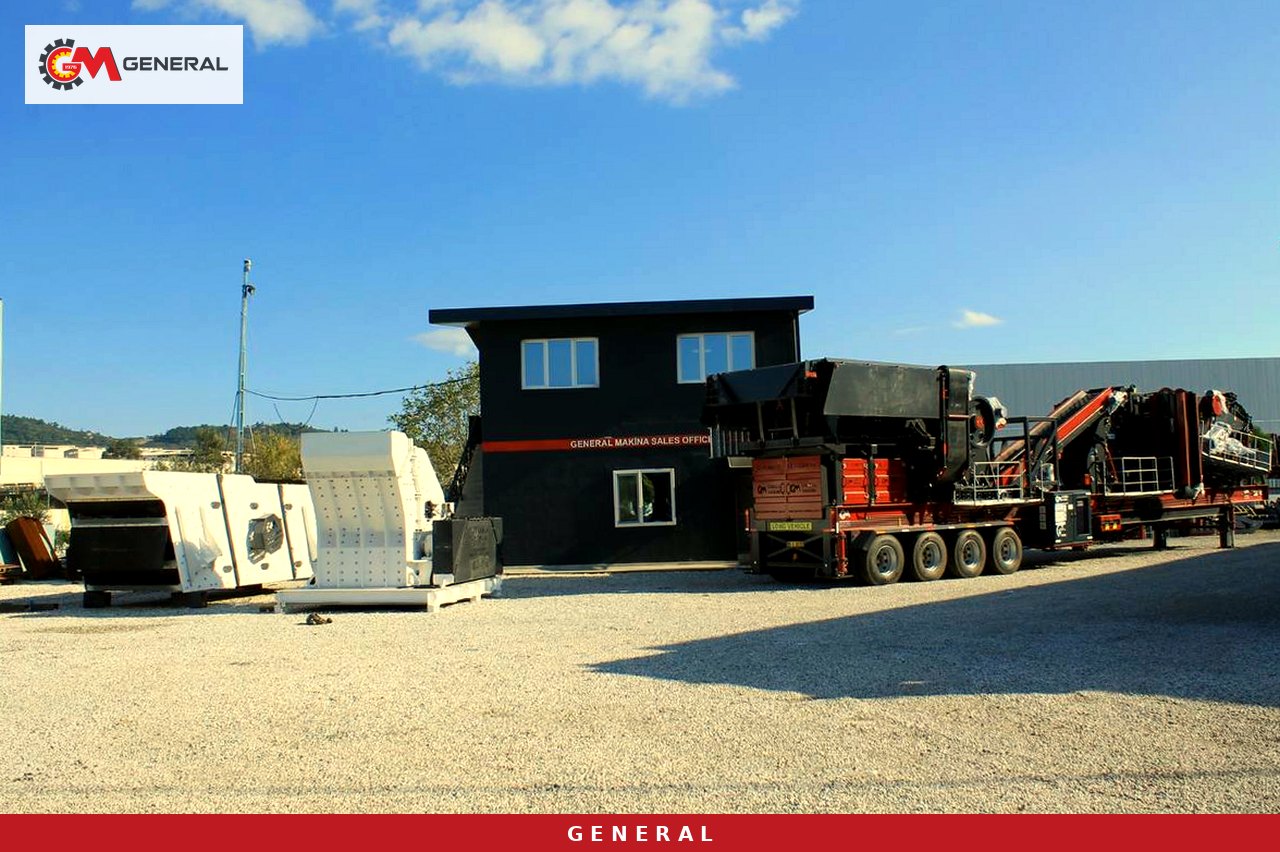
Once the crusher type is fixed, efficiency depends on how the machine is set up for limestone. In an impact crusher the blow bars on the rotor strike the material, which is thrown against the breaker plates (aprons) and breaks by impact, with no compression. In this mechanism the operator has three levers.
Blow bar alloy
For clean, low-abrasive limestone the product pages recommend high-chrome white cast iron (around 700–800 HB). If tramp iron such as bucket teeth or drill bits is expected in the feed, a tougher manganese or martensitic alloy is chosen. The wrong alloy loses in both directions: a brittle alloy cracks when it hits metal, while a tough alloy wears faster than necessary in clean limestone. Recording the wear cost per tonne over several sets shows which alloy suits your quarry based on data rather than guesswork.
Apron gap and closed circuit
The gap between the apron and the rotor sets the product size. As the blow bars wear the gap widens; if it is not readjusted, the share of oversize grows and screen overs return to the rotor. In closed-circuit mobile plants this recirculation is part of the design, but as the returning tonnage grows the crusher breaks the same material twice and leaves less room for fresh feed. Watching the load on the return conveyor is the most practical signal of when to reset the gap.
Feed balance through automation
In PLC-based automation the feeder speed is reduced automatically when the crusher current approaches its limit and increased again once the current returns to normal. Equipment is started in sequence from the stockpile back to the feeder; when a conveyor stops, every stage above it stops too, preventing starts under a loaded belt. In a limestone line this means the crusher runs neither empty nor choked during the shift. See the automation and control system page for the components.
Which mobile configuration for limestone?
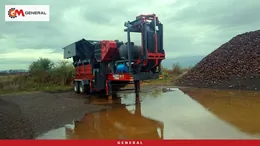
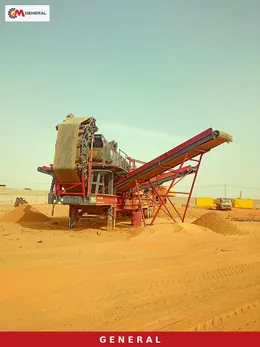
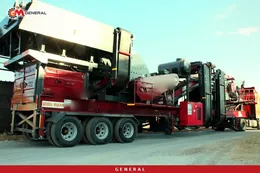
There are two main routes in a limestone quarry: a closed-circuit mobile plant that combines crushing and screening on one chassis, or a portable crusher unit that combines a feeder hopper and crusher on one chassis. The first arrives on site as one unit and delivers graded fractions with its own screen; the second is a modular stage added to an existing screen and conveyor layout. The table below uses data from the product pages.
| Model | Capacity | Max. feed | Crusher | Power | Screen |
|---|---|---|---|---|---|
| General 800 | 80-150 t/h | 600 mm | PDK 1280 primary impact | 450 kVA generator | 1300×4000 mm, 3-deck |
| General 01 | 120-180 t/h | 700 mm | GPS 1210 impact (primary + secondary) | 550 kVA generator | 1600×5000 mm, 4-deck |
| General 02 | 250-300 t/h | 1000 mm | GPS 1413 primary impact | 660 kVA generator | 2000×5000 mm, 4-deck |
| General 03 | 250-375 t/h | 900 mm | GPS 1415 primary impact | 750 kVA generator | 2400×5000 mm, 4-deck |
| M-PDK01 | 250-500 t/h | 1200 mm | Portable primary impact unit | 315 kW motor | — |
| M-PDK02 | 200-300 t/h | 1200 mm | Portable primary impact unit | 250 kW motor | — |
Three questions settle the choice:
- Tonnage and lump size: for a mid-tonnage limestone quarry with controlled lump size, the General 800 primary impact plant is described on its product page as the model built for limestone and low-abrasive rock. Where the quarry produces large blocks, the 1000 mm inlet of the General 02 reduces the need for pre-breaking; at higher tonnage the General 03 sits at the top of the family with 250-375 t/h.
- Mixed feed: the General 01 combines primary and secondary work in the single body of the GPS 1210, so one machine replaces two crushers; its by-pass grizzly feeder removes fines at the start.
- Existing line: if you already have screens and conveyors, the M-PDK portable primary impact unit accepts 0-1200 mm feed and delivers 0-70 mm cubical product, so only the crushing stage is renewed instead of the whole plant.
All wheeled models and their capacity ranges are listed together on the mobile crushing plants page.
Information to prepare before requesting a quotation
To get a configuration that fits your quarry and a realistic price from the manufacturer, gather the following in advance:
- Silica content and, if possible, Ai value of samples taken from different parts of the quarry.
- Size of the largest lump in the run-of-mine feed and the pre-breaking options available (excavator with hydraulic breaker, etc.).
- How the soil and clay share of the feed changes across the seasons.
- Target product list: which fractions are sold and in what proportions (for example 0-5 / 5-12 / 12-19 / 19-40 mm).
- Hourly and per-shift tonnage targets and the number of shifts.
- Power source: grid connection or generator?
- How often the plant will move as the face advances.
- Screens, conveyors and loaders that will remain in use on site.
The main price drivers are crusher type and size, screen area and number of decks, generator rating, automation scope and feeder type. That is why a figure only becomes meaningful in a project-specific quotation once the information above is clear.
Frequently asked questions
Should I choose a jaw crusher or an impact crusher for limestone?
In low-silica, brittle limestone an impact crusher delivers high reduction and cubical product in a single stage. If the quarry has high-silica bands or an Ai above 0.15, a jaw primary followed by a cone or cubicizer secondary should be considered.
How much does efficiency improve in a limestone line?
There is no fixed figure that fits every site. The gain depends on the soil share in the feed, the feed pattern, the blow bar alloy and the existing settings. To see the improvement, compare the periods before and after a change using the same indicators: saleable product ratio and wear cost per tonne.
Is a grizzly feeder enough for clayey limestone?
It is enough for dry and moderately moist material. With very wet, sticky material the grizzly can blind; in that case a Wobbler feeder separates the fines with its self-cleaning disc shafts.
What determines the price of a limestone plant?
The model, crusher size, screen area, generator and automation scope determine the price. Requesting a quotation with your material data and tonnage target pins down the price of the configuration that fits you. The plants are ISO 9001 and CE certified and carry a 1-year warranty, excluding wear parts.
Conclusion
Limestone lends itself to impact crushing, but high efficiency does not come by itself. Removing fines and soil before the crusher, choosing the blow bar alloy for the quarry's real composition, tracking the apron gap as parts wear and balancing the feed through automation determine how much saleable product the same machine delivers. General Makina, which has built crushing and screening plants in Izmir since 1976, proposes a configuration based on your samples and tonnage data. Send us your material analysis and request a quotation through our contact page.
Definitions of technical terms: Glossary