EN — English
 TR — Türkçe
 DE — Deutsch
 RU — Русский
 FR — Français
 ES — Español
 AR — العربية
 SR — Српски

Why Pre-Screening Matters in a Mobile Crushing & Screening Plant 100-200 TPH
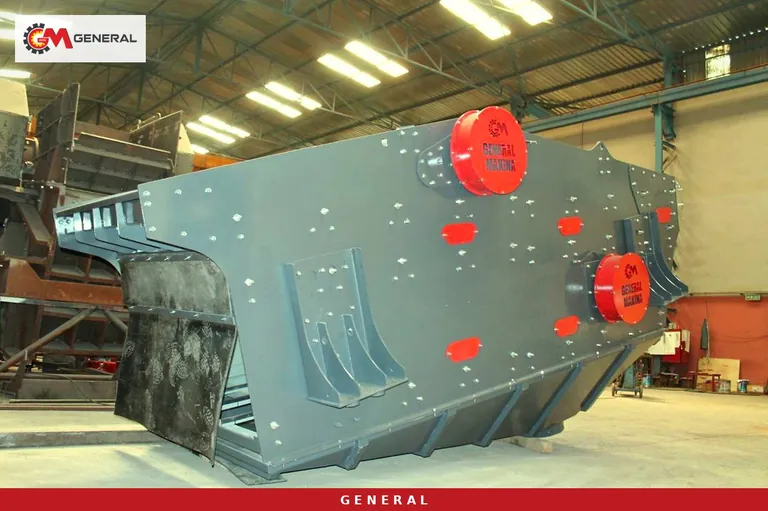
In a mobile crushing and screening plant aimed at 100-200 TPH, every tonne that passes through the crusher costs something: power, liner metal and running hours. Part of the run-of-mine feed, however, is either already at saleable size or is soil and clay that should never be crushed at all. A pre-screen removes that fraction before it reaches the crusher mouth. This article explains where pre-screening happens along the line, how the feed end is arranged on the wheeled General models in the 100-200 TPH band, and how to choose between a feeder grizzly, a separate grizzly screen and a pre-screening secondary unit, using the figures published for each model.
The load a pre-screen takes off the crusher
Run-of-mine rock loaded after blasting is never uniform. Between the large blocks there is fist-sized gravel, fine chippings and topsoil scraped off the quarry face. Once this material enters the crushing chamber it takes up volume that the large rock needs. Soil and clay smear onto jaw plates or blow bar faces, and fine siliceous grains grind the liners like sandpaper. None of it adds product value.
Crushing is energy spent to make a particle smaller. For a particle already below target size, that energy is wasted. A hypothetical example: if one fifth of 160 t/h of feed is small enough to fall through the grizzly bars, a plant with a pre-screen sends 128 t/h into the crusher. The crusher handles that load more comfortably on the same motor, or the feeder speed can be raised to lift total output. The real ratio differs from quarry to quarry; no ratio should be assumed for any plant before a sieve analysis of a sample has been done.
Before the primary: feeder grizzly and G-type grizzly screen
On most wheeled plants the first pre-screening point is the grizzly at the end of the feeder. On the GNR vibrating grizzly feederthe pan moves material forward while the fine fraction drops between the grizzly bars and goes to a conveyor or a separate pile without touching the crusher. In the 100-200 TPH band the matching sizes are GNR 90 (140-210 t/h, 2x4 kW) and GNR 110 (200-300 t/h, 2x7.5 kW); both accept feed up to 1500 mm. Other feeder types are listed together on the crusher feeders page.
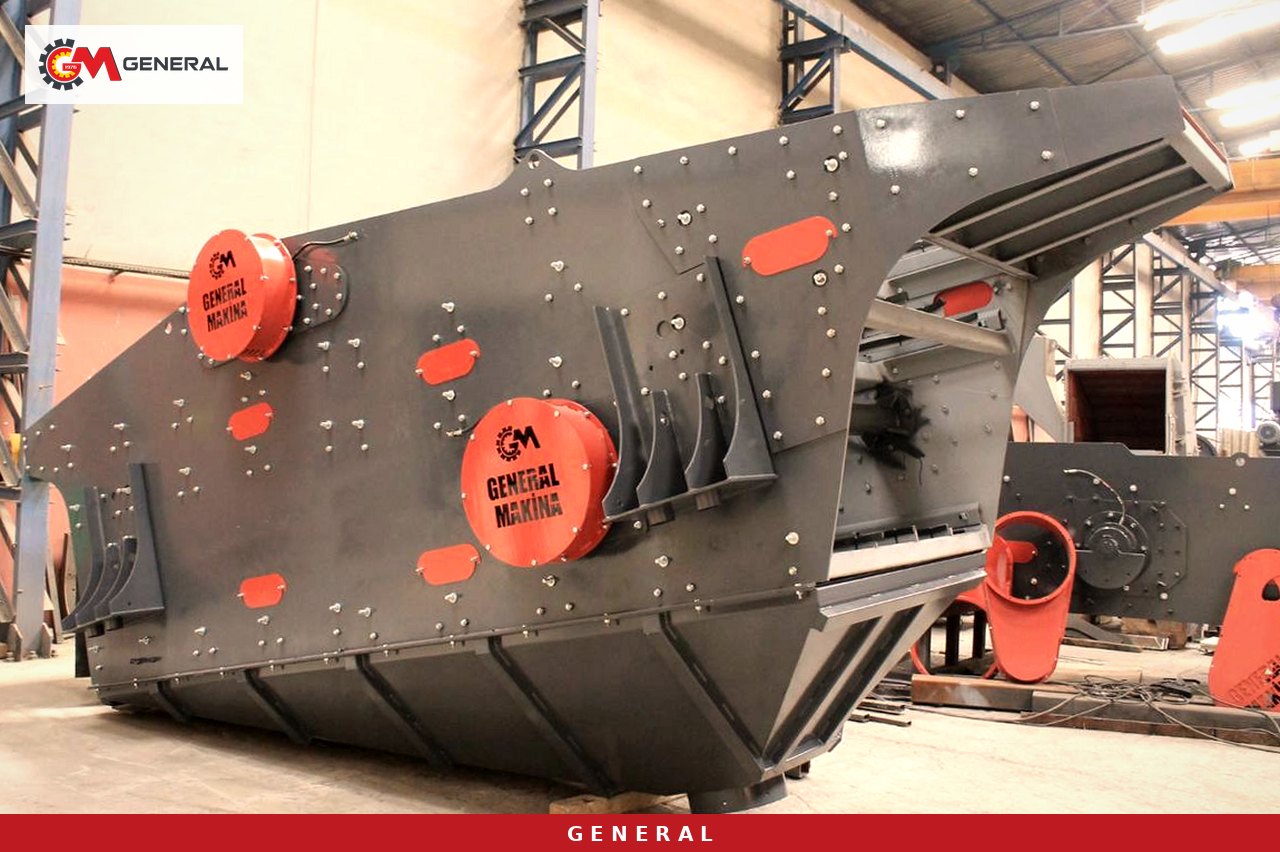
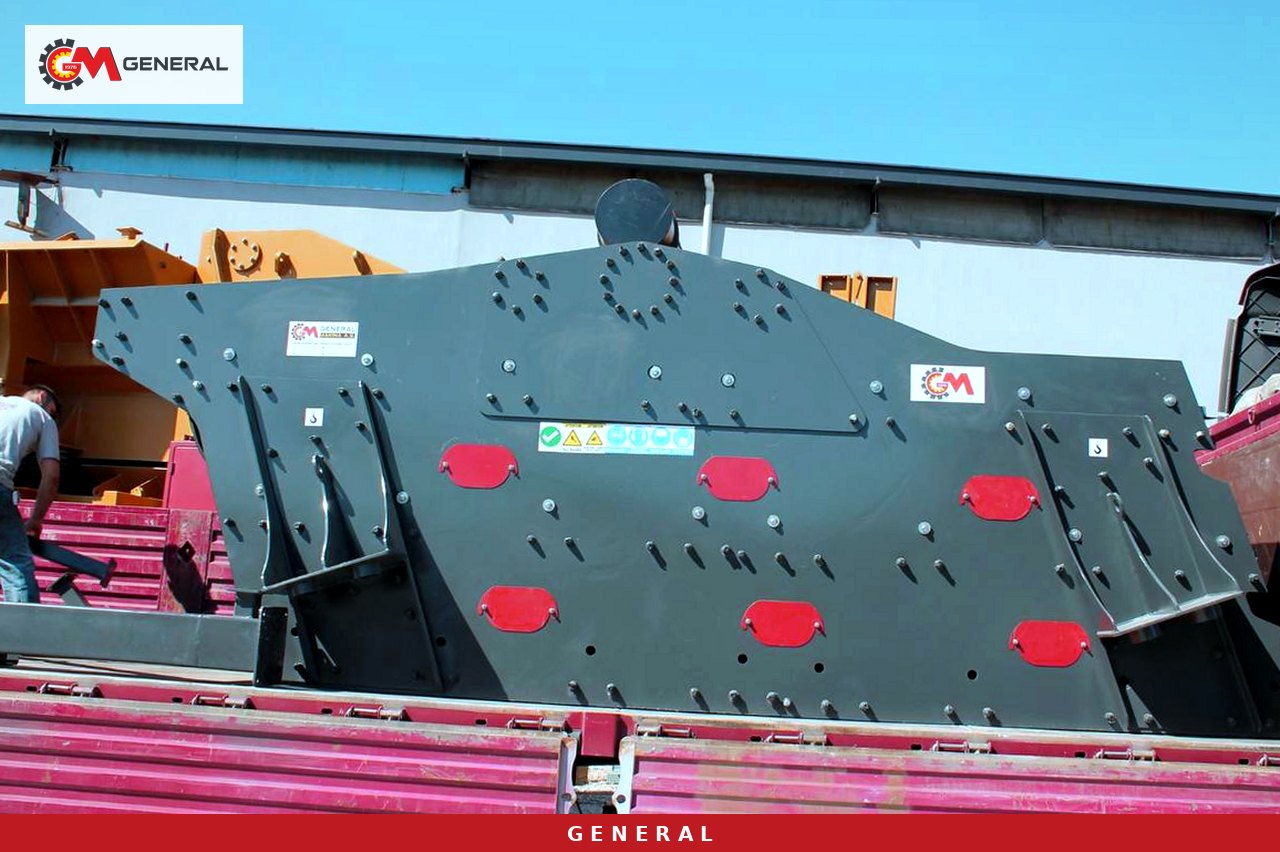
On quarries with a lot of soil the feeder grizzly may not be enough. A G-type grizzly screen is then placed between the feeder and the primary crusher. The ELKG series produces linear vibration with two vibromotors; motor power is 10.2 kW on the ELKG-1230 and ELKG-1430 and 11.5 kW on the ELKG-1930. The grizzly bars are high-manganese austenitic steel castings and the bar spacing is adjustable.
Before the secondary: M-type grizzly screen and pre-screening impact unit
Material leaving the primary crusher also contains grains that have already reached target size. Sending them into the secondary again wears blow bars on an impact rotor, or the mantle and concave on a cone crusher, for no return. The M-type grizzly screen (eccentric drive, circular motion) works at this point; the ELKM-1435 and ELKM-1640 run on 15 kW motors. For operators who want a separate unit, the mobile pre-screening DMK crusher combines a vibrating pre-screen and a twin-chamber impact crusher on one chassis: 0-100 mm feed, 0-30 mm product, 40-300 t/h.
Feed end of the 100-200 TPH wheeled models
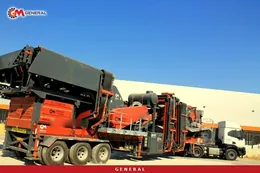
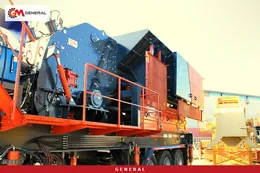
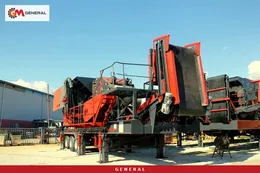
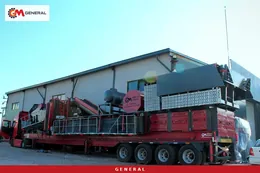
Among the General wheeled mobile crushing plantsfour single-chassis models cover this band, and the twin-chassis GNR-MC110 sits at its upper edge. The table combines product-page values with the pre-screening arrangement stated on the feed side. A cell marked "—" means the product page does not state it separately; it does not mean the equipment is absent, only that it must be confirmed in the order.
| Model | Capacity (t/h) | Max. feed (mm) | Primary / secondary | Screen | Pre-screening at feed end |
|---|---|---|---|---|---|
| General 800 | 80-150 | 600 | PDK 1280 primary impact | 1300×4000 mm, 3-deck | — |
| General 01 | 120-180 | 700 | GPS 1210 impact (two stages in one body) | 1600×5000 mm, 4-deck | Vibrating feeder with by-pass grizzly |
| General 944 | 120-180 | 800 | GPJ 90 jaw / GM430 cone | 1600×5000 mm, 3-deck horizontal | By-pass conveyor |
| General 950 | 120-180 | 800 | GPJ 90 jaw / DMK01 impact | 1600×5000 mm, 3-deck horizontal | — |
| GNR-MC110 | 200-300 | 900 | GPJ 110 jaw / DMK03 impact | 2000×6000 mm, 4-deck | — |
One detail stands out: the 944 and 950 carry the same jaw, the same feed opening and the same screen; the difference is the secondary. For pre-screening this matters. The GM430 cone on the 944 works by compression, and damp fines entering it can pack inside the chamber. Removing fines after the primary therefore pays back more on a cone-secondary line than on an impact-secondary line. On the General 01, the GPS 1210 performs primary and secondary work in one body, so the by-pass grizzly on the feeder is the only pre-screening point. On this model the bar spacing directly affects the product split.
Setting the grizzly gap to the feed
The bar spacing defines the largest particle that will be by-passed. A wide gap lowers the crusher load, but rock that needs crushing also escapes to the by-pass line. A narrow gap sends fines into the crusher anyway. The right gap comes from two pieces of information: the sieve analysis of the feed and the destination of the by-pass material.
If the by-pass material is clean, with little soil or clay, it can go to the main screen or straight to a road-base pile. At a quarry supplying a road job this material has value as sub-base fill. If it is dirty, it goes to a separate pile and does not contaminate the product. This decision changes the conveyor layout under the feeder; the direction of the by-pass belt should be fixed in the layout drawing at order stage.
One property of manganese castings affects maintenance planning. Mn13-type austenitic bars work-harden at the surface under impact, rising from about 200 HB to the 450-550 HB range. In the first weeks, before hardening, the bars are softer against large blocks. Measuring the bar gap and checking the bar fixings at the end of each shift during this period catches loosening early.
Where a grizzly reaches its limit: wet and clayey feed
A fixed grizzly blinds in sticky material. Clay smears between the bars and within a few hours most of the opening is closed. From then on everything goes into the crusher as if there were no pre-screen, and wet clay also sticks to the jaw plates, costing extra throughput.
There are two routes on such sites. The first is a wobbler feeder instead of a grizzly. On the GWB1136, synchronised shafts with elliptical discs drop the fine and muddy fraction and carry large rock to the crusher; the turning discs clean themselves, so blinding does not occur. The model is 1100 mm wide and 3600 mm long, with an 18.5 kW motor and 75-600 t/h feed capacity. The second route is the mobile jaw crushing unit with a wobbler feeder, which combines crushing and pre-screening on one chassis. Its 250-450 t/h capacity is above the 100-200 TPH target, so it suits only an operator planning to raise tonnage later.
If moisture changes with the season, the decision should be based on a sample taken in the wettest period. A grizzly feeder chosen from a dry-month sample will cut output in the rainy months.
Pre-screening equipment compared by model
| Equipment | Model | Position in line | Capacity (t/h) | Motor (kW) | Size / note |
|---|---|---|---|---|---|
| Vibrating grizzly feeder | GNR 90 | Before primary | 140-210 | 2x4 | 1000×3750 mm |
| Vibrating grizzly feeder | GNR 110 | Before primary | 200-300 | 2x7.5 | 1100×4750 mm |
| G-type grizzly screen | ELKG-1430 | Between feeder and primary | 100-400 (series range) | 10.2 | 1000×3000 mm, 3700 kg |
| M-type grizzly screen | ELKM-1435 | Before secondary | 100-400 (series range) | 15 | 1400×3500 mm, 6500 kg |
| Wobbler feeder | GWB1136 | Before primary, wet feed | 75-600 | 18.5 | 1100×3600 mm |
| Pre-screening impact unit | Mobile pre-screening DMK | Secondary stage | 40-300 | — | 0-100 mm feed, 0-30 mm product |
| Secondary unit with by-pass screen | M-DMK 02 | Secondary stage | 150-250 | 200 | 0-350 mm feed, 38,000 kg |
On stationary or modular lines the next step is a separate main screen after the primary. Among the aggregate vibrating screensthe ELK-U top-drive screen and the GNRTK vibration-controlled screen work in the 100-400 t/h range. The oval stroke that the GNRTK produces with its three-shaft drive reduces mesh blinding with near-size and damp grains. These screens are not added to a single-chassis wheeled plant; they are a configuration option for an operator who wants to expand the line in a second phase.
Pre-screening checklist before commissioning
- A sieve analysis and clay content of a feed sample should be in hand before the bar gap is chosen.
- The destination of by-pass material (main screen, road-base pile or waste) should be marked on the layout drawing.
- The bar gap at delivery, and how it is changed on site, should be written into the order documents.
- The stickiness of the material in the rainy season should be observed; if needed, a wobbler feeder should be requested as a separate line item in the quotation.
- Feeder speed and choke-feeding of the crusher should be set together; the pre-screen must not remove so much that the crusher runs starved.
- During the first weeks, the fixings of the manganese grizzly bars should be checked at the end of each shift.
- Whether to use an M-type grizzly screen or a separate pre-screening unit before the secondary should be decided by the type of secondary crusher (cone or impact).
Frequently asked questions
Does a pre-screen increase crusher capacity?
The crusher's own capacity does not change; what changes is the material entering it. With fines by-passed, the chamber is left to large rock and total plant output can rise with the same crusher. The size of the gain depends on the fines content of the feed and is calculated from a sample analysis.
Does every mobile crusher need a separate grizzly screen?
No. On a clean quarry with little soil, the feeder grizzly is often enough. A separate G-type grizzly screen makes sense with feed high in soil and fines, or where by-pass material will be sold as a separate product.
Can the bar gap be changed later?
Yes. Bar spacing is adjustable on the ELKG and ELKM series. When rock character changes in the quarry or the product list is updated, the gap is reset.
What sets the cost of pre-screening equipment?
Cost depends on the equipment type (feeder grizzly, separate grizzly screen, wobbler feeder), bar material, the main plant model and the shipping method. Before quoting a figure we need to see the feed data and the target product list.
Information to prepare for a quotation
To make the right pre-screen decision, send us the rock type, the largest block size, the sieve analysis of the feed (or an estimated soil content), the moisture in the wet season, the target products and the hourly tonnage. With this data we will select the right model among the General 800, 01, 944, 950 or GNR-MC110 and define the feed end layout together. General Makina has been manufacturing in Izmir since 1976, holds ISO 9001 and CE certificates, and gives a 1-year warranty on its machines, wear parts excluded. For a quotation and a technical discussion, reach us through our contact page.
Definitions of technical terms: Glossary