EN — English
 TR — Türkçe
 DE — Deutsch
 RU — Русский
 FR — Français
 ES — Español
 AR — العربية
 SR — Српски

Senegal Motorway Mobile Crushing & Screening Plant 120-180 Ton Per Hour
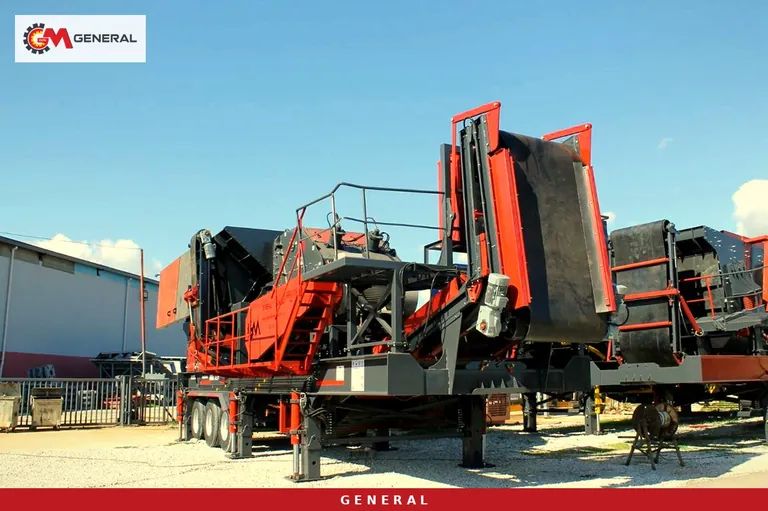
A contractor pricing a crushing plant for a motorway section in Senegal should not start with “which machine”. The first question is where the stone will come from along the alignment and at what rate the paving crews will consume it. On long, linear jobs such as the motorway corridors running from Dakar towards Thiès and Touba, the quarry often sits many kilometres from the works, and that distance keeps changing as the section advances. The 120-180 tph band is the range in which a single mobile line can feed both the sub-base and the asphalt chippings. Below we set out the real models that cover this band, which one makes sense on which rock, and what has to be settled before an order, from the point of view of an engineer who has commissioned crushing and screening plants on site.
From the specification to hourly tonnage: deriving the target capacity
On a motorway job, crushing plant capacity is worked backwards from the daily advance of the laying crew, not read from a brochure. Layer thickness of the sub-base and base courses, platform width and compacted density give the daily tonnage; the chippings needed by the asphalt plant come on top. These values are written in the client's specification and in the contractor's programme. Confirm them from those documents before choosing a plant: an assumed “so many tonnes a day” ends up either as an oversized machine standing idle or as an undersized line that keeps the paver waiting.
A simple formula does the job: required capacity (tph) = daily material demand (t) ÷ (operating hours per day × availability factor). A hypothetical example: the section needs 1,200 t of crushed material per day, the plant runs 10 hours, and stoppages for maintenance, setting adjustments and truck waiting give an availability of 0.8. 1,200 ÷ (10 × 0.8) = 150 tph. The result lands in the middle of the 120-180 tph band: the lower edge matches a laying pace slowed by the rainy season, the upper edge the busy months when asphalt chippings are added.
One item is often left out of the calculation: oversize returning from the screen. In a closed-circuit line, screen overs go back to the crusher, so the crusher sees more tonnage than the plant sends to stockpile. Selecting the crusher towards the top of the band for a net demand of 150 tph covers that margin.
Rock sources along Senegalese alignments and what they mean for the crusher
Most of Senegal sits on a sedimentary basin. In the west, around the Thiès area, limestone and basalt quarries are known; in the east of the country crystalline rocks such as granite come to the fore. Laterite is also widely used in road building as a traditional sub-base material. Laterite is mostly a matter of screening and stabilisation rather than crushing; the crushing line produces aggregate from hard rock for the base course and the asphalt.
This variety drives the crusher choice directly. On low-abrasion stone like limestone, an impact crusher gives a high reduction ratio and cubical grains while blow-bar consumption stays reasonable. On siliceous, abrasive rock such as basalt and granite, a cone crusher's compression principle in the second stage noticeably extends metal life. If the seam changes within the quarry, the wear-parts stock should be planned for both cases.
Whichever quarry supplies the stone, take a sample and have abrasiveness and compressive strength measured in a laboratory, and check the Los Angeles abrasion and particle-shape limits of the specification on the same sample. Any model recommendation given before those results arrive is only an estimate.
Three candidates for 120-180 tph, plus one step up
Three wheeled models cover this band on a single chassis. All three work in the same capacity range; the difference lies in how the crushing stages are arranged. We have added the larger model that comes into play when tonnage grows.
| Model | Capacity | Max. feed | Crushers | Screen | Generator | Weight |
|---|---|---|---|---|---|---|
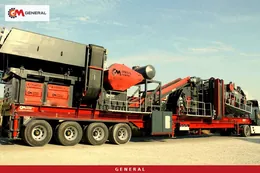
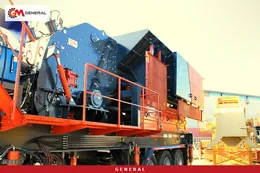
| General 01 | 120-180 tph | 700 mm | GPS 1210 impact (primary + secondary) | 1600×5000 mm, 4-deck | 550 kVA | 55,000 kg |
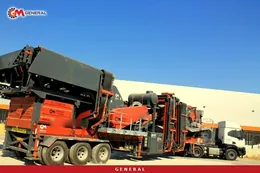
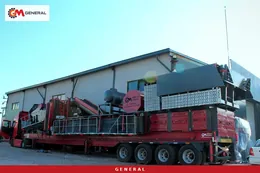
| General 944 | 120-180 tph | 800 mm | GPJ 90 jaw + GM430 cone | 1600×5000 mm, 3-deck horizontal | 550 kVA | 70,000 kg |
| General 950 | 120-180 tph | 800 mm | GPJ 90 jaw + DMK01 impact | 1600×5000 mm, 3-deck horizontal | 600 kVA | 70,000 kg |
| General 03 | 250-375 tph | 900 mm | GPS 1415 impact | 2400×5000 mm, 4-deck | 750 kVA | — |
General 01: limestone quarry, four fractions
The General 01 does primary and secondary work in one body with a single GPS 1210 impact crusher and accepts feed up to 700 mm. Its four-deck screen separates 0-5, 5-12, 12-19 and 19-40 mm fractions in one pass. That suits a motorway job that wants the coarse fraction for sub-base and the fine fractions for asphalt at the same time. If the quarry is limestone, it is the lightest and most economical answer in the band.
General 944: metal life in basalt and granite
The General 944 combines a GPJ 90 jaw with a GM430 cone. Because the cone breaks abrasive rock by compression, its wear parts are consumed more slowly than those of an impact secondary. The three-deck screen yields 0-5, 5-12 and 12-19 mm; if the specification calls for a coarser base fraction, the screen apertures are set per order to suit the material.
General 950: cubical chippings from hard rock
The General 950 puts a DMK01 impact secondary behind the same GPJ 90 jaw. It is the alternative to the 944 when hard rock must give high reduction and cubical grains, for instance when the particle-shape limit for wearing-course chippings is tight. The trade-off is that impact blow bars are changed more often than cone liners on abrasive stone. Anyone wanting to see a West African application can look at the General 950 project delivered to Niger.
If the calculation goes above 180 tph, or two sections are to be fed from one plant, the General 03 comes in: GPS 1415 impact crusher, 2400×5000 mm four-deck screen, 750 kVA generator and a four-axle chassis built to the international transport standard. All wheeled options are listed together on the mobile crushing plants page.
Moving the plant as the motorway advances
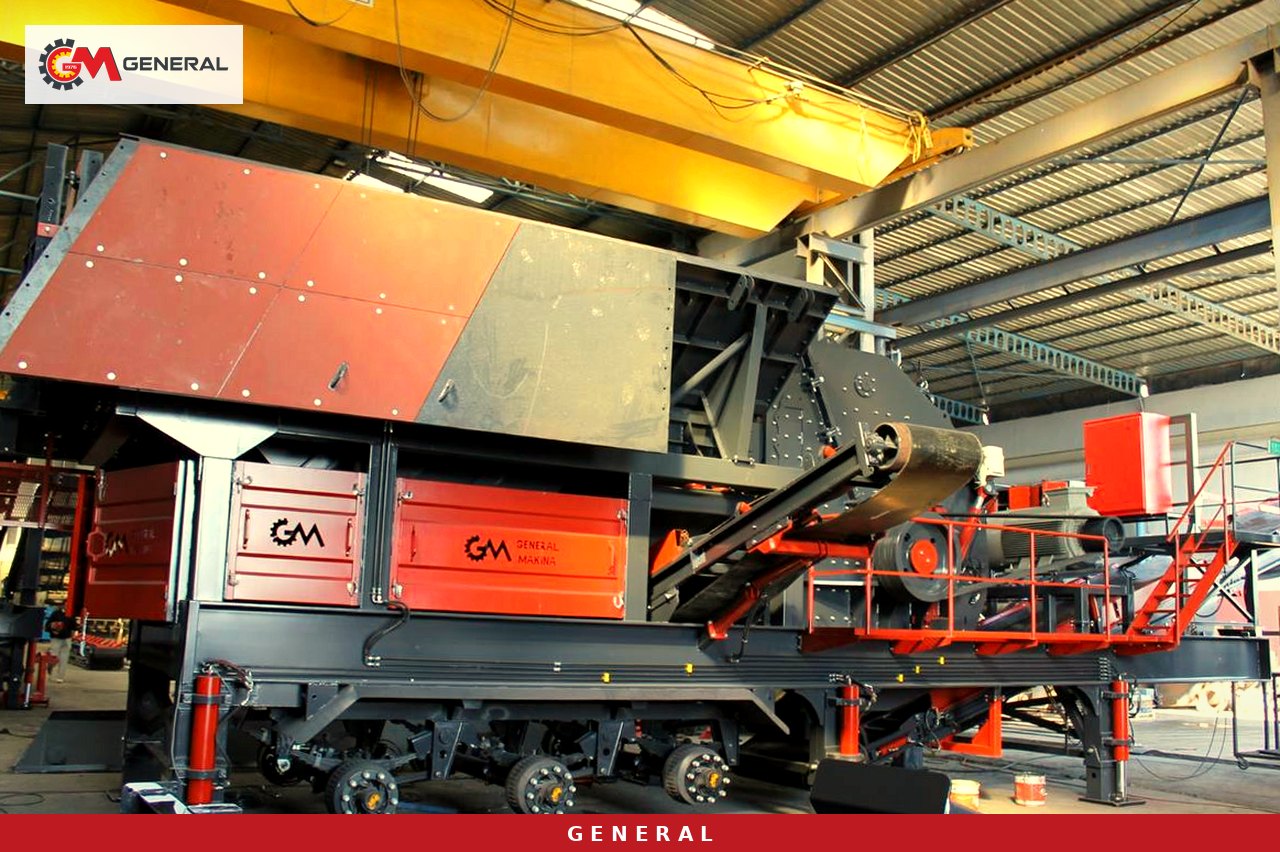
One of the largest cost items on a linear job is the truck haul from quarry to laying point. The real advantage of a mobile line is that, once the section has advanced a certain distance, the plant can be shifted to a new quarry or borrow area. Chassis dimensions matter here: the General 01 travels at 4300×18500×4500 mm, the General 944 and 950 at 4130×20350×4500 mm. Check with the haulier in advance whether those dimensions clear the bridges, junctions and town crossings along the route.
Export machines go by sea, and entry into Senegal is planned through the port of Dakar. For the road leg from port to site, lowbed requirements, escorts and customs paperwork belong in the contractor's logistics plan; confirm the time and cost of those procedures with the relevant authorities.
No concrete foundation is needed on site; the hydraulic legs rest on the ground. Bearing capacity and drainage still matter. Laterite ground softens in the rainy season; a compacted granular pad under the leg plates keeps the chassis level and the screen and conveyors in alignment.
Sub-base, wearing course and stabilised base: the fraction plan
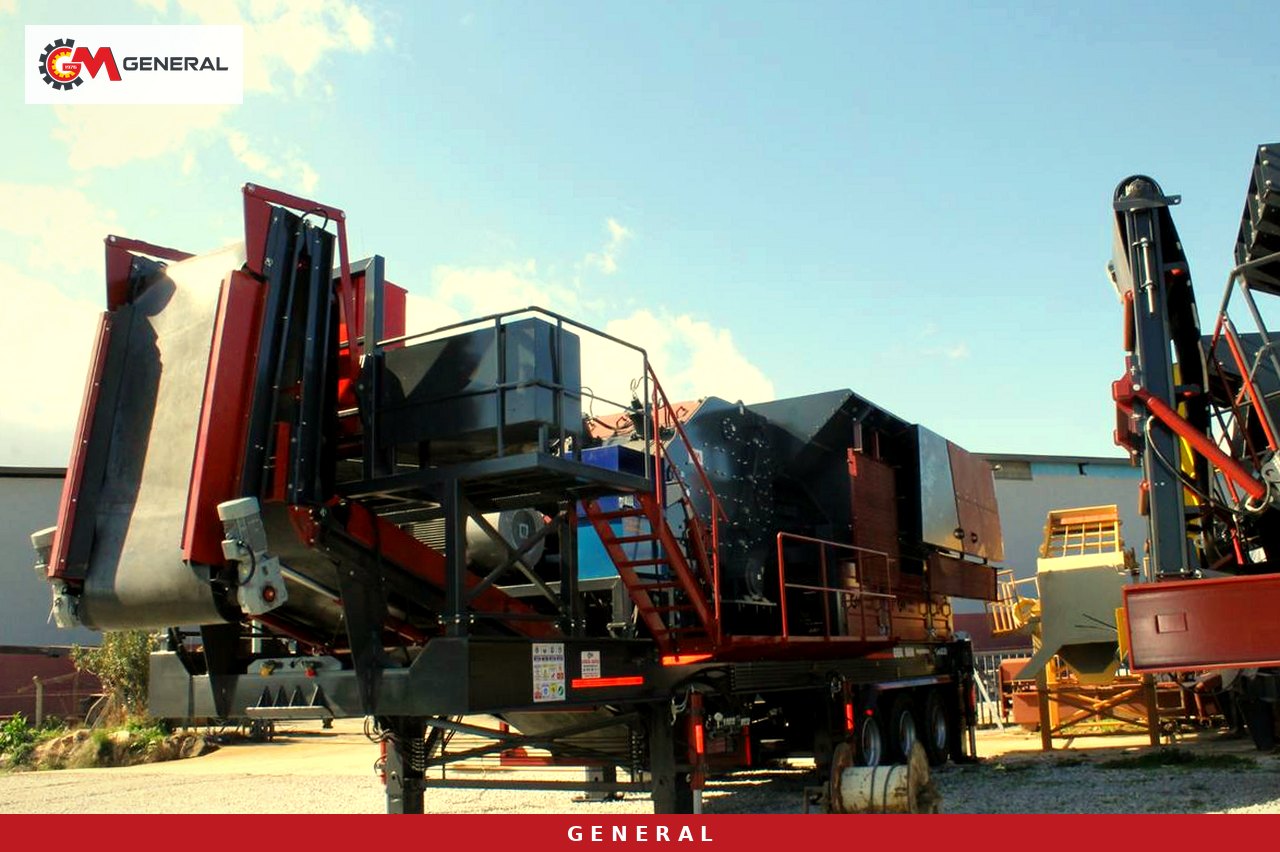
On a motorway, one plant turns out several products and each stockpile is managed separately. In a typical plan the coarse fraction (for example the General 01's 19-40 mm) goes to the sub-base and base mix, while 0-5 mm crushed sand and the 5-12 and 12-19 mm chippings feed the asphalt plant. Which deck carries which aperture is fixed at order stage according to the grading envelope of the specification, so share that envelope when you ask for a quote; screening options are on the vibrating screens page.
Where a cement- or binder-treated base is required, the crushed aggregate is mixed in a pugmill. The mobile pugmill plant works at 200-600 tph with 3-5 cold aggregate bins and a 2×22 kW twin-shaft mixer, and discharges into trucks from a 25 m³ loading bin. The balance between crushing output and pugmill input has to be set up from the start: a 150 tph crushing line cannot keep the pugmill's lower limit fed continuously on its own. Building up stockpiles first and running the pugmill in campaigns closes that gap.
The crusher arrangement for each road layer is discussed in more detail in our article on mobile plant configuration for road construction and base material.
Running a hot, dusty, off-grid section
Along the alignment there is usually no grid connection, so generator power is a selection criterion: 550 kVA on the General 01 and 944, 600 kVA on the 950. The site tanker route and fuel store location belong in the set-up plan from day one.
In the dry season, fine dust carried by the harmattan wind loads the engine air filters and the area under the screen. Measures that can be chosen per project include water-spray dust suppression at transfer points, belt covers and a maintenance schedule with shorter filter intervals. These are items to discuss for the site, not standard equipment. Jaw plates, blow bars and cone liners are manganese and high-chrome castings; to keep stoppages short at a remote site, plan the first season's spare set together with the order.
Checklist for the site team before commissioning:
- Are the abrasiveness and compressive-strength results of the quarry sample in hand?
- Have the specification's grading envelopes been translated into a screen deck layout?
- Have transport dimensions, including the 4500 mm height, been checked against crossings on the route?
- Is a compacted, drained pad ready for the hydraulic legs?
- Are generator fuel, filters and oil for the first month on site?
- Has the first season's wear-parts set been defined?
- Has the stockpile area between the crushing line and the asphalt plant or pugmill been sized?
Frequently asked questions
Is one plant enough for 120-180 tph, or are two units needed?
If net demand is around 150 tph, a single wheeled line is enough. If two sections must be fed at once, or demand exceeds 180 tph, move either to a larger model such as the General 03 or to two separate lines.
Does laterite need a crushing plant?
Laterite is usually not crushed; it is screened and, if required, stabilised with a binder. The crushing plant is needed mainly to produce base-course and asphalt aggregate from basalt, limestone and granite.
What sets the price and the delivery time?
Model, crusher combination, number of screen decks, generator, dust measures, spare-parts package and the scope of transport to Dakar. The exact figure comes from a written quotation prepared once these items are fixed.
What do the warranty and certificates cover?
The machines carry ISO 9001 and CE certification; the warranty is 1 year and excludes wear parts. General Makina has been manufacturing in Izmir since 1976 and exports to the Middle East, North Africa, Russia, the Turkic republics and the Balkans.
Conclusion: read rock, pace and route together
For a motorway section in Senegal, rock type and daily laying pace decide the right plant: the General 01 on limestone, the General 944 on abrasive basalt and granite, the General 950 when hard rock must give cubical chippings, and the General 03 if tonnage grows. Write to us with your quarry sample, the specification grading and route information, and our engineering team will prepare the configuration and quotation on that basis.
Definitions of technical terms: Glossary