EN — English
 TR — Türkçe
 DE — Deutsch
 RU — Русский
 FR — Français
 ES — Español
 AR — العربية
 SR — Српски

Abidjan Infrastructure Wheeled Mobile Crushing & Screening Plant 200-300 TPH
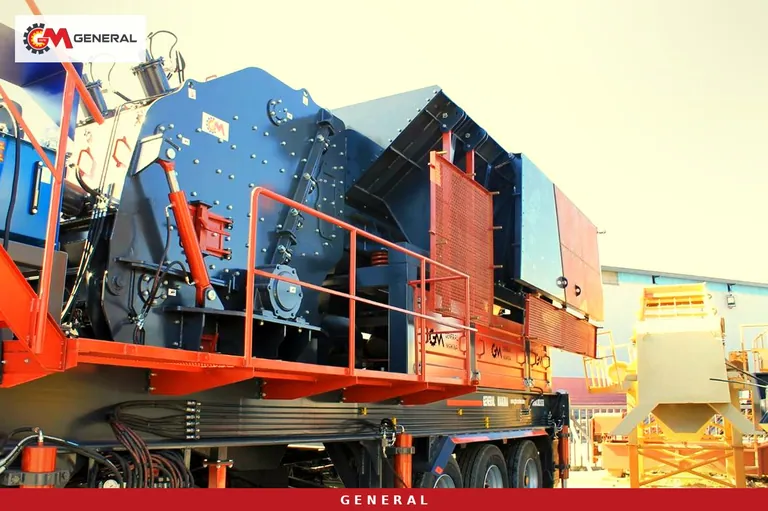
A contractor planning aggregate for a bridge pier, an urban road widening or a fill job near the port in Abidjan soon runs into a basic fact: the coastal strip and the shores of the Ebrié lagoon on which the city sits are largely sand and clay, while the hard stone that goes into concrete and road pavements comes from granite and gneiss quarries further inland. A crushing and screening plant supplying Abidjan infrastructure therefore has to withstand hard, abrasive rock and still be able to move from quarry to quarry. A wheeled plant in the 200-300 TPH range meets both conditions at once. In this article we compare the real models that fall into that band using the technical values on their product pages, and look at how the rainy season affects the feed line and what the route from port to quarry involves, from the point of view of an engineer who has worked on site.
Tender volumes, work schedules and aggregate specifications for individual projects belong to the relevant authority and the main contractor in Côte d'Ivoire. The recommendations here concern equipment selection; always confirm grading limits and quality classes against the authority's specification.
Why the first stage should be a jaw on granite feed
Granite and gneiss quarries are common in the interior of Côte d'Ivoire. Because these rocks contain free quartz, they are abrasive. A primary impactor gives a high reduction ratio and cubical grains in limestone, but in siliceous rock its blow bars wear out quickly and the wear cost per tonne climbs. A jaw crusher breaks stone by squeezing it between two plates, accepts large blocks and gives longer metal life on abrasive feed. For a granite quarry sending chippings to Abidjan, the sensible layout is a jaw in the first stage and a crusher that corrects product shape in the second.
This is not an absolute rule. If the quarry turns out limestone or a low-abrasion rock, the models with an impact primary run more economically. Base the decision not on a visual guess but on laboratory results from a sample taken at the quarry: the abrasion index, compressive strength and free silica content determine both the crusher type and the wear-part alloy. We explain how to read these tests in detail in our article on choosing a mobile crushing plant for basalt and granite.
Which products do urban infrastructure works expect from the plant?
Capacity is not planned with a single number but with the fraction split the job site needs. On bridge, interchange, drainage channel and road works in Abidjan, demand usually falls into two main groups, and the plant is set up according to the ratio between them.
Structural concrete and bridge aggregate
Deck, viaduct pier, culvert and precast concrete needs cubical crushed stone with a low flakiness ratio and limited dust. Here the character of the secondary crusher is decisive: an impact secondary provides high reduction and cubical grains, while a cone secondary consumes less metal in abrasive rock. When a four-deck screen separates the 0-5, 5-12, 12-19 and 19-40 mm fractions in a single pass, the three coarse products going to the batching plant and the manufactured sand end up on separate stockpiles.
Road body, sub-base and fill material
On road widening and interchange works, most of the tonnage goes to the sub-base and base layers. The shape tolerance for these products is wide, but the grading must be continuous and the clay content low. Being able to change the output setting within 0-100 mm lets the same machine make concrete aggregate one week and road material the next. For an operator feeding several job sites from one quarry, this flexibility can postpone investment in a second plant.
Wheeled configurations that cover 200-300 TPH
Below are the real options that meet the target in the title with one plant or with two units. The values in the table come from the respective product pages; a cell marked "—" has no published value.
| Configuration | Crushers | Capacity | Max. feed | Screen | Generator | Weight |
|---|---|---|---|---|---|---|
| GNR-MC110 (twin chassis) | GPJ 110 jaw + GS1215/DMK03 impact | 200-300 TPH | 900 mm | 2000×6000 mm, 4 decks | 750 kVA | 55,000 kg + 55,000 kg |
| General 03 | GPS 1415 primary impactor | 250-375 TPH | 900 mm | 2400×5000 mm, 4 decks | 750 kVA | — |
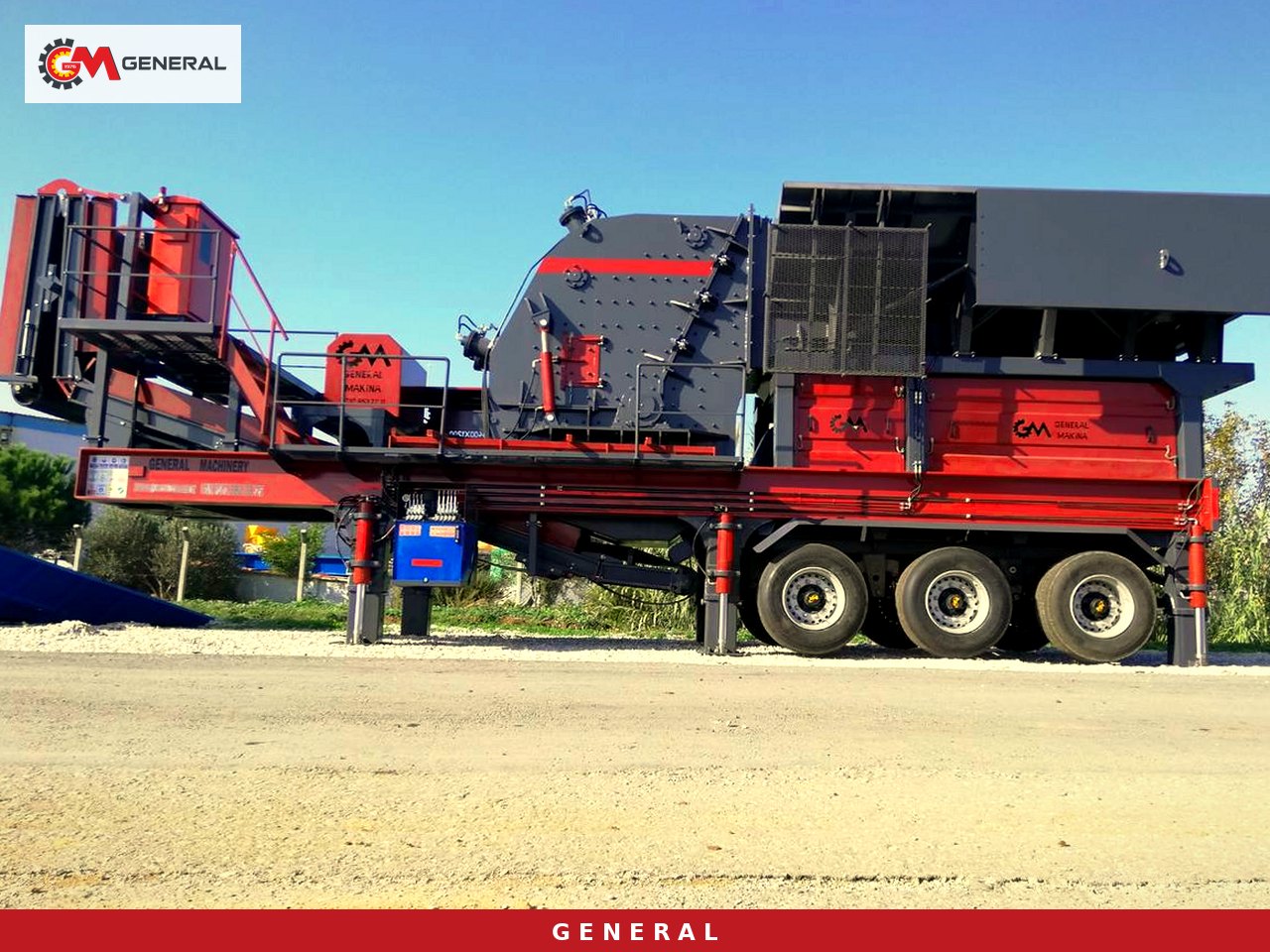
| General 02 | GPS 1413 primary impactor | 250-300 TPH | 1000 mm | 2000×5000 mm, 4 decks | 660 kVA | 76,000 kg |
| 2 × General 950 | Each unit: GPJ 90 jaw + DMK01 impact | 2 × 120-180 TPH | 800 mm | 1600×5000 mm, 3 decks | 600 kVA (per unit) | 70,000 kg (per unit) |
| 2 × General 944 | Each unit: GPJ 90 jaw + GM430 cone | 2 × 120-180 TPH | 800 mm | 1600×5000 mm, 3 decks | 550 kVA (per unit) | 70,000 kg (per unit) |
First candidate for a granite quarry: GNR-MC110
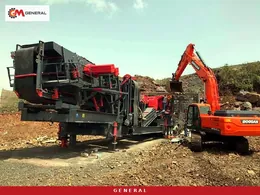
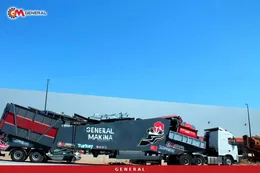
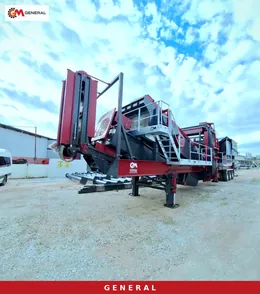
The GNR-MC110 splits the plant over two separate chassis: the first carries the feed hopper and the GPJ 110 jaw crusher, the second the GS1215/DMK03 impact secondary, a 2000×6000 mm four-deck screen and the conveyors. At 200-300 TPH it is the highest-capacity jaw-primary model in the family and sits squarely in the range in the title. Because the two groups run independently, the primary chassis can produce coarse fill on its own, while the secondary chassis comes in when concrete aggregate is needed. An operator who wants to stage the investment can buy the primary group first and add the secondary as volumes grow.
If the sample shows low abrasion
The General 03 runs at 250-375 TPH with its GPS 1415 primary impactor and delivers four fractions over a 2400×5000 mm four-deck screen; the General 02 has the widest inlet in the family at 1000 mm. Since the wear cost of an impact primary stays high in granite, consider these two models only when laboratory results show low abrasion. Two General 950 or 944 units, on the other hand, let you split capacity between two quarries or two job sites; when one unit is under maintenance, production does not stop completely. The 944's cone secondary gives longer metal life in abrasive granite, the 950's impact secondary a more cubical product. All wheeled models are listed on the mobile stone crushers page.
Running through the rainy season without choking the feed line
Abidjan has a humid tropical climate with distinct rainy seasons during the year. In these periods lateritic soil and clay get mixed into the run-of-mine, and the material turns sticky. On a static grizzly feeder, wet clay fills the bar gaps and the fines go into the crusher without being separated; bridging starts at the crusher mouth and the screen cloth blinds. As a result, the capacity on paper drops on site. Plan the following measures before the rains arrive:
- Wobbler feeder: the wobbler feeder GWB1136 separates the muddy fines ahead of the crusher by rotating elliptical, stepped disc shafts; because the discs turn continuously, the grate cleans itself. It is 1100 mm wide and 3600 mm long, with an 18.5 kW motor, 1500 mm maximum feed size and 75-600 TPH feed capacity.
- Vibrating grizzly feeder: sufficient in the dry season and with clean granite blasts; its by-pass grizzly removes fines before they reach the crusher. The options are on the vibrating feeders page.
- Sand cleanliness: clay in manufactured sand increases the water demand of concrete. If a sand equivalent or methylene blue test exceeds the specification limit, consider adding a washing unit to the line.
- Electrical protection: in humid, salty coastal air, protecting the control panel, motor terminal boxes and the generator air intake are measures that can be selected per project.
- Stockpile drainage: stockpiles that hold water disrupt the loader cycle. Preparing sloped, drained stockpile bases keeps feeding steady.
From the port of Abidjan to the quarry: what a wheeled chassis means for logistics
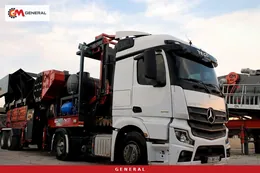
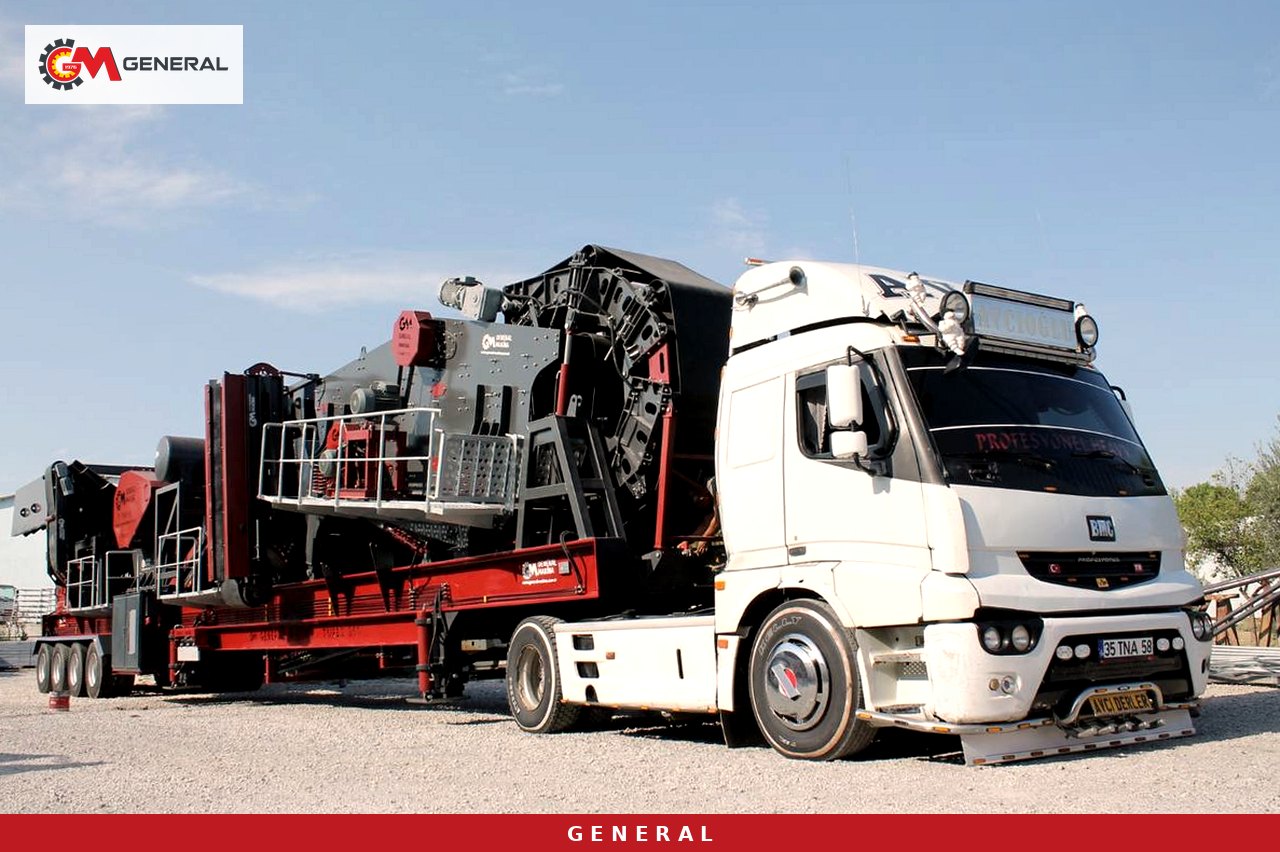
A plant shipped by sea from Izmir is unloaded at the port of Abidjan and then towed by road to the quarry. This is where the advantage of a wheeled chassis becomes clear: because the crusher, screen and conveyors arrive assembled on the chassis, the need for crane assembly and concrete foundations on site is minimised. Dimensions must be known from the start for customs, port handling and route permits. The GNR-MC110 primary chassis measures 3000 × 13500 mm and the secondary chassis 4200 × 18300 mm, each weighing 55,000 kg; the transport dimensions of the General 02 are 4340×20600×4500 mm.
Because the twin-chassis design spreads the weight over two vehicles instead of one platform, it can make narrow bridges and load-restricted roads easier to cross. Check bridge, bend and height restrictions along the route with the local haulier in advance. On the General 03, folding hydraulic conveyors and hydraulic legs allow fast setup without excavation or foundations. For inland quarries without a grid connection the generator is decisive; the technical data of the GNR-MC110 and the General 03 list a 750 kVA generator. A compacted, level setup surface also matters, so that the legs do not settle in the rain.
Information to prepare before requesting a quote
The right configuration and a realistic quotation come out once the information below is clear. The main factors that set the price are the secondary crusher type, feeder choice, washing requirement, generator and shipping scope.
- Abrasion, compressive strength and free silica results of a sample taken at the quarry
- Required fractions and the share of each in total output
- Largest block size after blasting and clay content of the run-of-mine (dry and rainy season separately)
- Daily operating hours and target hourly tonnage
- Energy source: grid, generator or both
- Route from port to quarry and access road inside the quarry
- Grading and cleanliness limits in the authority's specification
- Spare plan for manganese cast jaw plates and blow bars for the first year
General Makina has been manufacturing in Izmir since 1976; its machines carry ISO 9001 and CE certification and a 1-year warranty excluding wear parts.
Frequently asked questions
If I am crushing granite for Abidjan, should I choose the GNR-MC110 or two General 950 units?
If one quarry will produce high tonnage continuously, the GNR-MC110 is the more compact solution and accepts 900 mm feed. If capacity needs to be split between two different job sites or quarries, two General 950 units give flexibility. The decision should follow the number of quarries and the product split.
Is a grizzly feeder enough during the rainy season?
With clean granite blasts it is usually enough. If lateritic soil and clay get into the run-of-mine, the grate clogs; in that case a wobbler feeder prevents capacity loss by separating the fine, muddy fraction before the crusher.
Can the plant run without grid power?
Yes. The technical data of the GNR-MC110 and the General 03 list a 750 kVA generator and the General 02 a 660 kVA generator, so they can work independently at quarries far from the grid.
How are price and delivery time determined?
Both depend on the chosen configuration, the feeder and washing requirement, the generator and the shipping scope. Once sample results and target fractions are shared, a project-specific quotation is prepared.
Final assessment
For a quarry producing granite chippings for Abidjan infrastructure, the strongest candidate is the GNR-MC110 with its jaw primary and independent twin chassis. If capacity needs to be split, two General 950 or 944 units can be considered, and if laboratory results show low abrasion, the General 03 and General 02. Make the feeder choice for the rainy season from the outset. Share your sample results and target fractions and contact us for a configuration and quotation suited to your project.
Definitions of technical terms: Glossary