EN — English
 TR — Türkçe
 DE — Deutsch
 RU — Русский
 FR — Français
 ES — Español
 AR — العربية
 SR — Српски

Two-Stage vs Three-Stage Crushing and Screening Plant 150-375 TPH
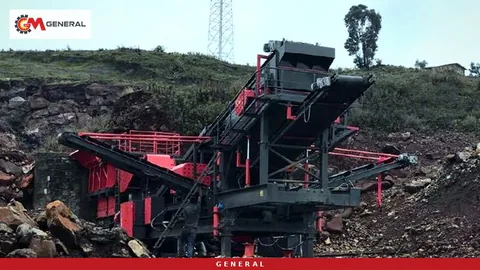
How many crushers go into a crushing and screening plant usually gets less attention in purchase talks than the capacity figure. Yet two lines delivering the same tonnage in the 150-375 TPH range will produce very different product lists if their number of stages differs. A two-stage line (primary + secondary) is enough for crushed stone and road base. A three-stage line adds a shaping crusher or sand maker in the middle or at the end, and delivers the cubical fine product and manufactured sand that concrete and asphalt specifications call for. This article compares the two layouts using real General Makina models and their catalogue values.
There is one thing we ask readers to prepare in advance: a written list of which products you will sell and in what proportion. The number of stages is derived from that list, not the other way round.
The product list sets the number of stages
Every crusher works efficiently within a certain reduction ratio. The typical values on our product pages are as follows: 4:1 to 9:1 for a jaw crusher (about 8:1 as a primary), 6:1 to 8:1 for a secondary cone crusher and around 10:1 for the DMK series secondary impact crusher. A vertical shaft impactor (VSI) has a low reduction ratio, roughly 1:1 to 4:1; this machine is used for grain shape and sand production rather than size reduction.
Put those ratios side by side and the picture becomes clear. Taking 800 mm quarry rock down to 0-40 mm with a jaw followed by a cone or impact crusher is possible in two stages. If you want a high share of 0-5 mm manufactured sand with cubical grains, you need a third machine to process the 5-20 mm material that builds up on the screen after two stages. For an operation that will not sell manufactured sand and only supplies sub-base and fill material, a third stage is often an unnecessary line item in the investment.
Two-stage lines: the flow ends at the second crusher
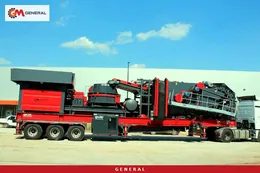
On a two-stage wheeled plant, the flow consists of a hopper with feeder, primary crusher, secondary crusher and a multi-deck screen; oversize from the top deck goes back to the secondary on a return conveyor. This closed circuit stops any grain above the set top size from reaching the stockpile. The factor that really drives the choice is how abrasive the rock is.
Jaw + cone for hard, siliceous rock
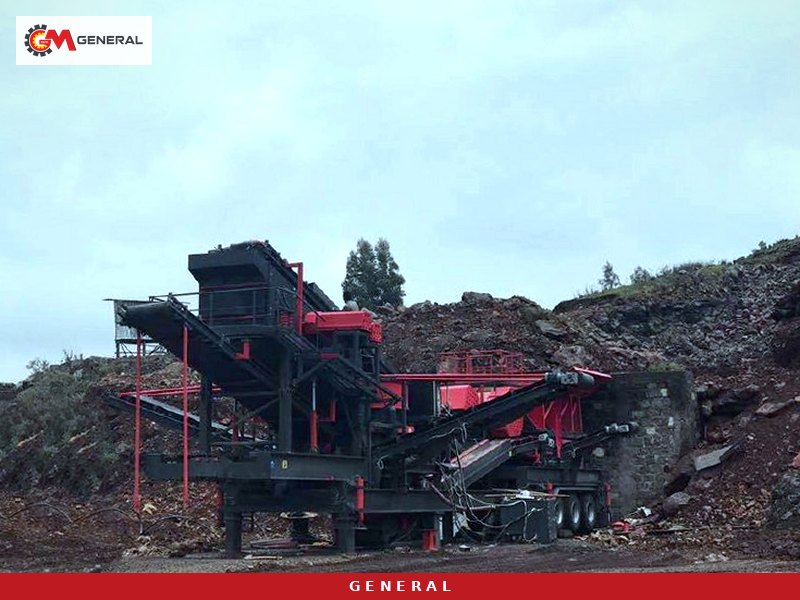
In basalt, granite and rock with high quartz content, the blow bars of an impact crusher wear quickly. This is where the General 944 fits: a GPJ 90 jaw primary and a GM430 cone secondary, 120-180 TPH capacity, 800 mm feed size, a 1600×5000 mm three-deck screen and a 550 kVA generator. If tonnage has to go above 150 TPH, the largest wheeled option with a jaw primary is the GNR-MC110. It carries a GPJ 110 jaw crusher and a DMK03 impact crusher on two separate chassis, delivers 200-300 TPH, accepts 900 mm feed and separates four products (0-5, 5-12, 12-19 and 19-40 mm) on a 2000×6000 mm four-deck screen. Because the primary chassis can run on its own, the second chassis can also be added later.
Two stages in one body for limestone
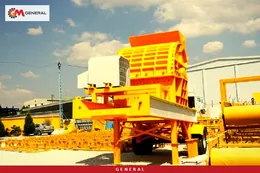
In low-abrasion limestone, a GPS series impact crusher does the primary and secondary work in the same housing. Technically, two crushing stages are combined in one machine, so the General 02 and General 03 should be treated as two-stage lines even though they look like single-crusher plants. The General 02 (GPS 1413) offers 250-300 TPH and 1000 mm feed; the General 03 (GPS 1415) offers 250-375 TPH, a 2400×5000 mm four-deck screen, 750 kVA of power and a four-axle chassis. The model that reaches 375 TPH, the top of the range in the title, on a single chassis is the General 03. The whole family is listed on the wheeled mobile crushing and screening plants page.
Products that call for a third stage
A third crusher enters the line for two different reasons. The first is demand for manufactured sand, the second is grain shape. Both can be solved with the same machine, but not always; the customer you will sell the product to changes the choice.
A VSI stage for manufactured sand
Where there is no river sand, or the sand is clayey, concrete batching plants turn to manufactured sand. On a two-stage line, 0-5 mm product comes out as a small share of the crushed rock and the grains are angular. The GNR-MVSI 900 wheeled VSI plant is designed to close that gap: 90-180 TPH, maximum 50 mm feed, 0-3, 3-5 and 5-12 mm products and an 850 kVA power unit. The 50 mm feed limit shows that this machine cannot replace a primary or secondary; it can only follow them. If oversize from the screen is to be turned into sand, the mobile tertiary sand making machine takes 0-200 mm feed, produces 0-10 mm sand and works in the 60-250 TPH range.
Shaping to correct flaky grains
Asphalt and high-strength concrete specifications set limits on the flakiness index. Chippings from a cone crusher do not always stay within that limit. A common answer on basalt lines is the mobile cubicizer; the GNR MK110 model delivers 0-25 mm cubical product at 160-250 TPH with feed up to 350 mm. The second route is the mobile pre-screening DMK unit with two crushing chambers and a vibrating pre-screen: 0-100 mm feed, 0-30 mm product and 40-300 TPH. The pre-screen takes out fines that are already in size before they enter the crusher, so the manganese liners work under a lighter load. All of these units are compared in the portable rock crushers category.
Real configurations in the 150-375 TPH band
The table below contains catalogue values only. On the three-stage rows, read the capacity together with the limit of the lowest-capacity unit; the third stage does not process the whole flow, only the share the screen sends to it.
| Configuration | Stages | Capacity | Feed size | Screen | Power unit |
|---|---|---|---|---|---|
| General 944 | 2: GPJ 90 jaw + GM430 cone | 120-180 TPH | 800 mm | 1600×5000 mm, 3 decks | 550 kVA |
| GNR-MC110 | 2: GPJ 110 jaw + DMK03 impact | 200-300 TPH | 900 mm | 2000×6000 mm, 4 decks | 750 kVA |
| General 03 | 2 (single body): GPS 1415 | 250-375 TPH | 900 mm | 2400×5000 mm, 4 decks | 750 kVA |
| GNR-MC110 + GNR-MVSI 900 | 3: jaw + impact + VSI | 200-300 TPH (VSI branch 90-180 TPH) | 900 mm / VSI 50 mm | 2000×6000 + 1600×5000 mm | 750 + 850 kVA |
| General 944 + mobile pre-screening DMK | 3: jaw + cone + impact | 120-180 TPH (DMK 40-300 TPH) | 800 mm / DMK 0-100 mm | 1600×5000 mm + pre-screen | 550 kVA (no catalogue value for DMK) |
The exact power and screen combination is settled at quotation stage, based on the sample results and the required product split.
Recirculating load and a hypothetical screen calculation
Adding a third stage does not change the capacity table by itself; it changes the screen load. Our screen pages give two rules: each additional screen deck reduces capacity by about 10%, and the bed depth at the discharge end should not exceed 3-4 times the aperture size. On a three-stage line, product returning from the VSI is screened again, so the screen sees the same tonne twice.
Hypothetical example: A tonnes of rock per hour enter the line, and a share B is sent to the VSI as the fraction retained above 5 mm. With the VSI running, the total load on the screen is roughly A × (1 + B) tonnes. If B is 0.4, the screen needs enough area to handle 1.4 times the feed tonnage. That is why, in a three-stage design, a second screen (such as the VSI's own 1600×5000 mm screen) or a larger main screen deserves as much attention as the crusher. The figures are only an example; the real ratio comes out once the breakage behaviour of the rock has been measured.
Laying out three stages on a stationary plant
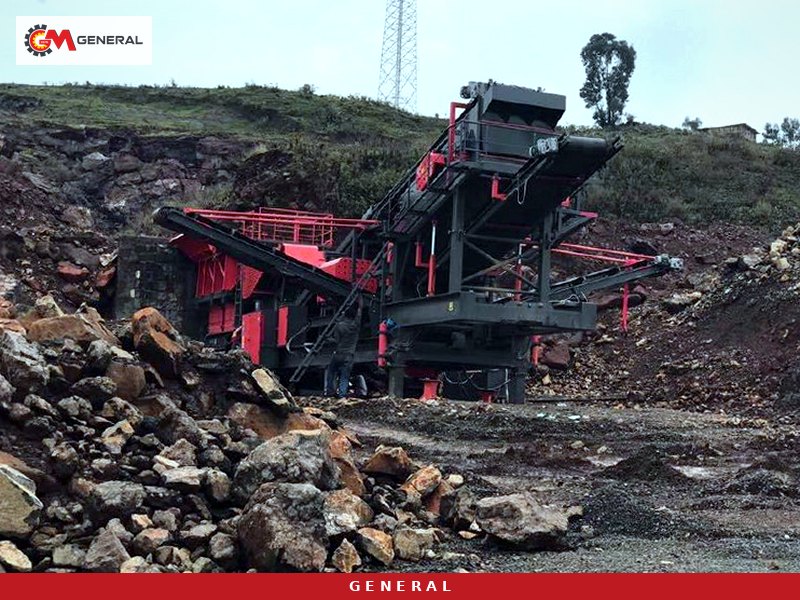
For lines of 300 TPH and above that will stay at the same quarry for years, three stages are usually built as stationary crushing and screening lines. With no chassis transport limit, the primary can be a GNRK 110 jaw crusher (1100×850 mm opening, 200-350 TPH) or, in limestone, a GNR PDK01 primary impact crusher (1000 mm feed, 250-500 TPH). The third stage can be a GNR 150 tertiary impact crusher (200-300 TPH, maximum 150 mm feed) or, in hard rock, a GNR 900 VSI (80-210 TPH). If a single screen chokes at high flow rates, a twin vibrating screen gives two screening surfaces on the same footprint in the 100-500 TPH range.
For a real example on site, look at the 300 TPH GNR PDK01 plant in Manisa: a primary impact crusher followed by a tertiary crusher produces cubical aggregate from limestone. When choosing between mobile and stationary, look at how long you will stay on site and how many different sites you will move to; a three-stage mobile line means two or three separate units, and the conveyors have to be realigned after every move.
What to settle before asking for a quote
- The list of products to be sold and the approximate share of each (for example 0-5 mm sand, 5-12 mm, 12-19 mm, 19-40 mm).
- The rock type and an abrasiveness or silica value from a laboratory; if there is no test, a few kilos of representative rock.
- The largest block size coming from the quarry face; on a jaw crusher the maximum feed is about 0.8-0.9 times the opening width.
- Your customer's written requirements, such as a flakiness index or a fines limit for sand.
- Whether grid power is available; on a generator-powered site, the total kVA demand of three units.
- How many years the site will be worked and how many times the plant will be moved.
- Whether washing is needed if the material is clayey or wet.
Once this information arrives, the number of stages is usually clear in the first meeting, and the quote can be prepared with two or three alternative configurations.
Frequently asked questions
Can a two-stage line produce manufactured sand?
It can, but 0-5 mm product will be a small share of total tonnage and the grains stay angular. If sand is one of the main products, you need to add a VSI stage such as the GNR-MVSI 900.
Does a third stage increase line capacity?
No. Feed capacity is set by the primary and secondary. A third stage changes the product split and grain shape; because the screen load goes up, the screen area has to be recalculated.
Can a third stage be added later?
On wheeled lines, yes. Material is fed by conveyor from the main plant's screen discharge to a VSI or pre-screening DMK unit. On the GNR-MC110, the fact that the primary chassis can run independently also suits growing the line step by step.
What warranty and certificates apply?
Our machines carry ISO 9001 and CE certification, with a 1-year warranty excluding wear parts. Because the price changes with the number of stages, the screen combination and the power unit chosen, it is given in a project-specific quotation.
Which line suits which operation
For a quarry selling sub-base, road base and concrete chippings, two stages are enough: the General 944 or GNR-MC110 in hard rock, the General 02 or 03 in limestone. If you will sell manufactured sand and cubical aggregate to specification, a third stage opens a real revenue line and has to be planned together with screen capacity. Our team, building crushing and screening plants in Izmir since 1976, will compare two-stage and three-stage options in the same quotation once we have reviewed your product list and rock sample. You can send your details through our contact page.
Definitions of technical terms: Glossary