EN — English
 TR — Türkçe
 DE — Deutsch
 RU — Русский
 FR — Français
 ES — Español
 AR — العربية
 SR — Српски

Cone or VSI? Cubic Aggregate in a 120-180 TPH Crushing and Screening Plant
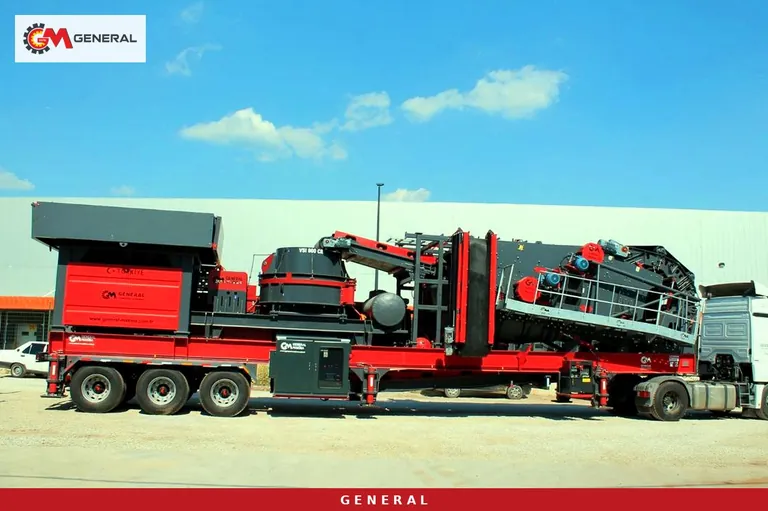
For a quarry selling chippings to ready-mix plants or asphalt mixers, particle shape looks like a single line in the lab report; when that line fails, a whole batch comes back. A crushing and screening plant producing 120-180 TPH has two routes to cubic aggregate: close the circuit with a cone crusher, or add a vertical shaft impactor (VSI). The two machines are often mentioned as if they did the same job. They do not. They apply different forces to the rock, give different product curves and generate a different wear bill. This article works through the decision with real General Makina models, fraction by fraction: where a cone is enough, where the specification cannot be met without a VSI, and when the two belong together.
How cubicity is measured in a specification
When a buyer asks for "cubic aggregate", he usually means the Flakiness Index and the Shape Index. Both tests report the weight share of particles that are clearly thin or elongated relative to their size. In concrete, flaky particles reduce workability and call for more water and cement to reach the same slump. In asphalt, flaky stones that break under the roller mean voids and cracks in the first years of the pavement. Limit values differ by country, by road authority and by product class. So before choosing a machine, get the specification of the buyer you will supply and confirm in writing which limit applies to which fraction.
The shape problem is usually concentrated in one fraction. The picture we meet most often on site: 12-19 mm chippings pass easily, 5-12 mm is borderline, and with 0-5 mm sand the discussion moves to fines content and grading as well as shape. The cone-or-VSI answer depends on which fraction is failing. Looking for a fix for that fraction alone, instead of rebuilding the whole plant, also keeps the investment smaller.
Crushing by compression versus crushing by impact
How a cone crusher shapes the rock
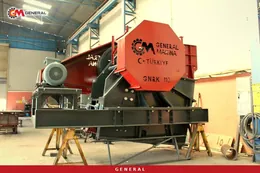
In a cone crusher the eccentrically gyrating head squeezes the feed against the concave again and again; a particle is crushed several times until it passes the closed side setting (CSS). Cubic product comes from inter-particle crushing, rocks pressing on each other inside the chamber. That only happens when the chamber is full, in other words under choke feed. A half-empty cone breaks the stone with a single contact between the liners and produces flaky particles. The General cone crusher page gives a reduction ratio of 6:1-8:1 for the secondary stage and about 10:1 for the tertiary stage. Closing the setting to go beyond these ratios spoils the shape instead of improving it. Hydraulic CSS adjustment and hydraulic cylinder protection against sudden blockage make it easier to hold product size constant as the liners wear.
How a VSI shapes the rock
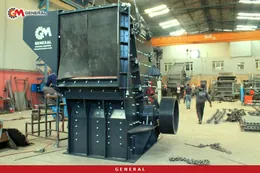
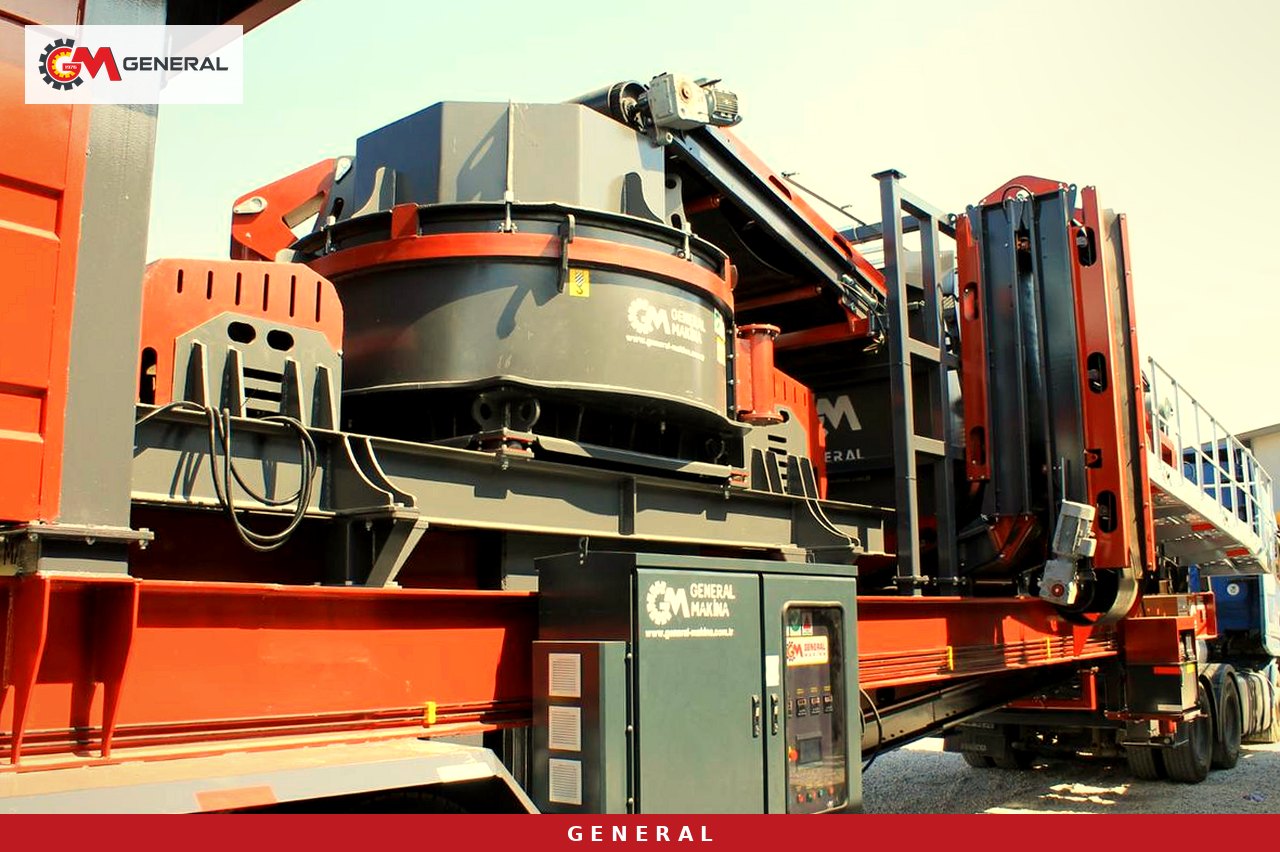
In a VSI a vertical rotor accelerates the feed to roughly 80 m/s and throws it either against metal anvils or against a bed of rock that builds up inside the machine. In rock-on-rock mode a particle loses its corners by rubbing against other particles. The result is a rounded cubic grain that is hard to obtain with a cone. A VSI should not be seen as a size reduction machine: its reduction ratio is low and it does not accept large stone. The GNR-MVSI 900 takes a maximum feed of 50 mm. In return it makes sand. From the same feed it yields noticeably more 0-5 mm material than a cone. If you sell sand, that is a gain; if you sell only chippings, it becomes a by-product piling up in the yard.
Real General configurations for 120-180 TPH
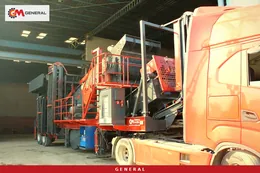
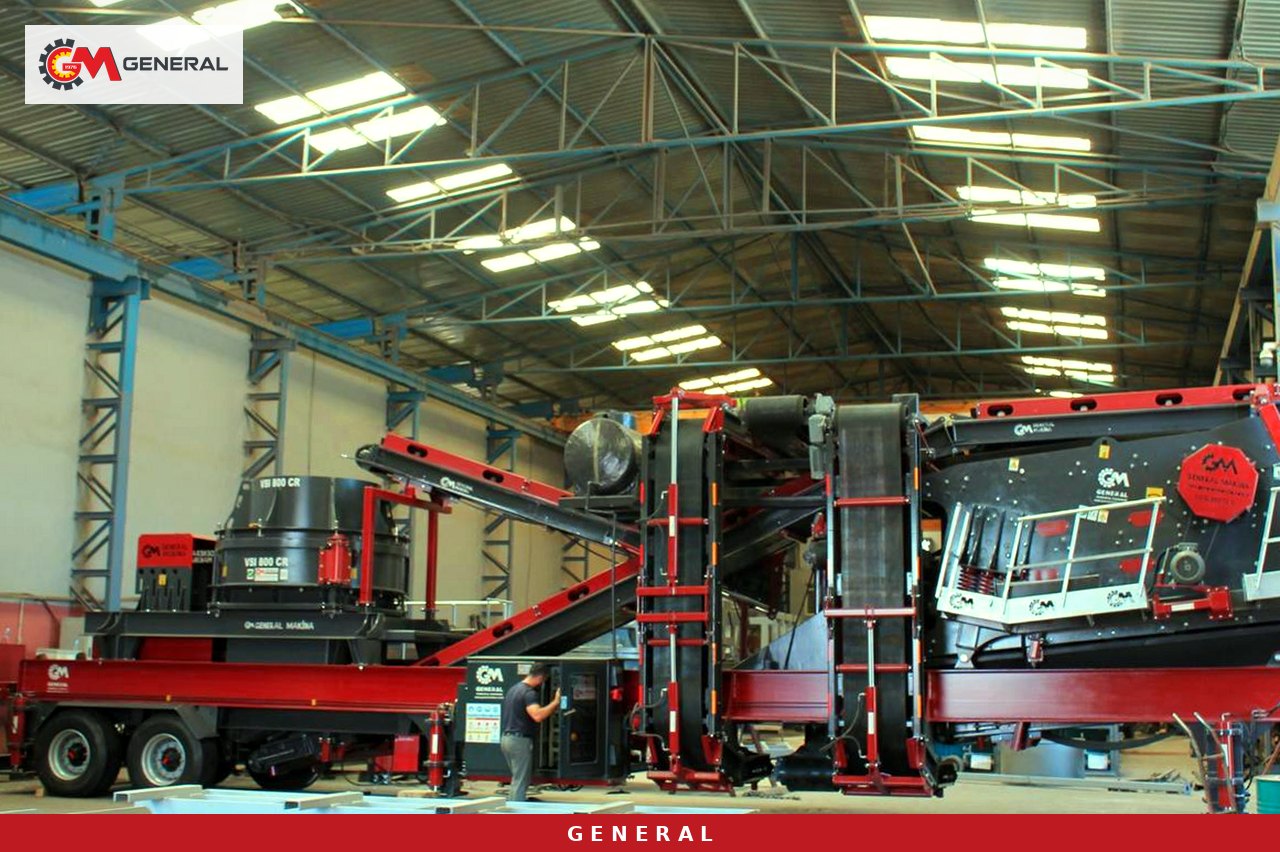
Three set-ups fit this capacity band. The first is the General 944carrying a jaw primary and a cone secondary on one wheeled chassis. The second is the General 950, with a DMK01 impact secondary in place of the cone on the same chassis. The third is the wheeled VSI unit GNR-MVSI 900 added behind one of these plants. For a stationary line, the GNR series vertical shaft impactor models take the same role on a concrete foundation. The values below come from the product pages; for empty cells, ask for project-specific data at the quotation stage.
| Model | Duty | Capacity (t/h) | Max. feed (mm) | Crusher | Product fractions (mm) | Power |
|---|---|---|---|---|---|---|
| General 944 | Primary + cone secondary, wheeled | 120-180 | 800 | GPJ 90 jaw + GM430 cone | 0-5 / 5-12 / 12-19 | 550 kVA generator |
| General 950 | Primary + impact secondary, wheeled | 120-180 | — | GPJ 90 jaw + DMK01 impact | — | — |
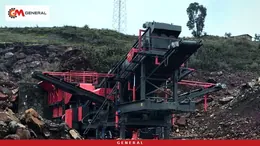
| GNR-MVSI 900 | Shaping and sand, wheeled | 90-180 | 50 | VSI 900 vertical shaft | 0-3 / 3-5 / 5-12 | 850 kVA generator |
| GNR 800 | Stationary VSI | 55-160 | 40-50 | 800 mm rotor | — | 132-160 kW motor |
| GNR 900 | Stationary VSI | 80-210 | 50-55 | 900 mm rotor | — | 2×200 kW motor |
The first finding from the table: the capacity ranges of the 944 and the MVSI 900 almost overlap. That shows the VSI can run behind the 944 without becoming a bottleneck. Still, the VSI does not receive the 944's entire output, only the part to be shaped or turned into sand; screen apertures decide how tonnage is split across the line. The layout and transport plan must also allow for the difference between the two chassis: the 944 weighs about 70,000 kg, the MVSI 900 weighs 42,000 kg, and the VSI unit's transport dimensions are 4100 × 16200 × 4500 mm.
Choosing the machine by fraction
For 5-19 mm chippings a cone is usually enough
For asphalt and concrete chippings, the GM430 cone secondary on the 944 gives product that meets the specification when it is run correctly. Condition one is keeping the cone full: feed belt speed and hopper level are set so that the chamber stays packed with stone at all times. Condition two is holding the CSS close to the target product. If 12-19 mm is wanted, the setting should not drop far below that top size; an over-closed gap adds fines and does not correct shape. Finally, oversize returning from the screen must go back to the cone. A closed circuit sends particles through the chamber more than once and lowers the flaky share. The 1600 × 5000 mm three-deck horizontal screen and the return conveyor on the 944 build this circuit on the chassis itself.
For 0-5 mm sand the VSI pulls ahead
The 0-5 mm material a cone produces is a by-product of crushing; its grains are angular and its grading is hard to control. A concrete plant can blend it with natural sand, but if you want to sell manufactured sand on its own, you need a VSI. The 1600 × 5000 mm three-deck screen of the MVSI 900 separates the product into 0-3, 3-5 and 5-12 mm, so sand and shape-corrected fine chippings leave the same unit. If silt and dust in the sand exceed the specification, washing and dewatering have to be added behind the VSI. Trying to solve that on a dry line with screen settings usually ends in lost output.
Choosing by rock type and wear
In high-silica abrasive rock such as granite, basalt, quartzite and river gravel, both machines can do the job; their wear economics differ. The compression principle of a cone protects the metal. Manganese steel liners, or high-chrome liners in high-silica rock, last far longer in this kind of stone than impact crusher parts. In a VSI the same rock wears rotor tips and anvils quickly in anvil mode. That is why abrasive rock is run in rock-on-rock mode: a rock bed replaces the metal surface, and for high-silica feed ceramic or tungsten carbide reinforced rotor tips are used.
Limestone changes the arithmetic. In soft, low-abrasion limestone a cone cannot reach a high reduction ratio. Here an impact secondary (such as the DMK01 on the General 950) reduces more and gives cubic grains by itself. If a limestone quarry has a shape problem, the impact secondary comes first, and the VSI joins when sand production is the goal. With river gravel the specification also asks for a share of crushed faces on rounded particles; the cone breaks the surface, the VSI tidies the shape.
Whatever the rock, do not finalise a machine choice before running abrasion, compressive strength and Los Angeles tests on a representative quarry sample. Even within one licence area the rock can change from bench to bench.
Cone, VSI or both
Separating three scenarios makes the decision easier. If you sell only chippings and shape is borderline in the 5-19 mm range, first try running the 944's cone with correct feeding and a closed circuit; in most hard rock quarries that is enough. If you sell manufactured sand and fine chippings bound by a shape limit, adding the MVSI 900 behind the 944 is the right set-up: the cone brings the rock down to size, the VSI delivers the shape and the sand. If you process limestone and need high cubicity, starting with the impact-secondary 950 instead of the cone is more economical.
A paired set-up needs its own power plan. The 944 is listed with a 550 kVA generator and the MVSI 900 with 850 kVA; if a grid connection is used, the connected load of both units should be confirmed with the utility in advance. You can compare other wheeled options on the mobile crushing and screening plants page and stationary machines in the crushers category. The basic differences between jaw, impact and cone crushers are covered in our crusher type selection article.
Information to prepare before requesting a quote
- The size range of every fraction you will sell and the buyer's flakiness or shape index limit.
- Target hourly capacity and the estimated split of that tonnage across fractions.
- Rock type and sample test results: abrasiveness, compressive strength, Los Angeles value.
- The largest block size in the run-of-quarry feed and its clay and soil content.
- If manufactured sand will be sold, the fines limit and whether washing water is available on site.
- Power source: grid connection or generator.
- The layout area on site and the condition of the road the chassis will take to the quarry.
A quotation built on this information compares the cone and VSI options in one table and shows which machine works on which fraction.
Frequently asked questions
Can a cone crusher produce cubic particles?
Yes, especially in chippings above 5 mm. The conditions are choke feeding, a CSS close to the target product and returning oversize through a closed circuit. A half-empty cone produces flaky particles.
Can a VSI be placed directly after the primary crusher?
No. The GNR-MVSI 900 accepts a maximum feed of 50 mm and cannot take the large stone leaving a primary crusher. A cone or impact secondary stage must come before it.
Is VSI wear cost higher than a cone's?
It depends on the rock and the operating mode. In abrasive rock a VSI in anvil mode consumes parts fast; in rock-on-rock mode the rock bed protects the metal surfaces. To compare cost per tonne, calculate wear part life with your own rock.
What determines price and delivery time?
The chosen configuration (944 alone, 944 with MVSI 900, or a stationary line), the number of screens and conveyors, the power source and the wear part material. Figures are given in a project-specific quotation prepared with your rock data and fraction list.
Decision summary and quotation
A shape problem in chippings usually comes from how the cone is fed rather than from the machine; fix that first. If sand and specification-bound fine chippings will be sold, a VSI stage is needed, and in the 120-180 TPH band the 944 and the MVSI 900 are a complementary pair. In limestone the impact secondary is the first candidate. General Makina has been building crushing and screening plants in Izmir since 1976; the machines carry ISO 9001 and CE certification and a 1-year warranty excluding wear parts. Send your rock sample data and fraction list through our contact page and we will prepare a quotation comparing the cone and VSI options with you.
Definitions of technical terms: Glossary