EN — English
 TR — Türkçe
 DE — Deutsch
 RU — Русский
 FR — Français
 ES — Español
 AR — العربية
 SR — Српски

Tanzania Geita Gold Belt Ore Crushing and Screening Plant 100-200 TPH
An investor planning a mine or ore-preparation plant in the gold belt between Geita and Mwanza, south of Lake Victoria, usually thinks about the crusher last: drilling, reserves and the leach plant come first. Yet in an ore stream of 100-200 tonnes per hour, the crushing and screening circuit is where a mistake costs the most: a poorly chosen primary either starves the mill or chokes it with oversize. This article sets out the layouts that can be built for this tonnage band from General Makina models verified in our product data, how the belt's ore character shapes machine selection, and what information to prepare before asking for a quotation, seen through the eyes of a crushing engineer.
What does ore in the Geita–Mwanza belt demand from a crusher?
The gold fields south of Lake Victoria sit within Archean greenstone belts. Gold in the belt is known to be associated with banded iron formations, quartz veins and shear zones along the contacts of granitoid intrusions. For a crusher, these three settings share high silica and the abrasiveness that comes with it. Banded iron formation is also a dense rock: the same volume of ore weighs more, so tonnage rather than volumetric capacity becomes the limit at the hopper, the belts and the crusher mouth.
Near the surface lies a laterite and saprolite cover produced by tropical weathering. This material is soft but clayey; in wet periods it blinds grizzly gaps and sticks to the jaw crusher cavity. That is why it pays to plan from day one for two different feed characters at the same pit during the year: hard, abrasive fresh rock in the dry season, and a sticky, fines-rich mix in the wet season. Actual behaviour varies from pit to pit. Machine size should not be fixed before abrasion index, compressive strength and moisture tests have been run on representative samples from drill core.
Sizing capacity backwards from the mill
In gold ore, the customer of the crushing circuit is not the stockpile but the grinding circuit. The feed size and hourly tonnage specified by the mill supplier define the crusher's target. Both figures are in the project engineering documents and must be confirmed before a crusher quotation.
The hourly capacity of the crushing line follows from this formula: required capacity (t/h) = daily ore requirement (t) ÷ (daily operating hours of the crushing circuit × availability). A hypothetical example: if a plant processing 2,000 tonnes of ore per day runs its crushing circuit 16 hours a day at 0.8 availability, the required capacity is 2,000 ÷ (16 × 0.8) ≈ 156 t/h. Running the crushing circuit fewer hours than the mill and bridging the gap with a fine-ore stockpile is a common approach, and it means sizing the crusher slightly above mill tonnage. The 100-200 TPH band is exactly the range of such mid-sized operations.
Three realistic layouts for the 100-200 TPH band
No single “standard plant” covers this band. The choice depends on mine life, ore hardness and how the initial investment is to be split. Each of the three layouts below is built from real models in our data.
Layout A: a single-chassis mobile line with the General 944
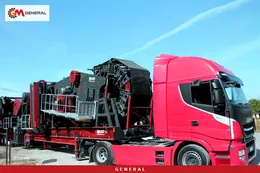
The General 944 combines a GPJ 90 jaw primary and a GM430 cone secondary on one wheeled chassis; it produces 120-180 t/h, accepts 800 mm feed and works with a 1600×5000 mm three-deck screen. It weighs 70,000 kg and its generator is 550 kVA. The cone second stage consumes metal more slowly than an impact rotor in quartz-rich and iron-bearing ore. If the pit location will change within a few years, or if mining starts in the oxide zone and later moves to another pit, this layout offers flexibility. For a target approaching 200 t/h a single unit is not enough; a second line or the stationary layout below should be considered. Other wheeled options are listed on the wheeled mobile crushing plants page.
Layout B: a stationary jaw + cone circuit on foundations
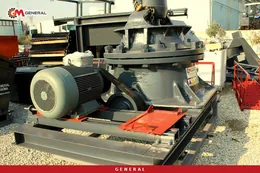
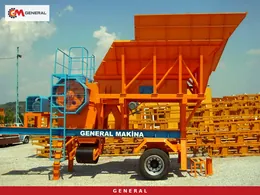
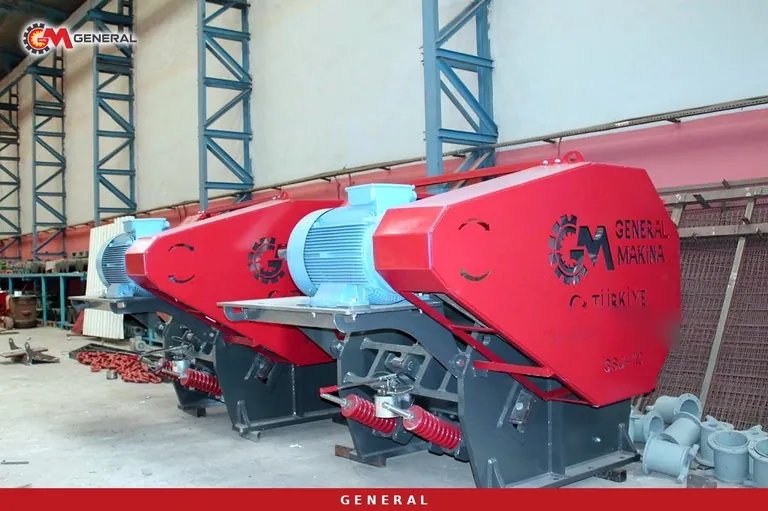
Where mine life is long and the process plant is fixed, a line built on concrete foundations gives a wider choice. At the inlet, a GNR 110 vibrating grizzly feeder (200~300 t/h, 2×7.5 kW) delivers ore evenly to the primary and separates fines and soil falling through the bar gaps before they reach the crusher. The primary stage is a GNRK series jaw crusher: the GNRK 90 (900×650 mm opening, 75/90 kW, 60–225 t/h) covers the whole band, while the GNRK 110 (1100×850 mm, 110/132 kW, 200–350 t/h) adds headroom at the top end and accepts larger blocks. At the secondary stage a cone crusher takes 50–250 mm feed and reduces it to the 0–60 mm range. The components of this layout are engineered within our fixed crushing plants range.
Layout C: staged investment, mobile primary first
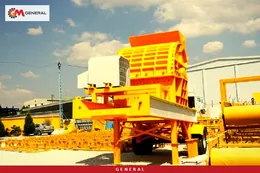
If the feasibility study is not yet final, a mobile primary jaw unit with feeder hopper can be bought first. The GNR 110 (GNRK 110 jaw, 180-300 t/h, 55,000 kg) reduces 0-1100 mm feed to 0-250 mm; the cone secondary and screen are added once the process plant's exact feed size is known. This route splits the initial investment, but on its own it does not produce mill feed size.
| Layout | Main machines | Capacity | Max. feed | Power / weight |
|---|---|---|---|---|
| A – Mobile single chassis | General 944: GPJ 90 jaw + GM430 cone, 1600×5000 mm 3-deck screen | 120-180 t/h | 800 mm | 550 kVA / 70,000 kg |
| B – Stationary, lower end | GNR 90 feeder + GNRK 90 jaw + cone | feeder 140~210, jaw 60–225 t/h | 1500 mm (feeder) | jaw 75/90 kW |
| B – Stationary, upper end | GNR 110 feeder + GNRK 110 jaw + cone | feeder 200~300, jaw 200–350 t/h | 1500 mm (feeder) | jaw 110/132 kW |
| C – Staged | GNR 110 mobile primary jaw | 180-300 t/h | 0-1100 mm | / 55,000 kg |
The cone crusher has no separate row because its model-by-model capacity table is issued per project; the secondary is selected at quotation stage according to primary discharge and target product size.
Wear parts in banded iron formation and quartz
In the belt's ore, the cost item that drives operating expense is metal consumption more than energy. In the jaw crusher the jaw plates are austenitic manganese steel (Mn13/Mn18) that work-hardens at the surface under impact; for high-silica ore Mn18/Mn22 is chosen. In the cone crusher the wearing parts are the mantle and concave liners: usually manganese steel, with high-chrome liners in high silica.
Liner life depends on operating discipline as much as on material. When a cone crusher is choke-fed, breakage also happens particle-on-particle; the liner wears more evenly and the product comes out more cubical. A half-empty cone wears a groove in the lower liner and makes the CSS hard to hold. On the primary side, a jaw crusher's reduction is typically 4:1–9:1 and the maximum feed is about 0.8–0.9 times the opening width. Blasted blocks that exceed this limit cause bridging and waiting at the crusher mouth; secondary breaking at the face with a rock breaker, or adjusting the blast pattern, should therefore be discussed together with crusher selection.
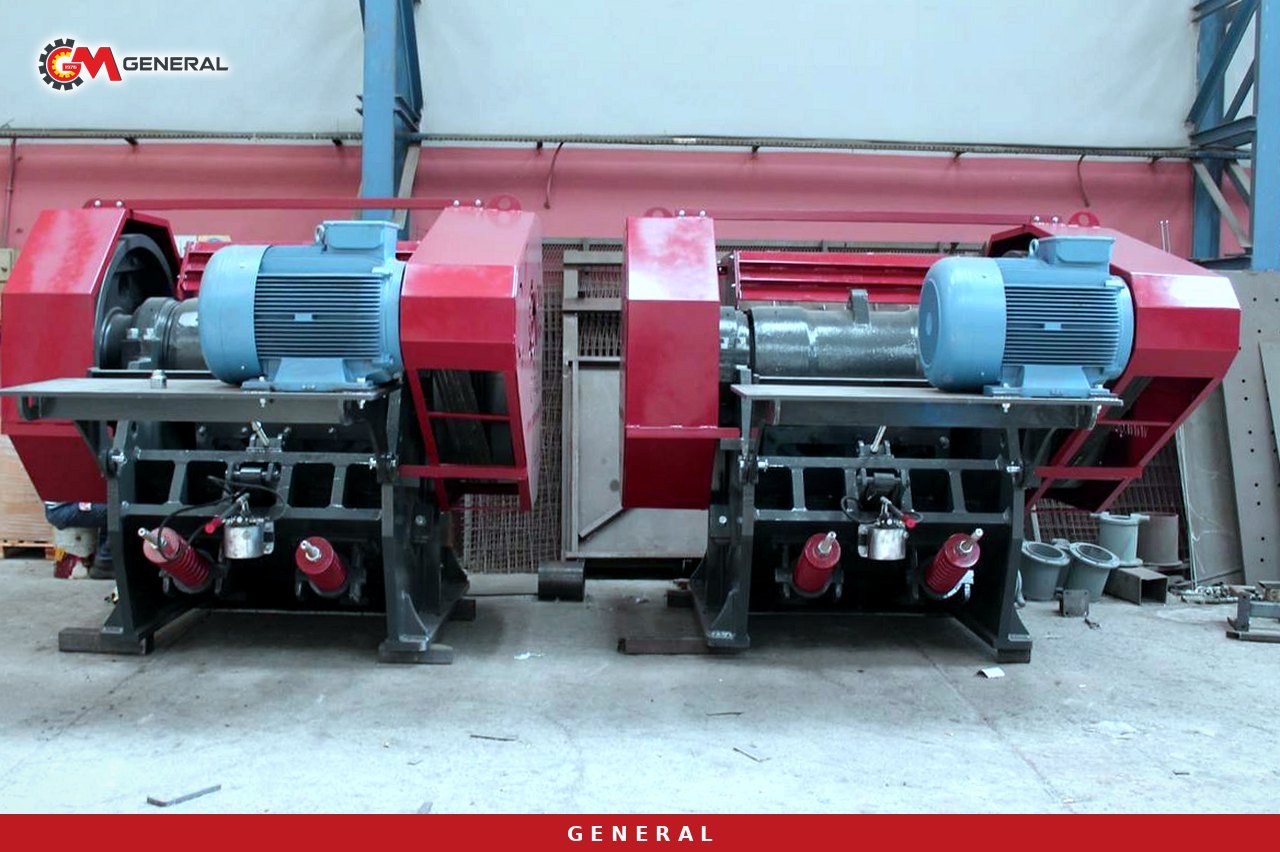
The spare parts plan is part of the same calculation. Getting a set of jaw plates or cone liners to a site in the lake region takes time, so shipping at least one set of jaw plates and one set of cone liners with the initial order limits the cost of an unexpected stoppage.
From Dar es Salaam port to the lakeshore: shipping, power and site
Equipment arriving by sea from Izmir is usually moved by road from the port of Dar es Salaam to the lake region, with Mwanza serving as the regional logistics hub. The length of the route means the shipping package must be planned correctly from the start. The wheeled General 944 can be towed on its own chassis; a stationary line arrives as modular steel structure, crushers and belt conveyors, and needs foundation concrete on site. Dimensions and weights of heavy items should be shared with the haulier in advance to check bridge and road restrictions.
On power, at a process plant with a grid connection the crushers can run from the grid; at a remote pit a generator is unavoidable. The 550 kVA generator of the General 944 lets a single unit run independently in that case. In a tropical climate, cooling of motors and electrical panels, air filter service intervals in the dusty dry season, and stockpile drainage in the wet season should be written into the site plan. Enclosed transfer points on the belts and water-spray dust suppression are among the measures that can be selected per project.
We have previously delivered a Titan 100 mobile concrete batching plant (100 m³/h) to Tanzania. That project is a batching plant; a crushing and screening line is engineered separately using the options above.
The file to prepare before requesting a quotation
A sound quotation for an ore project in the lake region is prepared from the information below. Each missing item raises the risk of an oversized or undersized crusher.
- Feed size and hourly tonnage required by the mill supplier
- Daily operating hours of the crushing circuit and fine-ore stockpile capacity
- Abrasion index, compressive strength and moisture results from drill samples
- Annual split of oxide/laterite versus fresh rock according to the mine plan
- Largest block size expected after blasting
- Grid connection or generator; site voltage and frequency
- Haul road restrictions to site and ground data for foundation concrete
- The technical specification of the authority or consultant managing the project (scope and schedule must be confirmed from this document)
Frequently asked questions
Can an impact crusher be used on banded iron formation ore?
Technically it will break it, but in high-silica, dense ore the wear parts of an impact rotor are consumed quickly. A jaw primary and cone secondary combination is therefore a more economical starting point for fresh rock in the belt.
Will clayey laterite stop the line in the wet season?
Grizzly gaps can blind and the cavity can clog. Separating the fine, clayey fraction at the feeder, draining the stockpile area and, where needed, pre-separation by washing reduce this risk. For very sticky material the feeder type should be assessed separately.
Does the line produce mill feed size directly?
A circuit with jaw primary and cone secondary delivers product around 0–60 mm, the cone crusher's product range. If the mill needs finer feed, a tertiary stage or closed-circuit screening is added; the decision is based on the mill supplier's data.
What do warranty and certificates cover?
Our machines carry ISO 9001 and CE certification and a 1-year warranty; wear parts are excluded. Manufacturing in Izmir since 1976, we quote price and delivery schedule based on project data.
Conclusion
The right layout for a 100-200 TPH ore line in the Geita–Mwanza belt depends on mine life and ore hardness: the General 944 for short-lived or moving pits, a GNRK jaw and cone crusher line on foundations for long-life stationary plants, and a mobile primary first where feasibility is still open. Send your sample results and mill data through our contact page and we will prepare a project-specific configuration and quotation.
Definitions of technical terms: Glossary