EN — English
 TR — Türkçe
 DE — Deutsch
 RU — Русский
 FR — Français
 ES — Español
 AR — العربية
 SR — Српски

Ghana Ashanti Gold Ore Jaw + Cone Crushing and Screening Plant 100-200 TPH
When a crushing line for Ashanti gold ore is being planned, the conversation usually opens with tonnage, yet the deciding factors are the ore itself and the grinding circuit that follows the crushers. Along the gold belt running south-west from the Kumasi area, a single concession can deliver soft, clay-rich oxide ore and hard, quartz-bearing primary ore from the same pit. For an investor targeting 100-200 TPH, the right answer is a jaw + cone crushing and screening circuit that can carry load across both extremes, keep wear cost under control and give the mill a steady feed. This article builds that circuit step by step, using real models, setting logic and the logistics specific to a Ghanaian site.
Two faces of Ashanti ore: the oxide zone and quartz-rich primary rock
Geological literature describes the Ashanti gold belt as Birimian metavolcanic and metasedimentary rock cut by quartz veins. In a tropical climate the near-surface portion weathers deeply, so the first years of mining typically bring laterite mixed with clay, wet, sticky oxide ore. With depth the ore hardens, free silica rises, and the real test for the crusher's metal parts begins.
That transition creates two opposite selection mistakes. A light circuit chosen only for oxide ore loses capacity and part life once primary ore arrives. A line built only for hard rock spends its early years fighting clay build-up on grizzly bars and hopper mouths. Before any plant quotation, samples taken from different depths should therefore be tested for abrasiveness (Bond Ai) and crushability. The ore properties of a particular mining licence are outside the scope of this article; your own drilling and sample data form the basis of the design.
The crushing circuit's real customer: the grinding and leach plant
In an aggregate quarry the product is saleable chippings; in a gold mine the crusher's product is the feedstock of the next step. Crushed ore normally goes to a mill and then to the leach circuit. The mill designer specifies a feed size, and the finer and more consistent that feed, the less energy grinding consumes. This is where the crushing line is judged: even if hourly tonnage is met, a fluctuating share of coarse particles is paid back as lost mill capacity.
The target product size should therefore be set by the process designer, not by the crusher supplier. On the crushing side we work out how many stages and which closed-circuit setting will reach that size. The cone crusher stands out here for a simple reason: because it breaks by compression, part consumption stays low in quartz-bearing ore, and its hydraulically adjusted CSS keeps product size steady through the shift.
Two real routes to the 100-200 TPH band
The range in the title is a planning band, not a figure to squeeze into one machine. Two realistic layouts cover it; the life of the mine and the need to move within the concession decide which one fits.
Mobile layout: General 944
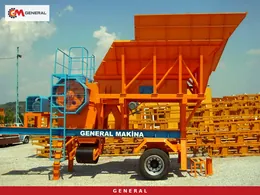
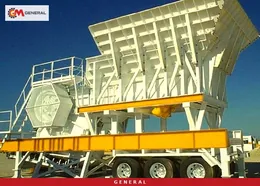
The General 944 combines a GPJ 90 primary jaw and a GM430 cone secondary on one wheeled chassis. Its product page lists 120-180 tph capacity, 800 mm feed size, a 1600×5000 mm three-deck horizontal screen, a 550 kVA generator and a weight of 70,000 kg. Keeping the line close to an advancing pit face shortens truck haul distance; for a mine that will not stay in one spot for years but shift between several pits, this layout makes sense. A hard-stone application of the same model in Africa is described on the GNR 944 project page; that project is not in Ghana and serves only as an example of how the machine behaves in hard rock.
Stationary layout: jaw primary + cone secondary
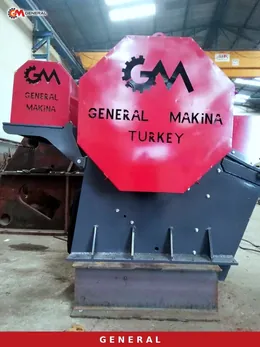
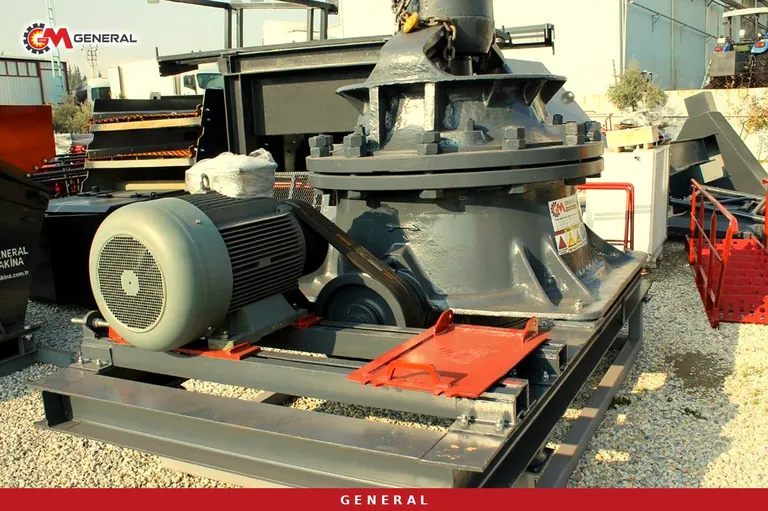
If the mine life is long and the crushing point will be fixed next to the mill, a staged stationary crushing plant covers the whole band more flexibly. The proposed backbone: a GNR 90 vibrating grizzly feeder (140~210 tph), a GNRK 90 jaw crusher (900×650 mm opening, 60–225 tph) and a General cone crusher behind it. Model-specific capacity, power and weight tables for the cone crusher are supplied per project, so those cells are left blank in the table below.
| Component | Mobile: General 944 | Stationary: GNRK 90 line | Growth margin: GNRK 110 line |
|---|---|---|---|
| Feeding | Hopper with vibrating feeder | GNR 90 feeder, 140~210 tph | GNR 110 feeder, 200~300 tph |
| Primary crusher | GPJ 90 jaw | GNRK 90, 900×650 mm, 75/90 kW | GNRK 110, 1100×850 mm, 110/132 kW |
| Primary capacity | 120-180 tph (plant) | 60–225 tph | 200–350 tph |
| Secondary crusher | GM430 cone | General cone | General cone |
| Cone capacity / power | — | (per project) | (per project) |
| Screen | 1600×5000 mm, three-deck | GNR 1650, 1600×5000 mm, 15 kW | GNR 2050, 2000×5000 mm, 18.5 kW |
| Power | 550 kVA generator | Grid or generator | Grid or generator |
If the target may later exceed 200 TPH, the GNRK 110 backbone in the third column allows capacity to be added on the same layout. A general comparison of mobile and stationary options is also available in the mobile stone crushers category.
Running a cone crusher efficiently on quartz-bearing ore
A cone crusher performs best when its chamber is full (choke feeding): particles break between mantle and concave and also against each other, the product comes out more cubical and the liners wear more evenly. Under partial feed the mantle wears heavily on one side and product size drifts. Decoupling the jaw discharge from the cone with a surge bin or stockpile stops primary-side fluctuations from reaching the secondary.
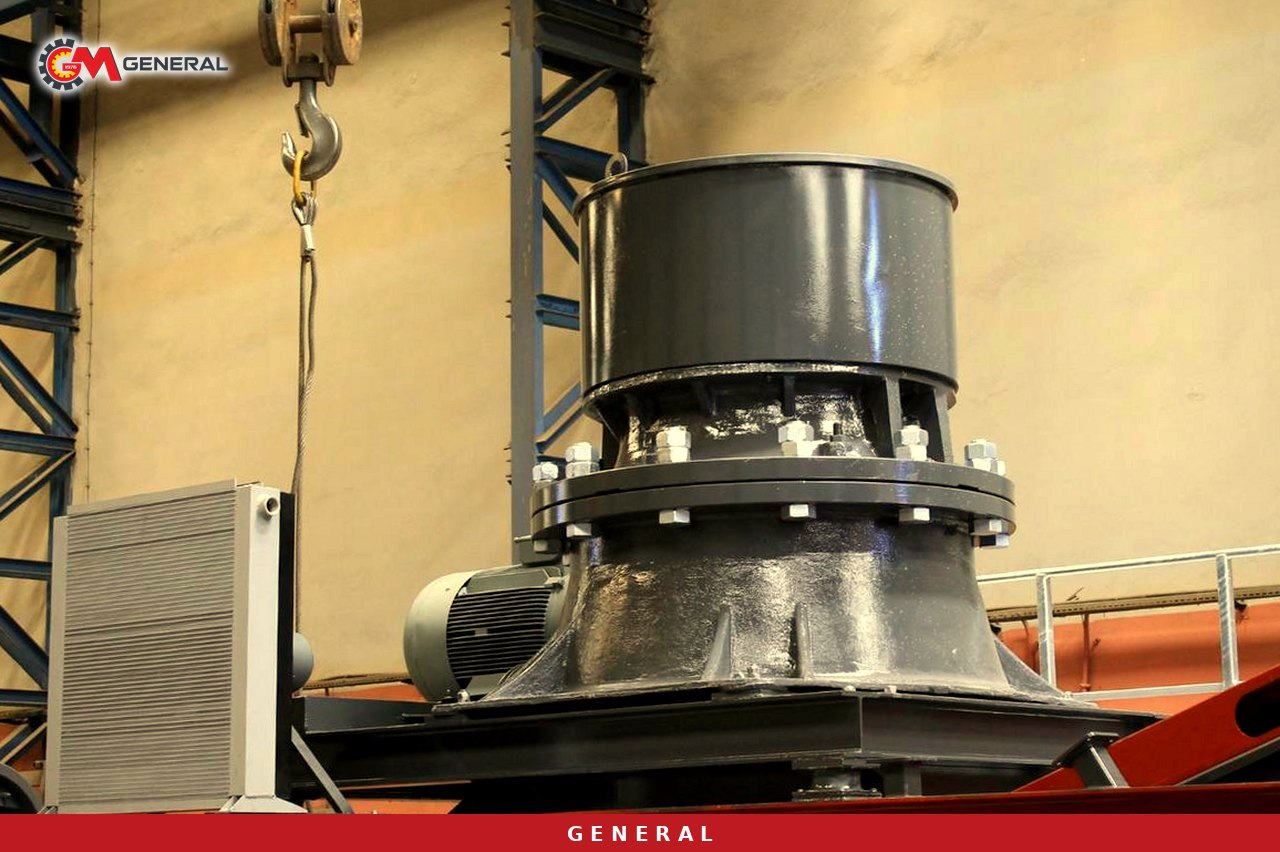
According to the order-of-magnitude values on the product page, a cone crusher works at a 6:1–8:1 reduction ratio in the secondary stage and about 10:1 in the tertiary stage, with feed of 50–250(300) mm and product of 0–60(75) mm. The jaw crusher's reduction ratio is 4:1–9:1, and the largest feed lump is roughly 0.8–0.9 of the opening width. These ratios decide whether the mill's required size is reached in two stages or in three by adding a tertiary cone. Closing the circuit between screen and cone returns oversize and guarantees the top size of the product sent to the mill.
A risk peculiar to gold mines is uncrushable metal: drill bits, bucket teeth and rock-bolt pieces can arrive with the ore. The hydraulic cylinder on the cone crusher protects against sudden packing, but adding a magnetic separator and metal detector on the belt ahead of the secondary is a measure that can be selected per project. On the wear side, jaw plates and cone liners are made of manganese steel (Mn13/Mn18); for high-silica ore Mn18/Mn22 is preferred.
Rainy season and clayey feed: the front end of the line
Southern Ghana has two rainy periods, and during them the moisture of oxide ore rises noticeably. A vibrating grizzly feeder removes fines ahead of the crusher in dry or medium-moisture material, easing the jaw's load, but sticky clay can blind the gaps between the bars. In that case a wobbler feeder with elliptical shafts (model GWB1136, 75-600 tph) separates the mud while carrying coarse ore to the crusher.
Screen media blinding during the wet season also cuts capacity. Assessing aperture and deck count separately for oxide and primary ore, covering belt conveyors and planning drainage of the stockyard are details the site engineer should draw from the outset. In the dry season the same points turn into dust sources; water-spray dust suppression at transfer points works in both seasons.
From Tema or Takoradi to Ashanti: shipping, foundations and power
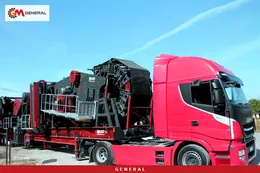
Equipment leaving Türkiye reaches Ghana's Tema or Takoradi port by sea and is then trucked inland. In the mobile layout the chassis itself is the transport unit; in the stationary layout the crushers, screen and conveyors ship in sections and are mounted on concrete foundations on site. Bridge and road limits on the route and customs procedures at the port should be confirmed in advance with a local haulier and the relevant authority.
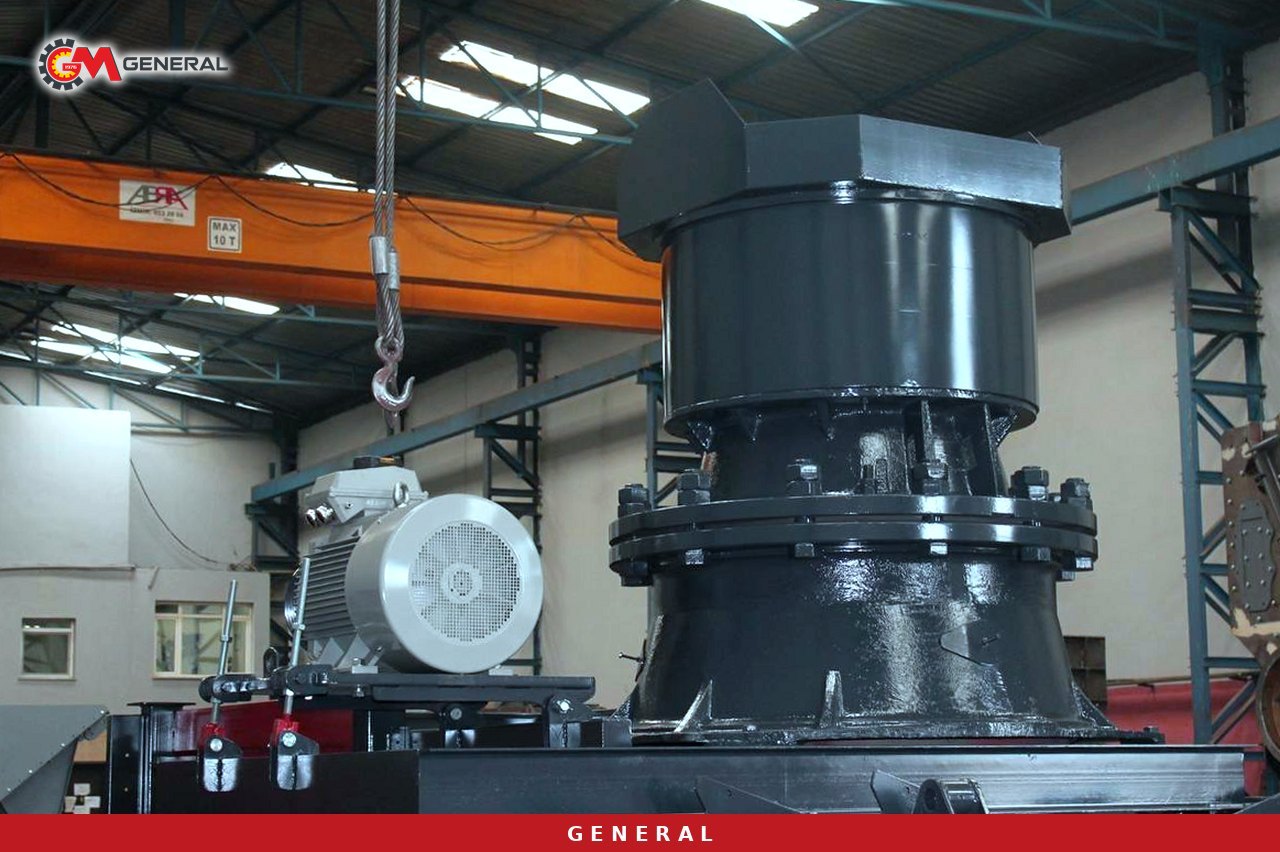
The power decision also depends on the layout. The mobile General 944 runs off-grid on its own 550 kVA generator, which is an advantage for a pit the grid has not yet reached. On a stationary line, electric-motor drive is preferred where a grid connection exists; otherwise generator capacity is sized to the sum of crusher, screen and conveyor motors. In humid heat, motor and panel cooling and keeping oil coolers clean are regular items on the maintenance plan.
Frequently asked questions
Why a cone crusher rather than an impact crusher for gold ore?
In quartz-bearing primary ore, an impactor's blow bars and plates wear out fast. A cone crusher breaks by compression, so metal wear and part cost per tonne stay low, and product size is held steady by the hydraulic setting.
Can a single General 944 reach 200 tonnes per hour?
No. The General 944 is rated at 120-180 tph. For 200 TPH and above, a stationary line built on a GNRK 90 or GNRK 110 backbone, or a multi-unit layout designed per project, is evaluated.
When the oxide ore runs out, can the same line crush primary ore?
Yes, if the line was chosen for hard ore from the start; what changes is the feeding unit, screen aperture and liner alloy. A wobbler feeder can serve the oxide phase and a grizzly feeder the primary phase.
How are price and delivery time determined?
Price is set by the number of stages, the cone crusher model, screen and conveyor lengths, the power solution and shipping scope. Delivery time is likewise given in writing at quotation stage according to the chosen configuration.
Decision summary and what a quotation needs
A line crushing gold ore in Ashanti should be built around two different ore types and the mill's feed requirement. For short-lived, shifting pits the General 944 stands out; for a long-life installation next to the mill, the GNRK 90 + cone crusher backbone does. General Makina has manufactured in İzmir since 1976, holds ISO 9001 and CE certification and delivers its machines with a 1-year warranty excluding wear parts. To prepare a sound quotation, send the following together:
- Abrasiveness and crushability test results for samples of oxide and primary ore
- The feed size required by the mill designer and daily operating hours
- The largest block size from the pit and moisture condition (wet and dry season)
- Estimated mine life and number of pits, to decide stationary versus mobile
- Whether a grid connection exists and, if so, voltage and power limits
- Preferred discharge port and road restrictions up to the site
With this data we prepare the configuration and quotation that suit you; reach our engineering team through our contact page.
Definitions of technical terms: Glossary