EN — English
 TR — Türkçe
 DE — Deutsch
 RU — Русский
 FR — Français
 ES — Español
 AR — العربية
 SR — Српски

Soft Rock Crusher and Screener Plant 120-180 TPH: Limestone & Dolomite
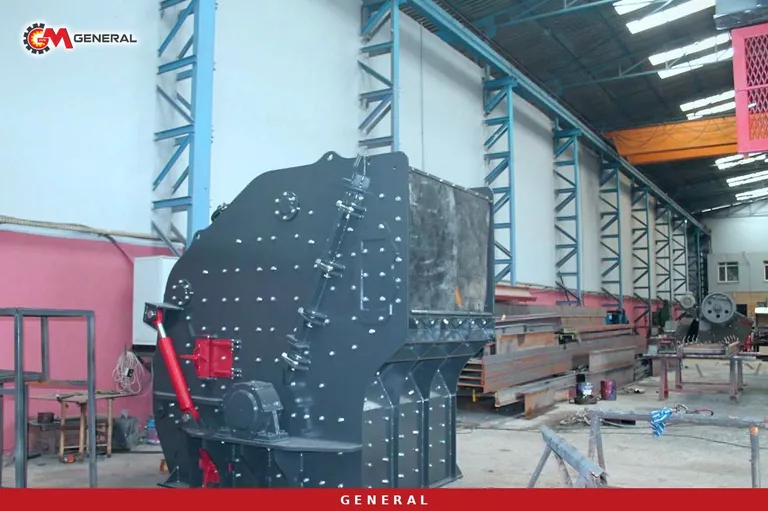
Selling a jaw and cone line built for hard rock to a quarry owner who crushes limestone or dolomite is a solution that works but wastes his money. On soft rock, a crusher working on the impact principle delivers the same tonnage with fewer stages, a more cubical product and, in many cases, a lower investment. This guide is written for buyers targeting 120-180 TPH: first how limestone and dolomite behave inside the crusher, then the real General models that cover this range, and finally the settings that decide your wear cost.
All technical values in this article are catalogue data from our product pages. A firm decision about your own quarry rock needs a laboratory sample; the recommendations below are a starting point to be confirmed by that test.
How to recognise soft rock on site
In crushing engineering the word "soft" does not mean what it means to a geologist. Our yardstick is how much the rock wears the crusher parts and how much energy it needs to break. Rock with a low abrasion index (Ai) and little free silica counts as soft for an impact crusher. Limestone typically has an abrasion index between 0.001 and 0.03; siliceous rocks such as granite and quartzite go above 0.15. That gap shows up as a many-fold difference in blow bar life.
Limestone: calcite-rich and brittle
Limestone, made of calcite, splits easily along its bedding and fracture planes when struck. The impact crusher exploits this: the blow bar on the rotor hits the stone, the stone strikes the breaker plate and shatters. The resulting particle shape is cubical and the flaky fraction stays low. That is why the shape quality required by concrete and asphalt specifications is usually reached on limestone without an extra shaping stage.
Dolomite: same family, a little more stubborn
Dolomite is a close relative of limestone, but its magnesium content makes it somewhat harder and denser. In the crusher this shows as a slightly coarser product at the same rotor speed and a higher motor load. In a dolomite quarry it is sounder to aim at the middle of a model's range than to plan on running at its upper limit. The degree of dolomitisation can also vary within a single quarry, so do not decide on one sample: take material from different benches.
Chert, silica bands and clay
In a soft rock quarry the real enemy of an impact crusher is not hardness but silica hidden inside the stone. Limestone carrying chert nodules or quartz veins consumes blow bars far faster than clean limestone. If free silica exceeds 10 percent, a jaw primary with a cone crusher should be considered instead of an impact primary. Clay is a different problem: clayey infill between the beds contaminates the product and blinds screen meshes. That material has to be removed by grizzly pre-screening before it reaches the crusher.
What an impact crusher gains on soft rock
A jaw crusher breaks stone by compressing it between two jaws, and its overall reduction ratio is limited. A primary impact crusher can reach up to 20:1 reduction in a single stage on limestone; in general use the ratio sits between 4:1 and 6:1. In practice, the product size a jaw line reaches with two crushers is often obtained on soft rock with a single impact body. Fewer stages also mean fewer conveyors, chassis and electrical panels.
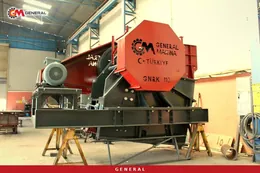
The second gain is particle shape. Because impact breaks the stone along its weak planes, the product comes out cubical. For a ready-mix producer that means less cement and better workability; for an asphalt producer, better interlock. The third point is adjustment: by changing the apron gap and rotor speed the product curve can be made finer or coarser. The red hydraulic cylinder on the side of the PDK housing in the cover photo is used to open the housing for these adjustments and for maintenance.
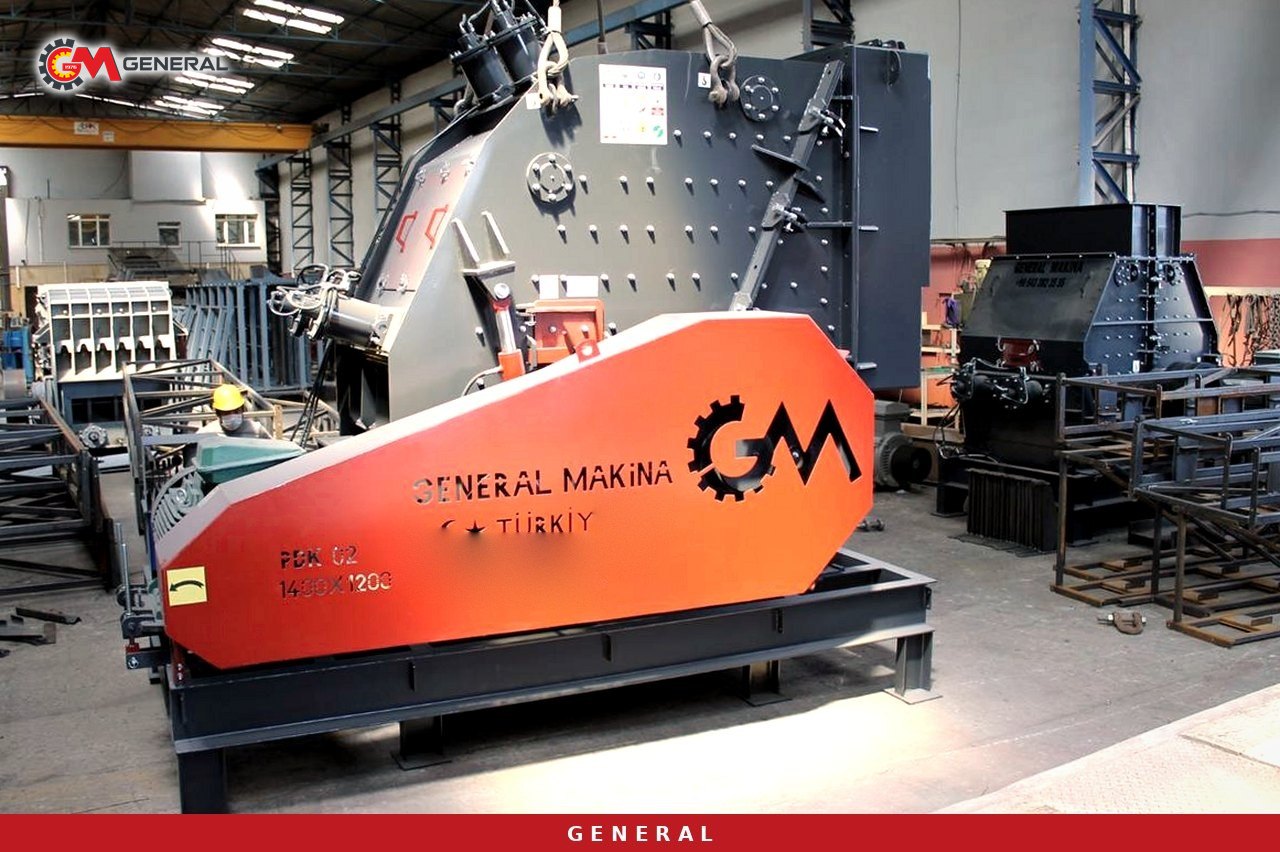
Model comparison for the 120-180 TPH range
Three approaches are possible at this tonnage: a single-chassis wheeled mobile plant, a self-propelled tracked unit and a stationary line. The table below brings together the values from our product pages; unknown cells are left blank.
| Model | Type | Capacity (t/h) | Max. feed (mm) | Crusher | Screen | Power | Weight (kg) |
|---|---|---|---|---|---|---|---|
| General 01 | Wheeled mobile | 120-180 | 700 | GPS 1210 impact (primary+secondary) | 1600×5000 mm, 4-deck | 550 kVA | 55,000 |
| General 800 | Wheeled mobile | 80-150 | 600 | PDK 1280 primary impact | 1300×4000 mm, 3-deck | 450 kVA | 35,000 |
| GM 100 | Tracked mobile | 100-180 | 600 | GNR-01 impact, 160 kW | 1500×5500 mm, 3-deck | 450 kVA | 42,000 |
| GPS-1210 | Stationary line crusher | 100-250 | 600 | Primary+secondary HSI, 160 kW | — | — | — |
| M-DMK 01 | Portable secondary | 120-180 | 350 | Secondary impact, 160 kW | — | — | 32,000 |
A full line on one chassis: General 01
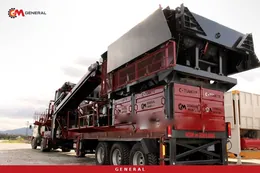
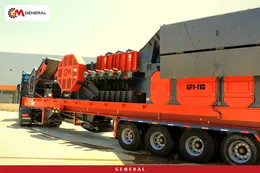
General 01 is the exact match for this range. Its GPS 1210 crusher handles primary and secondary work in one body, accepts blocks up to 700 mm and, thanks to the 4-deck screen, separates the 0-5, 5-12, 12-19 and 19-40 mm fractions at the same time. For a buyer who wants the four products needed for ready-mix concrete and asphalt from a single machine in a limestone quarry, this is the first candidate.
A lighter start: General 800
General 800 covers the lower half of the range with 80-150 t/h. At 35,000 kg and with a 3-deck screen it is more compact. If your target is around 120 tonnes per hour and you process clean limestone, it is enough; if you want to approach 180 tonnes, General 01 is the step up.
For crews that move often: GM 100
If the plant relocates frequently within the quarry or between sites, the tracked GM 100 deserves a look. It works in closed circuit with grizzly pre-screening, a 3.6 m³ hopper and an integrated 3-deck tracked screen, and needs no foundation or leg set-up. In a permanent quarry, a line built around the GPS-1210 crusher or the M-DMK 01 secondary unit processing primary product joins the options. All wheeled options are on the mobile crushing and screening plants page, and the individual machines in the crushers category.
Blow bar economics and silica control
The largest item in an impact crusher's operating cost is the blow bar. The right alloy directly sets the wear cost per tonne. On clean, homogeneous limestone, high-chrome white cast iron of roughly 700-800 HB gives long life. If demolition concrete gets mixed into the feed, or there is a risk of metal arriving with the bucket, tougher manganese or martensitic steel is preferred; a high-chrome bar can crack when it meets tramp metal. In bands where silica rises, ceramic-insert MMC parts can offer roughly 2-3 times the life of high-chrome.
There is also work to do on the quarry side to keep blow bars running longer. Stockpiling siliceous bands separately and blending them into the main feed in a controlled way lowers the average abrasiveness of what reaches the crusher. Turning or swapping the blow bars at set intervals spreads wear evenly across the surface. Logging each change date together with the tonnage crushed in that period gives, within a few months, a reliable wear-per-tonne figure for your own quarry. The approach in our article on high-efficiency mobile crusher solutions for limestone also helps with this calculation.
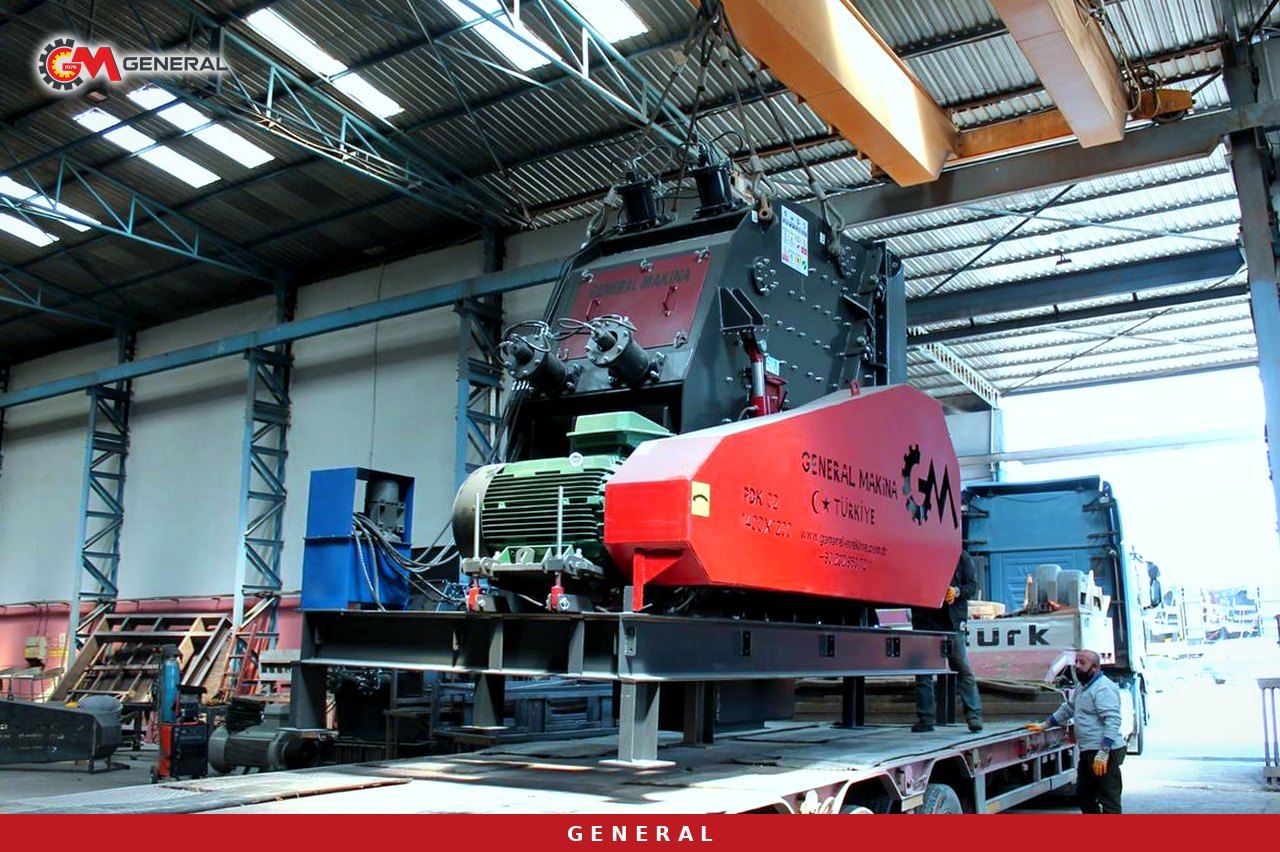
Product list, fines and screen layout
When soft rock is crushed, the fines share is higher than with hard rock. This can be an advantage: for an operation that wants to make crushed sand from limestone, the 0-5 mm fraction becomes a saleable product directly. But the same fines also mean a dusty grading curve and sand with a high silt content. If the fines limit for concrete sand is exceeded, a washing unit has to be added; decide that after the sample analysis.
On the screen side, the point to watch is how deck count and mesh sizes match the product list. The 4-deck screen of General 01 separates four products at once, while the 3-deck screens of General 800 and GM 100 either combine one fraction or are completed with a separate screen. Output setting on all these models is adjustable within 0-100 mm. Choosing meshes without knowing which product you will sell, and in what share, piles up unsold stockpiles in the yard.
Dolomite has one more detail: the colour and density of magnesian dust differ from limestone dust, and some buyers object to it in sand. If sand sales are planned, get the buyer's specification early. For dust control, water spraying at the crusher discharge and conveyor transfer points, plus belt covers, are measures that can be added to suit the project.
Sample and pre-quotation checklist
The following information is enough for us to recommend the right model. Each missing item raises the risk of a wrong capacity estimate.
- Rock type and at least a few samples taken from different benches (limestone, dolomite or a mix of both).
- Free silica content and abrasion index from a laboratory; compressive strength if possible.
- Largest run-of-mine block size and typical post-blast size distribution.
- Clay and soil content, and how sticky the material gets in wet periods.
- List of products to be sold and the approximate share of each (such as 0-5, 5-12, 12-19, 19-40 mm).
- Daily operating hours, and whether grid power or a generator will be used.
- Whether the plant stays fixed in the quarry or how many times a year it will move.
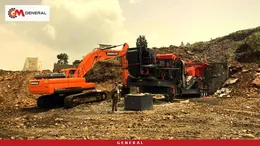
Once this list is filled in, our engineering team proposes the crusher type, the screen layout and, if needed, a washing stage together. The limestone plant built with a GNR PDK01 in Manisa is a site example of how an impact primary produces cubical aggregate on soft rock; that line was built for a higher tonnage.
Frequently asked questions
Is impact crusher capacity on dolomite the same as on limestone?
It usually drops a little, because dolomite is harder and denser. When choosing a model we recommend placing your target tonnage in the middle of the range rather than at its top. A firm figure is given after the sample test.
Is a jaw crusher never used on limestone?
It is. If run-of-mine blocks are larger than the impact crusher's feed opening, or high-silica bands are frequent in the quarry, a jaw primary makes sense. On clean limestone, however, an impact crusher gives a more cubical product with fewer stages.
What are the warranty and certification terms?
Our machines are ISO 9001 and CE certified. A 1-year warranty applies, excluding wear parts. Spare parts and service support are provided after sale.
How do I get price and delivery information?
Price depends on the model, screen layout, generator or grid connection, extra stages such as washing, and the shipping method. Send us the checklist above and we will prepare a project-specific quotation.
A last word for the investment decision
In a soft rock quarry, the right choice starts with proving through a sample that the stone really is soft. If silica is low, a single-body impact line in the 120-180 TPH range is a simpler solution with a more cubical product than a two-stage jaw and cone line. The choice between General 01, General 800 and GM 100 then comes down to tonnage, how often the plant moves and the product list. Contact us with your sample results and we will define the right configuration for your quarry together.
Definitions of technical terms: Glossary