EN — English
 TR — Türkçe
 DE — Deutsch
 RU — Русский
 FR — Français
 ES — Español
 AR — العربية
 SR — Српски

Tunisia Municipal Roads Compact Crusher and Screener Plant 60-100 TPH
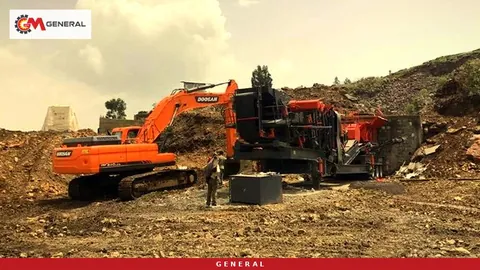
A road programme run by a Tunisian municipality, or by a contractor working for one, moves at a different rhythm from a large motorway job: a broken side street in one district, shoulder repairs on a ring road the following week, then the sub-base of a newly opened residential road. Each job is small on its own, but over a year they add up to a serious aggregate demand. Crushing near the work instead of trucking material from a distant commercial quarry cuts haulage and supply uncertainty. This article explains how to choose a compact mobile crusher for a municipal scale of 60-100 TPH, which real model fits that band, and what must be settled before a tender file goes out.
The aggregate recipe of a municipal road programme
Crusher selection should start from the road cross-section, not from the machine. The layers of an urban road call for material of different sizes and different cleanliness, and a plant does not deliver all of them on one setting. First work out how much each layer weighs in the annual programme, then configure the crusher around it.
Fill, sub-base and base layers
By tonnage, the largest share usually goes to the sub-base and base. What matters here is that the grading sits inside the specification envelope and that the material is free of clayey soil, which is why removing soil from the run-of-mine before it reaches the crusher has a direct effect on product quality. Limestone quarries are common in northern Tunisia and along the coastal belt; limestone reduces well under impact, but hardness and clay content vary from one quarry to the next. Confirm the required grading in the technical specification of the municipality or ministry concerned, and have a sample from your intended quarry tested in a laboratory.
Fine product for patching, surface dressing and kerb concrete
The second line item in municipal work is chippings for surface dressing, fine aggregate for asphalt patching, and concrete aggregate for kerbs, pavements and small structures. Cubical particle shape and a clean sand fraction become important here. Flaky, elongated particles bond poorly with binder in surfacing and reduce workability in concrete. A plant with an impact crusher in the secondary stage therefore has an advantage at municipal scale: in a single pass it delivers both the coarse product and well-shaped fine fractions.
Why the 60-100 TPH band suits a municipality
A high-capacity line often stands idle on small, scattered jobs, and an idle machine keeps carrying its fixed costs. For a municipal programme, the number of shifts needed to cover monthly demand matters more than maximum crushing capacity. You can work this out with your own figures using this formula:
Monthly output = average hourly capacity × net operating hours per day × operating days per month
A hypothetical example: the plant runs between 60 and 100 tonnes per hour depending on rock hardness, with 8 net operating hours a day. One day's output then falls roughly between 480 and 800 tonnes. Divide the total tonnage of your annual programme by this daily figure and you see how many days the machine needs to be on site. If that fills most of the year, this band suits you; if the machine would sit idle most days, a smaller solution makes sense, and if it is permanently overloaded, look at the next model up. When estimating net hours, deduct the time set aside for relocation, setup and maintenance.
The General 640 and its nearest alternative in figures
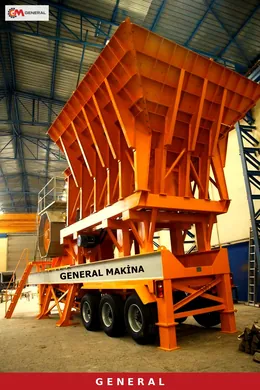
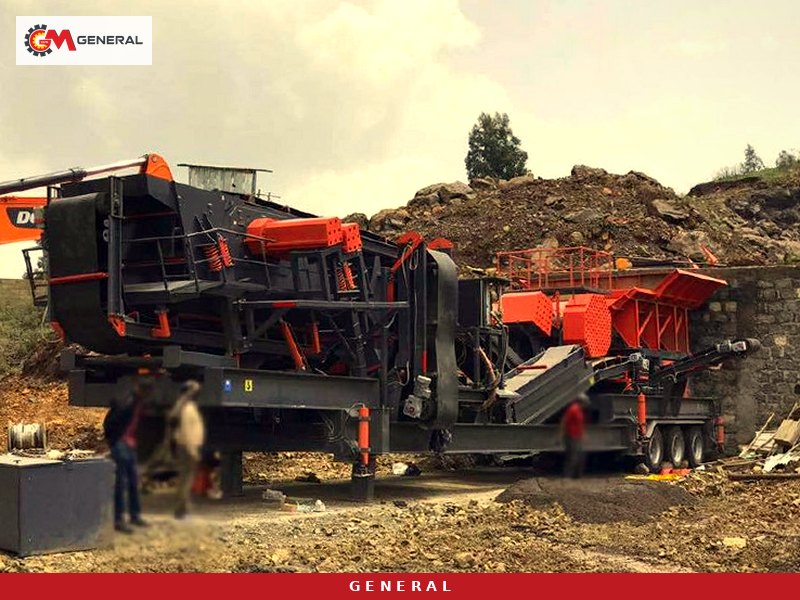
The model that covers this band on one chassis is the General 640 compact wheeled plant. It carries a GPJ 60 jaw crusher in the primary stage and a GNR 50 impact crusher in the secondary stage, and runs in closed circuit. Municipal work, however, rarely sees one uniform rock type, so the neighbouring model in the family belongs on the table too. You can compare all tyre-mounted options on the wheeled mobile crushing plants page.
How the rock travels through the machine
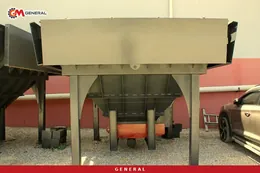
A loader or excavator tips run-of-mine into the hopper with its vibrating feeder. The grizzly by-pass section of the hopper separates soil and fines before they enter the jaw, which directly affects both the cleanliness of the sub-base product and the life of the jaw plates. The GPJ 60 reduces large blocks, and the GNR 50 gives the product its final size and cubical form. The 1200×4000 mm triple-deck screen splits the material into fractions, and oversize that fails to pass the target size returns to the crusher on the recirculation conveyor. The standard fractions are 0-5 mm sand plus 5-12 mm and 12-19 mm chippings; because the output setting spans 0-100 mm, a coarser sub-base product can be planned by changing the screen meshes.
| Item | General 640 | General 800 |
|---|---|---|
| Capacity | 60-100 TPH | 80-150 TPH |
| Max. feed size | 500 mm | 600 mm |
| Crusher layout | GPJ 60 jaw + GNR 50 impact | PDK 1280 primary impact |
| Screen | 1200×4000 mm, triple-deck | 1300×4000 mm, triple-deck |
| Product fractions | 0-5, 5-12, 12-19 mm | 0-5, 5-12, 12-19, 19-40 mm |
| Generator | 300 kVA (optional) | 450 kVA |
| Weight | 38,000 kg | 35,000 kg |
| Transport size (W×L×H) | 3500×17000×4500 mm | 3600×15500×4500 mm |
| Suitable rock | Wide range, hard and abrasive included | Limestone and low-abrasive stone |
The selection logic is simple. If your quarry rock comes in hard, siliceous or mixed, the 640 is the safer choice because the jaw takes the first hit. If the rock is clean limestone and the programme climbs above 100 tonnes per hour, the General 800 deserves a look, and its 19-40 mm fraction can simplify sub-base work. Do not assume two Tunisian quarries share the same hardness; a sample test before ordering settles the debate.
District to district: shipping to Tunisia and setting up on site
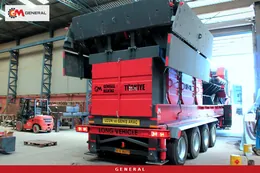
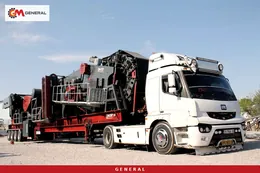
In municipal work, a machine earns its keep by how quickly it changes location. The General 640 is towed by a single vehicle and set up on hydraulic legs, with no concrete foundation. For a plant dispatched from Izmir, the usual route is by sea to a Tunisian port such as Radès or Sfax and then by road to site. When planning the route, check in advance that the transport size of 3500×17000×4500 mm clears bridges, junction turns and urban access restrictions, and confirm the required permits and escort conditions with the relevant authority.
The point to watch when setting up is that the stockpile area takes as much space as the machine. Placing a plant on a tight plot without allowing for three separate fraction heaps, a truck turning area and loader manoeuvring room slows output from day one. You can see the same model in service in Turkey on the GNR 640 mobile crushing plant project page.
Summer heat, dust and urban neighbours
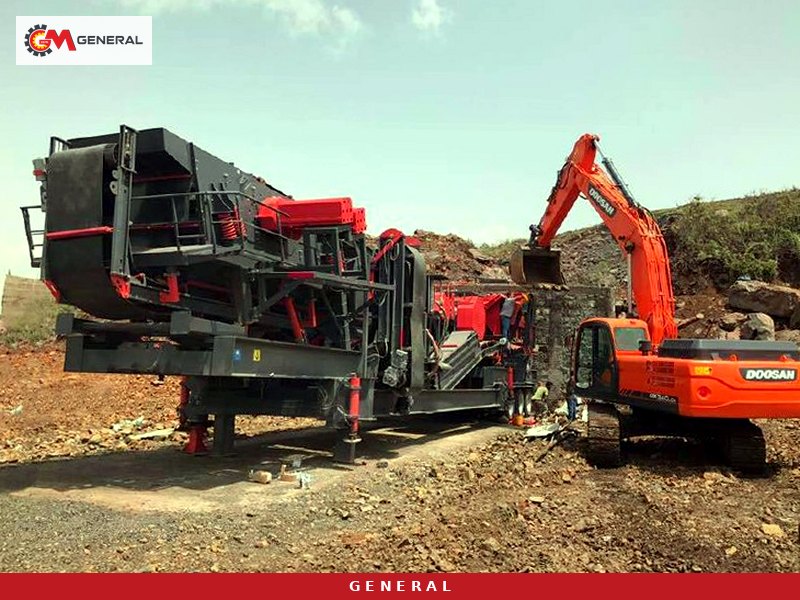
Summers in Tunisia are hot and dry, and dusty winds become more frequent inland and further south. Under these conditions, engine and generator cooling capacity, air filter change intervals and screen mesh inspections sit at the centre of the maintenance plan. For a municipal plant working close to town, dust and noise are also a matter of neighbourliness. Measures that can be selected per project include water-spray dust suppression at conveyor discharge points, conveyor covers, positioning stockpiles with respect to the prevailing wind, and aligning working hours with local rules. Discuss which of these you need before ordering; do not confuse them with the standard package.
On wear, a moderate rating brings an advantage: the 640 is designed to work without straining its jaw and rotor parts. Even so, go to site with enough spare jaw plates, blow bars and screen meshes. Plan manganese and high-chrome castings via the crusher wear and replacement parts page. If a district lies away from the grid, write the optional 300 kVA generator into the scope of the quote.
Checklist for the tender and purchasing file
In municipal purchasing, a clearly written technical specification prevents later disputes. Prepare these points before requesting a quote:
- Rock type of the quarry or quarries to be used, with laboratory results (hardness, abrasiveness, clay content).
- Annual and monthly tonnage target, the split by layer and the required grading curves.
- Maximum block size; if feed will exceed 500 mm, a pre-breaking or blasting arrangement at the quarry.
- Power source: grid connection or generator?
- Port, road route and urban access restrictions.
- The authority's expectations for dust suppression, covered conveyors and noise.
- A list of spare wear parts for the first year and operator training.
- Certificates and warranty: the plant carries ISO 9001 and CE; the warranty is 1 year, with wear parts excluded.
If you also plan to turn crushed aggregate into stabilised base material, pugmill plants for road base can be added behind the crusher as a separate investment item.
Frequently asked questions
Can the General 640 produce both sub-base and surfacing chippings?
Yes. The standard screen arrangement yields 0-5, 5-12 and 12-19 mm fractions; since the output setting is 0-100 mm, a coarser sub-base product can be planned by changing the screen meshes. Confirm the required curve in the specification.
640 or 800 for Tunisian limestone?
Clean, low-abrasive limestone and a target above 100 tonnes per hour point to the 800. If the rock is hard, siliceous or mixed and the target is 60-100 TPH, the 640 with its jaw up front is the better fit. Let the test result from a quarry sample make the decision.
Does the plant work on a site without mains power?
It does. A 300 kVA generator is offered as an option for the General 640; on sites with a grid connection the generator can be left out.
How are price and delivery time determined?
Price depends on the generator choice, screen mesh arrangement, add-ons such as dust suppression, the spare parts package and the shipping method. Delivery time varies with the scope of the order and is confirmed in writing at the quotation stage.
Short assessment
For a contractor supplying aggregate to scattered municipal road jobs in Tunisia, the 60-100 TPH band is a realistic scale for running a machine all year without idle time. With its jaw and impact stages, grizzly by-pass hopper and single-vehicle body, the General 640 answers that need directly; for clean limestone and higher tonnage, the General 800 remains the alternative. Share your quarry sample, tonnage target and site conditions and we will settle the configuration together: request a quote through our contact page.
Definitions of technical terms: Glossary