EN — English
 TR — Türkçe
 DE — Deutsch
 RU — Русский
 FR — Français
 ES — Español
 AR — العربية
 SR — Српски
Primary, Secondary and Tertiary Crushing Stages
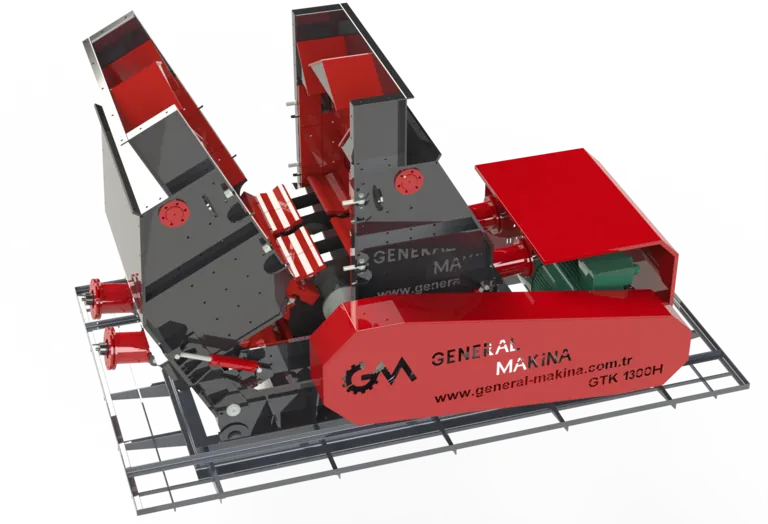
A crushing and screening plant is not a single machine. Material passes through several stages from the size it leaves the quarry until it reaches saleable aggregate size. In this article we explain what the primary, secondary and tertiary stages do and which machine works in which stage, using General Makina's actual technical figures.
Why isn't one machine enough?
Every crusher has a maximum feed size it can accept, and the reduction ratio it can deliver in a single pass is limited. A 900 mm block coming from the quarry does not turn into 0-5 mm sand in one step. The stages close this gap step by step.
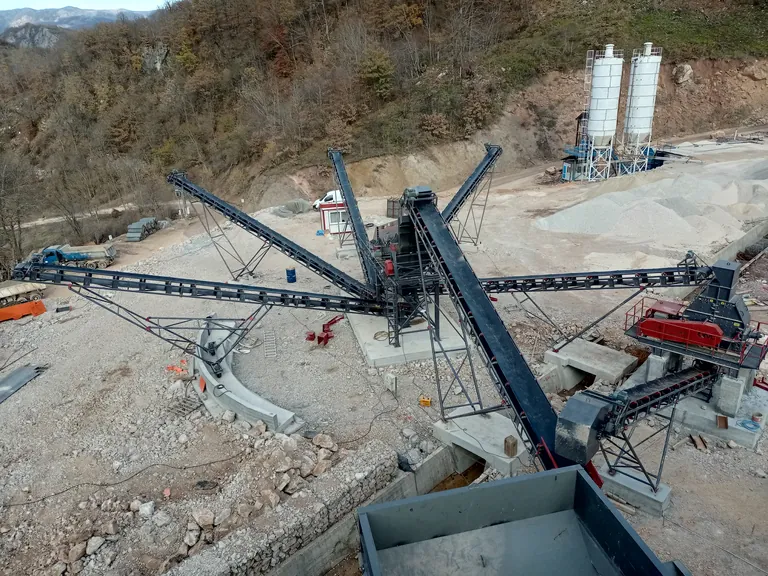
The table below places the actual feed values of our product family side by side in stage order — the logic of the chain becomes visible here:
| Stage | Machine | Largest piece accepted | Capacity (t/h) |
|---|---|---|---|
| Primary | Jaw GNRK 90 | 900 x 650 mm opening | 60-225 |
| Primary | Impact GNR PDK03 | 1300 mm | 500~900 |
| Secondary | Impact GNR DMK01-05 | 800 mm | 120-500 |
| Tertiary | Tertiary GNR 65-150 | 150 mm | 70-300 |
| Tertiary | Cubitizer GNR K50-K110 | 120-210 mm | 45-250 |
| Tertiary/sand | VSI GNR 700-900 | 25-55 mm | 45-210 |
The figure to watch is the third column: 1300 mm → 800 mm → 150 mm → 25-55 mm. Each stage reduces the material to a size the next one can accept. The VSI's 25-55 mm feed limit makes at least two stages ahead of it mandatory — feeding a VSI directly with quarry material is not possible.
Primary stage: the first reduction
This is the stage that first receives the raw material from the quarry. There are two options:
- Jaw crusher — crushes by compression, preferred for abrasive and hard material (basalt, granite). GNRK 90: opening 900 x 650 mm, output 70-180 mm, 75/90 kW.
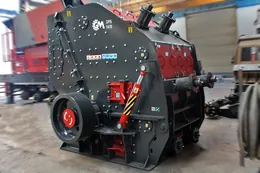
- Primary impact crusher (PDK) — crushes by impact, delivers higher output and cubical grain in medium-hard material such as limestone/dolomite. PDK03: feed 1300 mm, 500~900 t/h, 500 kW.
The primary output is still coarse (in the 70-180 mm band) and is not directly saleable for most applications.
Secondary stage: halving the size
The secondary impact (DMK) series takes the primary output. The most striking feature of the series is this: in all four models the largest piece accepted is fixed at 800 mm — from DMK01 to DMK05 the capacity rises from 120 to 500 t/h while the feed limit stays the same.
| Model | Rotor (mm) | Feed (mm) | Capacity (t/h) | Motor |
|---|---|---|---|---|
| GNR DMK01 | 1100 x 1000 | 800 | 120-180 | 160 kW |
| GNR DMK03 | 1100 x 1500 | 800 | 250-300 | 250 kW |
| GNR DMK05 | 1400 x 2000 | 800 | 250-500 | 500 kW |
That is why the question in secondary selection is not "which piece size does it accept" but "how many tons per hour will I put through".
Tertiary stage: shape and fineness
In the third stage two different purposes separate:
Tertiary crusher (GNR 65-150) — fine product
| Model | Rotor (mm) | Feed (mm) | Capacity (t/h) | Motor (kW) |
|---|---|---|---|---|
| GNR 65 | 1200 x 650 | 150 | 70~130 | 132 |
| GNR 100 | 1200 x 1000 | 150 | 90~160 | 160 |
| GNR 130 | 1200 x 1300 | 150 | 130~200 | 200 |
| GNR 150 | 1200 x 1500 | 150 | 200~300 | 250 |
The pattern is the same here: the feed stays fixed at 150 mm, and as the rotor width grows from 650 to 1500 mm the capacity rises from 70 to 300 t/h. The rotor height (1200 mm) does not change in any of the four models — it is the width that determines capacity.
Cubitizer (GNR K) — cubical shaping
| Model | Rotor (mm) | Feed (mm) | Capacity (t/h) | Motor (kW) |
|---|---|---|---|---|
| GNR K50 | 1000 x 750 | 120 | 45~80 | 45 |
| GNR K100 | 1550 x 1200 | 180 | 90~130 | 90 |
| GNR K110 | 1550 x 1800 | 210 | 160~250 | 160 |
In the cubitizer the feed limit varies by model (120 → 210 mm) and the motor power increases in proportion to capacity (45 → 160 kW). The aim is to bring flat/elongated grains close to a cubical shape; concrete and asphalt specifications require this.
Sand production: VSI
The vertical shaft impactor (VSI) sits at the end of the chain and has the narrowest feed range:
| Model | Rotor (mm) | Feed (mm) | Capacity (t/h) | Motor (kW) |
|---|---|---|---|---|
| GNR 700 | 700 | 25-35 | 45~135 | 90-132 |
| GNR 800 | 800 | 40-50 | 55~160 | 132-160 |
| GNR 900 | 900 | 50-55 | 80~210 | 2 x 200 |
Note that the GNR 900 has twin motors of 2 x 200 kW — while the single-motor 800 model draws 132-160 kW, the next size up moves to two motors. Sand production is the most energy-intensive step of the chain.
A typical chain example
- Primary: GNRK 90 jaw — a 900 mm block goes in, 70-180 mm comes out
- Secondary: GNR DMK03 impact — accepts up to 800 mm, capacity 250-300 t/h
- Tertiary: GNR 130 — 150 mm feed, 130-200 t/h
- Sand: GNR 800 VSI — 40-50 mm feed, 55-160 t/h
Note how capacity drops at each step. In plant design the bottleneck is the stage with the lowest capacity; screening and stockpile conveyors are sized accordingly.
Related pages
Definitions of technical terms: Glossary