EN — English
 TR — Türkçe
 DE — Deutsch
 RU — Русский
 FR — Français
 ES — Español
 AR — العربية
 SR — Српски
Plant Selection for Basalt Crushing and Screening
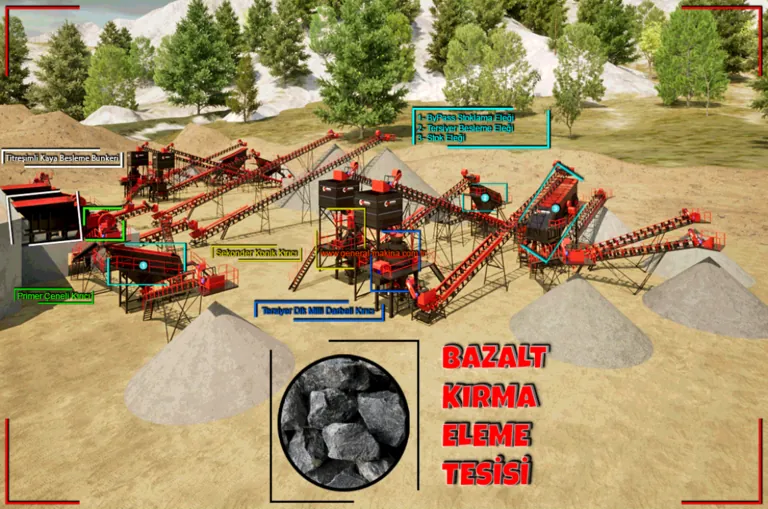
When choosing a crushing and screening plant, the selection must be made according to the type of stone to be crushed. Because, although crushing and screening plants are basically similar in working principle, the equipment used varies depending on the type of stone crushed. As the name suggests, a basalt crushing and screening plant crushes basalt.
Basalt is a very hard, abrasive volcanic rock, and this characteristic is generally seen in the different basalt types extracted from basalt deposits in many parts of the world. This means that the crushing and screening equipment we choose must be resistant to hard and abrasive basalt.
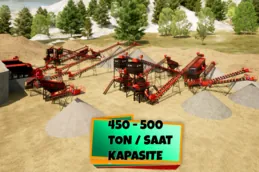
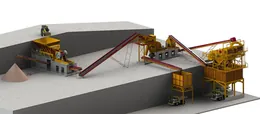
First, let us list the main machines that should be present in order in a standard plant. These are: the vibrating feeder, the stone crusher at the primary stage, the vibrating screen and adaptable equipment; secondary crushers, screens, tertiary crushers and stockpile bunkers. In addition, adaptable conveyor belt systems and the control system, that is, the control panel, are selected.
In this article, we will select the main equipment for basalt crushing and screening and explain why we chose this equipment.
The vibrating feeder is used as standard in all crushing and screening plants. Because it is designed to receive the run-of-mine (raw) material to be crushed in the plant by truck, excavator or loader. Although there are models with different extra features, the general working principle is as follows: the run-of-mine material fed by work machines moves, thanks to the slope of the armored side walls, to the feeding table in the middle, and from there, with the vibrations produced by the vibro motors attached beneath this table, it feeds the primary stone crusher.
Since we will be feeding this plant with basalt, the vibrating feeder to be selected must be able to convey large basalt rocks to the crusher without wearing out its body, and at the same time must have a bypass unit that separates the coarse soil stuck to the basalt.
A vibrating rock feeding bunker will be the suitable choice for these tasks.
Our next selection is the primary stone crusher; on this subject, the first of the crusher options accepted by all crushing and screening authorities is the jaw crusher, and the second is the cone crusher.
Jaw crushers are the most widely used stone crushing machines, consisting of two armored plates, one fixed and the other movable, crushing by squeezing and pressing the fed material between them through the eccentric movements the movable plate makes.
The main reasons why jaw crushers, also known as concasseurs, are used so much are: they are suitable for use with all stone types, their capacities are high, their operating and maintenance costs are low, and they are suitable for use at the secondary stage.
Cone crushers are high-level stone crushing machines made up of many parts. With their unique crushing ability, the movable conical head called the mantle performs an eccentric opening and closing movement against the fixed head called the concave from all four sides, squeezing and crushing minerals and mineral ores against the concave, while the material flow is carried out vertically by natural gravity during these operations. Cone crushers are machines that can be used for all hard and abrasive minerals and mineral ores with a high silica content, generally serving at the secondary stage and sometimes usable at the tertiary stage, with a high initial investment cost but a low operating cost, crushing and grinding hard rocks such as basalt.
As you can see, both crushers are necessary for crushing basalt.
The key point here is this: depending on the size of the basalt to be fed as run-of-mine, it will be wise to choose a jaw crusher at the primary stage and a cone crusher at the secondary stage, because the jaw, that is the mouth opening, of jaw crushers can be adjusted quite easily to an opening wide enough to accept quite large rock pieces, whereas in cone crushers the jaw, that is the mantle mouth setting, cannot be opened as wide as in a jaw crusher; therefore choosing a jaw concasseur for the primary stage will be correct.
Now that we have determined the stone crushing machines, which are the heart of the plant in all crushing and screening plants, for the basalt crushing and screening plant, let us continue with our next machine.
Although vibrating screens have different drive zones and deck numbers depending on the screen model, their basic function is this: with the horizontal vibrations produced by the vibro motors mounted on the body, the stones discharged onto the main body working on helical springs move towards the inclination direction of the screen and are screened between the screen wires of different sizes, that is the decks, with each deck connected to an outlet chute, transferring the material, as preferred, to the stockpile area, the secondary crusher, the tertiary crusher or the truck feeding bunker.
Since we will be screening basalt, the screen wires we choose and the discharge chutes on the screens must be of a wear-resistant structure and armored with wear-resistant plates.
In addition, depending on the desired capacity, the deck numbers and type of the screen to be selected, as well as the total number of vibrating screens in the plant, may vary.
We mentioned above that we would prefer a cone crusher at the secondary stage; so now, finally, let us give information about the selection and function of the crusher that will crush basalt at the tertiary stage.
When the tertiary stage is mentioned, the first thing that comes to mind is tertiary impact crushers, which take their name from the stage. However, tertiary crushers are not preferred for basalt due to excessive wear and spare part costs.
Vertical shaft impact crushers are ideal stone crushing machines for crushing basalt at the secondary or tertiary stage and for obtaining the fine material referred to as sand.
As the name suggests, it throws the stones poured onto the stator on a vertical rotor at high speed into the armored pockets in the body; here a natural stone armor forms over the pockets and it completes the crushing process by striking stone against stone.
We have come to the end of our blog post in which we provided general information about a standard basalt crushing, screening and stockpiling plant.
It should not be forgotten that the information we gave above consists of introductory explanations about a hypothetical basalt crushing and screening plant.
In reality, in addition to the process above, the necessary data are collected at stages such as research - analysis - contract - plan - project, and afterwards the manufacturing - assembly stages are carried out, and with our professional team we build, today as we did yesterday, the crushing and screening plant most suitable for you to crush basalt or other minerals and mineral ores.
Definitions of technical terms: Glossary