EN — English
 TR — Türkçe
 DE — Deutsch
 RU — Русский
 FR — Français
 ES — Español
 AR — العربية
 SR — Српски

Mobile Plant Transport and Permit Planning
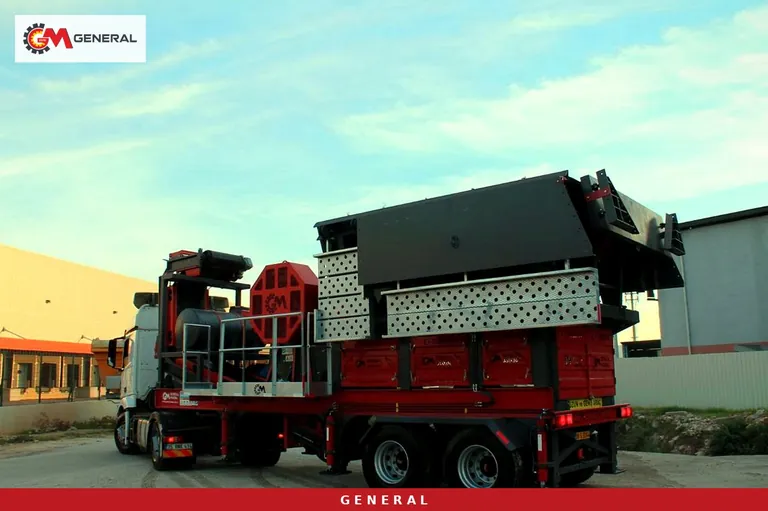
Why mobile plant transport and permit planning start with plant selection
Getting a crushing and screening plant onto a jobsite is a continuation of machine selection, not a separate task. Mobile plant transport and permit planning begin with a single question: how many frames is the plant split into? Frame count drives vehicle count, and vehicle count drives the size of the permit file. Of two solutions with the same capacity, the one built on fewer frames means fewer trips and shorter erection, while the one split into many units travels more easily but takes longer to commission. The decision is taken together with the dimensions the route actually allows.
Legal dimension limits and the abnormal load threshold
A vehicle combination that moves freely on public roads works inside defined limits of size and weight. The framework applied to international transport in the European Union is built on 2.55 metres of width, 4.00 metres of height, 16.50 metres of length for an articulated combination and 40 tonnes of gross weight for a five or six axle combination, with a higher ceiling available for combined transport under defined conditions. Member states may allow different and often more generous limits for domestic traffic, so every country on a cross-border move is checked separately. The moment any one of those four values is exceeded, the load is no longer a normal load: it travels under permit, on a defined route, at defined hours and with escort where required.
| Dimension | Free movement framework (EU international) | What happens when exceeded | Point to check in planning |
|---|---|---|---|
| Width | 2.55 m | Permit, escort may be required | Do side overhangs, handrails and platforms fold in |
| Height | 4.00 m | Route survey becomes mandatory | Can hopper, screen and conveyors be lowered |
| Length (articulated) | 16.50 m | Turning radius becomes the constraint | Is the tail conveyor removable |
| Gross weight | 40 t (5-6 axles) | Axle distribution and bridge limits govern | Will the crusher body travel separately |
| Axle load | Per national regulation | Heavy load permit and bridge assessment | Does the lowbed have enough axles |
From frame count to truck count
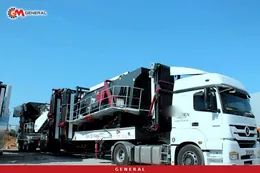
The planning table has three columns: unit, transport dimension, vehicle type. The truck carrying the primary unit is usually the heaviest; where feeder and scalping screen sit on the same frame, weight concentrates on one vehicle. Secondary unit, screen unit, conveyor group and the electrical and automation container are separate line items. Conveyors ride on their own vehicle because of length rather than mass; here the deciding factors are length and deck area, not tare. And unless one vehicle is reserved for spares, a liner set and erection equipment, commissioning waits on site for parts that were never loaded.
How product selection reaches the shipment
As capacity rises, unit dimensions and feed opening grow, and both land directly on transport height and weight. The figures below are specification data from different capacities in the same product family, and they show why selection and shipping plan are read side by side.
| Model | Maximum feed size | Capacity | Optional generator |
|---|---|---|---|
| General 640 | 500 mm | 60-100 t/h | 300 kVA |
| General 950 | 800 mm | 120-180 t/h | 600 kVA |
| General 01 | 700 mm | 120-180 t/h | 550 kVA |
| General 02 | 1000 mm | 250-300 t/h | 660 kVA |
The route survey belongs before loading
A route survey is not a line drawn on a map; it is a checklist walked physically before a vehicle is loaded. The headings are fixed. Carrying capacity of bridges and culverts, clear height of underpasses and overpasses, height of power and telecom lines crossing the road, turning radius at roundabouts and tight bends, gradient of the site access road and the bearing capacity of its surface. That last item is the one most often skipped: an access road softened by rain can strand a perfectly legal vehicle two hundred metres short of the pad. During the survey an alternative is noted against every constraint, so that nothing is left to be argued about on delivery day.
The permit file and its timing
Permit application content varies by country, yet the requested information is similar: vehicle and trailer registration data, axle count and axle load distribution, loaded overall dimensions, mass and centre of gravity of the load, route definition and requested travel dates. Some of that cannot be stated before the loading plan exists, which is why permit and loading plan run in parallel. Because duration depends on season and on how many authorities sit along the route, no fixed number of days is assumed; when a delivery date goes into a contract, permit time is named as a separate item.
Loading, lashing and unloading order
Loading order is the reverse of erection order: the unit erected first must arrive on the first vehicle, not the last. Lashing is about securing the load against sliding and tipping under braking and cornering forces; in Europe the calculation of securing forces is defined within EN 12195-1, and it works from the mass of the load, the friction coefficient, the rated capacity of the lashing device and the lashing angle together. Three practical rules earn their keep on site. Keep the centre of gravity low and on the trailer axis. Never stack two units on one vehicle to save a trip. Mark the unloading point, the crane position and the erection area before the shipment leaves, because otherwise the vehicle waits, and waiting becomes the most expensive line in the freight account.
Three mistakes that keep repeating
The first is confusing transport dimensions with working dimensions; folding platforms and lowerable conveyors are exactly what creates the difference between the two. The second is reading total weight and skipping axle distribution: gross weight can sit inside the limit while a single axle sits above it. The third is straying off the permitted route, where a small detour voids the permit and stops the shipment at the roadside.
Definitions of technical terms: Glossary