EN — English
 TR — Türkçe
 DE — Deutsch
 RU — Русский
 FR — Français
 ES — Español
 AR — العربية
 SR — Српски

Mobile Crushing Plant Hourly Fuel Consumption and Operating Cost Calculation
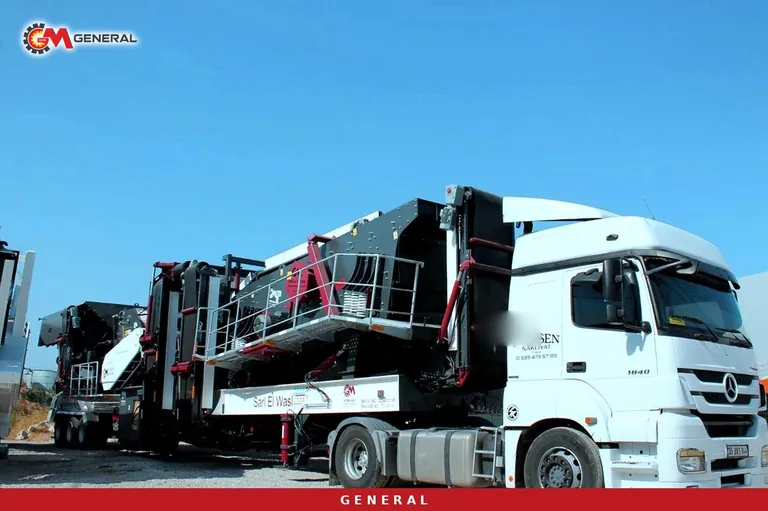
You pay for a mobile crushing and screening plant once; fuel, wear parts, oil and labour come back every hour it runs. That is why the number worth comparing in an investment decision is the cost per tonne the plant actually delivers. This article shows, step by step, how to measure hourly fuel consumption on a generator-powered mobile plant, how to build the operating cost from its individual items, and how to turn the result into cost per tonne. If you are planning to run this calculation on a used machine, note one thing up front: with a generator of unknown history and a worn crusher, none of the variables in these formulas can be trusted. Buying a new machine is always the most sensible and correct choice, both for cost forecasting and for day-to-day operation.
Fuel follows the load the generator carries, not its nameplate
Quotations list the power unit in kVA: 450 kVA for the General 800, 550 kVA for the General 01, and so on. That figure is the maximum apparent power the generator can supply; it says nothing about the power the plant actually draws hour by hour. A diesel engine burns fuel in proportion to the active power (kW) taken from the alternator, and active power equals installed kVA times the power factor (cos φ) times the load ratio at that moment.
So hourly fuel consumption is best understood through this relationship:
Fuel (l/h) = Average active load (kW) × Specific fuel consumption (l/kWh)
The engine manufacturer's data sheet gives specific fuel consumption at different load steps, and at low load every kWh costs more fuel. The practical consequence: an oversized generator idling far below its rating produces fewer tonnes and also makes each kWh more expensive. Sizing the generator against the combined installed power of the crusher, screen, feeder and conveyor motors is the first step of any fuel calculation.
Four steps to measure litres per hour on site
A fuel figure taken from a brochure or from someone else's quarry does not apply to your material, your feed arrangement or your operator. A reliable value can only be measured on your own site against your own output. The method below gives results accurate enough for a decision after one normal week of work:
- Top-up difference: Fill the tank to a marked level at the start of the shift and top it up to the same level at the end. The litres added are the real consumption for that shift.
- Running hours: Record the generator hour meter at the start and end of the shift. Divide consumption by the hours the engine actually ran, not by clock hours.
- Tonnes produced: Add up the tonnes dispatched or sent to stockpile during the shift from weighbridge tickets or belt-scale readings.
- Idle log: Note separately the time when no material reaches the crusher (waiting for the excavator, truck queues, blockages). This time burns fuel but produces no tonnes.
These four records give you two indicators: litres per hour and litres per tonne. The second matters more for an investment decision, because the same litres-per-hour value means less fuel per tonne as hourly output rises.
Power unit and capacity by model
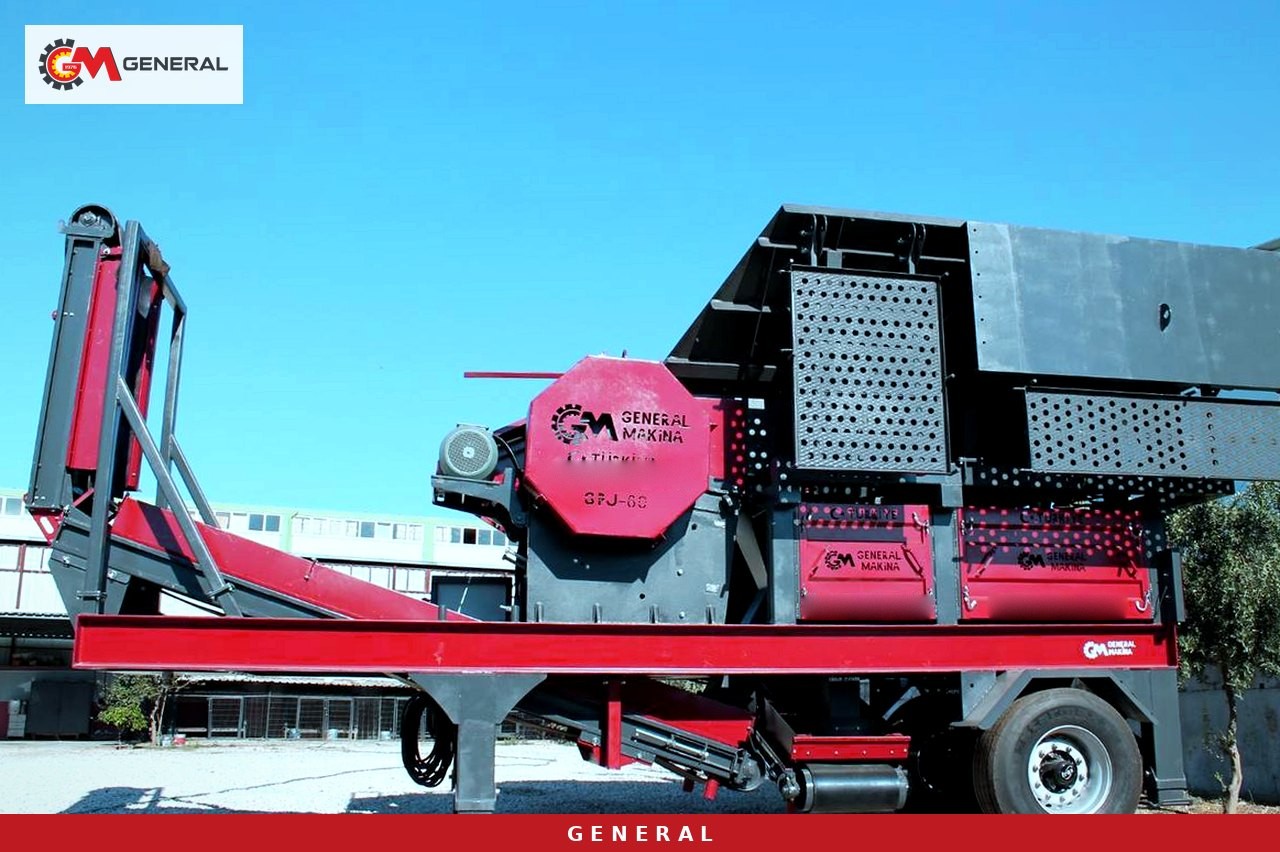
The table below brings together the generator rating and capacity range published on the product pages of the General mobile plant family. There is deliberately no litres-per-hour column: that value depends on the generator make, load ratio and material, and must be measured on site with the method above.
| Model | Crusher layout | Capacity | Generator | Cost calculation note |
|---|---|---|---|---|
| General 640 | GPJ 60 jaw + GNR 50 impact | 60-100 t/h | 300 kVA (optional) | Generator is optional; on grid power, energy is costed in kWh |
| General 800 | PDK 1280 primary impact | 80-150 t/h | 450 kVA | Cubical product from a single crusher in limestone and low-abrasive stone |
| General 01 | GPS 1210 impact (primary + secondary) | 120-180 t/h | 550 kVA | Two crushing stages in one body |
| General 944 | GPJ 90 jaw + GM430 cone | 120-180 t/h | 550 kVA | Long metal life in abrasive stone; lowers the wear share |
| General 950 | GPJ 90 jaw + DMK01 impact | 120-180 t/h | 600 kVA | Larger power unit in the same capacity band |
| General 02 | GPS 1413 impact | 250-300 t/h | 660 kVA | At high tonnage, fixed items are spread over more tonnes |
| General 03 | GPS 1415 impact | 250-375 t/h | 750 kVA | 4-axle chassis; cost transport as a separate item |
The practical lesson: the 944 and 950 sit in the same 120-180 t/h band, yet their power units differ (550 kVA and 600 kVA). Installed power alone does not set fuel use, but it does affect generator selection and the initial investment. When comparing models, judge fuel per tonne and wear against your own material. The whole family is on the mobile crushing plants page.
The items that make up hourly operating cost
Reducing hourly cost to a single fuel figure is a common mistake. Split the items into those that arise while the plant runs and those spread over its hours.
Variable items
- Fuel: measured litres per hour × fuel unit price
- Wear parts: blow bars, jaw plates, cone mantle and concave, screen mesh; part cost ÷ tonnes produced over the part's life
- Engine oil, filters, grease and hydraulic oil: amount divided over the service interval
- Conveyor belt and idler replacement
Items spread over operating hours
- Operator and helpers
- Planned maintenance reserve (including generator overhaul)
- Depreciation: machine cost ÷ planned total operating hours
- Transport and set-up: cost of moving to site ÷ total operating hours on that site
- Insurance and financing
As a formula:
Hourly cost = (F × Pf) + W + L + S + R + (M ÷ H) + (T ÷ Hs)
Here F is the measured fuel consumption (l/h), Pf the fuel unit price, W the hourly wear-part share, L the oil and consumables share, S staff cost, R the maintenance reserve, M the machine cost, H the planned total operating hours, T transport and set-up cost, and Hs the operating hours on that site. Cost per tonne is then:
Cost per tonne = Hourly cost ÷ Actual hourly output (tonnes)
To estimate energy and wear by material quickly, use the site's per-tonne energy and wear cost calculator, then confirm the result with the field measurement described here.
Hypothetical example: how cost per tonne shifts when output drops
The figures below are a hypothetical example chosen only to show the logic of the calculation. They are not real values and are not measurements from any model. Amounts are given in "units" rather than a currency.
Assume a shift where the hourly items come out as follows: fuel 40 units, wear parts 15 units, oil and consumables 5 units, staff 20 units, maintenance reserve 10 units, depreciation plus transport share 30 units. Total hourly cost is 120 units.
- If the plant averages 100 tonnes per hour, cost per tonne is 120 ÷ 100 = 1.2 units.
- If irregular feeding and waiting pull the average down to 80 tonnes per hour, hourly cost stays almost the same while cost per tonne rises to 120 ÷ 80 = 1.5 units.
The real lesson of the example: a small improvement in fuel is overshadowed by the effect of holding tonnage. When output falls, staff, depreciation and transport are divided over fewer tonnes. Nothing damages cost per tonne more than a machine running at low utilisation.
Site decisions that cut fuel and cost per tonne
Once you have measured, start improving where the biggest loss is. These are the areas with a directly visible effect on site:
Take unnecessary load off the crusher
A feed arrangement with pre-screening, such as the vibrating feeder with by-pass grizzly on the General 01, separates material that is already in product size before it enters the crusher. Every tonne that bypasses the crusher is energy the rotor and motor do not spend. Feeder types are covered in the vibrating feeders category.
Match the crusher type to the material
The PDK 1280 primary impact crusher on the General 800 gives a high reduction ratio and cubical product in limestone and low-abrasive stone. In hard, abrasive rock such as basalt or granite, a jaw-and-cone layout (General 944) extends wear-part life. The wrong crusher type inflates the wear item more than the fuel item and damages cost per tonne from there. The General 800 product page explains this distinction at model level.
Cut idle running and hard starts
When the crusher and conveyors keep turning while waiting for the excavator, the generator runs at low load and produces expensive kWh. Planning loading equipment to match plant capacity directly shortens waiting time. Sequential start-up and a soft-starter limit the current surge at start; on the General 01 a touchscreen control panel, soft-starter and internet-based remote monitoring can be added as options. We cover other energy options in our article on energy-saving technologies.
Consider grid power
If the site has a grid connection of adequate capacity, energy is costed in kWh instead of litres: Energy cost = Average active load (kW) × operating hours × kWh unit price. The optional generator on the General 640 brings this option into play; confirm feasibility at the quotation stage. Which energy source is cheaper depends on local electricity and fuel prices and on how long you will stay on site.
Account for relocation
The advantage of a mobile plant is moving from site to site, but every move brings tractor, permit and set-up costs. The General 800's 35,000 kg weight and 3600×15500×4500 mm transport dimensions are the data for transport planning. On short jobs, the transport share can be a significant part of hourly cost, so calculate T ÷ Hs separately for each site.
Hourly cost on a new versus a used machine
The purchase price of a used mobile plant can look attractive, but the picture changes once you work through the hourly cost formula. Compare the variables one by one:
- Generator (F): On a new machine engine hours start at zero and consumption can be checked against the engine data sheet. On a used engine, hours and overhaul history are often undocumented; F becomes a guess.
- Crusher and wear (W): Fatigued bearings, a worn rotor and housing draw more power for the same tonnage; both F and W grow.
- Maintenance (R): On a machine with unknown history the reserve cannot be forecast; nobody can say when the major overhaul is due.
- Downtime: Unplanned breakdowns divide the hour-based items over fewer tonnes; the shift from 1.2 to 1.5 units in the hypothetical example shows this.
- Assurance: General Makina's new plants carry CE and ISO 9001 certification and a 1-year warranty excluding wear parts; a used purchase has no such assurance.
General Makina does not sell used machines and does not offer rental. For an operation producing continuously the advice is clear: the way to make cost per tonne predictable is a new machine. Buying a new machine is always the most sensible and correct choice.
Frequently asked questions
How many litres of fuel does a mobile crusher use per hour?
There is no single figure valid for every site. Consumption depends on the generator's average load, the engine's specific fuel consumption, the hardness of the material and idle time. Measure for a week on your own site with the top-up method and evaluate the result in litres per tonne.
Does a bigger generator burn more fuel?
An engine burns fuel according to the load drawn, not its rated power. But an oversized generator runs continuously at low load and uses more fuel per kWh. Correct sizing is based on the plant's total installed power.
Does a used plant lower operating cost?
Even with a lower purchase price, the fuel, wear and downtime items become uncertain, and that uncertainty feeds straight into cost per tonne. Warranty and certification assurance come with a new machine. That is why a new machine is always the right choice.
What information should I give when requesting a quote?
Material type and hardness, maximum feed size, required fractions, target hourly tonnage, daily operating time, whether grid power is available on site, and how often you move between sites. With this information the power unit and crusher layout are configured correctly; the price is then set in a quotation built on that scope.
Conclusion
Hourly fuel consumption is only one item of operating cost; the deciding figure is cost per tonne. Measure fuel on your own site, place the items into the formula and make holding tonnage the priority. For the calculation to be reliable, the variables must be known, and that is possible with a new machine; a used plant adds uncertainty to every line. For a mobile plant configuration that fits your material and tonnage target, get in touch with us and we will prepare your quotation from your site data.
Definitions of technical terms: Glossary