EN — English
 TR — Türkçe
 DE — Deutsch
 RU — Русский
 FR — Français
 ES — Español
 AR — العربية
 SR — Српски

How to Calculate Mobile Crushing & Screening Plant Capacity in Ton Per Hour
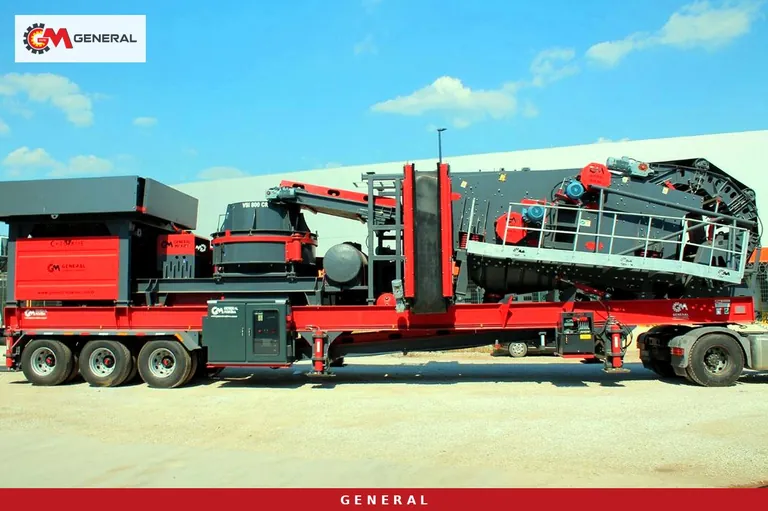
The brochure for a mobile crusher says "120-180 t/h". On site, the same machine makes 170 tonnes an hour in one quarry and 110 tonnes in another. The gap is not a defect in the machine. Capacity is less a fixed number stamped on the crusher body and more a result: it depends on the rock type, the feed size, the product size you want and the number of hours the plant actually runs each day. This article walks through the ton-per-hour calculation step by step, the site factors that throw the numbers off, and three hypothetical site examples that show how to arrive at the right model. Unless stated otherwise, the figures in the examples are assumptions chosen to demonstrate the method; the model data comes from our product pages.
What the two ends of a catalogue range tell you
Manufacturers quote capacity as a range because the same crusher reaches different tonnages in different materials. The lower end usually corresponds to hard, abrasive rock with a fine product; the upper end to soft, dry rock with a coarser product. Take the 120-180 t/h band given for the General 01: an operation crushing limestone into 19-40 mm road base will run near the top, while the same machine asked to make mostly 0-5 mm sand will drop toward the bottom.
The first rule is therefore simple: size your requirement to the middle of the range, not the ceiling. If the target tonnage lands on the upper limit of a model, look at the next model up or at a two-unit layout. A plant that lives at its ceiling falls below target every time wear parts are changed and every time the feed comes in wet.
From daily target to hourly tonnage: the calculation chain
The capacity calculation starts with the material you want to sell or use, not with the crusher. Once the daily demand of the job site or the customer is known, the hourly value comes from this formula:
Required capacity (t/h) = Daily target (tonnes) ÷ (Shift hours × Availability factor)
Choosing a realistic availability factor
Availability is the share of the shift during which the plant is actually crushing rock. Start-of-shift warm-up, waiting for trucks, belt adjustment, screen mesh changes, greasing and the lunch break all come off this figure. Planning with a value between 0.75 and 0.85 brings the tonnage on paper close to the tonnage on site. Hypothetical example: a road project that needs 1,600 tonnes a day, working a 10-hour shift at 0.80 availability, needs 1,600 ÷ (10 × 0.80) = 200 t/h of net capacity. Run the same calculation with 0.95 and you get 168 t/h, and the plant would come up short on site every single day.
Saleable tonnes versus crushed tonnes
The daily target in the formula is the product that meets the specification. Part of the crushed material ends up as dust, as an unwanted intermediate fraction or as surplus sitting in a stockpile. If, for example, 5-12 and 12-19 mm go to the batching plant and 0-5 mm sells only in part, the total tonnage the crusher has to process is larger than the saleable tonnage. Take this ratio from a sieve analysis of samples from your own quarry, not from a guess.
Corrections the material adds to the calculation
The same formula points to different machines in two different quarries, because the rock brings its own multipliers. These factors should be pinned down at the quotation stage with samples and simple tests.
Feed size and the fines already in it
A block larger than the feed opening cannot enter the crusher. It has to be broken or sorted out in front of the hopper, and that time comes straight off the tonnage. Maximum feed size is 500 mm on the General 640, 600 mm on the General 800, 700 mm on the General 01, 800 mm on the General 944 and 950, 900 mm on the GNR-MC110 and General 03, and 1000 mm on the General 02. Do not pick a model before you know the size of the largest blocks after blasting. The reverse also holds: if the run-of-quarry feed already contains fines at product size, a grizzly bypass feeder separates them before they reach the crusher. Hypothetically, if one fifth of a 200 t/h feed passes through the grizzly, the crusher sees 160 t/h, and the calculation has to be made for that load.
Hardness, abrasiveness and moisture
Basalt, granite and quartz-bearing rock slow the crusher down and eat through wear parts quickly. The same model runs toward the upper side of its range in limestone and toward the lower side in these rocks. For hard, abrasive stone, a cone secondary (General 944) or an impact secondary (General 950) behind a primary jaw is the usual choice. In limestone and other low-abrasion rock, the primary impact models General 800, 01, 02 and 03 give a higher reduction ratio. Moisture and clay blind the screen openings and cause build-up on the feeder. With clayey river material a dry screening calculation does not hold: either plan for wet screening or keep the capacity figure low.
Circulating load from the screen in closed circuit
In a closed circuit plant, oversize that stays on the screen deck is sent back to the crusher. This material is not new product, yet it loads the crusher and the conveyors a second time. The load the crusher sees is calculated as follows:
Crusher load = Fresh feed × (1 + recirculation ratio)
Hypothetical example: with 150 t/h of fresh feed and 30 percent recirculation, the crusher processes 195 t/h. If that value exceeds the range of the selected model, the hopper overflows on site or the feeder has to be slowed down, and net production falls. Two things push the recirculation ratio up: a small target product and a tight crusher setting (closed side discharge opening).
The screen side deserves the same attention. According to the conventional screen data on our product page, each additional deck cuts capacity by roughly 10 percent, and commercial screening efficiency sits at 90-95 percent. A line that needs four fractions therefore needs more screen area at the same tonnage: the General 01 works with a 1600×5000 mm four-deck screen, the General 02 with 2000×5000 mm, the GNR-MC110 with 2000×6000 mm and the General 03 with 2400×5000 mm.
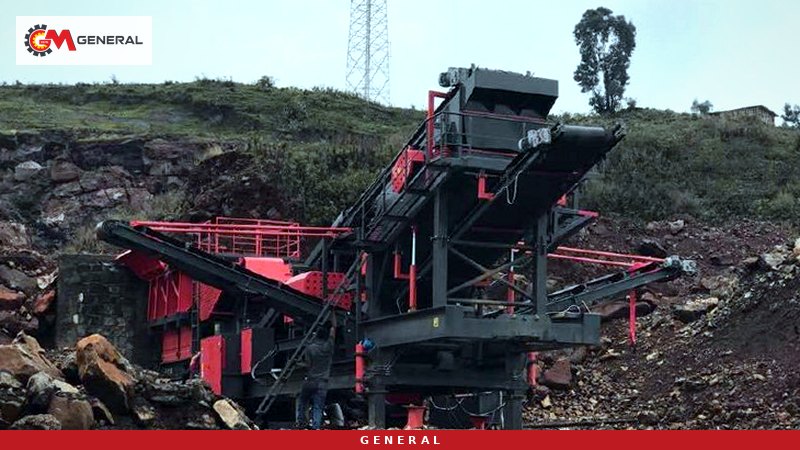
Three hypothetical site examples
The examples below do not belong to a real customer. They were built to solve three situations that come up often in the field, using the same calculation chain.
Example A: road base from a limestone quarry
Daily target 1,200 tonnes, one 10-hour shift, availability 0.80. Required capacity is 1,200 ÷ 8 = 150 t/h. The 80-150 t/h range of the General 800 meets the target only at its ceiling, while the 120-180 t/h band of the General 01 keeps the target near the middle, and its 700 mm feed opening gives some slack with blasted blocks. Because limestone is low in abrasion, the GPS 1210 impact crusher, which does primary and secondary work in a single body, makes sense here. The General 01 project in Algeria on our website is also listed at 150 t/h.
Example B: concrete aggregate from basalt
Daily target 2,000 tonnes, two shifts totalling 16 hours, availability 0.75. Required capacity is 2,000 ÷ 12 = about 167 t/h. The General 944 and 950 cover that value within their 120-180 t/h range, but once you account for running toward the lower end in hard rock and for the circulating load created by 0-5, 5-12 and 12-19 mm products, the margin is very thin. Here the twin-chassis GNR-MC110, with 200-300 t/h primary jaw capacity, is the sounder choice; in the first phase the primary unit can also run on its own.
Example C: clayey river gravel
Daily target 1,500 tonnes, 10 hours, availability 0.75, required capacity 200 t/h. The sample shows a high fines content and some clay. If a feeder with a bypass screen removes the dirty fines ahead of the crusher, the load on the secondary crusher drops; the M-DMK series offers 120-180, 150-250 and 175-300 t/h options for this job. Without wet screening in place of dry screening, the screen openings blind and the calculated 200 t/h never shows up on site.
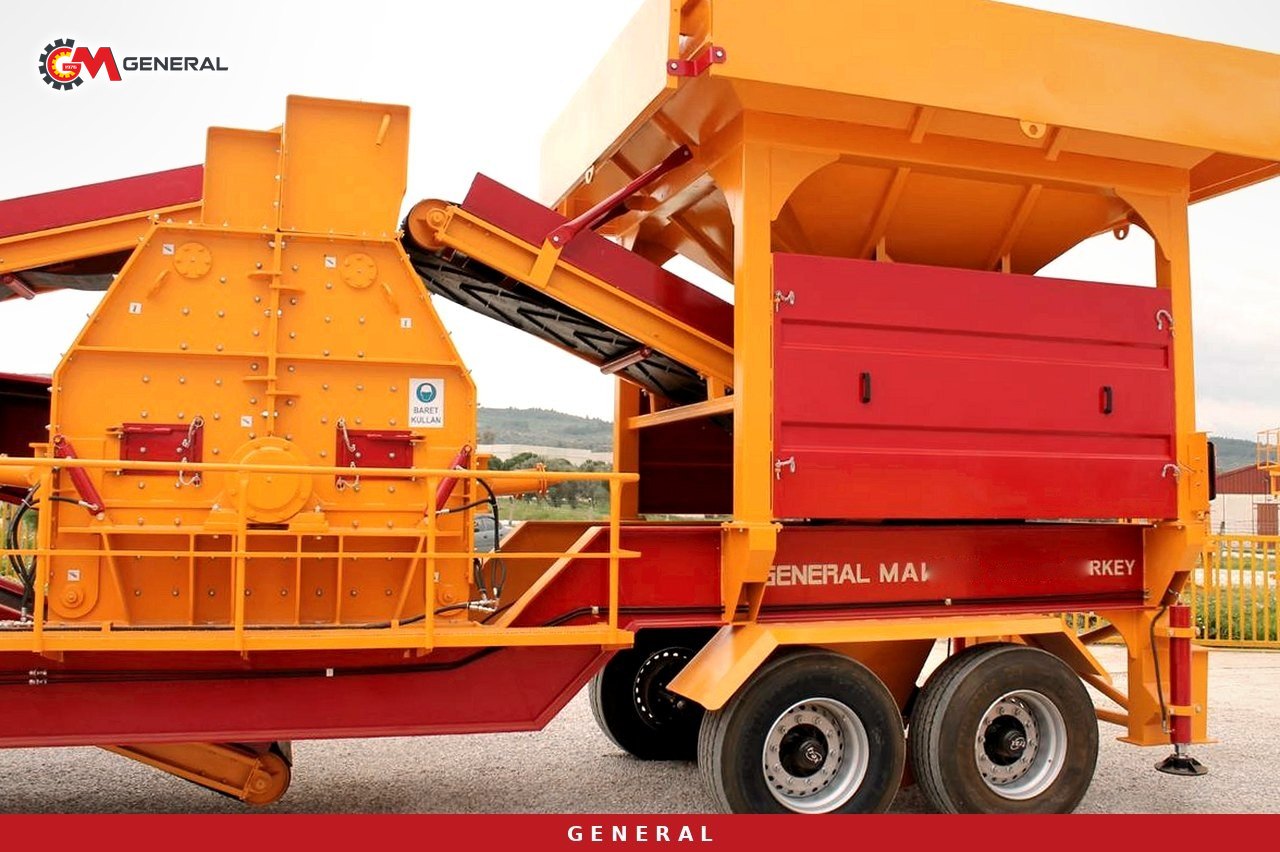
Matching the calculated tonnage to model ranges
At the end of the calculation you have a net hourly figure, the largest block size, the rock type and a list of fractions. The table below was prepared to compare these four inputs with the ranges of our wheeled models. All models and chassis options are on the wheeled mobile crushing and screening plants page; standalone primary or secondary units are on the mobile crushers page.
| Model | Capacity (t/h) | Max. feed size (mm) | Screen | Generator (kVA) | Suitable rock |
|---|---|---|---|---|---|
| General 640 | 60-100 | 500 | 1200×4000 mm, 3 decks | 300 (optional) | Wide range incl. hard and abrasive |
| General 800 | 80-150 | 600 | 1300×4000 mm, 3 decks | 450 | Limestone, low abrasion |
| General 01 | 120-180 | 700 | 1600×5000 mm, 4 decks | 550 | Limestone, mixed feed |
| General 944 | 120-180 | 800 | 1600×5000 mm, 3 decks | 550 | Basalt, granite, quartz |
| General 950 | 120-180 | 800 | 1600×5000 mm, 3 decks | 600 | Basalt, granite, iron ore |
| GNR-MC110 | 200-300 | 900 | 2000×6000 mm, 4 decks | 750 | Hard rock, high tonnage |
| General 02 | 250-300 | 1000 | 2000×5000 mm, 4 decks | 660 | Limestone, low abrasion |
| General 03 | 250-375 | 900 | 2400×5000 mm, 4 decks | 750 | Limestone, low abrasion |
When the target goes above 300 t/h, the discussion turns to a wide-range model such as the General 03 or to two units running in parallel. If the product mix is sand-heavy, a shaping stage such as the GNR-MVSI 900, which takes 50 mm feed and is rated at 90-180 t/h, is added at the end of the line. The General 02 closed circuit installation, recorded on site at 250 t/h, is a concrete reference for where a model rated at 250-300 t/h is held in practice. To see the effect of energy and wear costs per tonne, use the operating cost calculator.
Data to prepare before you request a quote
Getting an accurate capacity statement from a manufacturer starts with giving the manufacturer accurate input. When you fill in and send the list below, the model recommendation rests on data rather than estimates:
- Daily or monthly saleable tonnage target, number of shifts and shift length.
- Rock type and, if possible, lab results: compressive strength, abrasion value, silica content.
- Largest block size after blasting or excavation, and a sieve analysis showing the fines share in the run-of-quarry feed.
- Required fractions (for example 0-5, 5-12, 12-19, 19-40 mm) and the approximate share of each.
- Moisture and clay content of the material, and whether washing is needed.
- Whether grid power is available on site or the plant will run on a generator.
- How often the site changes: how many relocations per year, and any road or bridge restrictions.
With this information, capacity can be written into the contract as a guaranteed value. Every input left vague pushes the manufacturer to declare the safe lower end of the range or to steer you toward a bigger machine than you need.
Frequently asked questions
Is the top catalogue figure the guaranteed capacity?
No. The upper value of the range shows the tonnage reachable with favourable material and a coarse product. The guaranteed capacity is determined separately from your rock, your feed size and your fraction list, and it is stated in the quotation.
What should I do if my data is in cubic metres instead of tonnes per hour?
Convert volume to tonnes by multiplying it by the measured loose bulk density of your sample. Density changes with rock type, grading and moisture, so weighing a sample taken from the quarry is more accurate than using a fixed conversion factor.
Is one large plant better than two smaller ones?
If a single site needs a steady tonnage, one large plant means fewer conveyors, fewer operators and simpler maintenance. If several sites need material at the same time, or you want to split the breakdown risk, two units make sense. The twin-chassis design of the GNR-MC110 sits between these two approaches.
Can I get the price and delivery time together with the capacity calculation?
Yes. Price depends on the model, crusher type, number of screen decks, generator, extra conveyors and freight, so the figure is given in a quotation prepared from the data list above.
From calculation to quotation
The right capacity is a calculation built backwards from the daily saleable tonnage: shift length, availability, fines share, circulating load and rock hardness are added one after another, and the resulting value is placed in the middle of a model range. General Makina has been building crushing and screening plants in Izmir since 1976; our plants carry CE and ISO 9001 certification and come with a 1-year warranty, wear parts excluded. Send your sample information and daily target through our contact page, and we will prepare a model and capacity recommendation calculated for your site together with a quotation.
Definitions of technical terms: Glossary