EN — English
 TR — Türkçe
 DE — Deutsch
 RU — Русский
 FR — Français
 ES — Español
 AR — العربية
 SR — Српски

Wear Part Life and Replacement Intervals in Mobile Crushing Plants
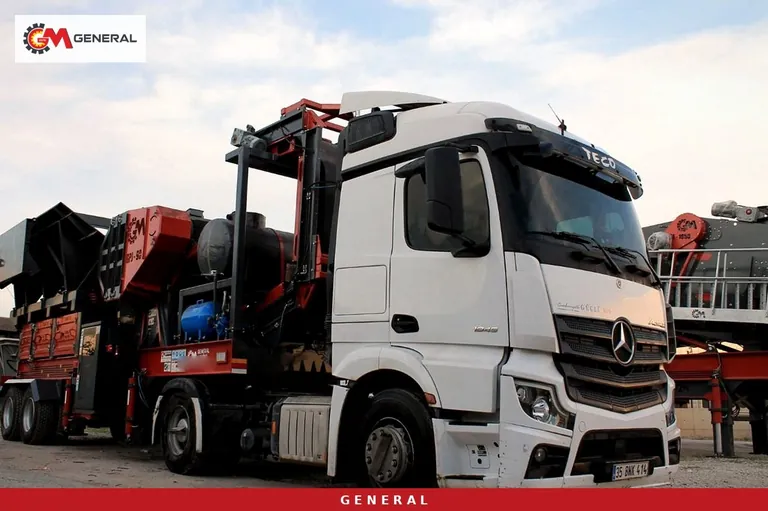
One of the first questions a buyer asks about a mobile crusher is: "How many hours do the jaw plates last, and how often do the blow bars need changing?" The honest answer is that no single figure in hours or tonnes holds independently of the site. The same model gives very different wear lives in limestone and in basalt, with dry or clayey feed, in steady or stop-start operation. This article does not promise numbers. It explains how to measure wear life on your own plant, how to record it, and how to calculate replacement intervals from that record. The focus is on turning part life into figures on a wheeled mobile crushing and screening plant.
Why wear life is tracked by tonnage and thickness, not hours
The hour meter shows how long the machine ran, not how much rock it crushed. A rotor spinning empty or a jaw running half-fed accumulates hours without wearing the parts in proportion to tonnage. The primary unit of wear life is therefore the tonnage passed through the crusher. Hours are kept as a second unit and serve to convert tonnage into a maintenance calendar. Tonnage can come from weighbridge tickets, a belt scale or the quantity of product shipped. Whichever source you choose, use the same one in every replacement period; if the source changes, the wear rates of two periods can no longer be compared.
The third measurement is the part itself: thickness, height or tooth profile. Tonnage answers "how much work was done", thickness answers "how much life is left in the part". Write both in the same table and you get the wear rate per tonne, and the replacement date stops being a guess. Ask the supplier of the part for the minimum thickness in writing, that is, the dimension at which the part must be removed at the latest.
Which parts wear on a mobile plant: a model-by-model map
On wheeled mobile plants, the list of wear parts depends on the crusher combination. A jaw crusher wears its jaw plates and cheek plates, an impact crusher its blow bars and apron liners, a cone crusher its mantle and concave. On every model, add the feeder grizzly bars, the screen mesh or polyurethane deck, and the conveyor idlers, pulleys and belt. The table below uses product page data for selected models from the mobile crushing plant range. The items in the last column follow from each model's crusher layout.
| Model | Crusher layout | Capacity | Max. feed | Screen | Wear items to track |
|---|---|---|---|---|---|
| General 640 | GPJ 60 jaw + GNR 50 impact | 60-100 t/h | 500 mm | 1200×4000 mm, 3 decks | Jaw plates, blow bars, apron liners, screen deck |
| General 800 | PDK 1280 primary impact | 80-150 t/h | 600 mm | 1300×4000 mm, 3 decks | Blow bars, apron liners, screen deck |
| General 01 | GPS 1210 impact (primary + secondary) | 120-180 t/h | 700 mm | 1600×5000 mm, 4 decks | Blow bars, apron liners of both chambers, by-pass grizzly, screen deck |
| General 944 | GPJ 90 jaw + GM430 cone | 120-180 t/h | 800 mm | 1600×5000 mm, 3 decks | Jaw plates, mantle and concave, screen deck |
| General 950 | GPJ 90 jaw + DMK01 impact | 120-180 t/h | 800 mm | 1600×5000 mm, 3 decks | Jaw plates, blow bars, apron liners, screen deck |
| GNR-MC110 | GPJ 110 jaw + GS1215/DMK03 impact | 200-300 t/h | 900 mm | 2000×6000 mm, 4 decks | Jaw plates, blow bars, apron liners, screen deck (on two separate chassis) |
The practical conclusion: two-crusher models (640, 944, 950 and MC110) have two separate replacement calendars, and they do not line up by themselves. Jaw plates and blow bars, or jaw plates and mantle, wear at different rates. Without a record, the plant suffers two unplanned stops a year, one per crusher; with a record, both changes can be grouped into a single shutdown window. On the single-crusher 800 and 01 the calendar is simpler, but checking whether the blow bars wear evenly across the rotor becomes more important.
What to measure, where and when
Measurements are taken with the machine stopped, isolated and locked out, using the access route shown in the manufacturer's maintenance instructions. Any measurement that requires entering the crusher is subject to the site safety procedure; do not shorten this step to save time. The measuring point and the tool for each part must also stay fixed; otherwise the values cannot be compared.
- Jaw plates: Measure tooth height on the moving and fixed jaw in the lower, middle and upper zones. Wear usually concentrates at the bottom; on symmetrical plates this reading decides when to turn them.
- Blow bars: Measure the height of each bar at both ends of the rotor and in the middle. The difference between ends and middle shows whether the feed is spread across the rotor width.
- Apron liners: Record liner thickness and the gap between apron and blow bar. As the gap opens, product size changes and the setting has to be corrected.
- Mantle and concave: On a cone crusher, note the total setting adjustment made to hold the closed side setting (CSS). A shrinking adjustment reserve tells you that replacement is approaching.
- Grizzly bars and screen deck: Measure the grizzly gap; check the screen apertures for stretching, tears or holes.
- Conveyors: Check that idlers turn, inspect pulley lagging and belt edges. A seized idler cuts a belt quickly.
Measure often on the first set of parts and less often on later sets. On a new site or a new face, check the first set at short intervals; once the wear curve is clear you can widen the interval. As soon as the feed rock changes, increase the frequency again.
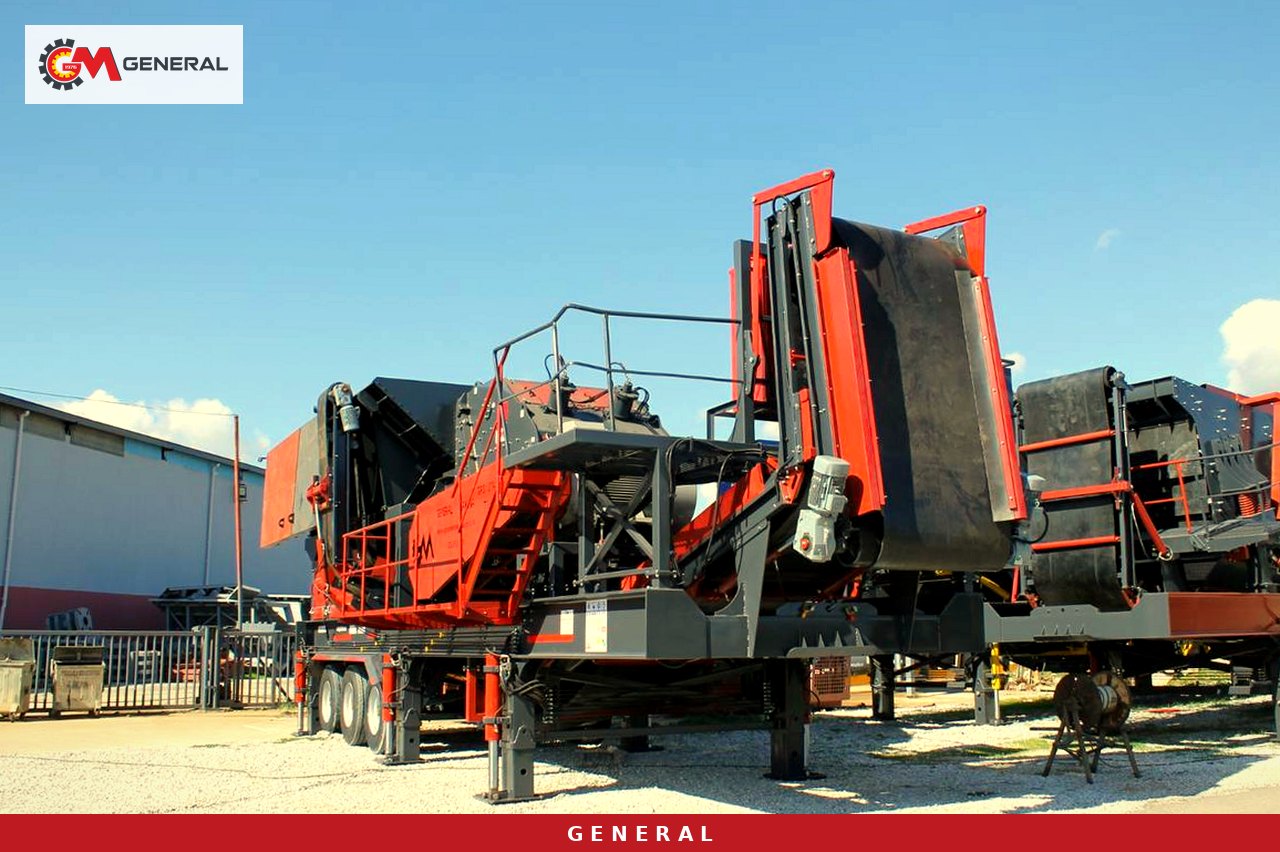
Calculating replacement intervals from your own record
At every check, write four values on one line: date, hour meter reading, tonnage crushed since the last change, and measured thickness. As these lines build up, the replacement time can be calculated:
- Wear rate = (thickness when fitted − measured thickness) ÷ tonnage crushed in that period
- Remaining life (tonnes) = (measured thickness − minimum thickness) ÷ wear rate
- Remaining life (days) = remaining life (tonnes) ÷ average daily tonnage
Hypothetical example, not a real value: a blow bar is fitted at 10 units of height and its minimum height is 4 units. At the first check it has lost 2 units while T tonnes passed through the crusher. The wear rate is 2/T units per tonne. The remaining margin is 8 − 4 = 4 units, so remaining life is 4 ÷ (2/T) = 2T tonnes. With an average daily tonnage of G, the change falls due after roughly 2T/G days. The calculation holds while wear progresses evenly; as the profile deteriorates the rate can rise, so refresh it with every new measurement.
The record also feeds the next purchasing decision. When comparing two alloys or two suppliers of the same part, the figure that matters is not the part price but the wear cost per tonne. To combine part cost, lost production during the change and labour, use the energy and wear cost per tonne calculator. Enter the wear rate from your own record, not from a catalogue.
Conditions that shorten wear life on mobile plants
In a stationary plant, feed, rock and setting may stay the same for months. On a mobile plant every relocation means a new wear condition, and the record from the previous site cannot simply be carried over. These four conditions cause the largest deviations in the record.
New site, new rock
When a plant moves from a limestone quarry to a basalt job, the impact crusher's blow bars wear at a completely different rate. According to the product pages, the General 800 and the other primary impact models are designed for limestone and low-abrasive rock. In hard, abrasive rock a jaw and cone layout such as the General 944 extends the life of metal parts through compression crushing. If the plant is already on site, the step to take is to restart the record from zero and measure the first set more frequently.
Exceeding the feed limit
Each model's maximum feed size is stated on its product page: 500 mm for the General 640, 600 mm for the General 800, 700 mm for the General 01, 800 mm for the General 944 and General 950. A block above this limit bridges in the jaw and, in an impact crusher, puts an off-design impact load on the blow bars. When the quarry changes, so does the blasting or pre-sizing pattern; watching the share of oversize blocks reaching the hopper in the first days protects part life.
Intermittent feed and fines
The hopper of a mobile plant is usually filled by an excavator or loader, so the feed rhythm depends on the operator. Manganese steel parts work-harden under impact; intermittent, half feeding prevents that hardening. Soil and fines entering the crusher also increase wear while cutting capacity. The by-pass grizzly vibrating feeder on the General 01 separates fines at the start, which is why keeping the grizzly gap clear affects part life as well as capacity.
Closed-circuit recirculating load
The General 640, General 800 and General 950 work in closed circuit: material that does not pass the target size on the screen returns to the crusher. As the return ratio rises, the crusher handles more material for the same product tonnage and the parts wear faster per tonne sold. Tracking product tonnage and the return conveyor load separately is a precondition for a correct wear rate. A hole in the screen deck also upsets this balance: oversize ends up in the stockpile or the return load changes unexpectedly.
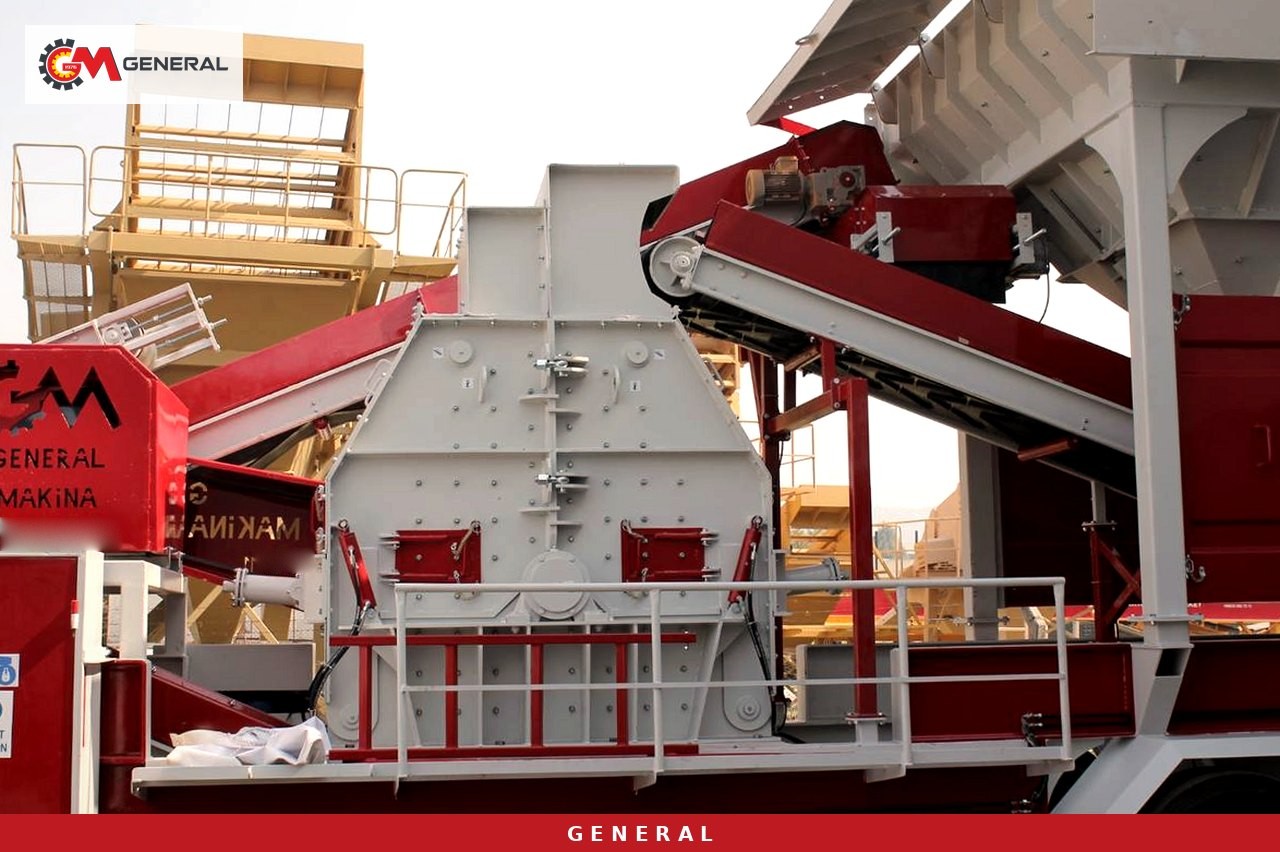
Planning the change: shutdown window, turning and parts readiness
The calculated remaining life gives the latest date for the change, not the date itself. Planning means matching that date with moments when the plant stops anyway: a relocation, a long maintenance stop, a seasonal break or a screen deck change. On a mobile plant the most efficient window is often just before a move. With the parts changed, the plant starts the new site with a clean record and the wear rate of the new rock is measured correctly from day one.
Turning is part of the life too. Symmetrical jaw plates and blow bars can be turned once and run on their second face, but only if the first face is removed before it reaches the minimum dimension. A bar run below the limit cannot be turned and puts the rotor holder at risk. Keep "turn" and "replace" as separate lines in the record; otherwise the life of the second face mixes with the first and the wear rate comes out wrong.
The record also drives parts supply. When remaining life drops to a few weeks, the order should already be placed and the part on site. General Makina supplies wear parts such as jaw plates, blow bars and cone liners and other crushing and screening spare parts. When ordering, sharing the wear rate from your record and the feed rock alongside the model makes it easier to recommend the right alloy. The 1-year warranty on the machines does not cover wear parts; their life depends on operating conditions and is managed by measurement.
For alloy selection, work-hardening and preventive maintenance routines, see our article on crusher plant maintenance and spare parts management. The measurement record described here is the tool for verifying those alloy decisions on site.
Frequently asked questions
After how many hours do jaw plates or blow bars need replacing?
There is no site-independent figure in hours. Life depends on rock abrasiveness, feed size, fines content and feeding pattern. The right value for your plant is the wear rate per tonne obtained by regular measurement on the first set of parts.
Are wear parts covered by the warranty?
No. General Makina machines carry a 1-year warranty and wear parts are excluded from it, because their life depends directly on operating conditions.
Is it worth running a part below the minimum dimension?
In the short term it yields some extra tonnage. But a part worn below the limit cannot be turned, can damage the holder and the housing, and spoils product sizing.
When we move the plant to a new site, is the old record still valid?
Not directly. If the new site's rock, feed size and moisture differ, the wear rate differs too. Keep the old record for comparison, but rebuild the calculation on the new site from the first measurements.
Conclusion
On a mobile crusher, wear part life comes from your rock, your feeding pattern and your measurements, not from a catalogue. An operation that writes tonnage and thickness in the same table moves replacements from unplanned stops to planned windows and bases the next parts order on data rather than guesswork. To choose a model and wear parts that suit your rock and capacity, reach us through our contact page; send us your material details and target capacity and we will prepare a quotation for your project.
Definitions of technical terms: Glossary