EN — English
 TR — Türkçe
 DE — Deutsch
 RU — Русский
 FR — Français
 ES — Español
 AR — العربية
 SR — Српски

Mauritania Iron Ore Primary Jaw Stone Crusher Plant 250-450 TPH
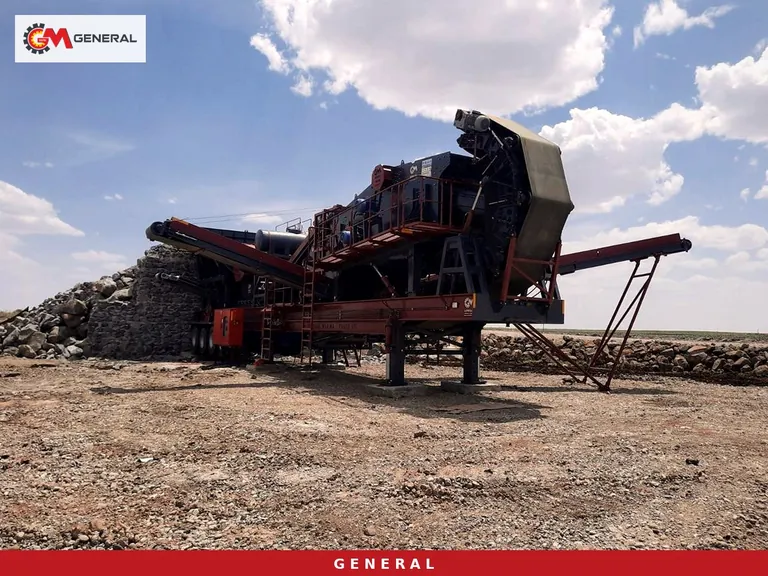
On the iron ore deposits of northern Mauritania, notably around Zouérat, the primary crushing line sets the pace for the whole mine: if blasted boulders cannot get through the jaw, the belts stay empty and the stockpile does not grow. For contractors and mine operators planning a primary line in the 250-450 TPH range, this article places the real configurations that can be built from the GNRK jaw crusher family and GNR grizzly feeders side by side, with catalogue figures for each model.
Every technical value below comes from our product catalogue. We give no information about any specific mining licence, tender or specification; please confirm the technical requirements of your project with the operating authority or the tender documents. What we cover here is the selection logic and the concrete problems you will meet on site.
Why a jaw as the primary crusher for iron ore?
Iron ores in Mauritania generally contain hematite and magnetite, often interbanded with quartz-rich layers. For the crusher this has two consequences. First, free silica is abrasive and quickly consumes the metal parts of a primary crusher that works by impact. Second, the ore is markedly denser than limestone or granite; the same volume of feed brings more mass and a higher load into the crushing chamber.
The GNRK series jaw crusher breaks material by compression between a fixed jaw and a swing jaw driven by an eccentric shaft. Under compression, metal wear advances far more slowly than in impact crushers, which is why our catalogue recommends a jaw for material with silica above 10% or a Bond abrasion index above 0.15. Discussing another primary crusher type for iron ore only makes sense when the ore is clayey, soft and low in silica, and that is something a sample analysis tells you, not a guess.
There is a third practical reason. A blasted muckpile occasionally contains drill bits, bucket teeth or other steel. Austenitic manganese jaw plates tolerate this kind of unexpected metal contact better than brittle alloy parts. Even so, adding a magnetic separator over the first conveyor is a measure to be evaluated per project.
250-450 TPH: not one range but two thresholds
The range in the title cannot be covered by a single machine. In the GNRK family, the lower end is served by the GNRK 110 and the upper end by the GNRK 130, which leaves a gap between 350 and 400 TPH. That gap is the reason no model should be chosen before the target is fixed. The formula is simple: required hourly capacity = daily tonnage target ÷ net crushing hours. A hypothetical example: a line that has to crush 6,000 tonnes of ore per day over 16 net hours needs 375 TPH and lands right in the gap; spread the same target over 20 net hours and 300 TPH is enough, so the GNRK 110 class does the job.
| Configuration | Opening (mm) | Output setting (mm) | Capacity (t/h) | Crusher motor (kW) | Weight (kg) | Feeder |
|---|---|---|---|---|---|---|
| Stationary, GNRK 110 | 1100×850 | 150-225 | 200-350 | 110/132 | 33,000 (crusher) | GNR 110 (200-300 t/h) or GNR 140 |
| Stationary, GNRK 130 | 1300×1000 | 125-250 | 400-500 | 160 | 42,500 (crusher) | GNR 140 (350-600 t/h) |
| Stationary, GNRK 140 (expansion margin) | 1400×1100 | 135-300 | 500-600 | 200 | 47,000 (crusher) | GNR 140 (350-600 t/h) |
| GNR 110 single-chassis unit (GNRK 110 jaw) | 1100×850 | — | 180-300 | — | 55,000 (unit) | On-chassis 1100×4750 mm |
| Two GNR 110 units in parallel | 2 × 1100×850 | — | 360-600 (total) | — | 2 × 55,000 | One feeder per unit |
250-350 TPH: GNRK 110 with the right feeder
With its 1100×850 mm opening and 110/132 kW motor, the GNRK 110 produces 200-350 t/h. The largest block the jaw can accept is roughly 0.8-0.9 of the opening width, around 880-990 mm. If the blast design leaves boulders bigger than that, the problem lies at the face, not in the crusher. On the feeding side, the GNR 110 (1100×4750 mm, 2×7.5 kW) is sufficient up to 300 t/h; for a 300-350 t/h target, stepping up to the GNR 140 is the most reliable way to keep the jaw choke-fed.
400-450 TPH: GNRK 130 with GNR 140
The 1300×1000 mm opening of the GNRK 130 accepts blocks of about 1040-1170 mm and delivers 400-500 t/h with a 160 kW motor. A 450 TPH target sits mid-range for this model; that margin is what keeps the line on target when ore hardness or moisture changes. The GNR 140 feeder, at 1400×5000 mm and 350-600 t/h, is its natural partner. The GNRK 140 belongs on the table only when a later expansion is firm; its output setting opens up to 300 mm, which changes the sizing of the downstream conveyors as well.
Staged growth: the GNR 110 mobile primary jaw unit
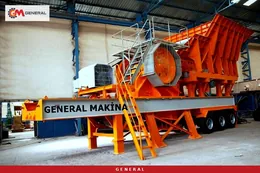
Where the crusher has to follow an advancing face, the GNR 110 wheeled primary jaw unit carrying the feeder hopper and the GNRK 110 jaw on one chassis, opens a different route. A single unit delivers 180-300 t/h, accepts 0-1100 mm feed and is set up on hydraulic legs without foundations. Two units running in parallel give a combined range of 360-600 t/h, the most flexible way to close the 350-400 TPH gap. When one unit is under maintenance the other keeps producing, a concrete advantage at a remote mine. Other single-chassis options are listed under single-chassis mobile crusher units.
From muckpile to belt: feeding and pre-scalping
On a primary line, most capacity loss happens not inside the crusher but in the feeding arrangement in front of it. The GNR vibrating grizzly feeder walks material forward on a vibrating trough resting on helical springs; the grizzly section at the end lets fines and soil drop through without ever reaching the jaw. On iron ore mines, separating overburden sand and dust this way spares the jaw plates needless load.
Hopper volume can be selected between 15 and 100 m³. On a truck-fed line, the hopper must be large enough that the jaw never runs empty between two trucks. A rough check: hopper volume ≥ (average waiting time between trucks × line capacity) ÷ bulk density of the ore. Dense ore takes up less volume for the same tonnage, so run the calculation with the density of your own ore, not a generic rock value.
After the jaw, material travels by belt. Our belt conveyors come in widths from 500 to 1200 mm and are designed for 0-250 mm material. The output settings of the GNRK 110 and GNRK 130 stay within that limit; the widest setting of the GNRK 140 exceeds 250 mm and calls for a rethink of the first belt and the transfer chute. With coarse, dense ore, belt speed and incline must be calculated together, and impact idlers should be used at the loading point.
Saharan conditions: dust, sand and power
Inland Mauritania has a hot, dry climate with plenty of wind-blown sand. These three factors add cost at three separate points on a primary line: motor air intake, bearing lubrication and operator visibility. The following measures should be treated as project-specific options rather than standard equipment: water-spray dust suppression at transfer points, an enclosed chute and belt covers between the crusher discharge and the first conveyor, heavy-duty air filtration for the generator and electrical panel with a sand-protected cabin, and dust seals on bearing housings.
At remote mines, power usually comes from a generator. Generator rating is sized from the total installed motor load: on a GNRK 110 class line, a 110/132 kW crusher motor, a 2×7.5 kW feeder and the conveyor motors; on a GNRK 130 class line, a 160 kW crusher and a 2×9.2 kW feeder are the starting point. Add the starting current of a jaw under load and the derating of generators in hot weather. Choose the generator only after the motor list is final.
On the automation side, the most useful function is linking feeder speed to crusher current. When crusher current approaches its limit the feeder slows; once current returns to normal it speeds up again. On a generator-powered line this protects the jaw against blockage and shields the generator from sudden load spikes.
From port to mine: shipping and installation
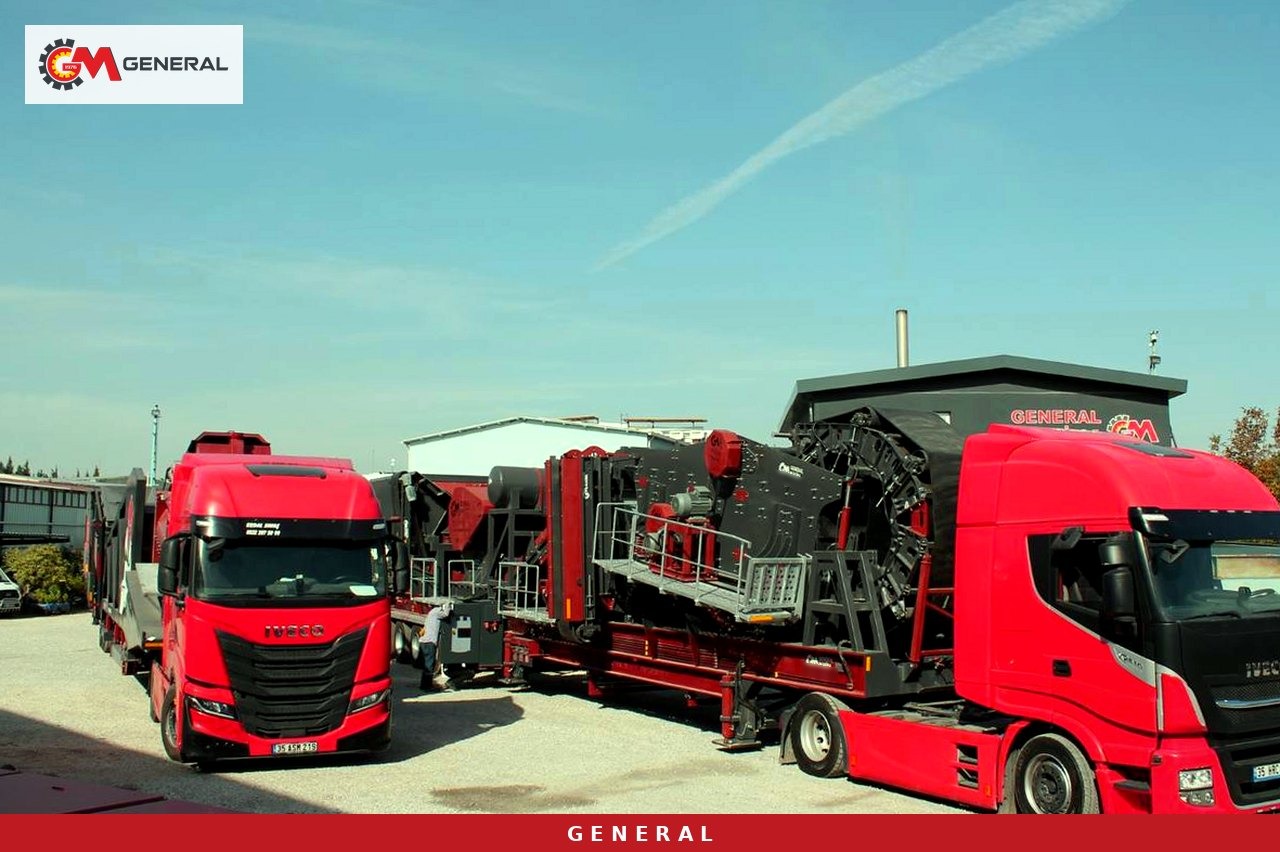
Equipment shipped by sea from Türkiye has two natural entry points in Mauritania: Nouakchott, the capital's port, and Nouadhibou in the north. Proximity to the northern mines favours Nouadhibou, but the port choice should be planned with your forwarder together with the road to the mine and the permits required. Weights are the basis of that plan: the GNRK 110 crusher weighs 33,000 kg, the GNRK 130 crusher 42,500 kg and the GNR 110 single-chassis unit 55,000 kg.
A stationary line ships as separate items: crusher, feeder, frames and conveyors; on site it needs concrete foundations and steel structure erection. The options for this layout are on the fixed crushing plants page. The single-chassis unit travels behind one tractor and is set up on hydraulic legs. If the face will move significantly over the years, the relocation ease of the mobile unit has to be weighed against the permanent, settled layout of a stationary line.
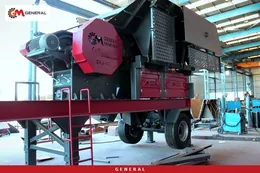
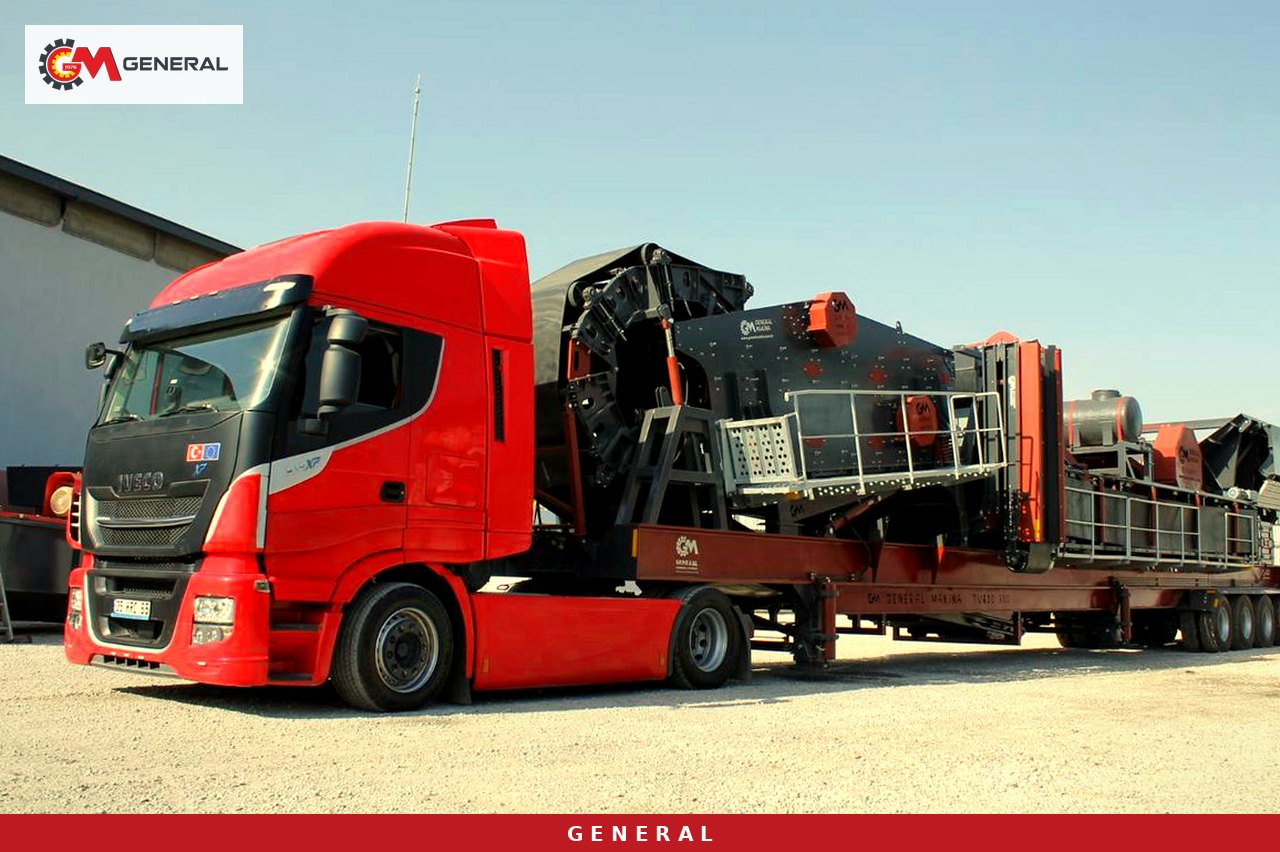
The General 950 in the photos is a 120-180 TPH line that combines a GPJ 90 jaw with a DMK01 impact crusher on one chassis, and iron ore is among the materials its catalogue entry lists. It does not replace a 250-450 TPH primary line; however, when the mine needs a separate, smaller product line or pilot production, this model, which takes 800 mm feed and runs on a 600 kVA generator, can be considered.
Wear planning and first-week checks
On iron ore, jaw plates are the most frequently replaced item. Austenitic manganese steel plates work-harden at the surface under impact; for high-silica ore, Mn18 or Mn22 alloy should be preferred. The right metric is not part price but cost per tonne crushed: part price, replacement frequency and downtime are evaluated together. Downtime hours are expensive at a remote mine, so keeping one spare set of jaw plates on site is usually the most sensible precaution. Alloy options are explained on the crusher wear parts page.
The feeder's grizzly bars and body wear plates are bolted and replaceable too; add them to the same stock list. During the first week after commissioning, run these checks at the start of every shift:
- Measure the closed-side setting (CSS) and compare it with the target product size; drift changes both capacity and the load on the first belt.
- Watch whether the jaw runs full; if the mouth is half empty adjust feeder speed, if it keeps overflowing adjust hopper discharge.
- Check the grizzly gap: too narrow sends fines to the jaw, too wide lets oversize escape straight to the belt.
- Re-measure crusher and feeder bearing temperatures around midday; in a hot climate the daytime difference is noticeable.
- Inspect generator and panel air filters at the end of each shift and log sand build-up.
- Photograph the wear profile in the lower zone of the jaw plates; it is the most practical way to predict replacement time.
Frequently asked questions
How do I confirm the right model for my ore?
Share a representative ore sample, the daily tonnage target, operating hours, the largest block size after blasting and the required output product. If crushability and abrasion tests have been carried out, the results settle the choice directly; if not, we recommend having them done by a laboratory.
My target is 380 TPH: GNRK 110 or GNRK 130?
The upper limit of the GNRK 110 is 350 t/h, so at 380 t/h it would be permanently overloaded. The GNRK 130 runs comfortably at the low end of its range and leaves room for growth. A flexible alternative is two GNR 110 single-chassis units installed in parallel.
Which stages follow the jaw crusher?
This article covers primary crushing only. The jaw product sets the size that goes on to the secondary crusher, the screens and, if needed, the beneficiation plant. Those stages are designed separately according to your ore processing flowsheet, and the primary output setting is finalised together with that design.
What determines the price?
Model size, stationary or single-chassis design, feeder and hopper choice, conveyor lengths, dust and filtration measures, generator requirement, spare parts package and shipping method all determine the price. The warranty is 1 year, excluding wear parts. A firm figure is given in a quotation prepared from this information.
Decision summary
For iron ore primary crushing in Mauritania, the GNRK 110 is the right starting point for 250-350 TPH and the GNRK 130 for 400-450 TPH; for targets in between and for an advancing face, two GNR 110 single-chassis units add flexibility. As a manufacturer producing in İzmir since 1976 with ISO 9001 and CE certification, we prepare the quotation for your North African project starting from your ore data. Send your sample information and tonnage target through our contact page.
Definitions of technical terms: Glossary