EN — English
 TR — Türkçe
 DE — Deutsch
 RU — Русский
 FR — Français
 ES — Español
 AR — العربية
 SR — Српски

Northern Iraq Limestone Jaw + Impact Aggregate Crusher Plant 150-250 TPH
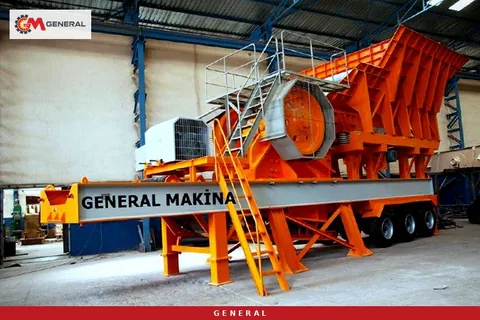
In the limestone quarries of Northern Iraq, crusher selection is often reduced to one question: "Limestone is soft, so isn't an impact crusher enough?" What we see on site is more complicated. Quarries opened along the foothills of the Zagros fold belt can deliver clean limestone, dolomitic layers, siliceous nodules and clay from karst cavities from the same bench. This article explains why a jaw primary in front with an impact crusher behind it makes sense for a 150-250 TPH target, which real models build that line, and what a quarry near Mosul, Duhok or Kirkuk should clarify before requesting a quotation.
Limestone is soft, but Northern Iraq quarries are not uniform
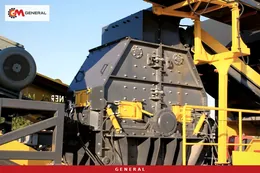
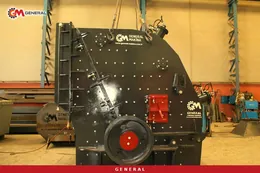
A primary impact crusher can achieve a reduction of up to 20:1 in a single stage on clean limestone, which on paper leaves a jaw crusher behind. The blow bars of an impact crusher, however, are sensitive to the silica content of the feed. According to the manufacturer's data, blow bar life drops sharply when silica exceeds 10%. Chert bands and siliceous levels occur here and there in the region's limestone formations, and nobody can promise that the ratio will stay low for the whole life of a quarry without sampling.
Chert bands and dolomitic transitions
If the rock changes as the bench advances, an impact primary can suddenly become the main item of wear cost. A jaw crusher breaks rock by compression; its manganese steel jaw plates work-harden under impact, so metal consumption stays under control when a siliceous layer arrives. The jaw primary therefore acts as insurance: it handles the first breaking whatever the rock brings and leaves the impact crusher a smaller, more predictable feed.
Karst infill and clay pockets
The red clay that fills solution cavities in limestone quarries turns sticky after winter rain. If this material goes straight into an impact crusher it plasters the rotor chamber. The grizzly feeder in front of the jaw primary and the by-pass screen on the feeder deck of the secondary unit send soil-laden fines to a separate stockpile without passing through the crusher. If a bench has a high clay content, this separation has to be part of the design from the start.
Real model pairings that fit the 150-250 TPH band
No single wheeled chassis covers the range in the title; the target is reached with a line of two or three units or with a stationary plant on foundations. The table below contains manufacturer catalogue values only. Unknown values are marked "—".
| Configuration | Jaw primary | Impact secondary | Primary capacity (t/h) | Secondary capacity (t/h) | Notes |
|---|---|---|---|---|---|
| Mobile, upper band | GNR 110 mobile primary (GNRK 110 jaw, 1100×4750 mm feeder) | M-DMK 03 (1500×4000 mm feeder, 250 kW) | 180-300 | 175-300 | Primary unit 55,000 kg, secondary 45,000 kg |
| Mobile, middle band | GNR 110 mobile primary | M-DMK 02 (1200×3750 mm feeder, 200 kW) | 180-300 | 150-250 | Secondary 38,000 kg; the line is limited by the secondary |
| Mobile, lower band | GNR 90 mobile primary (1000×3800 mm feeder) | M-DMK 01 (1000×3000 mm feeder, 160 kW) | 70-180 | 120-180 | For a target of about 150 t/h |
| Stationary line | GNRK 110 (1100×850 mm opening, 110/132 kW) | GNR DMK02 (1100×1200 mm rotor, 200 kW) or DMK03 (250 kW) | 200-350 | 170-250 / 250-300 | GNR 110 grizzly feeder in front (200-300 t/h) |
| Single chassis | GPJ 90 (inside General 950) | DMK01 (inside General 950) | 120-180 (plant total) | 600 kVA generator, 70,000 kg | |
Three-chassis mobile line
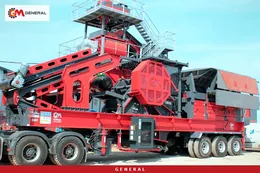
If the quarry face moves every few years, a wheeled primary jaw unit with feeder hopper is set up next to a mobile secondary impact crusher with by-pass screen. The GNR 110 mobile primary accepts 0-1100 mm feed and delivers 0-250 mm product; because the M-DMK series takes 0-350 mm feed and produces 0-50 mm, the closed side setting of the primary is chosen to suit that limit. A third chassis, the GNR ME2060 dry screening plant (200-350 t/h, 2000×6000 mm three-deck screen, 0-100 mm feed), splits the fractions. Installed without foundations on hydraulic legs, this line keeps the flexibility offered by single-chassis mobile crusher units.
Stationary line on foundations
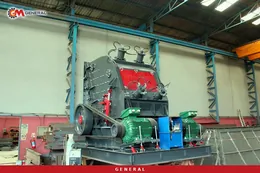
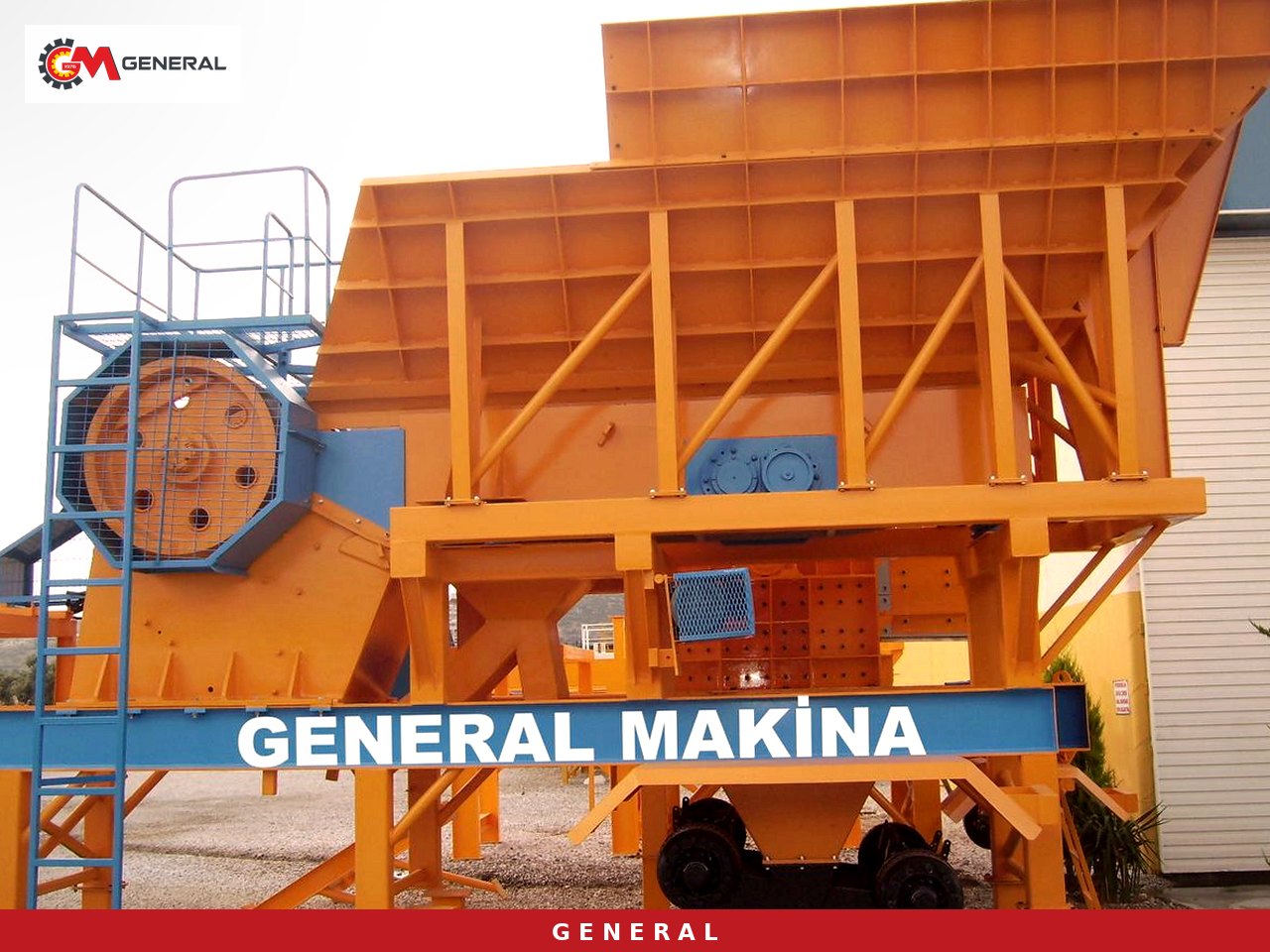
If the reserve allows years of work from the same point, fixed crushing plants offer a larger screening area and more product outputs. A GNR 110 grizzly feeder goes in front of the GNRK 110 jaw crusher and a GNR DMK02 or DMK03 behind it; the 800 mm maximum feed of the DMK series takes the primary product comfortably. On the screening side, the GNR 2060 circular vibrating screen (2000×6000 mm, 18.5 kW) is a common size at this tonnage.
Tuning the impact stage to the product list
Typical customers of a limestone quarry in Northern Iraq are ready-mix concrete plants, road construction sites and block manufacturers. Each of these buyers needs a different grading curve, and this is where the real value of an impact crusher shows. With its breaker plates set close to the rotor, a secondary impact crusher typically achieves a reduction of around 10:1 and produces cubical grains. Particle shape is a criterion specifications often ask for in concrete and asphalt chippings; final limit values must be confirmed from the specification of the relevant authority.
The logic of the setting is simple: as the apron gap narrows, the share of fines rises and cubicity improves, while blow bars and apron liners wear faster. When demand for manufactured sand is high, the gap is closed; when sub-base material dominates, it is opened and part of the primary product is sent straight to the screen. Blow bar alloy is also chosen by feed: high-chrome white iron for clean limestone, manganese or martensitic alloy for mixed feed with a risk of tramp metal.
In closed-circuit operation, oversize retained on the screen returns to the secondary crusher. A secondary selected without accounting for this recirculating load cannot deliver the 250 t/h promised on paper. Choosing the secondary one step larger than the primary is therefore a safe approach, particularly for orders with a high share of manufactured sand.
Road freight through Türkiye and layout at the quarry
From Izmir, units can be shipped to Northern Iraq by road along a route through Türkiye to a border crossing. Wheeled chassis are coupled to a tractor on their own axles; this design, which needs no dismantling, simplifies the loading plan at the border and on mountain roads. Weights drive the planning: the GNR 90 mobile primary weighs 25,000 kg, the M-DMK 02 38,000 kg and the GNR 110 mobile primary 55,000 kg. Bridge and road classes on the route must be verified with the haulage company in advance; permit conditions and weight limits should be confirmed with the relevant authority.
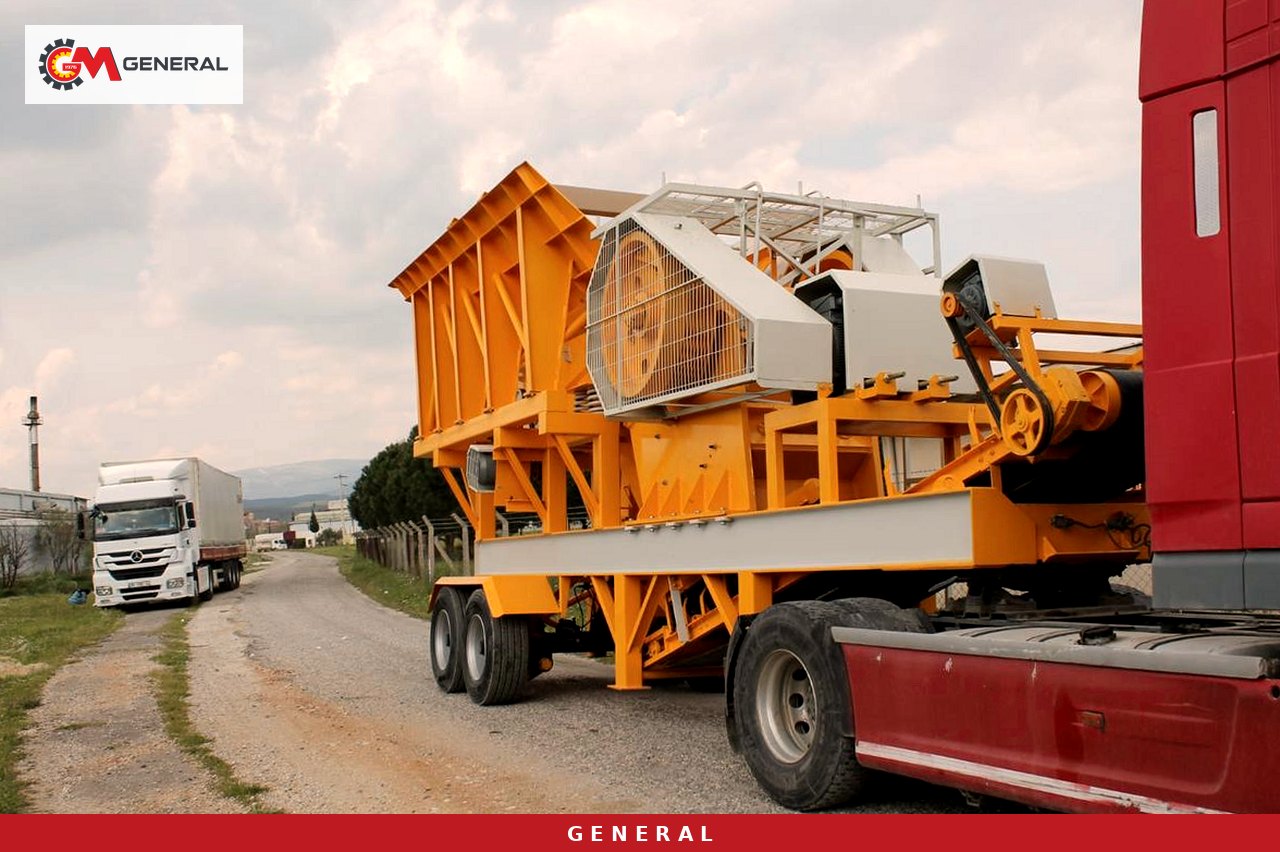
On arrival, the units are arranged according to the bench layout. The primary unit sits on a level platform where trucks or excavators can turn easily; the secondary and the screen are lined up towards the stockpiles at conveyor distance. On sloping quarries, placing the primary on the upper level and the secondary on the lower level reduces conveyor incline and separates loader traffic. On sites without a grid connection, generator capacity must be calculated from the total motor power of all units; for a single-chassis plant such as the General 950 this figure is given as 600 kVA.
Summer dust, winter frost: operating in all four seasons
Summers in the interior of Northern Iraq are hot and dry, while winters in the mountainous areas are cold and snowy. These two extremes call for different measures at the same quarry. In summer, dry limestone produces fine dust, and engine air filters and electrical panels pay the price first. Water-spray dust suppression at transfer points, belt covers and fan-cooled panels are measures that can be selected per project. Which equipment is standard and which is optional must be confirmed in writing for each model at the quotation stage.
In winter the problem reverses: wet clay clings to the grizzly, screen meshes blind and frozen stockpiles slow the loader down. Changing the by-pass screen aperture with the season, lowering the feeder frequency and running belts empty at the first morning start help in this period. Spare wear parts should be brought to site before the months when access becomes difficult; recording monthly consumption of jaw plates, blow bars and screen mesh keeps stock planning away from guesswork.
Quarry data to collect before requesting a quotation
The accuracy of a model recommendation depends on the quality of your data. Completing and sending the list below removes an unnecessary round of correspondence:
- Laboratory results of representative bench samples: silica content, abrasiveness and compressive strength.
- Largest block size after blasting and excavator bucket size.
- Clay and soil content and seasonal moisture variation.
- Target hourly tonnage and daily operating hours.
- Fractions to be sold and the approximate share of each (manufactured sand, chippings, sub-base).
- Power source: grid or generator?
- Quarry life and how many times the face will move; this is the basis of the mobile-or-stationary decision.
- Condition of the access road and the gradient over the last kilometres.
With this information, wheeled mobile crushing plants and stationary options can be compared in the same table. The main factors that determine price are the number of units, screen decks, generator requirement, dust suppression equipment and wear part alloy.
Frequently asked questions
Can a primary impact crusher be used directly on clean limestone?
Yes. If samples show a low and consistent silica content, the mobile primary impact crusher M-PDK02 (200-300 t/h, 0-1200 mm feed, 0-70 mm product) gives high reduction in a single stage. If the rock is variable, a jaw primary remains the safer choice.
Can a single wheeled plant deliver 250 TPH?
The General 950 which carries a jaw and an impact crusher on one chassis, works in the 120-180 t/h range. A 250 TPH target needs a line of separate primary and secondary units or a stationary plant.
What does the warranty cover?
The machines carry a 1-year warranty; wear parts are excluded. General Makina has been manufacturing in Izmir since 1976 and holds ISO 9001 and CE certification.
How are price and delivery date determined?
Both depend on the chosen configuration, the equipment list and the order period. Once you send your quarry data, a written project-specific quotation is prepared.
Conclusion
For 150-250 TPH on Northern Iraq limestone, the most balanced crushing and screening plant uses a jaw primary against variable rock and an impact secondary for cubical product and fines. If the quarry face will move, the GNR 110 mobile primary with an M-DMK 02 or 03 stands out; for a long-life reserve, the stationary GNRK 110 with DMK02 or DMK03 does. Send your sample results and product list through our contact page and we will define the right unit line for your quarry together.
Definitions of technical terms: Glossary