EN — English
 TR — Türkçe
 DE — Deutsch
 RU — Русский
 FR — Français
 ES — Español
 AR — العربية
 SR — Српски

Zambia Copper Ore Primary Jaw Stone Crusher Plant 250-450 TPH
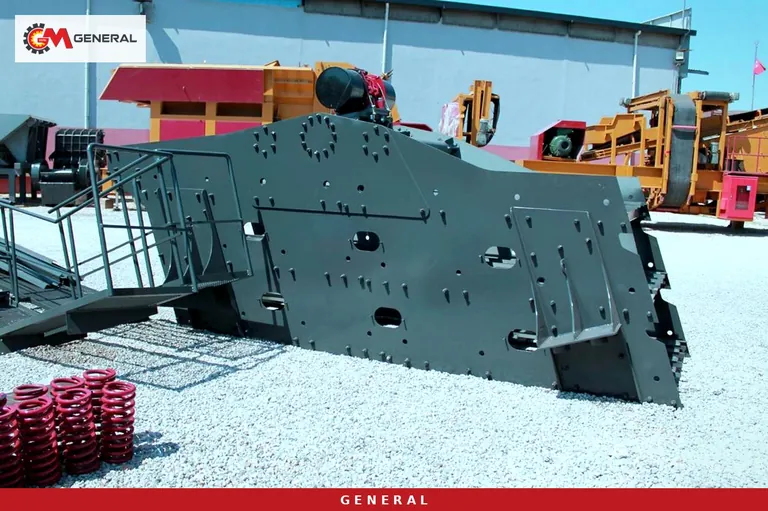
Copper mining in Zambia is concentrated in two regions: the Copperbelt Province, covering Kitwe, Chingola and Mufulira, and North-Western Province around Solwezi. In both, the first stop for blasted open-pit ore is the primary crushing station, and its hourly capacity sets the ceiling on the flow reaching the concentrator. This article looks at a primary jaw crushing station for 250-450 TPH of copper ore through three measurements: the largest block coming from the pit, the top size the crusher must release, and the peak tonnage within a shift. We then compare GNRK jaw crusher, GNR grizzly feeder and G-type grizzly screen combinations that meet those figures, using catalogue values.
We give no information about any specific mine's expansion plan, tender or operator. For product top size, station location and environmental requirements, rely on the mine's technical specification and the conditions of the relevant Zambian authority; the selection logic below becomes precise once those data are in hand.
Three measurements that define the station
The most common mistake when ordering a primary station is answering only "how many tonnes". In reality three separate measurements drive the jaw crusher choice, and each ties to a different machine property.
- Largest block: The biggest rock dumped by the excavator bucket or haul truck sets the crusher opening. Our catalogue rule is that the maximum feed to a jaw crusher is about 0.8-0.9 of the opening width. Larger blocks bridge in the mouth and must be reduced with a hydraulic breaker or by secondary blasting in the pit.
- Discharge top size: The crusher's closed-side setting (CSS) fixes the size at which ore goes to the next stage. The circuit downstream dictates this value, not the crusher: a secondary cone crusher, a stockpile conveyor or a direct grinding line each require a different top size.
- Peak tonnage: When truck cycles are irregular, the crusher feels short surges rather than the average. The feeder hopper buffers these swings; its volume should be judged together with the truck body and arrival frequency.
In Zambian copper deposits the host rock is mostly sandstone, argillite and carbonate rock; mineralisation is oxidised near surface and sulphidic at depth. This general picture appears in different proportions at every pit. At quotation stage, take samples of both ore types and have abrasiveness (Bond Ai) and free silica measured in a laboratory; the wear-part alloy is chosen from these values.
Which combination covers 250-450 TPH?
A single machine does not close this range comfortably. In the GNRK series jaw crusher family, the GNRK 110 has a catalogue capacity of 200–350 t/h and the GNRK 130 400–500 t/h, leaving a 350-400 t/h gap in between. Where your target falls in the range directly changes the station layout. The table below sets four realistic options side by side with catalogue values.
| Option | Crusher and opening (mm) | Crusher motor (kW) | Crusher weight (kg) | Crusher capacity (t/h) | Feeder | Target fit |
|---|---|---|---|---|---|---|
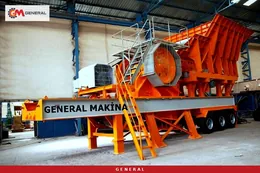
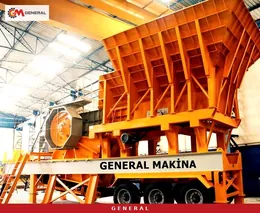
| A – Single stationary line | GNRK 110 – 1100×850 | 110/132 | 33,000 | 200–350 | GNR 110 (200~300 t/h, 2x7.5 kW) | 250-300 t/h |
| B – Heavy stationary line | GNRK 130 – 1300×1000 | 160 | 42,500 | 400–500 | GNR 140 (350~600 t/h, 2x9.2 kW) | 400-450 t/h |
| C – Two parallel lines | 2 × GNRK 110 – 1100×850 | 2 × 110/132 | 2 × 33,000 | 2 × (200–350) | 2 × GNR 110 | 350-450 t/h, redundant |
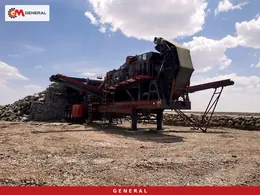
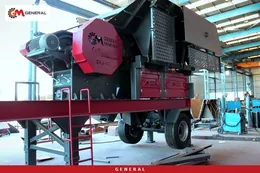
| D – Portable unit | GNR 110 primary jaw unit (GNRK 110) | — | 55,000 (unit) | 180–300 | On-board 1100×4750 mm | 250-300 t/h, first phase |
If the target is 250-300 TPH
Option A pairs the GNRK 110 crusher with the GNR 110 grizzly feeder. Note that the feeder capacity refers to total flow, including fines passing through the by-pass. When the fines ratio rises during the oxide phase, the net tonnage to the crusher falls, yet the load carried by the feeder stays the same. So for a target approaching 300 t/h, consider the next feeder size instead of running it at its limit. If the pit face moves often at the same tonnage, the portable primary jaw unit in option D is commissioned on hydraulic legs without foundations and is towed by a single truck as the face advances.
If the target is above 350 TPH
Option B covers 400-450 t/h with a single GNRK 130; its 1300×1000 mm opening accepts larger blocks and reduces the need for secondary blasting. Option C runs two GNRK 110 units in parallel: each machine stays in the lower-middle part of its range, and when one goes down for a jaw plate change the station does not stop completely. The price is two feeders, two collecting conveyors and a wider steel structure. For targets of 350-400 t/h, the choice depends on the mine's life-of-mine tonnage plan and the impact a single-machine stoppage has on the concentrator. On long-life sites with growth plans, the GNRK 140 (500–600 t/h, 200 kW) can be kept on the table as a reserve-capacity option.
The grizzly layer: separating fine ore before the crusher
Oxide copper ore often arrives in a weathered, fine-grained, clayey matrix. Letting this material into the jaw crusher does two kinds of damage: it takes up space in the crushing chamber, slowing the progress of large blocks, and it accelerates wear on the lower section of the jaw plates. The station's first line of defence is the by-pass section on the vibrating grizzly feeder; fines dropping between the bars go straight to the collecting conveyor without touching the crusher.
With high-fines feed, a G-type grizzly screen can be placed between feeder and crusher as a second stage. The G-type produces linear vibration with two vibromotors; its bars are high-manganese austenitic cast steel and the bar gap is adjustable. The G-type models in the catalogue are:
- ELKG-1230: 1200×3000 mm screen surface, 10.2 kW, 3500 kg
- ELKG-1430: 1000×3000 mm, 10.2 kW, 3700 kg
- ELKG-1930: 1200×3000 mm, 11.5 kW, 6500 kg
The grizzly screen's catalogue capacity is 100-400 t/h. In option B, which reaches 450 t/h, the grizzly layer must therefore be sized to order, or fines separation left to the feeder by-pass alone. The bar gap sets the top size of the separated material and is adjusted according to whether the fines count as ore or waste: at some pits the by-pass product goes straight to the concentrator, at others it is kept off the stockpile. The geology team's grade data should make this call.
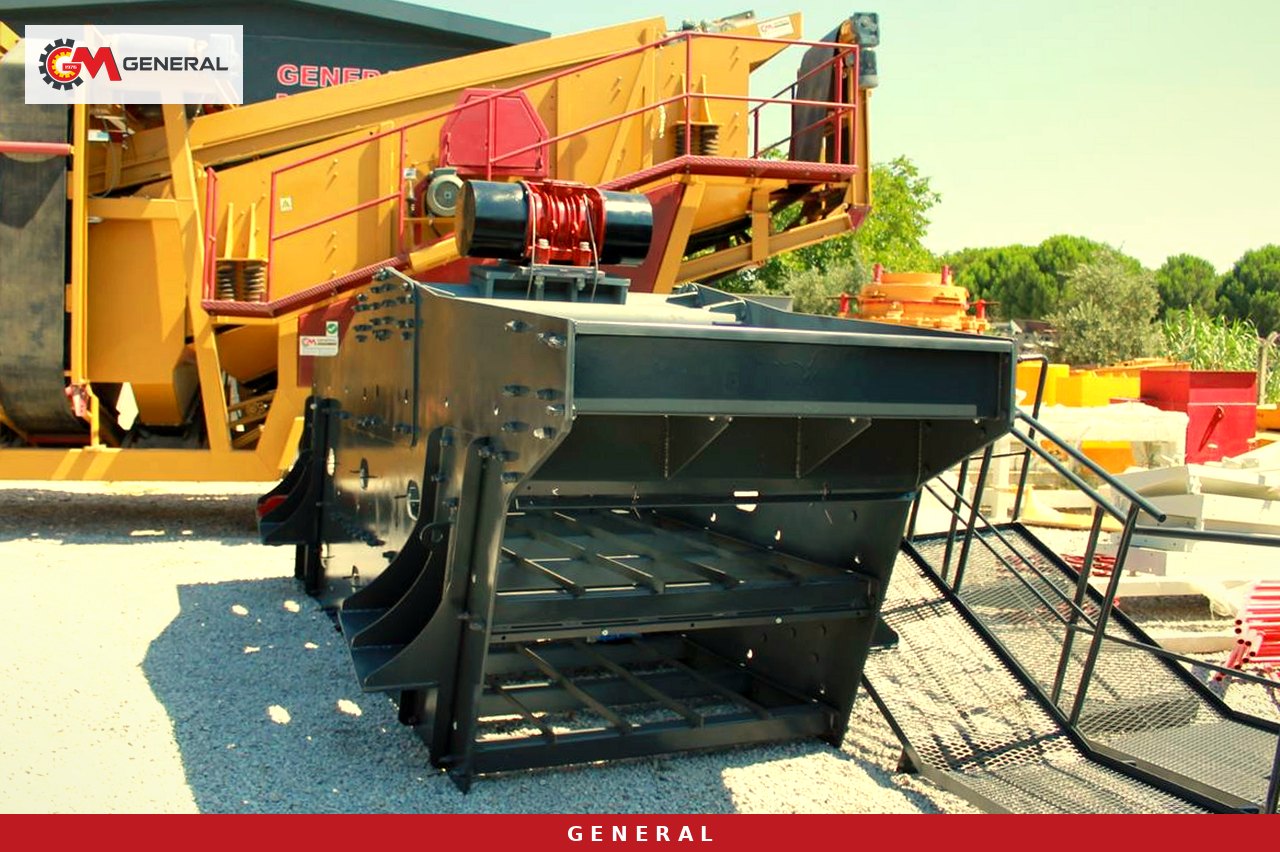
Grizzly blinding in the rainy season
In Zambia the rainy season is when the moisture of clayey oxide ore from the pit rises. Wet clay can close the bar gaps. Practical site measures include widening the bar gap, blending feed from high-fines faces with dry ore during the rains, and reconsidering the feeder type if the material stays sticky. A grizzly feeder works well with dry and medium-moisture ore; for feed that stays sticky all year, a wobbler feeder with elliptical shafts is the better option.
Wear parts: alloy choice for copper ore
Because a jaw crusher breaks by compression, it consumes metal far more slowly on abrasive ore than an impact primary does. This is the main reason the jaw is the natural primary choice in copper deposits with siliceous host rock. Even so, jaw plates remain the station's main operating expense, and the alloy is chosen by free quartz content rather than hardness.
GNRK jaw plates are austenitic manganese steel (Mn13/Mn18). This alloy work-hardens at the surface under impact; by our catalogue value, surface hardness rises from about 200 HB to 550 HB. In quartzitic zones with high silica, Mn18 or Mn22 is preferred. The yardstick should be wear-part cost per tonne crushed, not plate price: part price, replacement frequency, downtime during the change and the safety of handling heavy parts are counted together. The alloy comparison is detailed on our wear parts page.
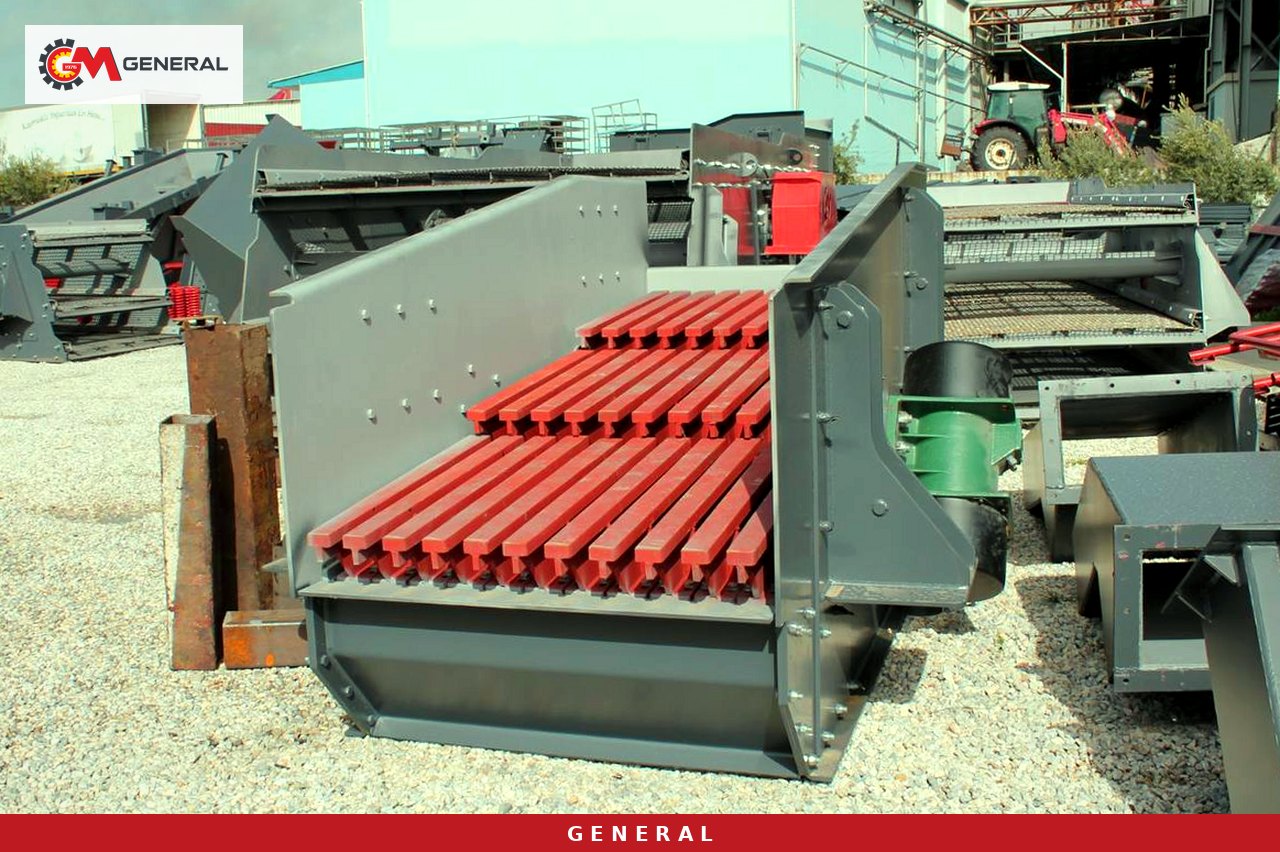
Zambia is landlocked; spare parts reach site by road or rail from ports in neighbouring countries. Because of this long supply chain, at least one set of jaw plates, grizzly bars and feeder body liners should travel with the station in the first shipment, and the reorder point for the second set should be based on the measured wear rate of the first.
From Solwezi to Kitwe: transport, erection and power
Crusher weights drive the shipping plan: the GNRK 110 weighs 33,000 kg and the GNRK 130 42,500 kg. For these bodies travelling by road to an inland mine, heavy-load permits, bridge and ramp restrictions on the route, and crane capacity on site must be settled before dispatch. The portable GNR 110 unit weighs 55,000 kg on a single chassis and arrives behind one truck; for stationary lines, the concrete foundation and steel structure are built on site. You can review the components of a stationary layout in our stationary crushing plants category.
Large mines may have grid power, but on newly opened faces the primary station often sits far from the line. In that case generator rating is calculated from the sum of the crusher main motor (110/132 kW for the GNRK 110, 160 kW for the GNRK 130), the feeder and conveyor motors, plus the starting current. Dust is heavy in the dry season. Water-spray dust suppression at the dump point, enclosed conveyor transfer points and frequent checks of engine and generator air filters are measures that can be selected per project.
The site file to prepare for a quotation
- Hourly target tonnage, daily operating hours and shift pattern
- Largest block size from the pit and blast design
- Separate samples of oxide and sulphide ore; Bond Ai, free silica and moisture values
- Fines ratio and clay content, separately for the rainy and dry seasons
- Required discharge top size and the equipment downstream
- Truck type, body volume and tipping direction
- Grid or generator; voltage and frequency
- Route to site, preferred port and lifting equipment
- Whether the by-pass product counts as ore or waste
The more complete this file, the fewer assumptions the model proposal rests on. Sourcing crusher and feeder from one supplier ties the match between opening and feeder width, and the wear-part supply, to a single counterpart.
Frequently asked questions
Why a jaw rather than an impact crusher as the primary for copper ore?
Compression keeps metal consumption low on siliceous, abrasive ore. Impact primaries achieve high reduction in soft, low-abrasive rock, but in copper deposits with siliceous host rock the jaw is the safe primary choice. You can compare other crusher types in our crushers category.
Which option stands out for a target between 350 and 400 TPH?
A single GNRK 130 gives a simpler station; two parallel GNRK 110 units give redundancy during stoppages. The choice depends on the mine's tonnage plan and the impact of a single-machine stop; with sample and site data we present both options side by side.
What is the jaw crusher's reduction ratio, and is a secondary stage needed?
Typical reduction in the catalogue is 4:1–9:1, up to about 8:1 in primary duty. If the top size required by the concentrator cannot be reached with this ratio, a closed circuit of secondary cone crusher and screen is added.
Which items determine the cost of a quotation?
Crusher and feeder model, the need for a grizzly screen, stationary or portable layout, steel structure and conveyor lengths, electrical panel and generator, the initial wear-part set and the shipping route. Once the site file clarifies these items, a project-specific quotation is prepared.
Conclusion
For 250-450 TPH primary crushing of copper ore in Zambia, the right jaw crusher is chosen by the largest block, the required top size and how fines will be separated, before tonnage. The GNRK 110 at 250-300 t/h, the GNRK 130 at 400-450 t/h and a parallel GNRK 110 line in between are the realistic options. Send your sample data and site information via our contact page and our engineering team, building crushers in Izmir since 1976, will prepare the station layout and model proposal for your project. Our equipment holds ISO 9001 and CE certification and carries a 1-year warranty, excluding wear parts.
Definitions of technical terms: Glossary