EN — English
 TR — Türkçe
 DE — Deutsch
 RU — Русский
 FR — Français
 ES — Español
 AR — العربية
 SR — Српски

Malawi Road Construction Mobile Stone Crusher Plant 80-150 TPH
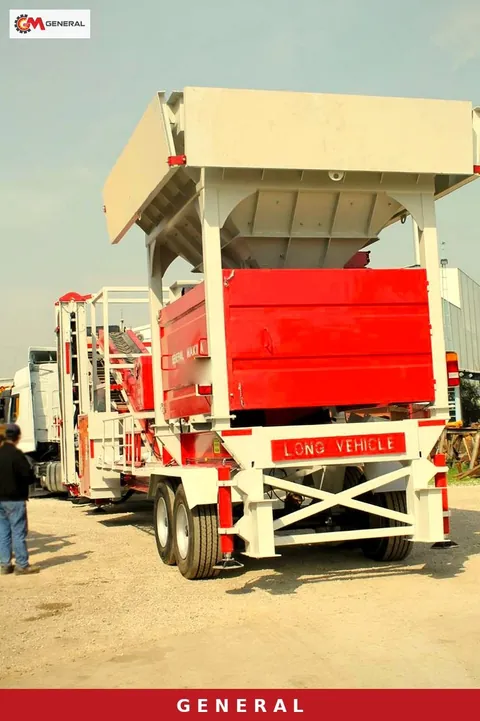
A contractor setting up a crusher on a Malawi road section usually starts by asking "how many tonnes?". In this country, though, two other things decide the purchase: the hard basement rock that changes along the alignment, and the route and dimensions by which the machine reaches a landlocked country. 80-150 TPH is a realistic band for producing sub-base, base course and surface-dressing chippings from a single plant on a road job around Lilongwe, Blantyre or Mzuzu. This article covers the real models that meet that band, which one makes sense where under Malawian conditions, and what information to prepare for the quotation.
The scope, tender status or schedule of any specific road project is not discussed here. For grading envelopes, particle-shape limits and quality tests, the technical specification of the roads authority or the employer is what counts.
What does 80-150 TPH mean on a road site?
Capacity should first be worked back from daily demand. The formula is simple: daily tonnes = layer volume to be laid × compacted density ÷ planned working days. Divide that by actual crushing hours and you get the hourly rate you need. Hypothetical example: a plant that really crushes 10 hours a day at an average of 100 t/h produces roughly 1,000 tonnes. Recalculate this with your own layer cross-sections, not with a generic figure.
The lower end of the band (around 80 t/h) suits maintenance and widening work, or sections where one fraction dominates. The upper end (150 t/h) suits a new paved road where sub-base and surfacing chippings are needed at the same time and the paver must not wait. The distinction matters: running a machine continuously at its catalogue ceiling in hard rock shortens liner life, while a plant with a little headroom above the target delivers the same tonnage at a gentler setting.
Gneiss, granulite and Shire valley basalt: the rock picks the crusher
Most of Malawi sits on the Precambrian basement complex, where gneiss, granulite and granite are common. These rocks are generally hard and rich in silica, which means abrasive. In the south, around the Shire valley, there are Karoo-age basalts and sedimentary units, and around Zomba igneous rocks such as syenite. In the north and near the lake shore, road contractors also frequently meet river gravel and clayey overburden.
In practice this variety means the right crusher for one section can be the wrong one two hundred kilometres away. The banded (foliated) structure of gneiss can raise the share of flaky particles, so if surfacing chippings are required, the effect of the secondary stage on particle shape must be considered from the outset. Instead of guessing the quarry's rock properties, an abrasion and crushability test on a representative sample is the least expensive insurance in machine selection.
Five models that cover the band, and how they differ
The values below come solely from the technical data on the product pages. Actual output depends on rock hardness, moisture, feed size and required fractions. All models belong to the wheeled mobile crushing and screening plant family.
| Model | Capacity | Max. feed | Crusher arrangement | Screen | Generator | Weight |
|---|---|---|---|---|---|---|
| General 640 | 60-100 t/h | 500 mm | GPJ 60 jaw + GNR 50 impact | 1200×4000 mm, 3 decks | 300 kVA (optional) | 38,000 kg |
| General 800 | 80-150 t/h | 600 mm | PDK 1280 primary impactor | 1300×4000 mm, 3 decks | 450 kVA | 35,000 kg |
| Mobil 90 | 90-150 t/h | 800 mm | GPJ 90 jaw + twin sand screw washer | 1600×5000 mm, 3/4-deck washing | 350 kVA | 45,000 kg |
| General 944 | 120-180 t/h | 800 mm | GPJ 90 jaw + GM430 cone | 1600×5000 mm, 3-deck horizontal | 550 kVA | 70,000 kg |
| General 950 | 120-180 t/h | 800 mm | GPJ 90 jaw + DMK01 impact | 1600×5000 mm, 3-deck horizontal | 600 kVA | 70,000 kg |
Hard basement rock: the 944 or the 950
Gneiss, granulite and granite quarries need a line that starts with a jaw crusher. The General 944 follows its GPJ 90 jaw with a GM430 cone working on the compression principle; longer metal life in abrasive rock is the main reason for this arrangement. Its twin, the General 950, pairs the same jaw primary with a DMK01 impact secondary, giving higher reduction and cubical grains, but rotor parts are changed more often in high-silica rock. The 120-180 t/h band of both models covers the upper half of the 80-150 TPH target and leaves working margin in hard rock without straining the machine.
Softer, low-abrasive rock: the General 800 on its own
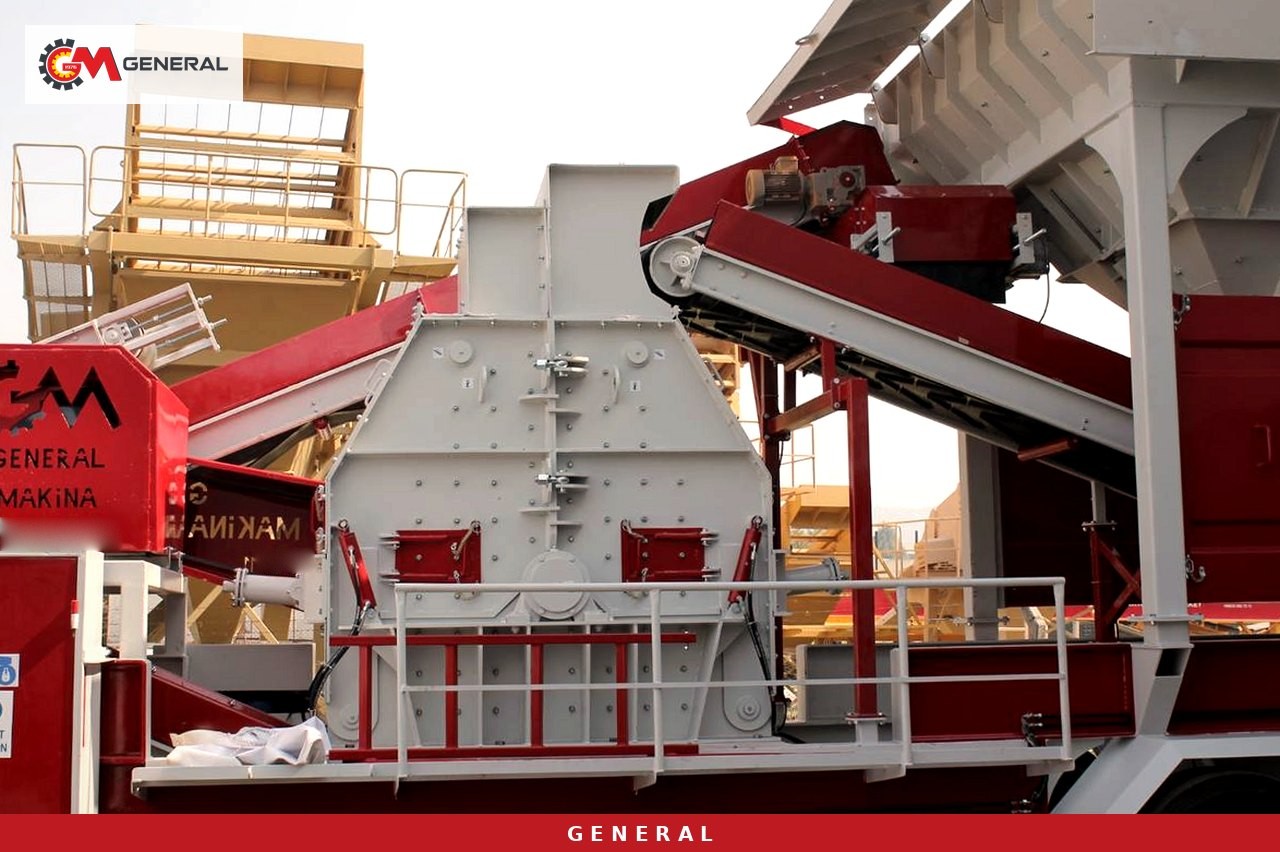
If the quarry is limestone or a low-abrasive sedimentary rock, the General 800 matches the target range exactly: the PDK 1280 primary impactor delivers high reduction and cubical grains in one body, and the 3-deck screen separates up to four products (0-5 / 5-12 / 12-19 / 19-40 mm). At 35,000 kg it is the lightest plant on the list. Using it in hard gneiss is technically possible but raises wear cost, which is why the rock test comes first.
Short sections and clay-laden river material: the 640 and the Mobil 90
For maintenance work or short sections, the General 640 handles hard rock at 60-100 t/h with its jaw + impact arrangement and fits the bottom of the band. If you are working clay-contaminated river gravel, a dry plant will not give clean aggregate. The Mobil 90 combines crushing, wet screening and a twin screw that retains 0-5 mm sand on one chassis, removing the need for a separate washing plant; a water source on site is, of course, a precondition.
Shipping and setting up in a landlocked country
Malawi has no seaport. A plant leaving Izmir reaches the ports of neighbouring countries by sea and then crosses the border by road. Nacala and Beira in Mozambique and Dar es Salaam in Tanzania are the starting points of the known corridors into the country. Which corridor to use should be settled with the logistics company based on port handling, transit documents and the site's location inside Malawi.
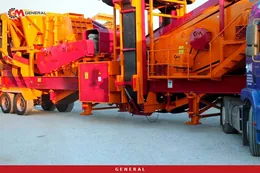
A wheeled chassis has a concrete advantage here: the plant travels behind a tractor unit, with no separate carrier and no dismantling. The loading dimensions, however, affect corridor choice. The stated figures are 3600×15500×4500 mm for the General 800, 3500×17000×4500 mm for the General 640, 3600×15700×4500 mm for the Mobil 90, and 4130×20350×4500 mm for the 944 and 950. A width over 4 metres and a length over 20 metres can mean permitted abnormal-load transport and route surveys; confirm the transit countries' rules with your haulier in advance.
On arrival, folding conveyors and hydraulic legs mean no concrete foundation is poured. Moving the plant to the next quarry as the road advances is therefore a logistics plan, not an engineering project. Mapping the quarry points and relocation frequency along the alignment beforehand is the most effective way to shorten truck haul distances. If a tracked alternative is considered, or primary crushing alone is enough, portable rock crushers are also worth a look.
Rainy season, laterite overburden and off-grid sites
The wet season, roughly from November to April, directly shapes the production calendar of road sites in Malawi. Two problems stand out in this period: red laterite and clayey soil covering the quarry face get wet and blind the grizzly and screen meshes, and damp fines stick at conveyor transfer points. The by-pass section of the vibrating grizzly feeder diverts the soil-laden fines away from the crusher; still, stripping the overburden during excavation is the cleanest solution. In the dry season, water sprays at transfer points and enclosed conveyors are measures that can be chosen per project for dust suppression.
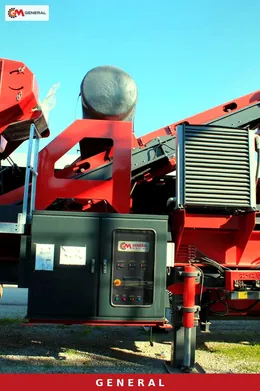
Most remote sites have no reliable grid connection, so power comes from a generator. Generator size varies by model: optional 300 kVA for the 640, 350 kVA for the Mobil 90, 450 kVA for the 800, 550 kVA for the 944 and 600 kVA for the 950. In hot, dusty weather, frequent cleaning of air filters and the radiator is the simplest yet most neglected maintenance step for the life of the engine and the electrical cabinet.
What to include in your quotation request
A sound quotation comes from a sound site description. With the list below completed, the model recommendation rests on data rather than guesswork:
- Rock type and, if possible, laboratory results (abrasiveness, crushability, compressive strength).
- Largest block size in the quarry; this decides between a 500, 600 or 800 mm feed opening.
- Fractions in the specification and daily demand for each (sub-base, base course, surfacing chippings).
- Clay or soil content of the material; whether washing is needed and whether water is available on site.
- Power source: grid or generator.
- The site's location in the country and the preferred port corridor.
- Number of quarries planned along the alignment and expected relocation frequency.
For a closer look at the fraction set-up for road layers, see our article on mobile plant configuration for road construction and sub-asphalt material.
Frequently asked questions
Can the General 800 be used in a Malawian gneiss quarry?
It can run, but a primary impactor wears its parts quickly in high-silica, abrasive rock. In gneiss and granulite, the jaw-primary 944 or 950 gives a more balanced operating cost. The final decision should follow a sample test.
Why recommend a 120-180 t/h model when the target is 80-150 TPH?
Running a machine continuously at its catalogue ceiling in hard rock shortens liner and screen mesh life. The 944 and 950 meet the top of the target at a more comfortable setting. If your target is in the lower half of the band, the 640 or 800 may suit better.
Which certificates and warranty are offered?
General Makina has been manufacturing in Izmir since 1976; the machines carry ISO 9001 and CE. A 1-year warranty is given, excluding wear parts.
What determines the price and delivery date?
The model, crusher arrangement, options such as generator and washing, the spare wear-part package and the port to which shipment is made are the main items of the quotation. Price and lead time are therefore stated in a project-specific offer prepared with the site information above.
Conclusion
When choosing an 80-150 TPH road plant for Malawi, look at the rock first: in the hard gneiss and granulite of the basement complex the jaw-primary 944 or 950 stands out, the General 800 in low-abrasive rock, the Mobil 90 for clayey river material and the 640 for short sections. Then check the loading dimensions against the port corridor and the generator rating against the site. Send your rock data, fraction list and site location through our contact page and we will prepare a configuration and quotation for your site.
Definitions of technical terms: Glossary