EN — English
 TR — Türkçe
 DE — Deutsch
 RU — Русский
 FR — Français
 ES — Español
 AR — العربية
 SR — Српски

Algeria Cement Raw Material Primary Impact Stone Crusher Plant 250-450 TPH
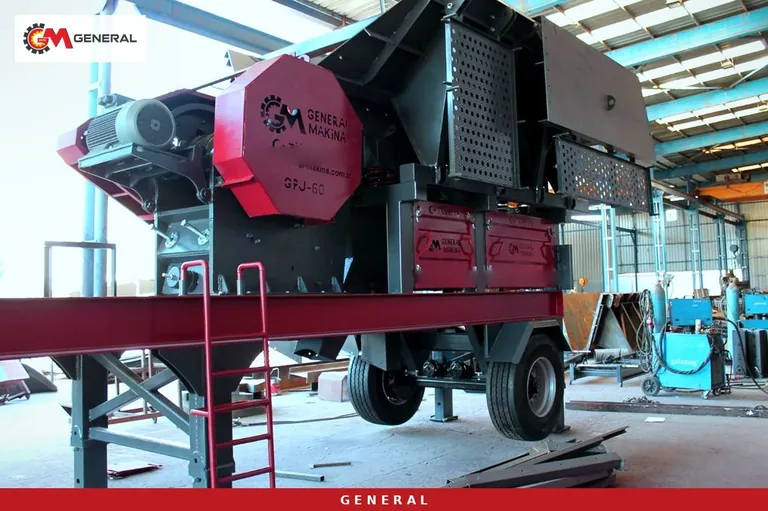
A cement works expects something different from its crusher than an aggregate quarry does. The aggregate producer talks about particle shape and the number of fractions; the cement side wants crushed limestone that keeps the raw meal chemistry steady on its way to the kiln, flows evenly into the pre-blending stockpile and does not overload the raw mill. In this article we look, through the eyes of a process engineer, at why a primary impact crusher stands out on a line that has to prepare 250-450 tonnes per hour of limestone and marl in Algeria, which real models cover that range, and what data must be collected at the quarry before the investment decision.
What the kiln line asks of the crusher: chemistry, top size, continuity
The crusher's task in cement raw material fits into one sentence: take the large, irregular blocks coming from the quarry and reduce them below the top size set by the mill supplier, at an uninterrupted and predictable feed rate. Cubical shape is a secondary issue here, because the raw material will be ground to powder in the mill anyway. What matters is three things.
The first is chemical consistency. Limestone does not go to the kiln on its own; it is prepared together with marl, clay or other corrective materials to balance silica, alumina and iron oxide. The steadier the crusher output, the easier the blend is to hit in the pre-blending pile. The second is size distribution. Too many oversize pieces raise the mill load, while an unnecessarily fine product increases dust and belt conveying losses. The third is continuity. When the crusher stops at an aggregate quarry, sales continue from stock; when the raw material stock runs down at a cement plant, the kiln schedule is at risk. Capacity should therefore be calculated around stoppage scenarios rather than average tonnage.
The character of cement raw material in Algerian quarries
In northern Algeria, particularly along the Tell Atlas belt, limestone and marl formations are widespread and the cement industry's raw material quarries rely heavily on this belt. A pure, hard limestone bench and clayey, moist marl layers can sit side by side in the same pit. That mix directly shapes crusher selection: hard benches set the crushing energy, clayey layers set the risk of blockage on the feed side.
Silica content is another factor that varies from site to site. Some limestone benches contain chert nodules or sandy interlayers. Such details cannot be read from a general geological map; no model should be chosen without abrasion and chemical analysis of samples taken from different levels of the quarry. Dust in the dry, hot summer months at inland pits and sticky marl in the rainy season at northern pits are two faces of the same operation, and the line is designed for both seasons.
Why a primary impact crusher pays off on limestone
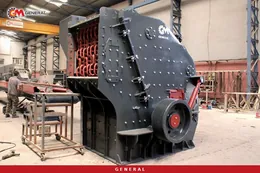
In a primary impact crusher (HSI), the blow bars on a horizontal rotor strike the material and throw it against breaker plates; breakage happens by free impact, not compression. On a brittle, low-abrasion rock such as limestone, this principle delivers very high reduction in a single stage. The GNR PDK series product data states a reduction ratio of up to 20:1 on limestone, well above typical jaw crusher ratios. For a cement line, the practical result is that fewer crushing stages, a shorter conveyor run and fewer transfer points are needed to reach the same final size. Fewer transfer points mean fewer dust sources and fewer maintenance points.
Another advantage of the impact crusher is that it handles clayey marl with fewer problems than a jaw crusher; material that would pack and cake in a jaw cavity is broken apart by the fast rotor impact. Even so, the real answer for wet, sticky feed lies on the feeder side, which we cover separately below.
What changes when silica rises?
The limit of an impact crusher is abrasiveness. The PDK product data gives the abrasion index Ai of limestone as roughly 0.001–0.03, and notes that on materials with more than 10% silica or an Ai above 0.15 the blow bars wear out very quickly, in which case a jaw + cone combination is preferred. If most of the raw material at an Algerian cement quarry is clean limestone but sandstone or silica sand is added as a silica corrective, preparing that additive on a separate route instead of passing it through the impact crusher keeps wear cost under control.
Real models covering 250-450 TPH
The table below compares primary impact crushers close to this capacity band using only values published on our product pages. Unknown cells are marked with a dash.
| Model | Design | Capacity (t/h) | Max. feed (mm) | Rotor (mm) | Motor (kW) | Weight (kg) |
|---|---|---|---|---|---|---|
| GNR PDK01 | Stationary primary HSI | 250–500 | 1000 | 1400×1500 | 315 | — |
| GNR PDK02 | Stationary primary HSI | 200–300 | 900 | 1400×1200 | 200 | — |
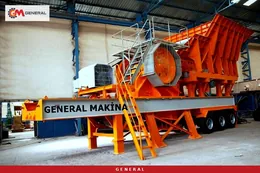
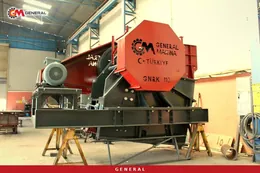
| M-PDK01 | Semi-mobile, with feeder hopper | 250-500 | 1200 | — | 315 | 50,000 |
| M-PDK02 | Semi-mobile, with feeder hopper | 200-300 | 1200 | — | 250 | 45,000 |
| GPS-1415 | Primary + secondary in one body | 150–400 | 1000 | 1400×1500 | 315 | — |
The conclusion is clear: the models that cover the whole 250-450 TPH band with a single machine are the GNR PDK01 primary impact crusher and its semi-mobile counterpart, the M-PDK01. The GPS-1415 tops out at 400 t/h, so it cannot meet a 450 t/h target alone; it is worth considering on lower-tonnage projects that also want a second-stage product. Readers comparing other crusher types can browse the crushers category.
Option A: a stationary GNR PDK01 line
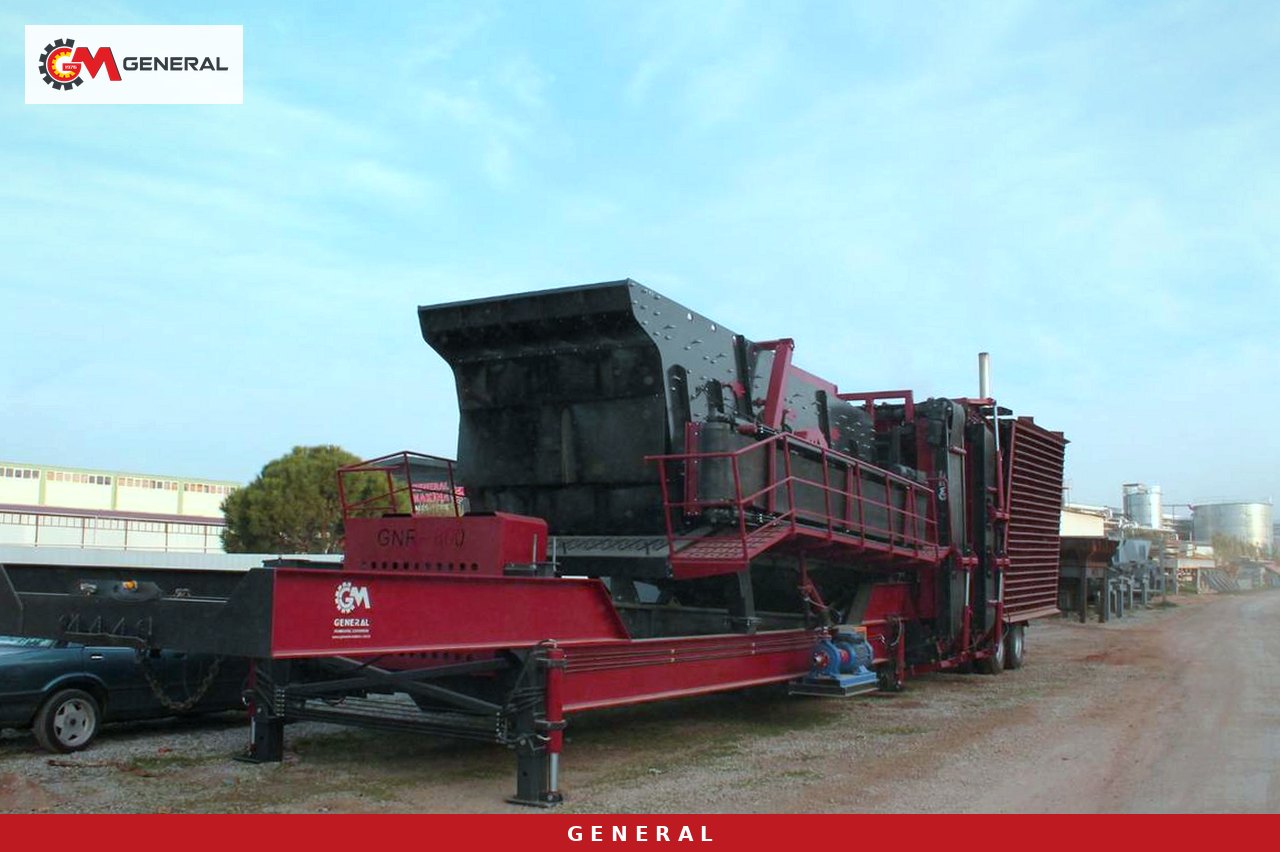
If the quarry has a long life and the crushing point will be linked to the plant by conveyor, the simplest solution is a single GNR PDK01 on a concrete foundation. Its 1000 mm feed opening accepts most of the large blocks from quarry blasting; the 315 kW motor and 1400×1500 mm rotor leave headroom above the 450 t/h target. Avoid one trap in feeder selection: a GNR 110 grizzly feeder at 200~300 t/h would starve this line, while the GNR 140 (1400×5000 mm, 2x9.2 kW) rated at 350~600 t/h matches the tonnage. For the full stationary layout, the stationary crushing plants page is a useful reference.
Option B: an M-PDK01 close to the quarry face
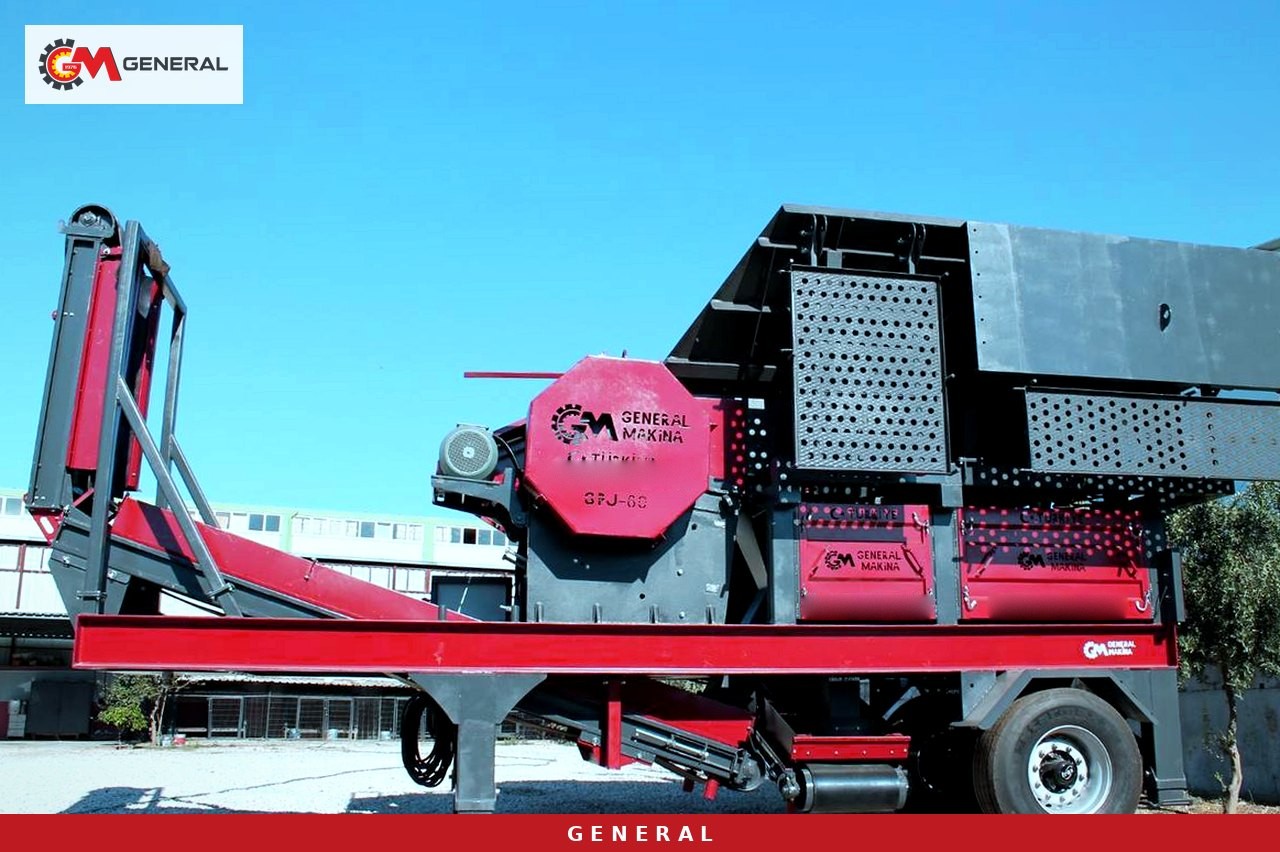
If the crushing point should move with the face as benches advance, the M-PDK01 semi-mobile primary impact crusher offers the same capacity band on a single chassis. The feeder hopper (1500×5000 mm) and crusher come together; it accepts 0-1200 mm feed and delivers 0-70 mm output. Shorter truck haul distances cut in-pit transport cost; on the other hand, every relocation of the 50,000 kg unit needs ground preparation and conveyor extension planned in advance.
Option C: two units for redundant feeding
If kiln continuity comes first, two M-PDK02 units (200-300 t/h each) reach a combined 400-600 t/h. In normal operation the pair covers 450 t/h comfortably; when one stops for a blow bar change or a fault, the other keeps feeding the pre-blending pile at close to the lower end of the band, around 250 t/h. Investment and operating items rise compared with one large machine; in return the raw material flow never drops to zero. Whether this option makes sense should be calculated together with the storage hall volume and the kiln's daily consumption.
Clayey marl and the rainy season: the feeder decision
At cement quarries the most frequent cause of lost capacity is not the crusher itself but clayey material bridging in the feeder or blinding the grizzly. For dry limestone benches a vibrating grizzly feeder is ideal: its bar section removes fines and soil before they enter the crusher, and the crusher mouth stays choke-fed. When the marl share is high and the season is wet, however, fixed bar gaps clog quickly.
For this condition the wobbler feeder (GWB1136) should be evaluated. Its synchronised shafts with elliptical discs clean themselves, separating the sticky fine fraction while carrying the large rock to the crusher. The figures given for the GWB1136 (75-600 t/h feed capacity, 18.5 kW motor power and 1500 mm maximum feed size) fit a 450 t/h PDK01 line. There is one more advantage specific to cement: the clayey fines removed here are often not waste but a component that can be used for alumina correction in the raw meal. Whether this fraction can be stockpiled on a separate belt and used should be assessed with the plant's chemistry laboratory.
Wear parts and tramp metal from blasting
The operating cost of a primary impact crusher is largely set by the blow bar alloy. High-chrome white cast iron is chosen for clean, highly abrasive feed; tough manganese or martensitic alloy is chosen where sudden impacts and tramp metal are a risk. The second case is more common at cement quarries than one might think: drill bits, bucket teeth and blasting debris can reach the crusher. A magnetic separator or metal detector on the belt line should therefore rank high among the measures that can be selected per project.
The same approach applies to dust. The crusher discharge, belt transfer points and stockpile feed conveyor are where dust concentrates. Covered belts, water spray suppression or filtered extraction are chosen according to the site layout and the plant's environmental specification. At inland pits where water is scarce a filter solution makes more sense; at pits with ample water but already moist marl, measured spraying is the better choice.
Data to gather from the quarry before requesting a quote
The right model and the right feeder can only be chosen with real quarry data. We list the information that should accompany a quote request:
- Chemical analysis and silica content of limestone and marl samples taken from different levels
- Abrasion test (Ai) and, if possible, compressive strength results
- Largest block size after blasting and typical size distribution
- Top size required by the mill supplier and the entry condition of the storage hall
- Hourly target plus daily and annual operating hours; redundancy needed for the kiln's raw material consumption
- Moisture and clay condition of the marl in the rainy season
- Power supply: grid connection or generator
- Distance and conveyor route between the crushing point and the plant
- Logistics: road route from the Mediterranean port to the quarry, bridge and road restrictions
It is also important to have the contract state which material and which output size the guaranteed capacity refers to; we cover this in detail in technical clauses to include in a crusher purchase contract. Capacity and environmental conditions in the technical specification of the plant or the authority responsible for the quarry should also be confirmed at the quotation stage.
Frequently asked questions
Do you have a machine already working in Algeria?
Yes, at a different scale: the General 01 mobile crusher project in Algeria at 150 t/h is listed on our site. That project is a mobile, lower-tonnage application; a 250-450 TPH cement raw material line is engineered separately around the PDK options above.
Can the primary impact crusher output go straight to the raw mill?
That depends on the top size the mill accepts. For the M-PDK series a 0-70 mm output is stated; if the mill needs finer feed, a second crushing or screening stage is required. The decision is made together with the mill supplier's feed requirement.
Can limestone and marl pass through the same line?
Yes; at many quarries both already come from the same blast. What matters is that the marl does not clog the feeder in the wet season and that both materials meet in the required ratio in the pre-blending pile. Feeder type and bar spacing are chosen for that balance.
What determines the price?
Model and quantity (a single PDK01 or two M-PDK02), stationary or semi-mobile design, feeder type, conveyor length, dust and metal separation equipment, power solution and shipping scope set the price. A project-specific quote is prepared from the quarry data.
Conclusion
For preparing 250-450 t/h of limestone and marl at a cement quarry in Algeria, the most direct route is a GNR PDK01 delivering high single-stage reduction, or an M-PDK01 working close to the face; if kiln continuity is the priority, a redundant layout with two M-PDK02 units is possible. The real difference comes from feeder selection, blow bar alloy and genuine analysis of quarry samples. Share your quarry data with our team, which has been building crushing and screening equipment in Izmir since 1976, through our contact page; we will prepare a quote for ISO 9001 and CE certified equipment with a 1-year warranty excluding wear parts.
Definitions of technical terms: Glossary