EN — English
 TR — Türkçe
 DE — Deutsch
 RU — Русский
 FR — Français
 ES — Español
 AR — العربية
 SR — Српски

Lesotho Highlands Dams Basalt Aggregate Crusher Plant 200-300 TPH
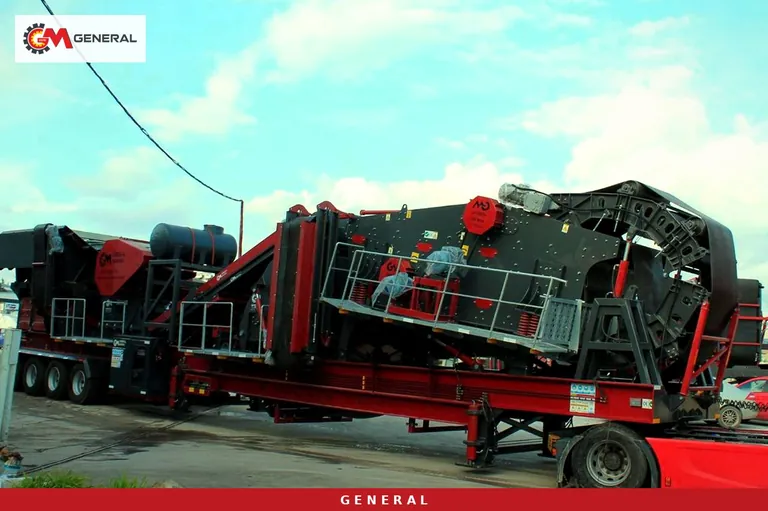
The eastern and northern highlands of Lesotho are capped by thick basalt flows that form the Drakensberg escarpment. The dams, transfer tunnels and access roads of the Lesotho Highlands Water Project sit in or right beside this rock. For an aggregate engineer the picture is simple: the raw material is under your feet, but turning it into aggregate with the cleanliness, particle shape and continuity that dam concrete demands is a separate task. This article explains which real machine layouts meet a 200-300 TPH basalt target, what changes the choice on a high-altitude site reached by narrow roads, and which data should be on the table before you ask for a quotation.
We give no information on project phases, volumes, schedules or contractors; confirm the concrete and aggregate specification with the relevant project authority and the employer's technical documents. All machine values in this article are catalogue data from our product pages.
What Drakensberg basalt brings to dam concrete, and what it takes away
Highland basalt is usually fine-grained, dark and massive. Massive basalt gives a strong, dense aggregate, exactly what body concrete and tunnel lining need. The same flow, however, can contain vesicular (gas-bubble) levels, weathered and clay-rich bands, and reddish interlayers trapped between flows. When this weak material passes through the crusher it raises the fines content, produces flaky particles and increases the water demand of the concrete.
Chemical compatibility is another issue for dam concrete. Some volcanic rocks can react with the alkalis in cement, so a petrographic examination and an alkali-silica reactivity test should be carried out before the quarry is opened. A crushing plant cannot change that result, but it can keep the product clean by removing weathered material at the pre-screening stage. Do not choose a machine without knowing how your own quarry behaves: take samples from several points and have compressive strength, Los Angeles abrasion loss and abrasiveness measured in a laboratory.
How it affects the choice of crusher type
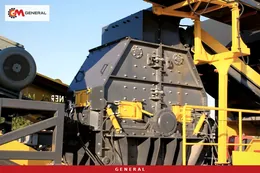
The hardness and silica content of basalt point to compression crushers: a jaw crusher at the primary stage, and at the second stage either a cone crusher with long liner life or an impact/cubicizer group that corrects particle shape. An impact secondary gives cubical product, but in hard basalt liner changes become more frequent; a cone secondary protects the metal but is more sensitive to steady feeding. In dam concrete, particle shape and grading continuity are often decisive, so the balance is set project by project.
Three real layouts for 200-300 TPH
The capacity band in the title has to be met by a line, not by a single unit. The table below sets out three ways of reaching it, using the values on our product pages. Values that are unknown or depend on the project are shown as "—".
| Criterion | GNR-MC110 (single line) | 2 × General 950 (parallel) | Fixed line: GNRK 110 + cone |
|---|---|---|---|
| Capacity | 200-300 t/h | 2 × 120-180 t/h | GNRK 110: 200-350 t/h (primary) |
| Primary crusher | GPJ 110 jaw | GPJ 90 jaw | GNRK 110 jaw, opening 1100×850 mm |
| Secondary crusher | DMK03 impact | DMK01 impact | Cone crusher (model per project) |
| Maximum feed | 900 mm | 800 mm | — |
| Screen | 2000×6000 mm, 4 decks | 1600×5000 mm, 3 decks (each unit) | e.g. GNR 2060, 2000×6000 mm |
| Generator | 750 kVA | 600 kVA (each unit) | — |
| Weight | 2 chassis × 55,000 kg | 2 × 70,000 kg | — |
| Products | 0-5 / 5-12 / 12-19 / 19-40 mm | 0-5 / 5-12 / 12-19 mm | According to screen decks |
GNR-MC110: covering the whole band with one line
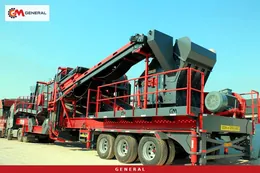
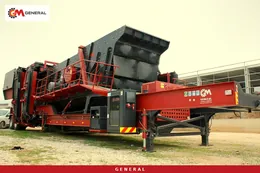
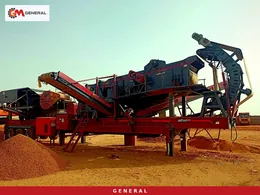
The GNR-MC110 carries a GPJ 110 jaw primary and a DMK03 impact secondary on two separate wheeled chassis. Accepting 900 mm feed, it takes large blasted basalt blocks without pre-breaking. The four-deck 2000×6000 mm screen also stockpiles the coarse 19-40 mm fraction that dam concrete calls for. Because the two chassis travel separately, you never have to move a single 70-tonne load over highland roads, and the primary group can start working before the secondary arrives.
Two General 950 units: redundant production
Two General 950 plants installed in parallel work together in the 240-360 t/h range, putting a safety margin above the title band. The real advantage is redundancy: while one unit has a liner change or service, the other keeps feeding the concrete crews. The drawback is that two units need separate feeding, separate operators and two generators. The three-deck screen of the 950 does not deliver material above 19 mm as a separate fraction; if coarse aggregate is required, an additional screen must be planned.
Fixed line: when one quarry feeds the job for years
If dam construction will draw on the same quarry for several years, a concrete-founded stationary crushing plant is a serious option. A GNR 110 vibrating grizzly feeder (200-300 t/h) removes weathered fines ahead of the primary, the GNRK 110 jaw crusher breaks the blocks, and a cone crusher reduces the basalt at the second stage while protecting the metal. On a fixed line the number of screen decks and stockpile conveyors is not limited by chassis size, so the separate fractions required by the batching plant come out more easily. In return, foundations, erection and a permanent power connection are needed.
Mountain roads and altitude: from shipment to the first tonne
Lesotho is landlocked and entirely surrounded by South Africa. A plant shipped from Turkey travels by sea to a port in the region, then by road to a border crossing, and finally onto winding, steep roads that climb to the highlands. On this route the deciding factors are curve radii, bridge load limits and transit permits. Walk the route with your haulier in advance and compare the transport dimensions of every unit with it.
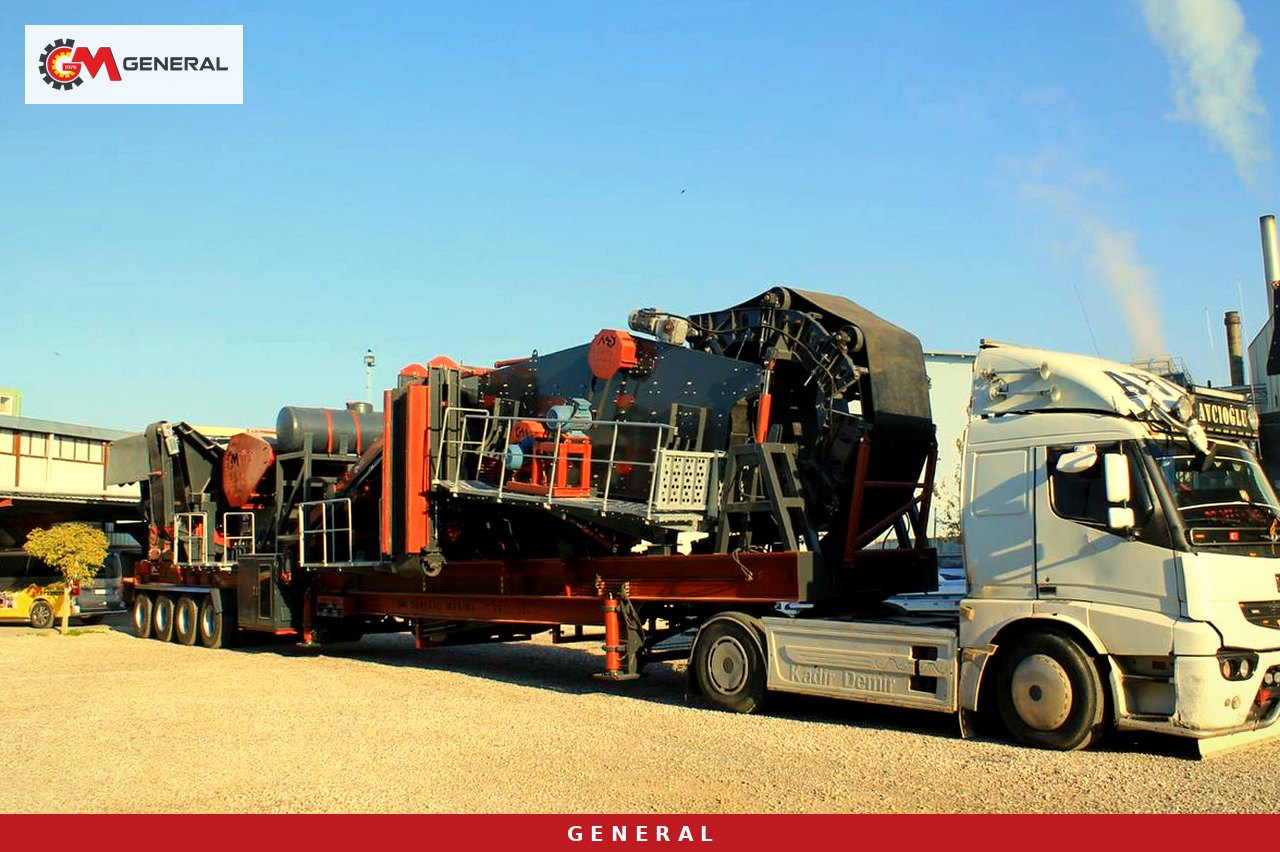
The General 950 travels on one chassis with transport dimensions of 4130 × 20350 × 4500 mm and is brought into working position on site in about 30 minutes. On the GNR-MC110 the primary chassis measures 3000 × 13500 mm and the secondary chassis 4200 × 18300 mm; two shorter pieces make manoeuvring on tight bends easier. Whichever is chosen, a compacted, level platform must be prepared on site for the chassis support legs.
Altitude also affects diesel engines. As elevation rises the air thins and the power a generator can deliver falls, so the kVA value in the catalogue should be read as a near-sea-level figure. For a plant working at high altitude, either one size larger is selected using the generator manufacturer's derating table, or the crusher motors and generator are sized together. Frost and snow in the highland winter affect water lines, dust suppression nozzles and hydraulic oil selection; drain valves against freezing and winter-grade oil should be added to the project.
Product plan for a dam site
Dam concrete is not a single "chippings" product but a set of complementary fractions. A typical plan stockpiles crushed sand, fine gravel, medium gravel and coarse gravel separately; shotcrete and tunnel lining need a finer grading. The number of screen decks comes straight into play here: a four-deck screen gives four products, a three-deck screen three. If the specification includes a fifth fraction, a separate screen or an extra deck on a fixed line has to be considered.
The fines content of crushed sand is the item that most affects concrete quality in basalt. If dust exceeds the specification limit, sand washing or air classification is needed. If particle shape proves poor, adding a cubicizer or vertical shaft impactor after the second stage of a wheeled mobile plant lowers the flakiness index. These additions should be requested as separate items in the first quotation; fitting them later becomes difficult because of conveyor lengths and layout.
Wear and dust: items that can be controlled on site
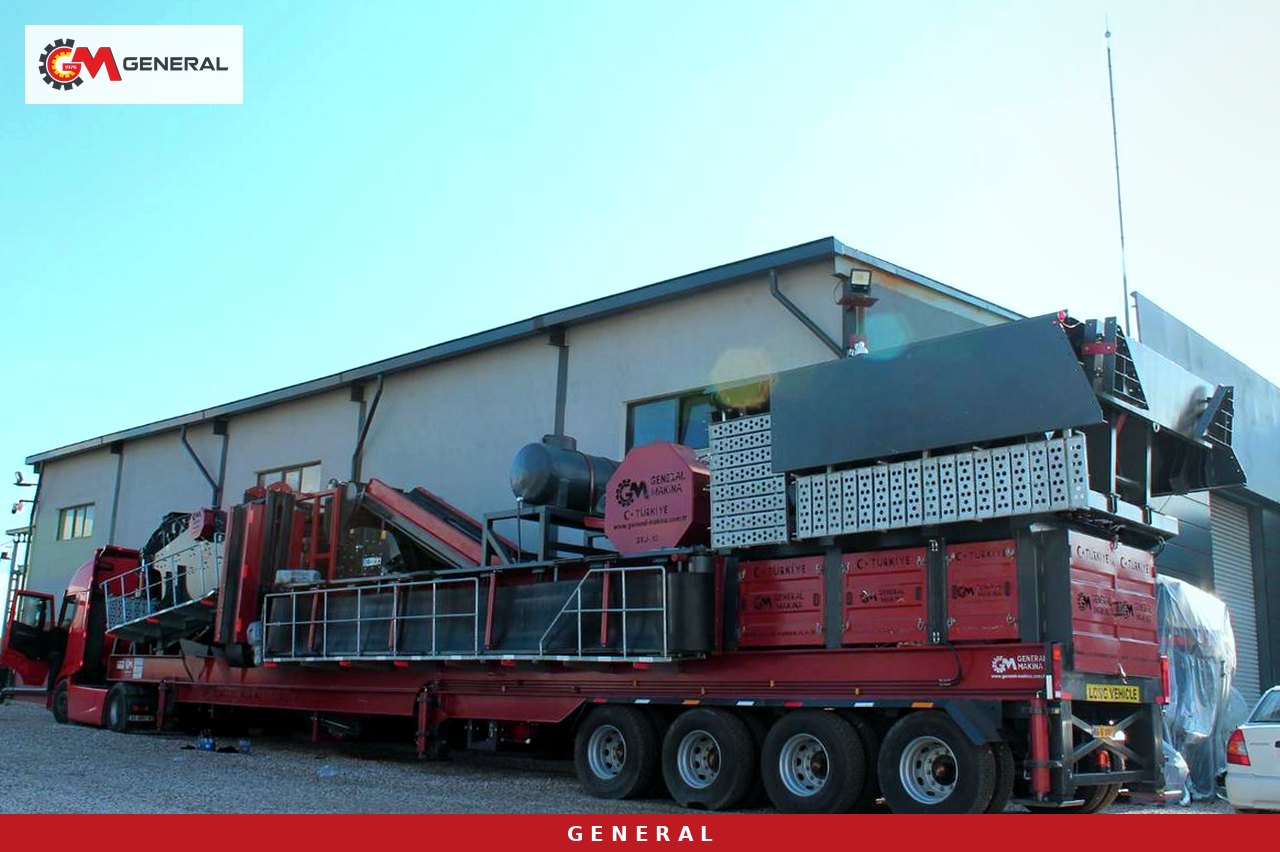
In a basalt quarry, wear cost is controlled through liner material and feed regularity. In a jaw crusher, manganese steel jaw plates work-harden on the surface under impact; in a cone crusher, manganese or high-chrome liners are chosen according to the silica content of the rock. A grizzly feeder that removes fines before the primary stops liners from working for nothing. For dust, water-spray suppression, curtains at conveyor discharge points and, where needed, covered belts are measures that can be selected per project; highland wind and dry-season dust travel quickly along open conveyors.
Information to collect on site before requesting a quotation
- Sampling points and laboratory results: compressive strength, abrasion loss, silica content, alkali-silica reactivity report.
- Largest block size after blasting (will 900 mm or 800 mm be accepted?).
- The fractions in the concrete specification and the daily share of each.
- Permitted fines content for crushed sand and the need for washing.
- Approximate site altitude, winter conditions and whether grid power is available.
- Curve, bridge and tunnel restrictions on the route from port to site.
- How many years the quarry will stay in one place: the mobile-or-fixed decision depends on it.
- Dust and noise limits in the employer's environmental management plan.
Once this list is filled in, the right layout usually becomes obvious. A wider comparison of model selection for hard, abrasive rock is in our article on choosing a mobile crushing plant for basalt and granite.
Frequently asked questions
Impact secondary or cone secondary for dam concrete?
If particle shape is the priority, an impact secondary (DMK03 or DMK01) gives cubical product; if wear cost is the priority, a cone crusher protects the metal. In massive basalt a cone is considered; where the flakiness limit in the specification is tight, an impact unit or a cone + cubicizer combination is evaluated.
Can the primary group of the GNR-MC110 work on its own?
Yes. The primary and secondary chassis are independent; during quarry preparation the primary group can produce fill or road sub-base on its own, and the secondary is brought in later.
What are the warranty and certificates?
Our plants carry ISO 9001 and CE certification, with a 1-year warranty excluding wear parts. General Makina has been manufacturing in Izmir since 1976.
What determines price and delivery time?
The layout (single line, two parallel units or fixed line), the number of screen decks, additions such as sand washing, generator power and the shipping route determine the price. The delivery time is stated in writing in the quotation once the configuration is final.
Conclusion
Producing basalt aggregate in the Lesotho highlands means choosing the right crusher type and also accounting for narrow roads, high altitude and the grading discipline of dam concrete. For 200-300 TPH, the GNR-MC110 offers a flexible single line, two General 950 units give redundancy, and a fixed GNRK 110 + cone line suits long-life quarries. Share your laboratory results and specification and we will prepare a project-specific layout and quotation: reach us through our contact page.
Definitions of technical terms: Glossary