EN — English
 TR — Türkçe
 DE — Deutsch
 RU — Русский
 FR — Français
 ES — Español
 AR — العربية
 SR — Српски

Ethiopia Basalt Wear-Resistant Aggregate Crusher Plant 150-250 TPH
An investor opening a quarry in the Ethiopian highlands usually finds basalt underfoot: the high plateaus and the shoulders of the Rift Valley are blanketed by layer upon layer of volcanic rock. That abundance is good news, because sound basalt yields the strong aggregate that concrete and asphalt specifications ask for. The bad news is that the same stone steadily eats crusher liners. In this article we do not treat "wear-resistant" as an advertising adjective. We explain, step by step, which design decisions lower metal consumption in a line handling 150-250 tonnes of basalt per hour, which models genuinely fit that band, and how site conditions specific to Ethiopia shape the choice.
Every model figure below comes from the catalogue data on our product pages. We give no information about any particular quarry, tender or road project; please confirm specification requirements with the relevant authority and the employer's technical documents.
How does Ethiopian basalt behave in a crusher?
It is normal to meet very different basalts in the same country, even in the same pit. Massive, fine-grained, dark flow basalt has high compressive strength and is the type that loads a crusher hardest. Vesicular basalt, full of gas cavities, is lighter and breaks more easily, but its voids raise the share of fines and dust. Weathered upper benches carry clay and soil; in the rainy season this material sticks in the feeder and breaks the rhythm of the line.
The main driver of wear is not Mohs hardness but free silica and the Bond abrasion index (Ai) that follows from it. Our cone crusher page gives an order of magnitude of Ai≈0.20 for basalt and Ai≈0.55 for granite. Basalt is therefore less abrasive than granite; what makes it demanding is the compressive and impact load its high strength places on the machine. This distinction decides the model: impact crushers can run on basalt, but their blow bar consumption rises faster than that of jaw and cone crushers, which work by compression.
A selection made without your quarry's real values is a guess. At quotation stage we ask for samples from the massive and vesicular levels, and if possible the weathered top zone, tested for compressive strength, Bond Ai, moisture and clay content. The recommendations that follow are starting points to be confirmed by those results.
Three real layouts that cover 150-250 TPH
No single basalt model in our catalogue spans exactly 150-250 TPH on its own. The target band is therefore reached in three different ways, each matching a different investment and operating style.
Two General 944 plants in parallel
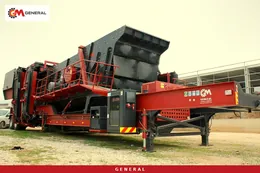
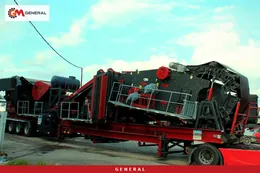
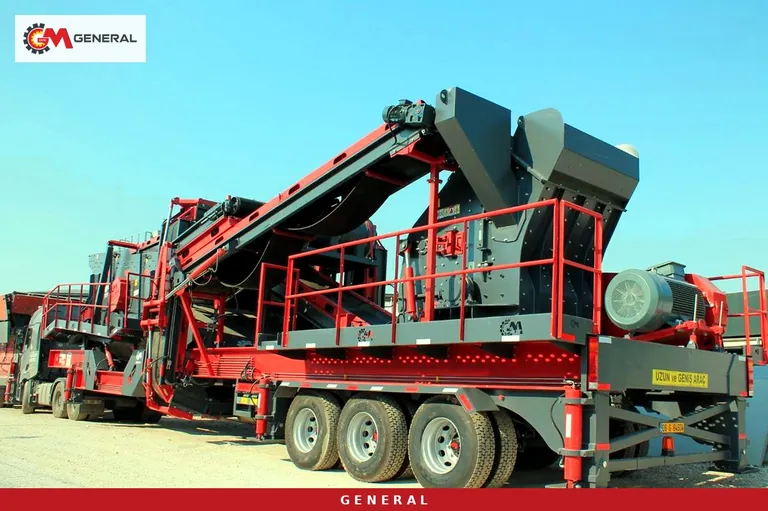
The General 944 combines a GPJ 90 primary jaw and a GM430 secondary cone on one wheeled chassis and works at 120-180 TPH. It accepts an 800 mm feed and, through a 1600×5000 mm three-deck horizontal screen, delivers 0-5 / 5-12 / 12-19 mm fractions. One unit covers demand around 150 TPH; targets approaching 250 TPH need two units running in parallel. The advantage is that both crushing stages work by compression, so metal life on basalt is long. While one unit is in maintenance the other keeps producing, a real safeguard on sites where spare parts travel a long way.
GNR 110 mobile jaw and GNR MK110 cubicizer
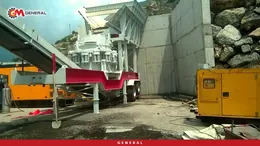
The second route uses two separate mobile units. The GNR 110 mobile primary jaw unit carries a 1100×4750 mm feeder and a GNRK 110 jaw on one chassis; it takes 0-1100 mm feed, delivers 0-250 mm product and runs at 180-300 t/h. The GNR MK110 cubicizer that follows turns feed of up to 350 mm into 0-25 mm cubical product at 160-250 t/h, with Hardox 500 internal liners. The primary's 0-250 mm output sits inside the cubicizer's 350 mm feed limit, so the two machines match dimensionally. The cubicizer, at 160-250 t/h, sets the line's ceiling. The strength of this layout is particle shape: the cubicizer's job is shaping rather than reduction, and it lowers the flakiness index. Its limit should be stated plainly too: our product page advises monitoring liner life in very abrasive material with high free quartz and, if needed, considering a cone crusher instead. If a massive, silica-rich basalt bench turns up, this choice is reviewed on the sample results.
Stationary line: GNRK 110 jaw and cone crusher
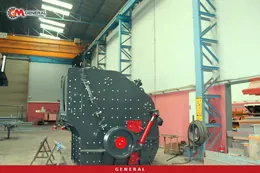
If the quarry has a long life and the crushing point will stay in one place for years, a stationary crushing and screening plant is the option to study. A GNR 110 grizzly feeder (200-300 TPH), a GNRK 110 jaw crusher with a 1100×850 mm opening (200-350 TPH) and a General cone crusher in the secondary stage form the backbone of this band. Because model-specific cone capacity is given per project, it is shown as "—" in the table; the catalogue orders of magnitude are 6:1-8:1 reduction in secondary duty and 50-250 mm feed.
| Layout | Crushing stages | Capacity (t/h) | Max. feed | Energy / power | Weight |
|---|---|---|---|---|---|
| One General 944 | GPJ 90 jaw + GM430 cone | 120-180 | 800 mm | 550 kVA generator | 70,000 kg |
| Two General 944 in parallel | 2 × (GPJ 90 + GM430) | 240-360 (combined) | 800 mm | 2 × 550 kVA | 2 × 70,000 kg |
| GNR 110 mobile primary + GNR MK110 | GNRK 110 jaw + rotor cubicizer | 160-250 (cubicizer limit) | 1100 mm | GNRK 110: 110/132 kW; MK110: 200 kW | Primary: 55,000 kg; cubicizer: |
| Stationary line | GNR 110 feeder + GNRK 110 + cone | Feeder 200-300; cone | 1100×850 mm opening | GNRK 110: 110/132 kW; feeder 2×7.5 kW; cone | GNRK 110: 33,000 kg |
The practical reading of the table: for 150-180 TPH, a single General 944 is the simplest answer. At 200-250 TPH, two 944s give both capacity and redundancy; if particle shape is the strictest clause in the specification, the jaw plus cubicizer pair comes forward. If the product range calls for 8 or more sizes, high tonnage and a long service life, the stationary line is the one to evaluate. You can compare all mobile and fixed options on our wheeled mobile crushing plants page.
Four engineering decisions that make a crusher wear-resistant
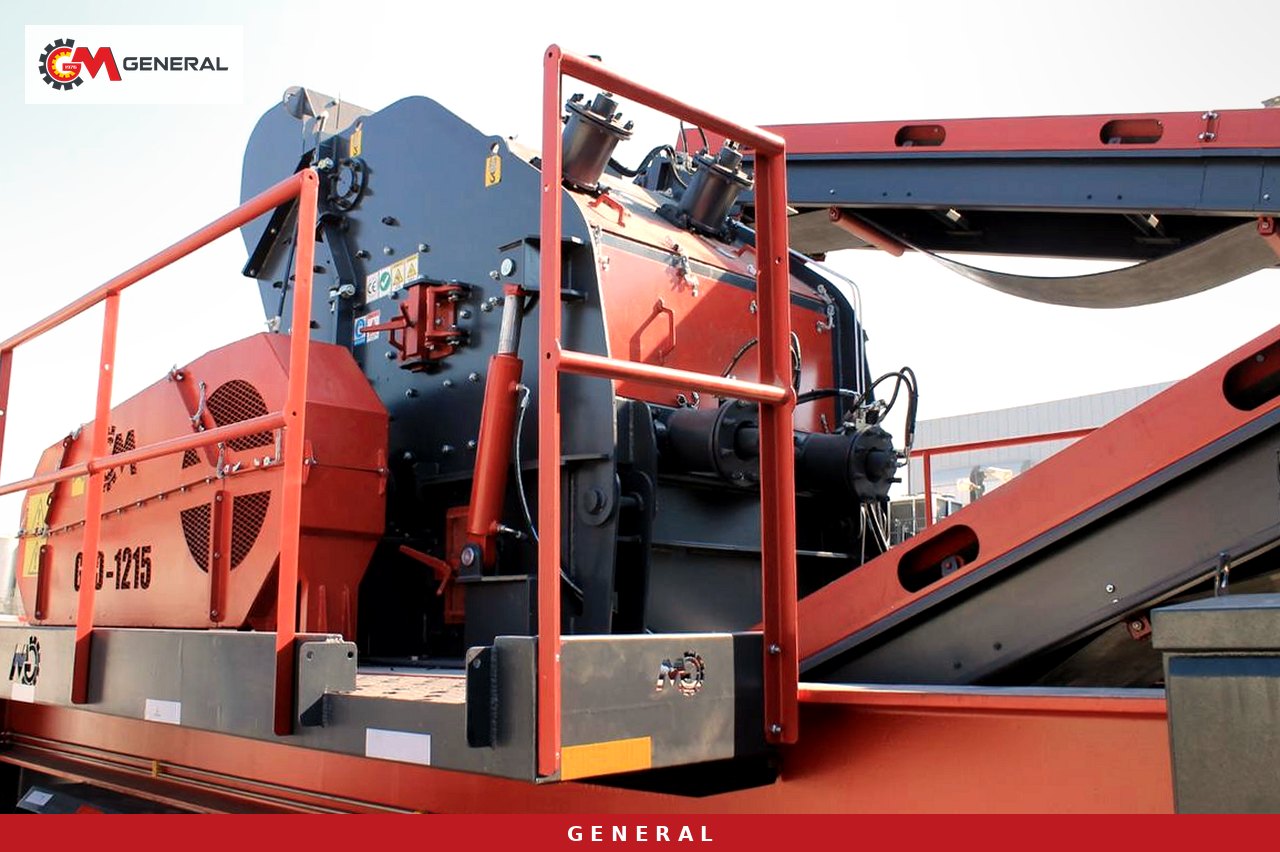
No single part decides how much metal a crusher burns on basalt. When the four decisions below are made correctly together, wear cost per tonne falls; when one is missing, the others do not deliver their expected result.
- Keep fines out of the crusher. The by-pass section of the grizzly feeder drops soil and fines through the bar gaps; because this material never enters the crusher, it does not wear the liners for nothing. The effect is most visible with clayey basalt from the weathered top zone.
- Prefer compression crushing. Jaw and cone crushers squeeze stone between two surfaces; there is no high-speed strike as in an impactor. On high-strength rock such as basalt this means slower, more predictable wear.
- Match the alloy to the rock. The standard for jaw plates and cone liners is austenitic manganese steel (Mn13/Mn18/Mn22): under impact its surface hardness rises from about 200 HB to 550 HB. High-chrome white iron (about 700-800 HB) resists abrasion but is brittle and can crack under coarse, tramp-metal-laden feed. The cubicizer uses Hardox 500 liners.
- Keep the mouth full. A feeder that keeps the crusher mouth constantly full (choke feed) builds a bed in which stone breaks stone. In a half-empty cone crusher, certain zones of the liner gouge out quickly and particle shape deteriorates.
To track the effect of these decisions in your own quarry, follow wear cost per tonne with a simple formula: (liner set cost + changeover labour + production lost during downtime) ÷ tonnes crushed between two changes. A hypothetical example: if a liner set and its change total 100 units and 50,000 tonnes are crushed between changes, the cost is 0.002 units per tonne. If improved feeding lets the same set run 60,000 tonnes, the figure drops to about 0.0017 units per tonne. Real values come from samples and operating records; jaw plates, blow bars and cone liners are excluded from the 1-year warranty, so budget accordingly.
From the port of Djibouti to the quarry: transport, power and climate
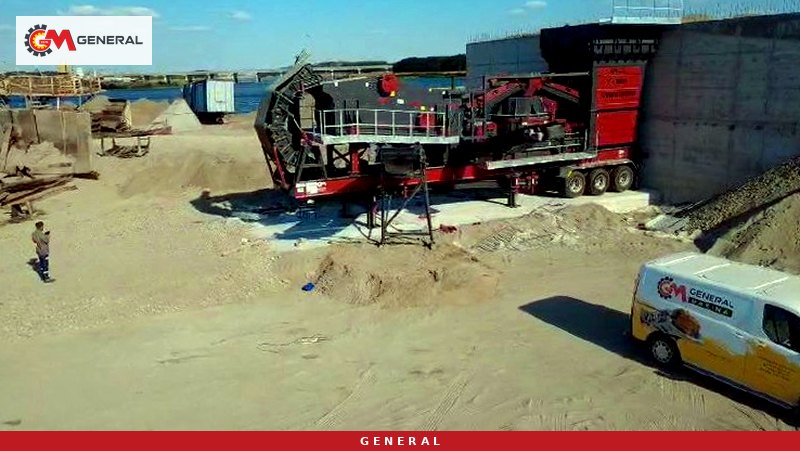
Ethiopia is landlocked; imported equipment mostly arrives through the port of Djibouti and then travels long road routes inland. On that route, wheeled mobile plants make life noticeably easier: the General 944, at 4130×20350×4500 mm and 70,000 kg, is towed as a single chassis, and the GNR 110 mobile primary sets up without foundations on hydraulic legs. A stationary line ships its crusher body, feeder and screen separately, so part dimensions and weights must be fixed at the start of shipping planning. Confirm bridge and road limits on the route with a local haulier.
Highland quarries sit at high altitude. Diesel engines and generators are known to lose power at altitude, so the site elevation should be given to the manufacturer when sizing the generator and the rating corrected for it. The catalogue value for the General 944 is 550 kVA. On sites close to the grid, electric operation can also be considered; the combined crusher, screen, feeder and conveyor motors then form the basis of the connection load.
Climate brings two separate scenarios. In the eastern lowlands and semi-arid zones, dry-season dust means engine and compressor filters are changed more often; water-spray dust suppression at belt transfer points and enclosed conveyor runs are measures that can be selected per project. In the highlands, the long rainy season raises clay and moisture in the feed; grizzly gaps and screen apertures should be adjusted to the season, with washing planned separately if needed.
Data to collect at the quarry before asking for a quote
As a reference we have delivered in Ethiopia, the 150 t/h basalt crushing and screening project in Jijiga shows how a line of similar scale was put together. So that we can recommend the right layout for your project, send the following together:
- Compressive strength, Bond Ai, moisture and clay content of samples from the massive, vesicular and weathered levels
- Largest block size after blasting and how material will be tipped into the hopper
- Target fractions and the daily tonnage of each; the flakiness limit the specification sets for particle shape
- Site altitude, whether grid power is available, and generator preference
- Route from Djibouti to site, with weight and dimension limits
- Estimated quarry life and whether the crushing point will move
Frequently asked questions
Why is an impact crusher not the first choice for Ethiopian basalt?
An impact crusher gives high reduction and good shape, but basalt's high strength consumes blow bars quickly. Jaw and cone crushers break rock by squeezing it, so metal consumption is lower and more predictable. In a soft, low-abrasion rock the decision may differ; a sample test shows which.
Does a cubicizer or a cone crusher give better particle shape?
The GNR MK110 cubicizer's main task is shaping, and it delivers 0-25 mm cubical product. A choke-fed cone crusher also produces cubical product and has longer liner life in siliceous material. If your basalt is moderately abrasive, the cubicizer fits; if silica is high, the cone is the safer choice.
What warranty and certificates apply?
Our machines carry a 1-year warranty; wear parts are excluded. Production follows an ISO 9001 quality management system and the machines are CE certified.
What determines price and delivery time?
Layout type (mobile, two units or stationary), number of stages, screen and conveyor selection, generator requirement, automation scope and the spare liner package added to the first order. Once these are clear, a project-specific quotation is prepared.
Conclusion
For basalt aggregate in Ethiopia at 150-250 TPH, the right crusher depends on the type of basalt in the pit and the priority of the specification: one or two General 944 plants for a simple, redundant solution; a GNR 110 mobile primary with a GNR MK110 cubicizer when shape comes first; a stationary line with a GNRK 110 and a cone crusher for long-life high tonnage. Wear resistance is achieved by applying pre-scalping, compression crushing, the right alloy and choke feeding together. As a team building crushing and screening equipment in Izmir since 1976, we can draw up your flow sheet from your sample results; send your data through our contact page.
Definitions of technical terms: Glossary