EN — English
 TR — Türkçe
 DE — Deutsch
 RU — Русский
 FR — Français
 ES — Español
 AR — العربية
 SR — Српски

Kinshasa Asphalt Chippings: DR Congo Aggregate Crusher Plant 150-250 TPH
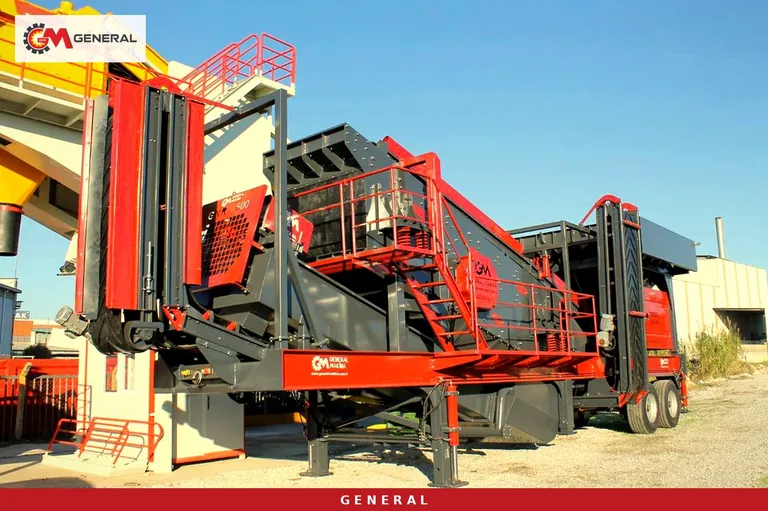
When an asphalt contractor in Kinshasa orders chippings, the first question is usually "how many tonnes per hour?" Yet what gets a wearing-course sample rejected is rarely tonnage; it is flaky, elongated particles. An investor supplying road rehabilitation and new link roads in the capital of the Democratic Republic of the Congo can set up a 150-250 TPH crushing and screening plant, but the real challenge is keeping the 5-12 and 12-19 mm fractions inside that tonnage well shaped, clean and continuous. This article walks through the real machine combinations that reach that target, in decision order, from rock selection to shipment through the port of Matadi.
For asphalt chippings, particle shape outranks tonnage
A bituminous mix carries load through aggregate interlock. Cubical particles create that interlock; flaky ones break under the roller, disturb the bitumen film, shift the void content and set the stage for rutting. That is why the laboratory's flakiness index, abrasion resistance and clay-and-dust content are the starting point of machine selection. The limit values that apply are written in the contractor's specification and the client's technical annexes; do not freeze the configuration before you have that document in hand.
A crushing line has three levers on particle shape. The first is not overdoing the reduction ratio at the primary; a big reduction in one stage produces flaky stone. The second is keeping the secondary choke-fed; in a full chamber rock breaks against rock and the edges even out. The third is adding a shaper to the final product stream. On a line working for Kinshasa's asphalt volume, the third lever is often decisive, because urban wearing courses are where the tightest shape limits are enforced.
What rock reaches Kinshasa: from soft sandstone to hard rock
Much of the near-surface rock around Kinshasa is weakly cemented, soft sandstone. It can serve for fill and sub-base work, but it often lacks the strength an asphalt wearing course expects. Hard aggregate for asphalt generally comes from quarries towards Kongo Central, from sites holding limestone, quartzite and igneous rock. Which quarry yields which rock varies from site to site; the two scenarios below directly change the machine choice.
Soft and medium-hard rock
In low-abrasion limestone and similar rock, an impact secondary gives both high reduction and cubical particles. A jaw primary followed by an impact secondary keeps metal consumption reasonable here and can reduce the need for a shaper.
Hard, high-silica rock
In hard, abrasive rock such as quartzite, granite or dolerite, a cone crusher working on compression in the second stage makes wear parts last far longer. If a shaper is used in such rock, liner life must be watched closely. In both scenarios, a Los Angeles abrasion test, Bond abrasion index and flakiness test on samples taken from the quarry are the first step that decides how accurate the quotation will be. For a detailed comparison see the ideal mobile crushing plant configuration for road construction.
Four real configurations for 150-250 TPH
Loading this whole band onto a single machine is not sound engineering. The combinations below are built from the published values of General Makina catalogue models; cells with no catalogue figure are marked "—".
| Configuration | Crushers | Capacity | Max. feed | Screen and product | Power |
|---|---|---|---|---|---|
| General 944 + GNR MK100 | GPJ 90 jaw, GM430 cone; MK100 cubicizer (rotor 1550×1200 mm) | 944: 120-180 t/h; MK100: 90-130 t/h | 800 mm; MK100: 250 mm | 1600×5000 mm triple-deck; 0-5 / 5-12 / 12-19 mm | 550 kVA generator; MK100 motor 132 kW |
| General 950 + GNR MK100 | GPJ 90 jaw, DMK01 impact; MK100 cubicizer | 950: 120-180 t/h; MK100: 90-130 t/h | 800 mm; MK100: 250 mm | 1600×5000 mm triple-deck; 0-5 / 5-12 / 12-19 mm | 600 kVA generator; MK100 motor 132 kW |
| GNR-MC110 (twin chassis) | GPJ 110 jaw, GS1215 / DMK03 impact | 200-300 t/h | 900 mm | 2000×6000 mm four-deck; 0-5 / 5-12 / 12-19 / 19-40 mm | 750 kVA generator |
| GNR-MC110 + GNR MK110 | Line above; MK110 cubicizer (rotor 1550×1800 mm) | MC110: 200-300 t/h; MK110: 160-250 t/h | 900 mm; MK110: 350 mm | Four-deck screen; cubicizer output 0-25 mm | 750 kVA generator; MK110 motor 200 kW; total power |
Lower band: 150-180 TPH
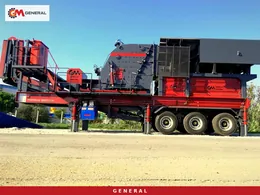
If the rock is hard and abrasive, the General 944 comes first; in soft or medium-hard rock, the General 950. Both share the same weight (70,000 kg), dimensions and capacity; the difference is the second stage: a GM430 cone on the 944, a DMK01 impactor on the 950. If shape is pushing the specification, the MK100 is tied into the line to take only the stream feeding 5-12 and 12-19 mm. So its 90-130 t/h rating should be compared with the amount of fraction to be shaped, not with total tonnage.
Upper band: 200-250 TPH
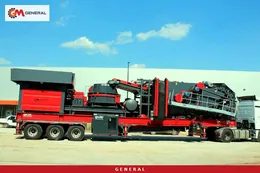
The GNR-MC110 is the family's highest-capacity jaw-primary line, delivering 200-300 t/h on 900 mm feed. The primary group (GPJ 110) and the secondary group (DMK03 with a four-deck screen) sit on separate chassis, and the primary can run alone. That layout lets the investment be split: sub-base material is produced first with the primary group, and the secondary group plus an MK110 cubicizer are added once asphalt contracts firm up. At a 250 TPH target where shape is critical, the MK110's 160-250 t/h range and 350 mm feed limit match this line.
Where the cubicizer sits in the line and what it fixes
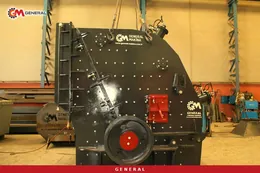
The GNR MK series is a rotor shaper working after the primary; its job is less about size reduction and more about breaking flaky particles and raising the cubical ratio. Its most efficient position is between the secondary and the final screen: material leaving the secondary is screened first, the coarse, badly shaped stream goes to the cubicizer, and its output returns to the screen. The closed circuit then works on both size and shape. Model and rotor dimensions for the series are on the mobile cubicizer crusher page.
Liners are Hardox 500 wear steel. In medium-abrasive basalt this steel performs well; in rock with high free quartz, liner change intervals should be planned from the Bond abrasion index and, if needed, shaping handled by a cone crusher instead. Keeping 0-5 mm fines out of the cubicizer extends liner life; that stream should go from the screen straight to stockpile. Flakiness rises as feed size grows and rotor speed drops, so settings should be tuned with samples taken in the first production week.
From Matadi to Kinshasa: shipping, set-up and power
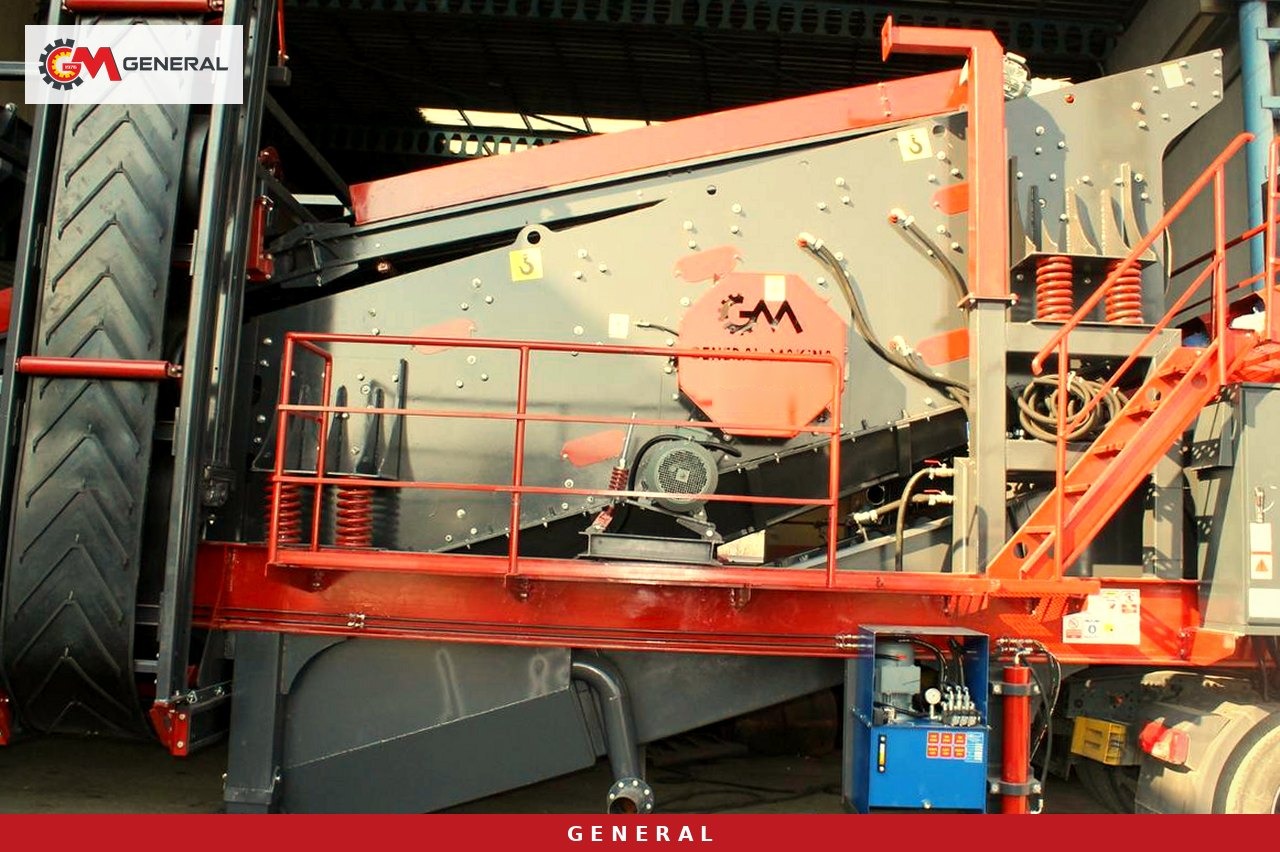
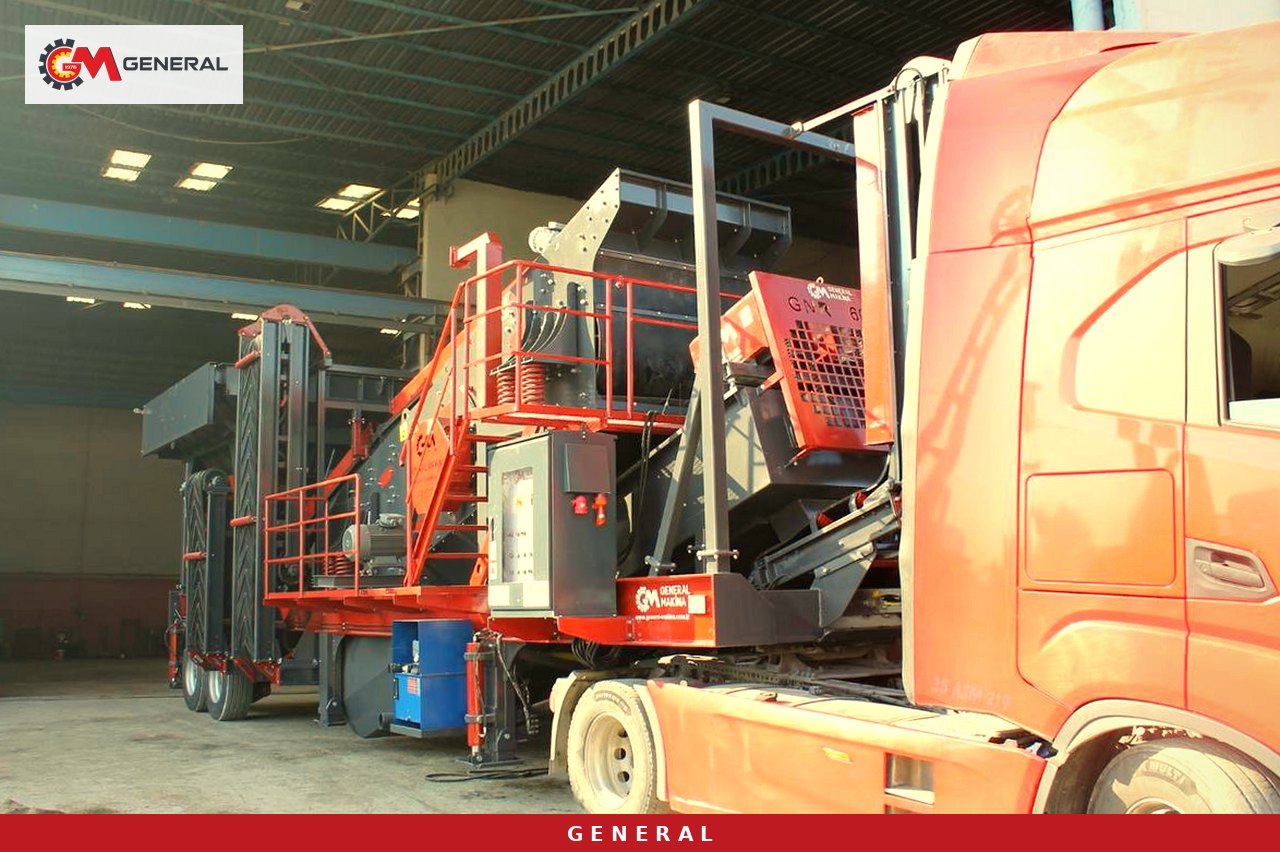
The natural gateway for equipment arriving by sea is the port of Matadi; from there the units are hauled to Kinshasa by road. Restrictions on roads and bridges for heavy loads vary by route, so chassis dimensions and weights should be shared with the haulier in advance. The twin-chassis design helps here: the GNR-MC110 primary chassis is 3000×13500 mm, the secondary chassis 4200×18300 mm, and each weighs 55,000 kg. The General 944 and 950 are single-chassis plants with transport dimensions of 4130×20350×4500 mm and a weight of 70,000 kg.
At quarries without a reliable grid, generator sizing becomes critical. Catalogue values are 550 kVA for the 944, 600 kVA for the 950 and 750 kVA for the MC110; the cubicizer motor (132 kW for the MK100, 200 kW for the MK110) must be added on top. In a hot, humid climate, check the generator maker's derating curve and clean air filters often.
In the rainy season, clay and mud from the quarry face are kept out of the line by pre-scalping on the grizzly feeder; where clay content is high, water sprays on the screen are a measure that can be added per project. In the dry season, water sprays at transfer points and belt covers limit dust. These measures should be written into the quotation as site-specific options, not as standard equipment.
Site data to collect before asking for a quote
- Quarry location, distance to the asphalt plant and the route into Kinshasa
- Rock type and sample results: Los Angeles abrasion, Bond abrasion index, flakiness index, clay content
- Target fractions (e.g. 0-5, 5-12, 12-19 mm), their shares and specification limits
- Hourly and daily production target, shift pattern
- Largest block size after blasting (to compare with the 800 mm and 900 mm feed limits)
- Power source: grid or generator, and how fuel logistics will work
- Water source for dust suppression or washing
- Port, road and customs restrictions
For a model comparison, browse the wheeled mobile crushing plants category, and for single-chassis units the single-chassis mobile crusher units category.
Frequently asked questions
Can asphalt chippings be produced without a cubicizer?
Yes. When a cone secondary is choke-fed, or an impact secondary runs at the right rotor speed, particle shape is often adequate. The cubicizer is insurance brought in when test results press against the limit; decide after sample testing.
Can a single GNR-MC110 deliver 250 tonnes per hour?
The catalogue range is 200-300 t/h, and 250 TPH falls inside it. The real figure depends on rock hardness, feed grading and the required fraction split, which is why sample data is requested at the quotation stage.
What warranty and certificates apply?
The machines carry a 1-year warranty; wear parts are excluded. Production runs under ISO 9001 quality management and the machines are CE marked.
What determines the price?
Single or twin chassis, whether a cubicizer is added, generator rating, number of belts, dust and water measures, packing and delivery terms. A quotation built on your site data gives a more accurate answer than a fixed list.
Conclusion
On a line producing chippings for Kinshasa's asphalt work, particle shape is the first question and capacity the second. In hard, abrasive rock the General 944 with an MK100, in medium-hard rock the General 950, and for a 200-250 TPH target with staged investment the GNR-MC110 with an MK110 are sensible starting points. General Makina has built crushing and screening plants in Izmir since 1976; send your quarry's sample results and target fractions through our contact page and we will prepare the configuration and quotation for your site.
Definitions of technical terms: Glossary