EN — English
 TR — Türkçe
 DE — Deutsch
 RU — Русский
 FR — Français
 ES — Español
 AR — العربية
 SR — Српски

Ghana Railway Ballast Aggregate Crushing Plant 200-300 TPH
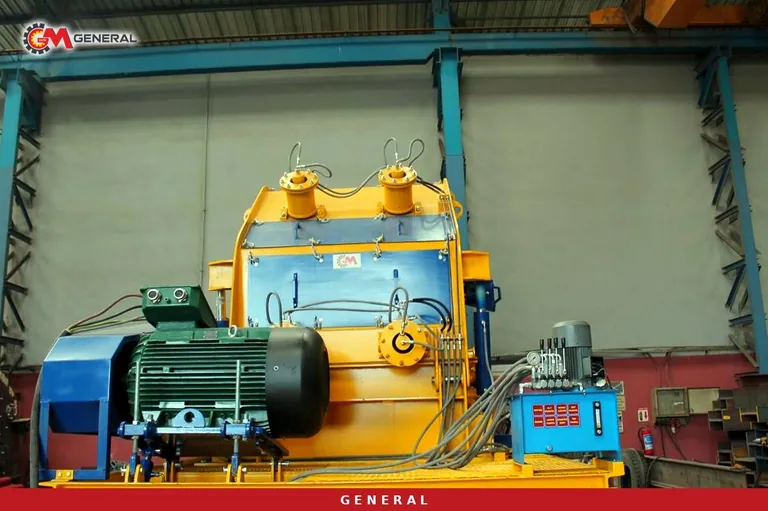
For a quarry supplying stone to a railway section in Ghana, the real challenge is not tonnage but how that tonnage splits. A line crushing 200-300 tonnes of rock per hour will inevitably produce smaller fractions alongside the coarse, angular ballast the specification calls for. Shaped correctly, those smaller particles can be sold as concrete and asphalt chippings into the construction market around Accra and Kumasi; left unshaped, they become dead weight occupying the stockyard. This article looks at a Ghanaian plant that treats ballast as the main product and chippings as a second revenue stream, working through rock geology, machine sequence, model combinations and the effect of the tropical climate on day-to-day operation. All technical values are taken from the tables on our product pages.
Two products from one ballast quarry: track stone and everything below it
The ballast grading envelope, abrasion and impact resistance, flakiness limit and permitted fines content are written into the technical specification of the authority tendering the line. Railway work in Ghana is no different: these values are set project by project, so confirm the specification and the required test methods with the relevant authority or the main contractor before selecting machines. In plant design this document decides two things: which size band goes to the ballast stockpile, and how much material falls below that band.
Ballast is required in a markedly coarser and narrower band than concrete aggregate. That is why the reduction ratio on a ballast line is deliberately kept low: few stages, controlled size reduction, minimum dust. Even so, no crusher produces stone only in ballast size. The particles that drop below the band tend to be flaky and elongated, which makes them hard to get accepted at a concrete batching plant or asphalt plant in that state. This is exactly where the economics of a Ghanaian plant diverge: will you treat the undersize as waste, or as a product?
Ghana's crystalline basement: gneiss, granite and the laterite cap
Granite, gneiss and metamorphic rocks of the Birimian belt are widespread across the south and west of the country; gneiss outcrops are common around the Accra plains, and granite intrusions appear frequently further inland. A good share of these rocks can have sufficient strength for ballast, but none should be accepted without proof at quarry level. The foliation in gneiss increases the tendency towards flaky particles when it breaks, and weathered or fractured bands may occur within the same quarry face.
Tropical weathering covers many quarries with a capping of red laterite and clay. However carefully the overburden is stripped, some soil reaches the plant with the run-of-mine rock. Because ballast cleanliness requirements are strict, this soil has to be separated before it reaches the crusher. At the quotation stage we ask for abrasion, impact, flakiness and water absorption reports on representative samples taken from the quarry; the same reports also indicate the silica content of the rock, which directly influences the choice of wear parts.
Flow sheet: five stops from feeder to cubicizer
For ballast from hard, abrasive crystalline rock, the backbone we recommend consists of compression-type crushers. In this rock, impact crushers mean more fines and faster wear, so they are kept out of the ballast branch. The cubicizer sits only in the by-product branch.
1. Grizzly feeder and laterite removal
The line starts with a vibrating grizzly rock feeder. The GNR 110 model has a width of 1100 mm, a length of 4750 mm and a 2x7.5 kW drive, working in the 200~300 t/h range; common values across the series are feed sizes up to 1500 mm and hopper volumes of 15-100 m³. The soil-laden fines falling through the grizzly bars bypass the crusher and are diverted to a separate conveyor. In a quarry with a high laterite share, that conveyor is the first measure keeping the ballast clean.
2. Primary crushing with the GNRK 110
Within the GNRK series jaw crusher range, the GNRK 110 covers the whole target band on its own: 1100×850 mm feed opening, 150–225 mm discharge setting, 110/132 kW motor, 33,000 kg weight and 200–350 t/h capacity. Compression crushing protects jaw plate life in granite and gneiss. The GNRK 140, in the 500–600 t/h class, is oversized for this job.
3. Cone crusher: a controlled step down to the ballast band
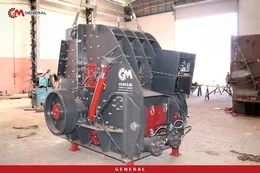
The General cone crusher works in the secondary stage. The figures stated on the product page are 50–250(300) mm feed, 0–60(75) mm product and a secondary reduction ratio of 6:1–8:1. Model-specific capacity and power values are given per project. On a ballast line the cone is opened via its hydraulic CSS adjustment close to the upper limit of the ballast band, so particles stay fractured-faced and angular and unnecessary fines are avoided. Hydraulic overload protection also guards against uncrushable pieces that can come in from the quarry.
4. Screen arrangement
The cone discharge is split on a screen with enough area for the coarse fractions. The GNR 2060 (2000×6000 mm, 18.5 kW) or the wider GNR 2460 (2400×6000 mm, 22 kW) are suitable candidates for this tonnage. Oversize from the top deck returns to the crusher, the ballast band drops straight onto its own stockpile conveyor, and material below the band is routed to the by-product branch. Screen meshes are chosen at the order stage to match the band dimensions in the ballast specification.
5. Cubicizer: for the by-product, not the ballast
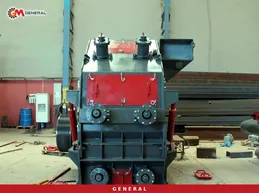
The GNR K series cubicizer crusher turns flaky, elongated particles into cubical ones and lowers the Flakiness Index; its job is correcting particle shape, not size reduction. For the stream below the ballast band, the GNR K100 (1550×1200 mm rotor, 180 mm feed, 90–130 t/h, 90 kW) is enough in most cases; where the by-product share is high, the GNR K110 (1550×1800 mm rotor, 210 mm feed, 160–250 t/h, 160 kW) is the choice. The cubicizer output is split into concrete and asphalt fractions on a second screen. One point to watch: in rock with a very high silica content, shaping bars and liners wear faster, and high-chrome or ceramic-reinforced parts should then be considered.
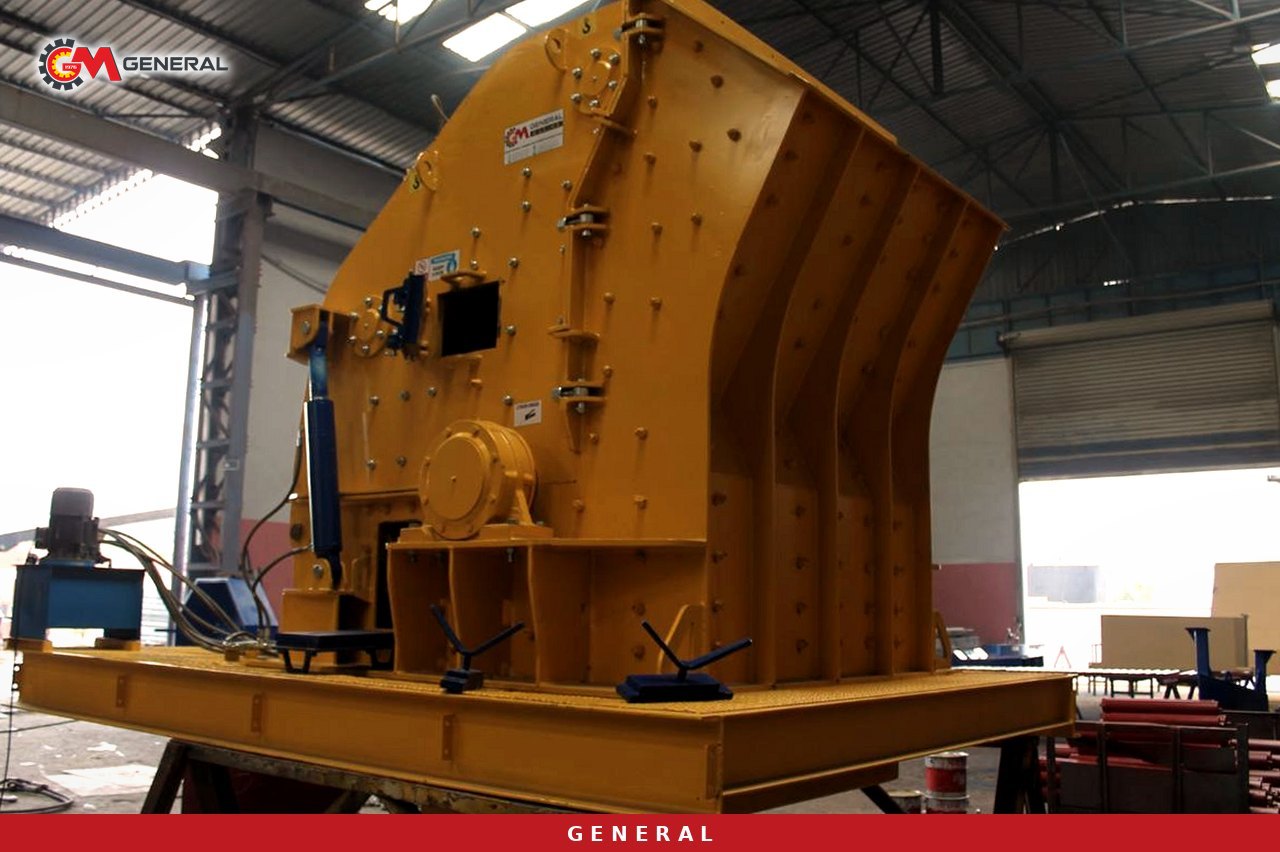
Machine matching table for 200-300 TPH
The table below shows real model combinations that meet the target range. Unknown or project-specific values are marked "—".
| Configuration | Primary | Secondary / shaping | Capacity | Max. feed | Screen | Power |
|---|---|---|---|---|---|---|
| A. Stationary line | GNRK 110 jaw (110/132 kW) | General cone + GNR K100 cubicizer (90 kW) | 200–350 t/h (primary) | GNR 110 feeder: 1500 mm | GNR 2060 or GNR 2460 | (generator/grid sized to installed power) |
| B. GNR-MC110 primary chassis + stationary cone | GPJ 110 jaw | General cone (stationary) + GNR K100 | 200–300 t/h | 900 mm | Separate stationary screen | — |
| C. GNR-MC110 full set | GPJ 110 jaw | GS1215 / DMK03 impact | 200–300 t/h | 900 mm | 2000×6000 mm, 4-deck | 750 kVA |
| D. General 02 | GPS 1413 impact | — | 250–300 t/h | 1000 mm | 2000×5000 mm, 4-deck | 660 kVA |
For granite and gneiss ballast, option A is the first choice: every crusher works on compression, and the cubicizer only touches the by-product. Stationary crushing and screening lines offer long service life and more screen area for a plant that will stay at the same quarry for the duration of railway construction.
Option B suits jobs where the quarry location is not yet fixed, or where the quarry may move as the line advances. The GNR-MC110 consists of two chassis, and the primary chassis can operate independently. Using it to feed a stationary cone and screen group takes the impact secondary out of the ballast branch. Option C is designed as a full set for 0-5 / 5-12 / 12-19 / 19-40 mm fractions; screen meshes must be changed for the ballast band, and you need to allow for the impact secondary raising the fines share in hard rock. Option D suits low-abrasion stone such as limestone; we do not recommend it for ballast from Ghana's crystalline rock. For a general comparison of crusher types, see the stone crushers and crushing machines page.
Humidity, rain and red dust: operating notes for a Ghanaian site
Southern Ghana has two rainy seasons a year, while in the north the harmattan wind carries fine dust during the dry season. Both conditions stress the equipment around the machine more than the machine itself. Measures that can be selected per project include:
- Wet run-of-mine: In the rainy season laterite and clay turn sticky. The feeder grizzly spacing and bypass conveyor should be set for this period, and if needed a washing spray can be added ahead of the ballast stockpile.
- Dust: In the dry season, water-spray dust suppression and covered conveyors at transfer points protect both the workforce and ballast cleanliness.
- Electrics and cooling: Heated, sealed control panels against condensation in humid weather, and frequent checks of generator air filters during dusty periods.
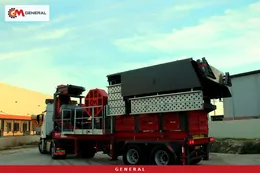
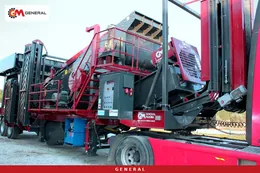
- Power: At quarries far from the grid, power comes from generators. The GNR-MC110 is supplied with a 750 kVA generator set; on a stationary line the generator size is calculated from total installed power.
- Transport: Machines can be shipped by sea to the port of Tema or Takoradi. For the road leg from port to quarry, the MC110 chassis dimensions of 3000×13500 mm and 4200×18300 mm (55,000 kg each) should be checked in advance against bridge and bend limits along the route.
- Wear part stock: At a remote site, keeping at least one spare set of jaw plates, cone liners and cubicizer bars at the quarry shortens downtime. The wear sections on the cubicizer and cone product pages give the details.
Quotation file: the information to send us
To work out the right configuration for a ballast job in Ghana, the following information is sufficient:
- The authority's ballast specification: grading envelope, test methods and acceptance limits.
- Abrasion, impact, flakiness and water absorption reports on quarry samples.
- Hourly and daily production targets, separately for ballast and by-product.
- The by-product market: concrete chippings, asphalt chippings or road base?
- Site observations on laterite overburden thickness and the soil share in run-of-mine rock.
- Power source (grid or generator) and the road route from the quarry to the port.
- How long the plant will stay in one place: a single quarry, or several quarries along the line?
Frequently asked questions
Can the cubicizer be applied to the ballast itself?
We do not recommend it. The cubicizer's feed limit is 120–210 mm depending on model, and its main function is correcting the shape of smaller fractions. The angular structure of ballast comes from the primary jaw and the cone crusher; the cubicizer turns material below the band into saleable chippings.
Can a single GNR-MC110 produce ballast on its own?
In terms of capacity it covers the 200-300 TPH range. However, its secondary is an impact crusher and its standard fractions are intended for aggregate. For granite or gneiss ballast, running its primary chassis together with a stationary cone and screen gives a more controlled result.
What warranty and certificates apply?
Our machines carry ISO 9001 and CE certification; a 1-year warranty is provided, excluding wear parts. General Makina has been manufacturing in Izmir since 1976.
What determines price and delivery time?
The configuration (stationary or mobile), the need for a cubicizer and a second screen, the generator, dust suppression and washing equipment, the transport method and the scope of on-site erection. A project-specific quotation is prepared from this information.
Conclusion and quotation
For a contractor setting up a ballast quarry in Ghana, the right line consists of clean feeding, two compression crushing stages and a cubicizer branch that turns the undersize into chippings. Share your quarry's rock reports and the authority's specification, and we will propose a concrete layout in the 200-300 TPH range: request a quotation via our contact page.
Definitions of technical terms: Glossary