EN — English
 TR — Türkçe
 DE — Deutsch
 RU — Русский
 FR — Français
 ES — Español
 AR — العربية
 SR — Српски

Jobsite material flow and stockpile layout
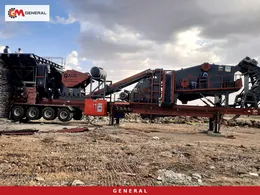
Once a mobile crushing and screening plant is on the ground, output is usually governed less by the machine rating than by how material travels around the site. When jobsite material flow and stockpile layout are wrong, conveyors stop, the loader waits and trucks block one another even though the plant is technically capable of its catalogue figure. When they are right, the same equipment ships more tonnes per shift.
The four points that define the flow
Every site has four critical points: the feed hopper where run of quarry material is tipped, the crushing and screening group itself, the cones where product fractions are discharged, and the loading point where trucks leave. The relative position of those four decides how many manoeuvres a shift contains. The general rule is that material should travel in one direction and no vehicle should cross the production line in reverse; truck traffic is planned as a closed loop with the entry separated from the exit.
How to calculate conical stockpile volume
Freely tipped crushed stone comes to rest at an angle characteristic of the material; for crushed aggregate that angle typically falls between thirty and forty-five degrees, and thirty-seven degrees is a reasonable starting value. The height of the cone equals the base radius multiplied by the tangent of the angle, and the volume is one third of the base area times the height. The table below applies both formulas and converts volume into tonnage using 1.6 tonnes per cubic metre, a widely accepted loose bulk density for crushed stone.
| Base radius | Pile height | Volume | Approximate tonnage |
|---|---|---|---|
| 5 m | 3.8 m | 99 m³ | 158 t |
| 8 m | 6.0 m | 404 m³ | 646 t |
| 10 m | 7.5 m | 789 m³ | 1,263 t |
| 12 m | 9.0 m | 1,364 m³ | 2,182 t |
| 15 m | 11.3 m | 2,663 m³ | 4,261 t |
The table is a geometric upper bound. Real piles fall short of it because of loader cuts, uneven ground and settlement, and because the pile is limited by the discharge height the conveyor can reach; a fifteen metre radius cone only forms if a folding conveyor is tall enough to build it.
How many days does that pile cover
Volume on its own means little; what matters is how many production hours it absorbs. The table below divides a ten metre radius cone by the daily output of plants of different capacity working an eight hour shift.
| Plant capacity (mid range) | Output in an eight hour day | Equivalent of a 1,263 t cone |
|---|---|---|
| 55 t/h | 440 t | 2.9 days |
| 100 t/h | 800 t | 1.6 days |
| 150 t/h | 1,200 t | 1.1 days |
| 300 t/h | 2,400 t | 0.5 days |
The result surprises most site teams: a pile that looks enormous from the cab represents half a day of production on a high capacity plant. Stockpile area should therefore be sized against the number of days of dispatch interruption you must absorb. On a site where haulage can stop for two days, half a day of buffer means the plant stops for two days as well.
Layout rules
Leave a lane between cones wide enough for the loader bucket to turn freely, because two piles that merge at the toe contaminate each other and create out of specification material. Grade the yard with a slight fall and provide drainage, since water standing at the toe binds the fines and moisture becomes dead weight inside the tonnage you sell. Place fine products downwind and coarse products towards the road. A radial conveyor rather than a fixed discharge point builds a larger pile with less segregation in the same footprint. Because a mobile installation has to rebuild this arrangement at every location, a mobile jobsite solution should carry a standard layout template rather than being improvised each time.
Conveyor or loader
Over short distances the loader is flexible; as distance grows, fuel and time per tonne rise in proportion and beyond a certain point a second machine becomes necessary. A conveyor delivers uninterrupted flow independent of distance for a fixed investment. The decision rule is simple: work out the loader cycle time and the tonnes moved per cycle, derive the daily number of cycles, then compare the same duty against a belt. If the loader spends most of the day travelling rather than loading, the belt wins. That decision belongs to the layout itself and should be taken on the first day of jobsite and mobile plant planning.
Frequently asked questions
Why limit pile height
The higher the pile, the further coarse particles roll towards the toe and the worse segregation becomes. A tall pile also forces the loader to cut into the slope, which creates both a safety issue and a contamination risk.
What should the stockpile floor be
A compacted base with adequate bearing capacity, ideally built from the same material. Bare soil lets the loader bucket pick up clay from the bottom row and contaminate the product.
How much room is needed for truck manoeuvring
Dimensions come from the turning radius of the largest vehicle used on site, and the layout is drawn to those figures. Provide a bay at the loading point so two vehicles can wait without blocking the loop.
Draw the layout once on paper: place the four critical points, the truck loop and the radius of every product cone to scale. That single drawing replaces weeks of trial and error on the ground. Send us your site dimensions and target fraction split and we will work the layout through with you.
Definitions of technical terms: Glossary