EN — English
 TR — Türkçe
 DE — Deutsch
 RU — Русский
 FR — Français
 ES — Español
 AR — العربية
 SR — Српски

Jaw Plate Replacement Timing in a 150-250 TPH Stone Crushing Plant
On most quarries, jaw plates are changed in one of two wrong ways. Either they come out when they are close to wearing through and crusher output has already dropped, or they are scrapped while there is still working metal on them, simply because the calendar says so. On a line processing 150-250 TPH both mistakes cost money. A late change sends oversize to the secondary crusher, inflates the recirculating load on the screen and puts the seating surface of the swing jaw at risk. An early change burns the wear-parts budget for nothing. This article explains the field signals that tie the change date to measurement instead of the calendar, the decision between turning a plate and replacing the full set, and how the jaw crusher models available for the 150-250 TPH range affect that decision.
Wear map: where the plate loses metal first
In a jaw crusher, rock enters the top of the cavity as large blocks and gets smaller as it is squeezed on the way down. In the upper zone breakage happens at a few large contact points. In the lower zone the particles are smaller, contact points multiply and the material slides against the plate on every stroke. That is why the tooth profile flattens first in the lower third, close to the discharge opening. The upper teeth can look almost new while the lower ones have rounded tips and filled-in grooves.
This uneven wear explains why a single measurement cannot drive the change decision. Even if total weight loss looks small, a worn-out lower profile means the crusher can no longer hold product size. On the other hand, if the lower zone is flat but the upper zone is sound, the plate can often be turned instead of scrapped. Measure tooth height at three levels at least (top, middle, bottom) and log every reading with the date and the tonnage processed.
Field signals that announce the change date
Before the plate is finished, the crusher gives several signals. Reading them together rather than one at a time cuts false alarms, because each signal can also have a cause unrelated to the plate.
Running out of adjustment
As the plate thins, the closed side setting (CSS) opens up by itself. The operator compensates with the adjustment system (shims or adjusting wedges, depending on the model). At some point the adjustment range is used up and the target CSS can no longer be reached. Strictly speaking this is the limit of the adjustment system, not of the plate, but in practice it means the change day has arrived. An operation that records the shim thickness added at each correction can see weeks in advance how close it is to that limit.
A growing oversize tail in the product curve
When the lower profile flattens, particles are no longer gripped between the teeth and slip through. At the same CSS, the share of oversize in the primary discharge rises. It usually shows first on the secondary crusher feed belt and in the amount of material returning from the screen. Taking regular samples from the primary discharge belt for sieve analysis is the only way to see this shift in numbers.
Throughput and motor load
A plate with no tooth profile struggles to nip the rock: material bounces in the cavity and takes longer to pass through. Hourly tonnage falls while motor current starts to fluctuate. If current values are logged on a control panel, take the week the new plates were fitted as the baseline and compare later weeks against it. Tonnage loss alone can also come from feeder settings or a change in blast fragmentation, so read it alongside the tooth measurements.
Cracks, broken teeth and loose bolts
A crack starting at the edge of a manganese plate, a broken-off tooth or fixing bolts that keep working loose call for action without waiting for the next measurement. If a gap opens between the back of the plate and the jaw body, the plate takes an impact on every stroke and the body surface gets damaged. In that case turning the plate is no longer an option either.
Turn or replace the set: the order of decisions
Jaw plates with a symmetrical profile can be rotated 180 degrees once the bottom is worn, giving a second working period. The lightly worn upper part moves down to where the real work happens. This extends life without buying a new plate, but two conditions apply: the plate must be free of cracks and its back must still seat properly against the jaw body. Plates with an asymmetrical profile cannot be turned, and that should be known before ordering.
The fixed and swing jaws rarely wear at the same rate. Renewing one and leaving the other as it is spoils the profile match between the two faces and makes CSS readings misleading. A practical rule: when one plate reaches its limit, measure the other; if its remaining profile will not last until the next planned stop, change both in the same shutdown. Check the cheek plates during that stop too, because when they thin out, large particles escape along the sides and the corners of the jaw plate wear faster.
After the change, set the crusher from scratch. With the new plates, remove the old shims added to the adjustment system, bring CSS to the target value and measure again at the end of the first shift. The fresh manganese surface work-hardens under impact in the first hours and can settle slightly.
Wear load by model on 150-250 TPH lines
Handling the same tonnage with a larger crusher opening lowers the load per unit area of plate. Model choice for a 150-250 TPH target therefore has a direct effect on the change interval. The figures below are the verified values from our product pages.
| Model | Build | Capacity (t/h) | Opening or max. feed (mm) | Motor (kW) | Setting / output (mm) |
|---|---|---|---|---|---|
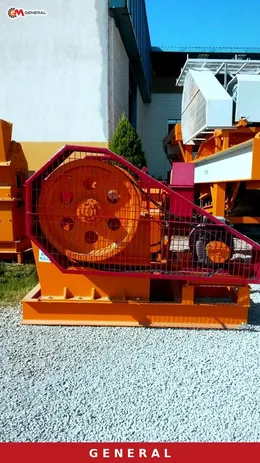
| GNRK 90 | Stationary jaw crusher | 60-225 | 900×650 opening | 75/90 | 70-180 |
| GNRK 110 | Stationary jaw crusher | 200-350 | 1100×850 opening | 110/132 | 150-225 |
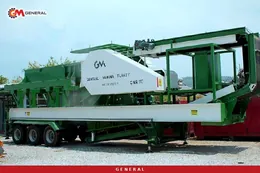
| GNR 110 mobile primary | Feeder hopper + GNRK 110, single chassis | 180-300 | 0-1100 feed | — | 0-250 final product |
| GNR-MC110 | GPJ 110 jaw + DMK03 impact, twin chassis | 200-300 | 900 feed | — | 0-100 |
| General 944 | GPJ 90 jaw + GM430 cone, wheeled | 120-180 | 800 feed | — | 0-100 |
On a line that runs near the top of the target range (200-250 TPH), the GNRK 90 approaches the limit of its capacity table; the cavity runs fully loaded all the time and lower-zone wear speeds up. The GNRK 110 handles the same tonnage in the lower part of its range, so the tonnes per plate are spread over a larger surface. For operations working at the lower end (150-180 TPH) and moving often, a wheeled line such as the General 944 or the GNR 110 mobile primary unit is worth considering. Crusher size also shapes the logistics of the change: a larger opening means heavier plates and stronger lifting gear. For a series comparison see rock and stone crushing machines, and for all GNRK values see the GNRK jaw crusher page.
Alloy, rock type and feeding set plate life
Choosing between Mn13, Mn18 and Mn22
Jaw plates are cast in austenitic manganese steel. The material work-hardens under impact: its outer face gets harder as it works while the core stays tough. Mn13 and Mn18 are standard; for high-silica, abrasive rock Mn18 or Mn22 is preferred. Wear is driven by the free quartz and silica content of the rock, not by its Mohs hardness. Granite or quartzite and limestone consume the same plate over very different periods. An abrasion test in a laboratory, done before the first set is ordered, is the cheapest step toward the right alloy for your rock. Plate types and other wear items are listed under crusher wear and replacement parts.
Keeping fines out of the crusher
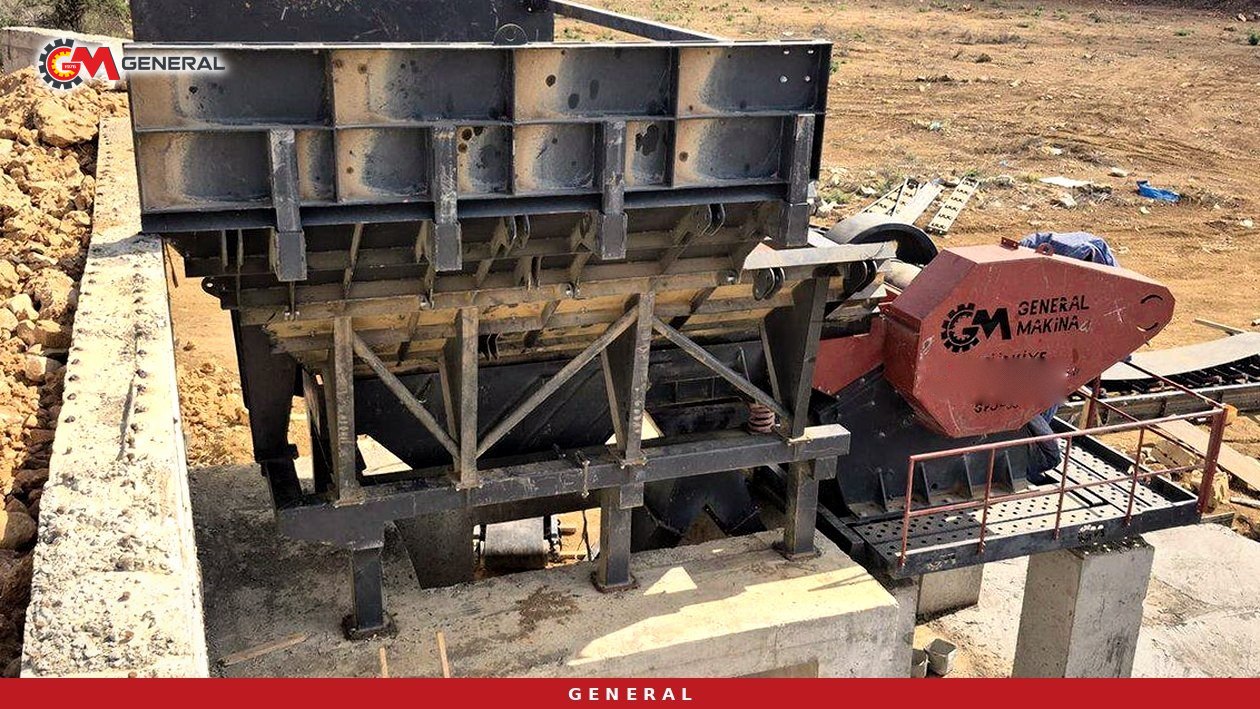
Soil and fine particles in run-of-mine rock need no crushing, but once inside the cavity they act like sandpaper on the plate face. A vibrating grizzly feeder separates this material through its by-pass ahead of the crusher. The GNR 90 feeder (140-210 t/h) and the GNR 110 feeder (200-300 t/h) cover both ends of this range, and both accept material up to 1500 mm. Steady feeding keeps the cavity choke-fed; in a full cavity particles also break each other and friction on the plate drops. In a crusher fed in bursts, large blocks fall into an empty cavity and hit the upper zone of the plate as impact. Feeder models are on the vibrating grizzly feeder page.
Planning the shutdown: records, spare set and safety
A well-prepared jaw plate change stops being one of the longest planned stops on the line. Plates are heavy and need lifting gear and a crew of at least two. Use the list below to finish preparation before the stop begins.
- Compare the last three tooth-height readings with the tonnage processed; the trend shows the change week.
- Confirm the spare set (fixed jaw, swing jaw, cheek plates, bolts and wedges) is in the site store.
- Check crane or lifting device capacity against plate weight and define the lifting points beforehand.
- Isolate, lock and tag the crusher, feeder and belts; clear any rock left in the cavity.
- Photograph and measure the removed plates and set aside those that can be turned.
- Fit the new set, bring CSS to target, torque the bolts and check again at the end of the first shift.
Jaw plates are wear parts, so they are not covered by the machine's 1-year warranty. The spare set therefore has to be planned by the operator. In practice one set should be working in the crusher while another waits in the store; on remote sites, shipping time makes this even more obvious. For the rest of the maintenance schedule see crusher maintenance and spare parts management.
To estimate the change interval, use your own data rather than a fixed hour value. Hypothetical example: if one set of plates, including a turn, processed A tonnes and the line produces B tonnes a week, the expected life of the next set is about A/B weeks. If the plates cost C units, plate cost per tonne crushed is C/A units. When the alloy or feeding arrangement changes, recalculate both numbers and you will see which change paid off. The general logic of wear part life is covered separately in wear part life and replacement intervals in mobile crushing plants.
Frequently asked questions
How many hours do jaw plates last?
There is no valid fixed figure. Life depends on rock abrasiveness, alloy, feeding and tonnage. The right interval comes from the measurement records of the first set.
Is it fine to replace only the swing jaw?
Yes, if the fixed jaw's remaining profile will last until the next planned stop. If not, change both in the same shutdown; otherwise a second stop follows soon and the profile mismatch upsets product size.
Are jaw plates covered by warranty?
The machine carries a 1-year warranty; wear parts such as jaw plates are excluded. That is why the spare set plan belongs in the purchasing discussion.
Does a turned plate do as much work as a new one?
A symmetrical plate with a lightly worn upper zone gives a second working period when turned. How long it lasts depends on the wear pattern of the first period and is tracked by measurement.
Linking plate changes to measurement
On a 150-250 TPH stone crushing plant, a jaw plate change becomes predictable once tooth measurement, adjustment margin, product curve and tonnage are tracked together. Model choice, alloy and feeding are three separate levers that stretch the interval. Send us your rock type, target tonnage and product fractions and we will assess the jaw crusher, feeder and plate alloy together and prepare a quotation: contact page.
Definitions of technical terms: Glossary