EN — English
 TR — Türkçe
 DE — Deutsch
 RU — Русский
 FR — Français
 ES — Español
 AR — العربية
 SR — Српски

DR Congo Katanga Heavy-Duty Jaw Stone Crushing Plant 250-450 TPH
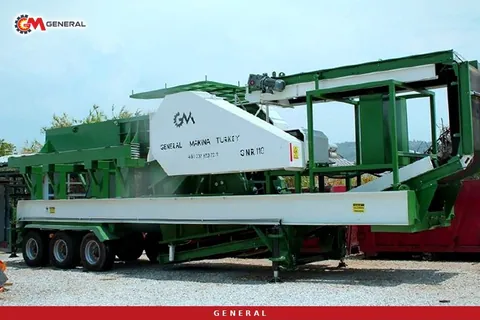
Run-of-mine rock reaching a primary crusher in a Katanga open pit looks nothing like the evenly blasted stone of an aggregate quarry. Dolomitic and siliceous host rock, mineralised zones and overburden soil can arrive in the same truck; in the dry season it brings fine dust, in the wet season sticky mud. The job of a heavy-duty jaw crushing station rated at 250-450 TPH is to reduce that mixed feed to a coarse size, shift after shift, without stalling. This article explains how we translate the tonnage target into a jaw opening, which components actually carry the "heavy-duty" label, and what site data a buyer should collect before asking for a quotation.
Every model figure below comes from our product catalogue. We give no information about any licence, tender or operator in Katanga; for tonnage, product size and environmental conditions, the binding document is the technical specification of the relevant mining authority or employer, and it should be confirmed there.
What "heavy-duty" means in a Katanga pit
For a primary crusher, three things define heavy duty: the largest single block, how abrasive the rock is, and the daily operating hours. Hard, silica-rich rock is common among the formations hosting ore in the Katanga copper-cobalt belt. On such material an impact primary consumes metal quickly, while a jaw crusher, which breaks rock by compression, wears far more slowly. Our catalogue states that the jaw crusher works reliably on material whose silica content exceeds 10% or whose Bond abrasion index exceeds 0.15. That is why, for hard rock and ore in the region, a jaw is the natural first stage.
The second factor is block size. The largest lump a jaw crusher accepts is roughly 0.8-0.9 of its opening width. If the blast design leaves oversize blocks, either the crusher is upsized or secondary breaking is done in the pit. The third is time: a mine running long shifts feels even short stops as lost tonnage. Here heavy duty means that wear-part change intervals and maintenance access can be planned.
Turning the tonnage target into a jaw opening: 250, 350 and 450 TPH
The 250-450 TPH in the title is a target range, not a single figure at which one machine runs at peak efficiency. The table below sets the real GNRK models and the single-chassis mobile primary unit that cover this range side by side, using catalogue values.
| Model | Opening (mm) | Output (mm) | Motor (kW) | Weight (kg) | Capacity (t/h) |
|---|---|---|---|---|---|
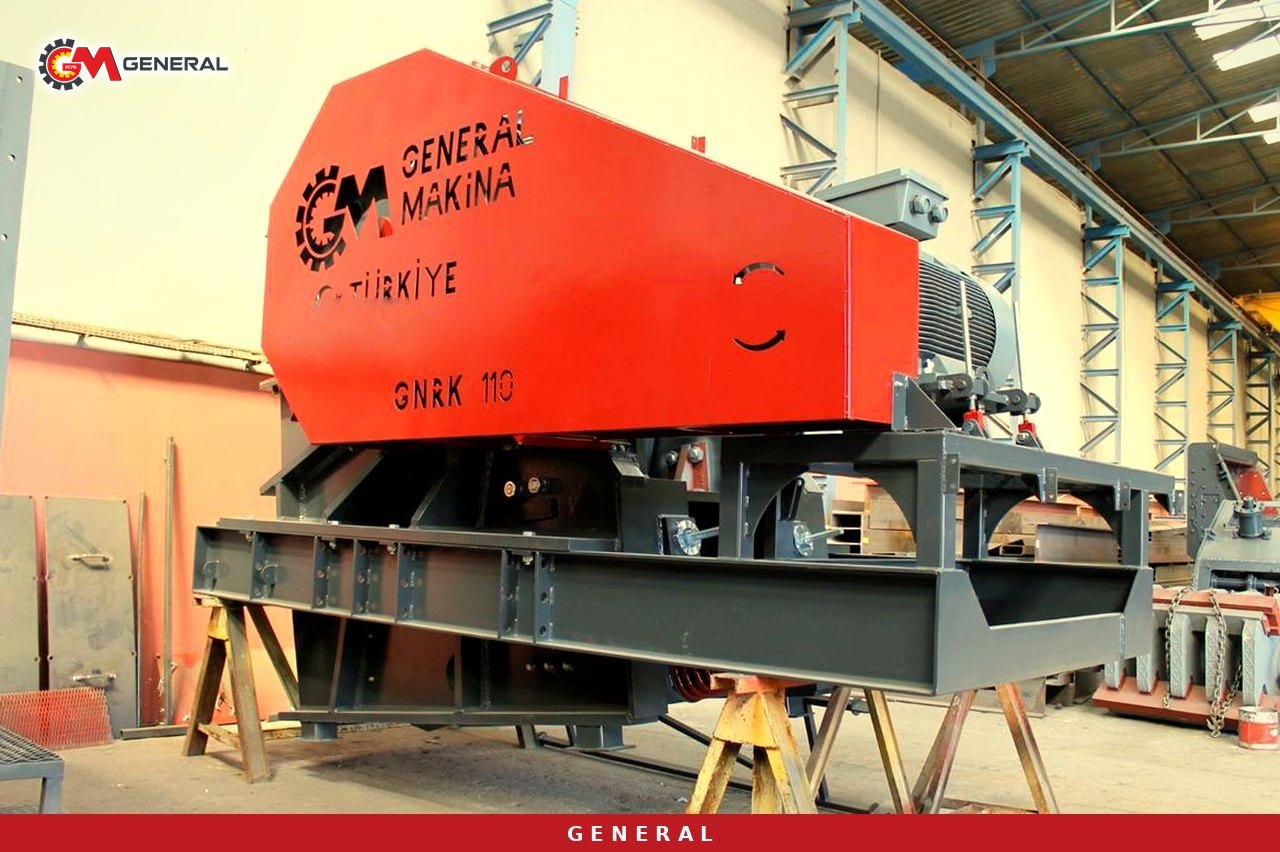
| GNRK 110 (stationary) | 1100×850 | 150-225 | 110/132 | 33,000 | 200-350 |
| GNRK 130 (stationary) | 1300×1000 | 125-250 | 160 | 42,500 | 400-500 |
| GNRK 140 (stationary) | 1400×1100 | 135-300 | 200 | 47,000 | 500-600 |
| GNR 110 mobile primary unit (GNRK 110 jaw) | — | 0-250 | — | 55,000 | 180-300 |
| 2 × GNR 110 mobile primary unit (parallel) | — | 0-250 | — | 2 × 55,000 | 360-600 |
250-350 TPH: a single GNRK 110 line
For the lower and middle band, the most balanced choice is the GNRK 110 jaw crusher with its 1100×850 mm opening. Its 200-350 t/h capacity covers both the 250 and 350 TPH points, and the opening accepts blocks of roughly 880-990 mm. If blasting leaves larger lumps, moving up one model is safer than parking oversize in front of the crusher.
350-450 TPH: a GNRK 130 or two parallel lines
Where continuous running up to 450 TPH is planned, the GNRK 130 with its 1300×1000 mm opening (400-500 t/h) meets the target with a single crusher and swallows larger blocks. If tonnage is expected to grow over the years, or the pit face will advance and the crusher must move, two GNR 110 mobile primary units can be installed in parallel: at the catalogue rating of 180-300 t/h each, together they reach 360-600 t/h, and one keeps producing while the other is under maintenance. The GNRK 140, at 500-600 t/h, sits above this target and should be considered only if block size forces it.
Which crusher components carry the heavy duty?
Two crushers giving the same tonnage can show very different service lives on a site like Katanga. The difference lies in how the frame, the jaw plates and the protection arrangement absorb the forces entering the crushing chamber.
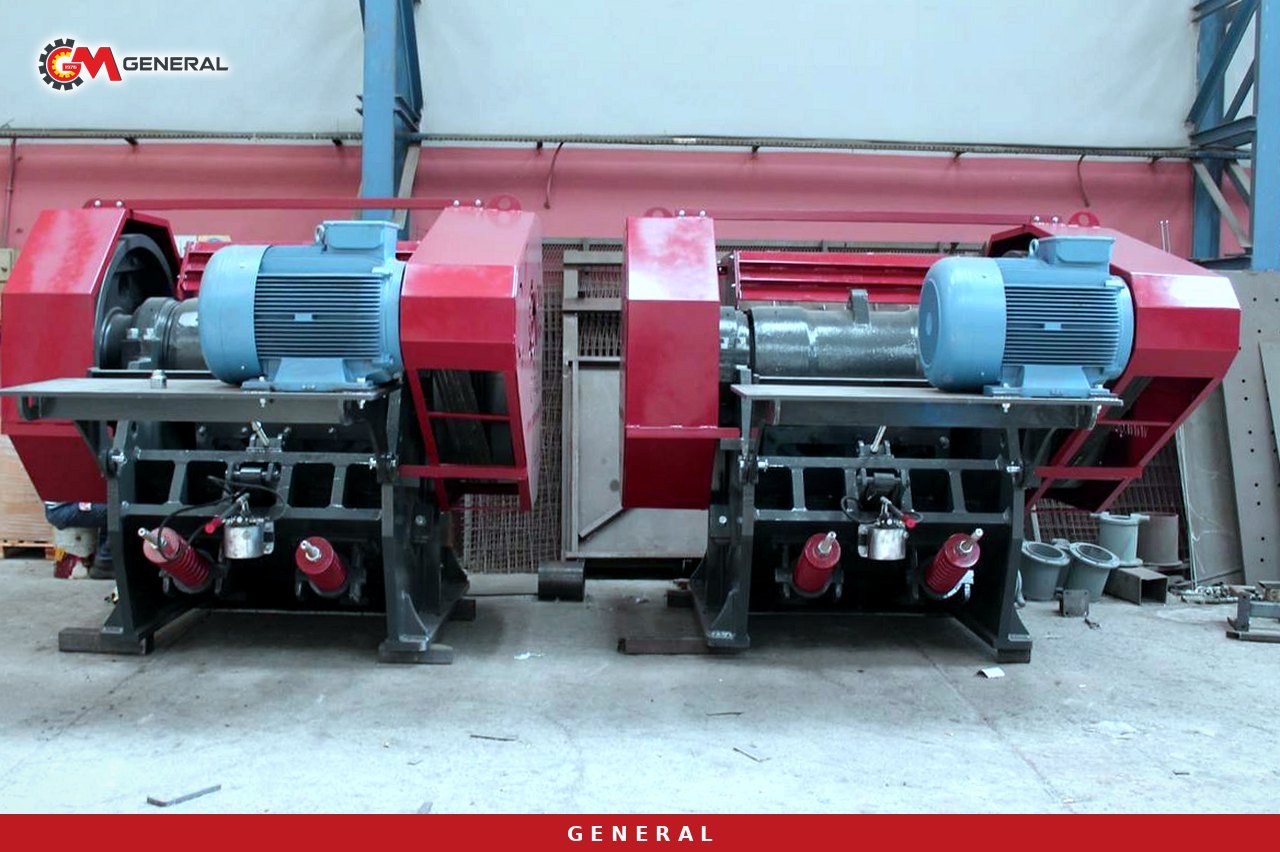
On the frame side, weight and rigidity are decisive. The GNRK 110 weighs 33,000 kg and the GNRK 130 42,500 kg, a concrete indication of how much steel mass is available to damp impact and vibration. Jaw plates are cast in austenitic manganese steel (Mn13/Mn18) that work-hardens under impact; our wear-parts catalogue puts that hardening at roughly 200 HB rising to 550 HB. On high-silica rock, Mn18/Mn22 is preferred. Turning plates to use both faces and seating them correctly affects service life as much as the alloy does.
On the setting side, the closed-side setting (CSS) governs both product size and tonnage. A CSS kept narrower than necessary cuts capacity and wears the lower part of the plates fast. Typical primary reduction is 4:1 to 9:1; if a finer product is needed, passing the load to a second stage is cheaper than forcing the jaw. We recommend matching plates, liners and grizzly bars to the alloy guide on our crusher wear parts page.
Feeder and grizzly: the first link protecting the crusher
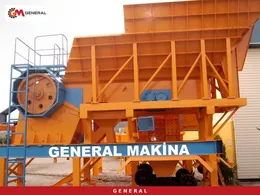
When soil and fines in Katanga feed enter the crusher, they absorb energy without doing useful work, abrade the plates and, in the wet season, pack the chamber. That is why the vibrating grizzly feeder ahead of the crusher is part of the heavy-duty chain. Its grizzly section by-passes fines to the conveyor while sending large blocks to the jaw mouth at a steady rate, keeping it choke-fed.
By catalogue values, the GNR 110 feeder measures 1100×4750 mm, has 2×7.5 kW motors and handles 200-300 t/h; the GNR 140 feeder is 1400×5000 mm, 2×9.2 kW and 350-600 t/h. All models offer a hopper volume of 15-100 m³ and a maximum feed size of 1500 mm. At the 450 TPH target, placing a GNR 140 feeder ahead of a GNRK 130 prevents the crusher from running empty between truck dumps. If clay turned to paste by rain blinds the grizzly gaps, other feeder types can be compared in our crusher feeders category; a wobbler with elliptical shafts suits that kind of feed better.
Power, transport and foundation decisions on site
Some Katanga sites lie far from the grid, and inland access relies on long road routes. These two facts shape the choice between stationary and mobile even before the equipment catalogue does.
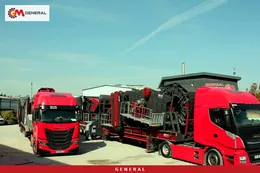
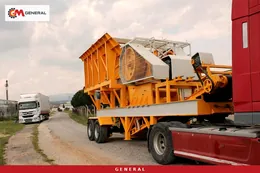
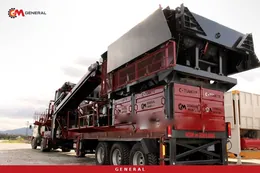
A stationary station on concrete foundations and steel structure suits mines that will stay at one point for years. A fixed crushing and screening plant built around a GNRK 110 or GNRK 130 carries the heavy frame on its foundation and transfers vibration loads evenly to the ground. A mobile primary unit, by contrast, is commissioned on hydraulic legs without foundations and towed by a single truck; moving the crusher closer as the pit face advances shortens haul distances.
On power, where there is no grid, generator rating is chosen from the sum of crusher, feeder and conveyor motors and their starting current. For example, the catalogue data of the twin-chassis GNR-MC110 plant lists a 750 kVA generator; that figure is for a line that also includes a secondary crusher and a screen, and should not be used directly to size a stand-alone primary station. Air filtration and cooling capacity for generators and motors in the hot, dusty season, and moisture protection for electrical panels in the wet season, are measures to be selected per project.
For transport, component dimensions and weights should be checked against bridge and road limits from the port to the site. Given that the GNR 110 mobile unit weighs 55,000 kg, the route's suitability for heavy loads must be confirmed before ordering.
Site data to request before a quotation
Choosing the right model takes site data, not a catalogue. The list below is what we ask first when preparing a quotation for a primary station in Katanga:
- Target tonnage (t/h) and daily operating hours; if growth is expected, the target year.
- Largest block size after blasting, and whether secondary breaking is done in the pit.
- Laboratory sample tests: compressive strength, silica content and Bond abrasion index.
- Soil and clay content of the feed; the difference between wet and dry seasons.
- Required primary output size and what the next stage will be (crusher, screen, stockpile).
- Whether grid power is available; if not, the available generator capacity.
- Route from port to site, with weight and dimension limits.
- Clauses on dust, noise and environmental conditions in the employer's specification.
Once this information arrives, the model, feeder, grizzly gap and spare-parts package are settled together. We do not guess the rock analysis of a specific pit in the region; any wear forecast given without sample testing remains an assumption.
Frequently asked questions
Is a single GNRK 110 enough for 450 TPH?
No. The catalogue capacity of the GNRK 110 is 200-350 t/h. Continuous running at 450 TPH needs a GNRK 130 (400-500 t/h) or two GNR 110 mobile primary units in parallel.
Why a jaw rather than an impact primary for Katanga ore?
On the hard, siliceous rock common in the region, the hammers of an impact crusher wear quickly. A jaw crusher breaks material by compression, so metal consumption per tonne stays low.
Will muddy feed in the wet season stop the crusher?
Wet, clayey feed can pack the crushing chamber. The by-pass section of the grizzly feeder removes fines; where clay content is high, a wobbler feeder or a washing stage is considered.
What determines the price and warranty scope?
Price depends on the model, feeder and grizzly selection, stationary or mobile design, motor and panel equipment, spare-parts package and shipping method. Our machines carry ISO 9001 and CE certification, with a 1-year warranty excluding wear parts.
Conclusion
For 250-450 TPH heavy-duty primary crushing in Katanga, the starting point is the GNRK 110 for the 250-350 t/h band, and the GNRK 130 or two parallel GNR 110 mobile units for continuous tonnage up to 450 TPH. A feeder that protects the crusher, the right jaw alloy and a selection based on sample testing are what make the catalogue capacity real on site. Send your site data to our team, building crushers in Izmir since 1976, and we will prepare a project-specific configuration and quotation: contact us.
Definitions of technical terms: Glossary