EN — English
 TR — Türkçe
 DE — Deutsch
 RU — Русский
 FR — Français
 ES — Español
 AR — العربية
 SR — Српски

Namibia Uranium & Gold Jaw Stone Crushing Plant 250-450 TPH
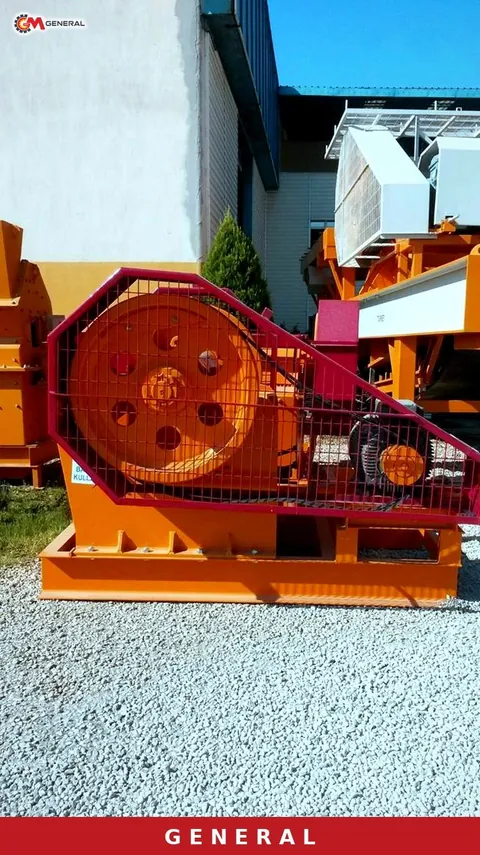
A mining team looking for a jaw crusher in Namibia is usually dealing with two very different ores: the uranium deposits of the arid Erongo interior and the gold fields of central Namibia. Each puts a different load on the primary crusher. Uranium ore mostly arrives in granitic host rock with high silica and wears the jaw plates down slowly and relentlessly; gold ore can bring quartz veins, marble and schist into the same blast pile. This article explains how to build a 250-450 TPH primary crushing line for Namibian conditions: which GNRK model to pick, how to size the feeder, how to handle dust when crushing uranium ore, and how the logistics chain from the port of Walvis Bay to site shapes the design of the jaw stone crushing plant.
Every figure in this article comes from our GNRK crusher and GNR feeder catalogue. We give no information about mining licences, operators or ongoing projects in Namibia; please confirm the product size specification, radiation safety rules and site permits with the mine operator and the relevant Namibian authority.
Uranium and gold: one country, two wear profiles
When selecting a primary crusher, the first question is not how hard the ore is but how abrasive it is. What consumes jaw crusher metal is free quartz. Our catalogue sets a clear threshold: above 10% silica or a Bond abrasion index (Ai) of 0.15, a compression-type jaw crusher is the safe choice, whereas an impact primary burns through its blow bars on the same material. Both Namibian ore types can sit above that threshold at many sites. Even so, determine the value for your own deposit with samples and laboratory tests, not by assumption.
Uranium in granitic rock: steady but punishing feed
Part of the Erongo uranium resource is hosted in granitic (alaskite-type) rock, while other deposits are shallow and calcrete-hosted. Granitic ore arrives in large, fairly uniform blocks; the challenge for the crusher is less about impact peaks and more about crushing the same high-silica material hour after hour. For that feed, Mn18 jaw plates are preferred, or Mn22 where silica is even higher; standard Mn13 plates lose their tooth profile sooner. Calcrete-hosted ore is softer and dustier, and with its higher fines content a larger share of the feed should be separated before it ever enters the crusher.
Mixed rock and quartz veins in gold ore
In central Namibia's gold fields, ore comes from metamorphic rock where marble, schist and quartz veins are interleaved. Soft marble fragments and very hard quartz blocks lie side by side in the blast pile. This variability makes the crusher's power draw fluctuate; if the chamber is not kept full, quartz blocks slide down the jaws and gouge the lower section of the plates. That is why feed control on a gold site matters as much as the crusher model itself. In gold processing the crusher discharge is also usually the feed to a grinding circuit, so the required particle size directly sets the CSS and the choice of the next stage.
Splitting 250-450 TPH across GNRK models
The range in the title is not a figure for one machine; it covers three distinct design thresholds. The table below shows the GNRK series jaw crusher models and possible configurations we would consider for a Namibian uranium or gold site, using catalogue values.
| Model / configuration | Feed opening (mm) | Setting (mm) | Motor (kW) | Weight (kg) | Capacity (t/h) | Role in this project |
|---|---|---|---|---|---|---|
| GNRK 110 | 1100×850 | 150–225 | 110/132 | 33,000 | 200–350 | Single unit for 250-350 t/h |
| GNRK 130 | 1300×1000 | 125–250 | 160 | 42,500 | 400–500 | Single unit for 400-450 t/h |
| GNRK 140 | 1400×1100 | 135–300 | 200 | 47,000 | 500–600 | Very large blocks or growth margin |
| 2 × GNRK 110 (parallel) | 1100×850 | 150–225 | 2 × 110/132 | 2 × 33,000 | 2 × 200–350 | Two redundant lines |
| Portable GNR 110 primary unit | — | Product 0–250 | — | 55,000 | 180–300 | Start-up during pre-production |
250-350 TPH: GNRK 110
If the target is 250-350 t/h, the GNRK 110 covers the whole band on its own with its catalogue capacity of 200-350 t/h. Its 110/132 kW motor and 33,000 kg weight sit comfortably on a concrete-founded stationary station. Keep in mind that 350 t/h is the top of this model's range: on a constantly abrasive feed such as uranium ore, the chamber profile changes as the plates wear and real throughput drops. If you will run near the upper limit permanently, include the next model up in your evaluation.
400-450 TPH: GNRK 130 or two parallel lines
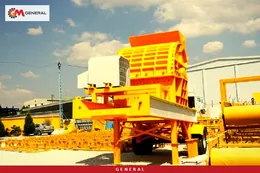
For a 450 t/h target, the GNRK 130 is the natural choice, with 400-500 t/h capacity and a 1300×1000 mm opening; because the target sits mid-range, it leaves headroom for ore variability. The alternative is two GNRK 110 units in parallel. In that layout, while one unit is down for a plate change the other keeps producing, which is a real advantage at a site far from main service points. The trade-off is two feeders, two hoppers and a larger foundation. If very large slab-shaped blocks come from the pit, or the line is expected to grow, the GNRK 140 (1400×1100 mm, 500-600 t/h) can be considered; the catalogue gives its maximum lump size as roughly 1.1-1.25 m.
Grizzly feeder: the work done in front of the crusher
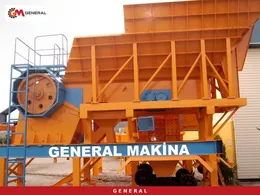
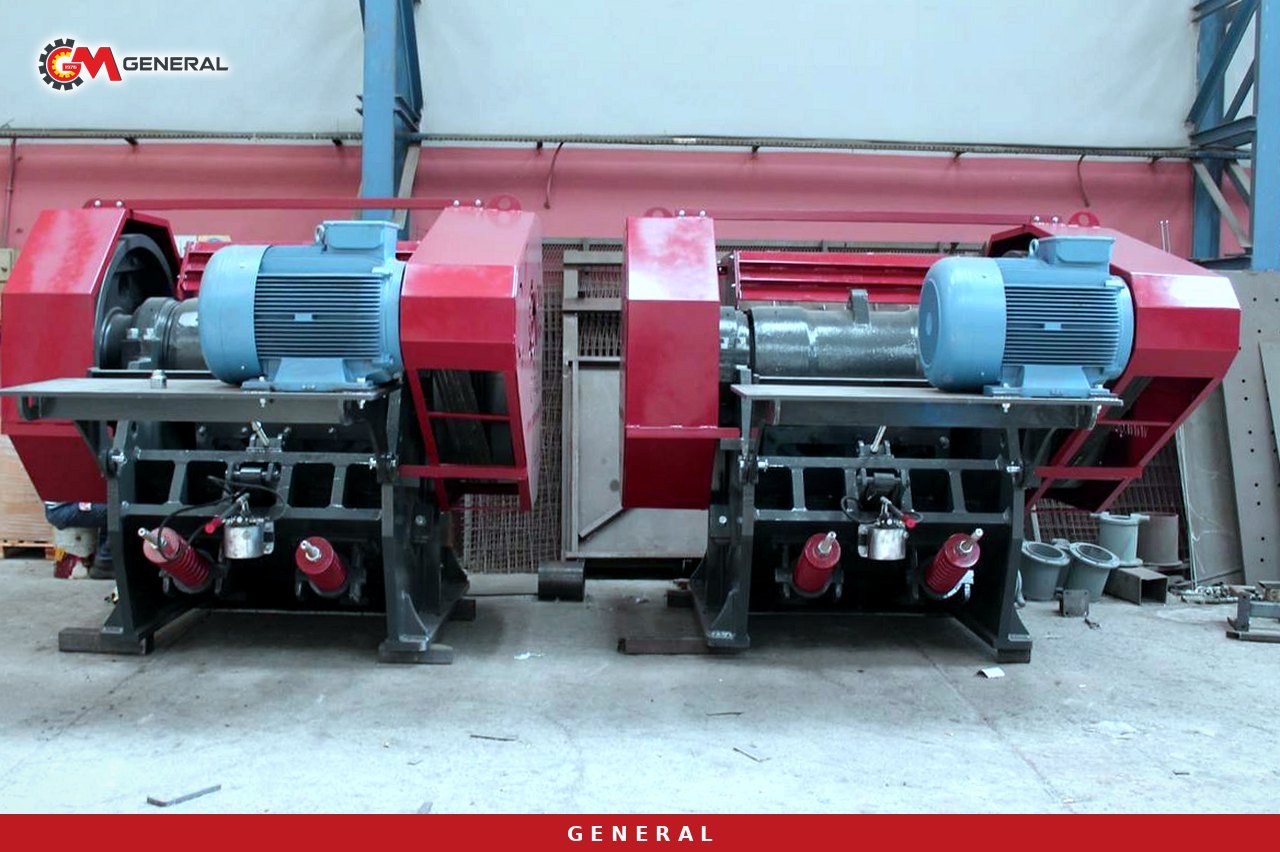
The share of fines and soil in Namibian ore piles should not be underestimated; it rises particularly in calcrete-hosted uranium and in the weathered upper zones of gold deposits. Passing fines through the crusher wastes both capacity and energy. The GNR vibrating grizzly feeder draws run-of-mine ore from the hopper, removes fines in its grizzly by-pass section and delivers the coarse ore at a rate that keeps the crusher mouth choke-fed.
Model matching works like this: for the GNRK 110, the GNR 110 feeder (1100 mm wide, 4750 mm long, 200-300 t/h, 2×7.5 kW); for the GNRK 130 at 450 t/h, the GNR 140 feeder (1400 mm wide, 5000 mm long, 350-600 t/h, 2×9.2 kW). All feeder models accept lumps up to 1500 mm, and hopper volume is chosen per project between 15 and 100 m³. Because the GNR 110 feeder tops out at 300 t/h, a target of 300-350 t/h requires the by-pass ratio and feeder selection to be calculated together.
Where the by-passed fines go is a different decision for gold and uranium. On a gold site this material is usually ore and rejoins the main conveyor; with uranium, the operator may want low-grade fines stockpiled separately. That decision affects conveyor layout and stockpile placement from the start, so settle it with your metallurgy team before ordering.
Dust and personnel safety when crushing uranium ore
At a station crushing uranium ore, dust is not just a visibility and equipment issue; it is part of the operation's radiation protection plan. As a crusher manufacturer we do not prepare that plan; the applicable measurements and limits are set by the mine operator's radiation safety officer and the competent authority in Namibia. Our contribution is a mechanical layout that helps reduce dust at source.
Measures that can be selected per project include: enclosing the crusher discharge point and conveyor transfers, covered or hooded conveyors, water-spray dust suppression at transfer points, placing the control cabin enclosed and away from the crusher, and dust extraction connections at maintenance areas. Because water can be scarce in Namibia's dry interior, it makes sense to pair low-water misting systems with enclosed transfers. None of this equipment is a standard part of the GNRK crusher; it is added to the quotation according to your requirements.
The same logic applies to maintenance. Changing jaw plates means contact with dust-laden surfaces. A layout that shortens the change, with access for lifting equipment, a cleaning area next to the crusher and spare plates stored nearby, also shortens the time staff are exposed to ore dust.
From Walvis Bay to site: stationary station or portable unit?
Heavy machinery bound for Namibia usually lands at the port of Walvis Bay and travels by road to inland sites. A stationary GNRK 130 station is shipped in sections and erected on a concrete foundation on site; this approach suits a mining operation that will work at the same point for years. Our stationary crushing plants page shows the components of this type of line.
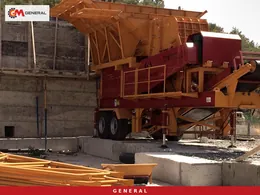
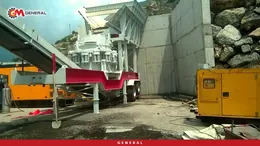
If the mine is still at pre-production or pilot stage and the crusher must move as the pit advances, a portable primary jaw crusher is a more flexible start. The portable GNR 110 unit combines the GNRK 110 crusher with an armoured feeder hopper on one chassis; it accepts 0-1100 mm feed, produces 0-250 mm, runs at 180-300 t/h and is set up without foundations on hydraulic legs. Above 300 t/h a single portable unit is not enough; a second unit or a later move to a stationary station should be planned from the outset.
On remote sites without a grid connection, the crusher, feeder and conveyors run on generators. Generator rating is calculated per project from the sum of installed motor power and starting currents. Filtered ventilation for motors and the electrical panel against desert dust, sunshades, and air intakes placed away from dust sources should also be part of the layout from the beginning.
Data to collect from the Namibian site before requesting a quote
The clearer the data you send, the fewer assumptions our model recommendation relies on. Include the following in your request:
- Ore type (uranium, gold or both) and laboratory results for each: silica content, Bond abrasion index and, if possible, compressive strength
- Largest block size after blasting and an estimate of fines and soil in the pile
- Target hourly tonnage, daily operating hours and required product size at the crusher discharge
- The stage after the crusher: grinding circuit, second crusher or screen
- Site power: grid, generator or a combination
- Water available for dust suppression
- For uranium sites, the operator's radiation safety and dust control requirements
- Shipping route: Walvis Bay or another port, and the general condition of the access road
With this data we prepare the model, feeder, hopper volume and plate alloy as a single proposal. You can see the whole GNRK range in the crushers category, and jaw plates and other consumables on the wear and spare parts page.
Frequently asked questions
Does uranium ore require a special GNRK crusher design?
The crusher's working principle does not change; the difference lies in the jaw plate alloy and the dust control equipment. For high-silica granitic ore, Mn18 or Mn22 plates, enclosed transfers and dust suppression are added per project. Radiation safety requirements are set by the operator and the competent authority.
One crusher or two for 450 TPH?
The GNRK 130 (400-500 t/h) meets the target as a single unit and needs fewer foundations, feeders and conveyors. Two GNRK 110 units mean production does not stop completely during maintenance. The choice depends on the site's tolerance for downtime and the installation area.
What discharge size should the crusher deliver on gold ore?
It is set by the feed size the grinding circuit accepts. The GNRK 110 setting range is 150-225 mm and the GNRK 130's is 125-250 mm. If a finer product is needed, a second crushing stage is added after the jaw crusher; we plan it together with you based on the size specification from your metallurgy team.
What determines the price and warranty coverage?
Price is built from the model, feeder and hopper choice, dust control equipment, electrical panel and generator scope, plate alloy and shipping method, which is why we only give figures in a quotation. Our machines carry a 1-year warranty; wear parts such as jaw plates are excluded. Our production is ISO 9001 and CE certified.
Final word
When choosing a jaw crusher for uranium and gold in Namibia, the deciding factors are ore abrasiveness, which threshold the target tonnage falls into, how much fines the feeder removes and, for uranium, controlling dust at source. The GNRK 110 for 250-350 t/h, the GNRK 130 or two parallel GNRK 110 units for 400-450 t/h, and the portable GNR 110 unit during pre-production are realistic starting points. To send your site data to our team, building crushers in Izmir since 1976, request a quote through our contact page; stating your target tonnage and ore type is enough.
Definitions of technical terms: Glossary