EN — English
 TR — Türkçe
 DE — Deutsch
 RU — Русский
 FR — Français
 ES — Español
 AR — العربية
 SR — Српски

Jaw Setting vs Product Size in a 150-250 TPH Stone Crushing Plant
When a quarry production manager complains that the chippings are coming out too coarse, the first suspect is usually the screen mesh. Yet in a crushing and screening plant that processes 150-250 tonnes per hour, most of the product curve is shaped much earlier, in the gap at the bottom end of the jaw crusher. The size of that gap, the setting, decides the primary crusher's throughput, the size of the material sent to the secondary crusher, wear part consumption and the circulating load coming back over the screen. This article turns the link between setting and product size into something you can measure on site, and uses models with verified catalogue values to show which setting range makes sense for a 150-250 TPH line.
Closed side and open side: what the setting actually measures
In a jaw crusher the cavity between the fixed jaw and the moving jaw, driven by an eccentric shaft, starts wide at the top and narrows towards the bottom. As the moving jaw swings, the gap at the discharge end oscillates between two extremes. The narrowest position is the closed side setting (CSS); the widest is the open side setting (OSS). The difference between the two is the jaw stroke. When a seller or an operator talks about "the setting", they mean the CSS, and the "discharge" column in a machine table gives the range over which this dimension can be adjusted.
This distinction matters when you discuss product size. Material falls out of the discharge end while the jaw is open, so the largest particles in the product are bigger than the CSS and approach the OSS. Flat and elongated pieces turn lengthwise and slip through the gap. As a result, jaw crusher product is never a clean fraction cut at the setting; it contains a broad distribution finer than the setting plus an oversize tail that exceeds it. The share of that tail varies with the rock, the stroke and how full the cavity runs. The only reliable way to see the ratio for your own quarry is to take a sample from the primary discharge belt and have a sieve analysis done.
Four factors that shape jaw crusher product
The setting alone does not draw the product curve. Two quarries running the same CSS can easily show clearly different primary products. Looking at each factor separately tells you why you are changing the setting in the first place.
Feed size and reduction ratio
The reduction ratio of a jaw crusher is typically between 4:1 and 9:1, around 8:1 in the primary stage. This ratio is the practical way to link the oversize blocks from blasting to the setting. Hypothetical example: if the largest blocks after blasting are 640 mm and a ratio of 8:1 is assumed, the target for primary discharge falls to around 80 mm. Forcing the same setting with 800 mm blocks leads to bridging in the cavity and lost tonnage. Maximum feed size is taken as roughly 0.8-0.9 times the opening width; if the blast pattern is not planned around this limit, adjusting the setting will not solve the problem.
Cavity fill and feeding pattern
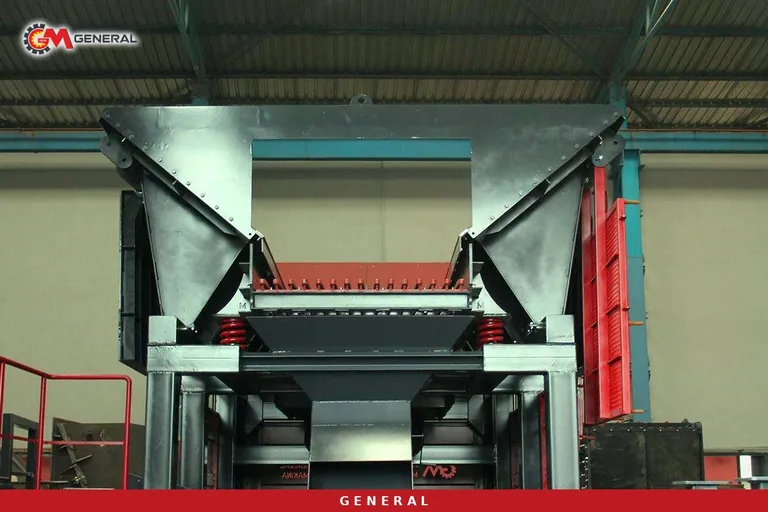
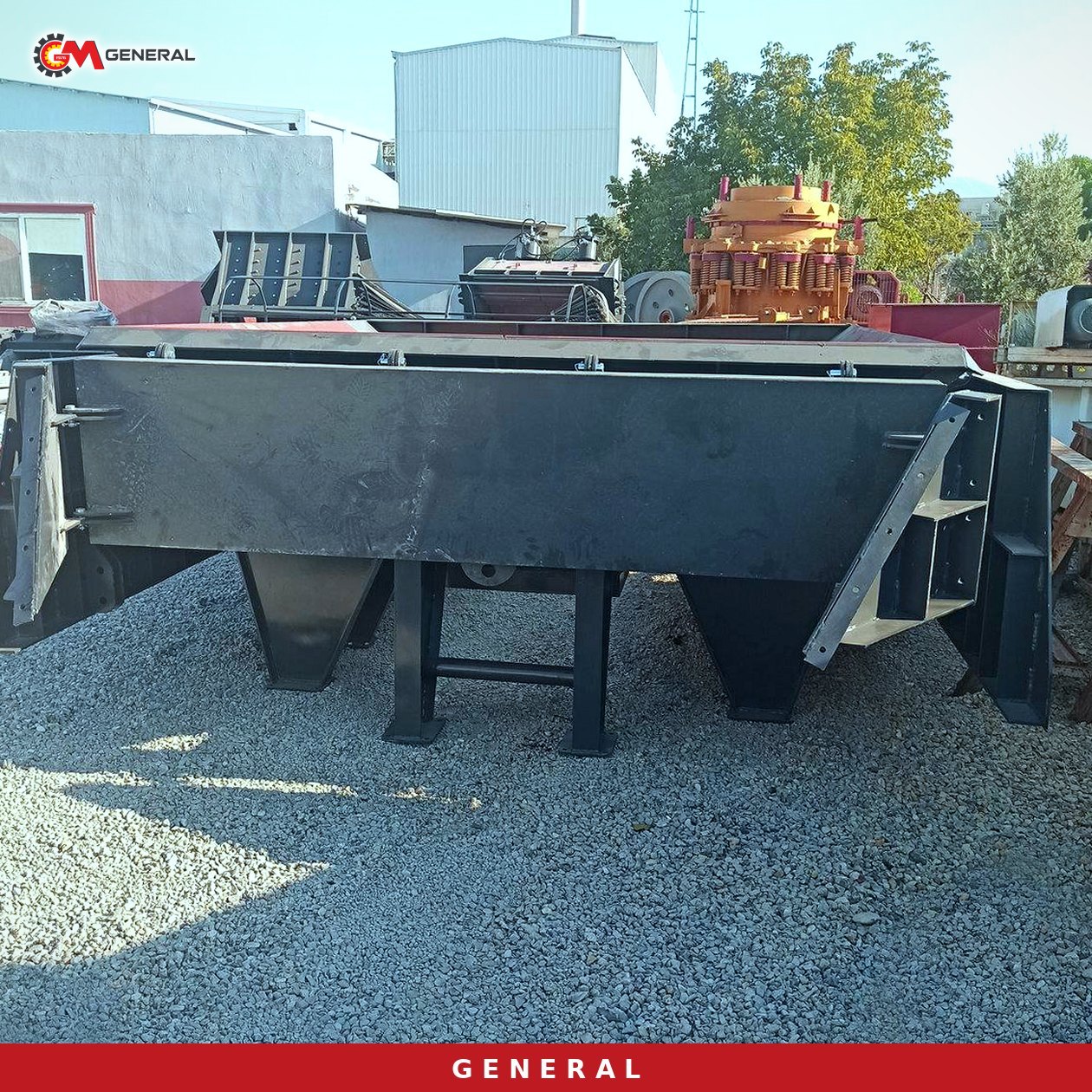
When the cavity alternates between empty and full, the product curve fluctuates too. A half-empty jaw produces flatter, more irregular product because particles do not get the chance to break against each other. The feeder is how you prevent this. The GNR series vibrating grizzly feeder delivers coarse rock to the crusher mouth at a constant rate and helps the crusher run choke-fed. Its grizzly by-pass section removes fines and soil before they enter the crusher. Whether this fine stream joins the primary product or goes to the screen or a stockpile on a separate conveyor is a decision for the plant design stage; if the fines mix into the primary product, a sieve analysis can produce results that look like "the setting is wrong".
Rock type and particle shape
Rock structure changes product shape and the share of the oversize tail. Massive limestone and a layered or schistose rock behave differently at the same setting; layered rock tends to produce flaky particles. In abrasive rock (silica above 10 percent or a Bond abrasion index above 0.15) the jaw crusher is the right primary choice, but in these rocks the jaw plates open the setting faster. Having abrasion and crushability tests run on a sample of your rock takes the setting plan out of guesswork.
Stroke and jaw plate profile
The stroke value and the tooth profile of the jaw plate affect how fine the product is. Stroke per model is not included in the table in this article; at the quotation stage, ask for the model's stroke and the plate profile options. Jaw plates are austenitic manganese steel (Mn13/Mn18) and work-harden on the surface under impact. Plate choice is the factor that decides how long a setting will hold.
Setting ranges by model for a 150-250 TPH line
The table below brings together the catalogue values of jaw crushers and jaw-primary mobile plants that fit the 150-250 TPH target. Capacity and discharge range should be read together: in manufacturer tables the lower end of capacity usually corresponds to the narrow setting and the upper end to the wide setting.
| Model | Opening (mm) | Discharge setting (mm) | Motor / power | Capacity (t/h) |
|---|---|---|---|---|
| GNRK 90 jaw crusher | 900×650 | 70-180 | 75/90 kW | 60-225 |
| GNRK 110 jaw crusher | 1100×850 | 150-225 | 110/132 kW | 200-350 |
| GNRK 1100 secondary jaw | 1100×350 | 20-110 | 75 kW | 100-150 |
| GNR-MC110 mobile line (GPJ 110 + DMK03) | — | 0-100 | 750 kVA generator | 200-300 |
| Mobile primary jaw GNR 110 (GNRK 110) | — | 0-250 product | — | 180-300 |
The table points to two different routes. Among the GNRK series jaw crushersthe GNRK 90 can close down to 70 mm and therefore sends finer material to the secondary crusher, but when it runs in the 70-100 mm band its tonnage drops towards the lower side of its capacity range. On a line approaching 250 TPH this makes the primary the bottleneck. The GNRK 110, with 200-350 t/h, has room on the tonnage side; in return its narrowest discharge is 150 mm, so the second-stage crusher receives coarser material. On a stationary line the choice follows the feed size the second stage can handle. The components of such a layout are shown on the stationary crushing plants page.
On the mobile side, the GNR-MC110 twin-chassis plant takes 900 mm feed, has a discharge setting range of 0-100 mm and, with a 2000×6000 mm four-deck screen, delivers 0-5, 5-12, 12-19 and 19-40 mm fractions. Because the primary and secondary groups can run independently, the effect of a primary setting change on the secondary load can be tracked separately on site.
How the primary setting changes the secondary crusher's job
On 150-250 TPH lines the setting decision is made at the primary but does not end there. Every millimetre the jaw crusher lets through comes back as load on the second stage. In hard, abrasive rock the second stage is usually a cone crusher. A cone crusher achieves 6:1-8:1 reduction in the secondary stage and about 10:1 in the tertiary stage, and accepts 50-250 mm feed (300 mm in some configurations). Its CSS adjustment is hydraulic and it has overload protection.
The cost of a tight setting
Closing the primary eases the secondary crusher, but the bill lands somewhere else. Material stays longer in the cavity, the jaw plates and toggle group carry more load, and the fines share rises. Primary tonnage drops and the 250 TPH target comes under threat. Dust suppression load increases. If the plant sells its sand fraction, the extra fines can be an advantage; if not, they pile up in the stockyard.
The cost of a wide setting
Opening the primary raises tonnage, but the oversize tail can hit the cone crusher's feed limit. When a cone crusher receives particles larger than its feed size, cavity fill is disturbed and the overload protection trips often. The circulating load over the screen grows and the closed-circuit conveyors start to fill up. The practical rule: choose the primary setting so that the oversize tail stays below the size the second stage accepts. The second stage also needs choke feeding to reduce flaky particles and keep the wear advantage of compression crushing.
Setting drift from wear and how to measure it
A 90 mm setting made with freshly fitted jaw plates turns, a few weeks later and without anyone noticing, into a wider gap. The lower zone of the plates wears fastest and the setting opens a little every day. The first sign that the product curve is slowly drifting coarse is usually an increase in screen oversize return. Measuring and logging the setting regularly catches the deviation before the sieve analysis does.
- Measure only with the machine stopped, locked out and tagged; never put a gauge into a running crusher.
- Measure CSS at the bottom of the cavity from the tooth tip on one plate to the tooth root on the other, and record which method you used.
- When plates are changed, note the first setting and the date; use the same point at every measurement.
- Check the type of adjustment mechanism (shims, wedge or hydraulic) and the adjustment step in the machine manual.
- Take a monthly sample from the primary discharge belt for sieve analysis and match the result with that day's CSS value.
- Decide on turning or replacing jaw plates by looking at the setting log, not by eye.
Safety instructions must be followed during plate changes and heavy-part handling. Wear part stock planning becomes far more accurate once you know how fast the setting opens.
Frequently asked questions
If I close the jaw setting, will all product come out below that size?
No. Part of the product comes out larger than the CSS, because material drops while the jaw is open and flaky pieces pass lengthwise. To learn the share of the oversize tail you need a sieve analysis on your own rock.
GNRK 90 or GNRK 110 for 150-250 TPH?
If the target stays below 200 t/h and finer feed to the secondary crusher is wanted, the GNRK 90 is worth considering. If the target approaches 250 t/h, the GNRK 110 leaves tonnage margin, but since its narrowest discharge is 150 mm, the second stage must be selected accordingly.
How often should I check the setting?
Decide by the abrasiveness of the rock rather than by a fixed number. Keep the interval short in abrasive rock, record how fast the setting opens with the first set of plates, and plan later sets from that record.
Does feeder choice affect product size?
Yes. Irregular feeding empties and refills the cavity and makes the product curve fluctuate. The grizzly by-pass decides whether fines join the primary product. The options are on the crusher feeders page.
Taking the setting decision to site
The jaw setting is the adjustment that balances line tonnage against the product curve, and it is never chosen in isolation: blast size, feeder, second-stage crusher and screen are considered together. For a 150-250 TPH line, the GNRK 90, GNRK 110 and GNR-MC110 offer different balance points. Share your rock sample, the oversize size after blasting, the fractions you want and your hourly target, and we will work out the setting range and crusher combination with you. For other crusher types see the rock and stone crushing machines page, and request a quotation with your project details through our contact page.
Definitions of technical terms: Glossary