EN — English
 TR — Türkçe
 DE — Deutsch
 RU — Русский
 FR — Français
 ES — Español
 AR — العربية
 SR — Српски

Middle East Stationary Stone Crushing Plant 300-500 TPH Planning
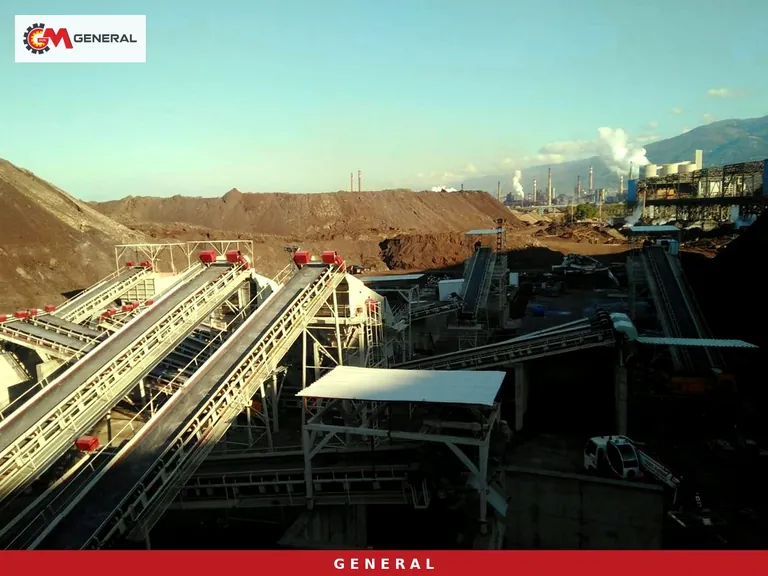
A stationary stone crushing plant in the Middle East that will run above 300 tonnes per hour rarely serves a single customer; it feeds the construction demand of a whole district: ready-mix concrete plants, asphalt plants, road sub-base and fill. At this scale a planning error is not a few lost tonnes but a bottleneck repeated every shift for years. This article explains the order in which decisions should be made when laying out such a line on paper, which real models cover the 300-500 TPH band, and what a hot, arid site adds to the plan.
Start the plan at the quarry face
On high-tonnage projects the first question is usually "how many tonnes?". The correct sequence is different: first the largest lump size of the run-of-mine rock coming from the face, then the hardness and abrasiveness of the rock, then the list of products to be sold. Capacity is the result of these three inputs. If part of the blasted blocks exceeds one metre, the feed opening of the primary crusher is chosen accordingly; if the opening is too small, you get either secondary blasting or constant waiting at the crusher.
The second critical input is the share of fines and soil in the run-of-mine material. Many limestone quarries in the Middle East contain dust, marl and weathered material in the upper benches. If this fraction enters the crusher, it wastes capacity and spoils the fines content of the final product. The pre-scalping decision therefore cannot be separated from the choice of primary crusher.
The third input is the product basket. If concrete aggregate, asphalt chippings, sub-base material and manufactured sand are to come from the same line, screen decks, surge stockpile and shaping stage must be planned from the start. Every stage added later forces you to rework existing conveyor elevations and the steel structure.
Two line backbones for Middle East rock types
The geology of the region is broad: limestone and dolomite quarries are common along the Gulf coast and in the Levant; the mountain belt of Oman and the UAE holds hard ophiolitic rock such as gabbro, while basalt fields occur in Jordan and the north of the Arabian Peninsula. Even within one country the crusher choice can change completely between two quarries. We therefore recommend abrasiveness and compressive strength tests on samples from your own quarry; the two backbones below are selected according to those results.
Impact backbone for limestone and dolomite
In low-silica rock an impact crusher delivers high reduction and cubical grains in a single stage. The primary is the GNR PDK series primary impact crusher: the PDK01 has a 1400×1500 mm rotor, 1000 mm feed size and 315 kW for 250-500 t/h. Above 500 t/h the PDK03 (1600×2000 mm rotor, 1300 mm feed, 500 kW, 500-900 t/h) comes in. In limestone the primary impact crusher's reduction of up to 20:1 noticeably lightens the load on the second stage.
Jaw + cone backbone for basalt, gabbro and granite
In abrasive rock the blow bars of an impact crusher wear out quickly, so compression machines are selected. The primary is a GNRK 130 jaw crusher (1300×1000 mm opening, 160 kW, 400-500 t/h) or GNRK 140 (1400×1100 mm opening, 200 kW, 500-600 t/h), with a cone crusher in the second stage. Model-specific cone crusher capacity data is provided per project, so the second stage is sized from the screen analysis of the primary discharge.
Model matching for 300-500 TPH
The table places the main machines of both backbones side by side using website data. All values come from the product page of the respective model; unknown values are left blank.
| Stage | Model | Feed / opening (mm) | Motor (kW) | Capacity (t/h) |
|---|---|---|---|---|
| Feeding | GNR 140 grizzly feeder | up to 1500 | 2×9.2 | 350-600 |
| Primary (limestone) | GNR PDK01 | 1000 | 315 | 250-500 |
| Primary (limestone, 500+) | GNR PDK03 | 1300 | 500 | 500-900 |
| Primary (hard rock) | GNRK 130 jaw | 1300×1000 | 160 | 400-500 |
| Primary (hard rock) | GNRK 140 jaw | 1400×1100 | 200 | 500-600 |
| Secondary (limestone) | GNR DMK05 | 800 | 500 | 250-500 |
| Secondary (hard rock) | Cone crusher | — | — | — |
| Sand and fines | GNR 150 tertiary | 150 | 250 | 200-300 |
| Shaping | GNR K110 cubitzer | 210 | 160 | 160-250 |
| Screening | Twin vibrating screen | — | — | 100-500 |
The practical conclusion is this: in the 300-500 TPH band a single primary crusher is enough, but on the screening side a single deck body often chokes. The main screen position is therefore planned with a twin-body vibrating screen; two surfaces double the screening area on the same footprint and reduce the recirculating load. If manufactured sand is required on a hard-rock line, a VSI or cubitzer is preferred over a tertiary impact crusher in the last stage, because impact wear parts have a short life in abrasive material.
Feed station and pre-scalping
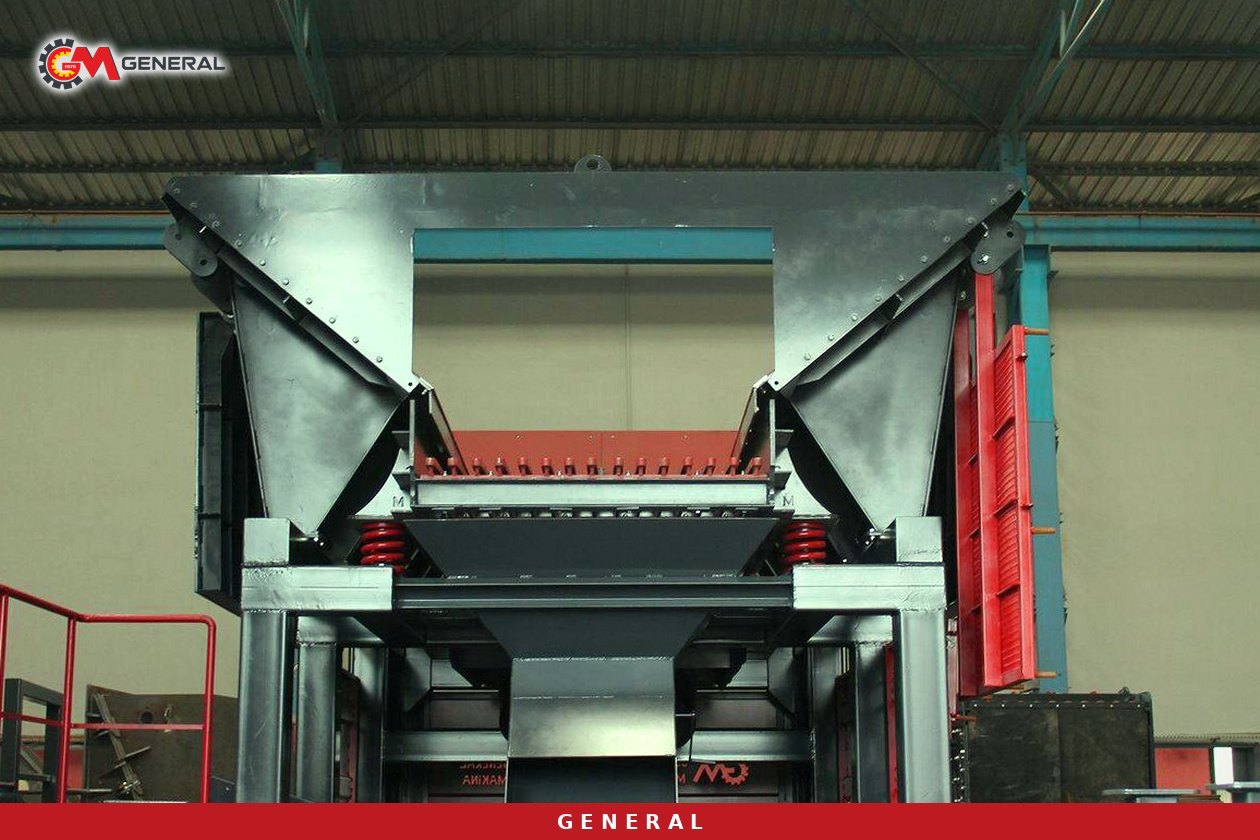
In a high-tonnage line the feed station is the buffer between trucks or loaders and the plant. Hopper volume can be selected between 15 and 100 m³; a large volume absorbs irregular truck cycles and keeps the crusher mouth from running empty. The GNR 140 model of the GNR series vibrating grizzly feeder carries 350-600 t/h with 1400 mm width, 5000 mm length and 2×9.2 kW; on lines around 300 t/h the GNR 110 (1100 mm, 2×7.5 kW, 200-300 t/h) would be at its limit, so one model up stays on the safe side.
The grizzly by-pass section of the feeder separates fines and soil before they reach the crusher. In Middle East quarries this fraction is either sent by a separate conveyor directly to the fill stockpile or passed over a scalping screen so that its clean part rejoins the main flow. Which route is chosen depends on the clay and marl content of the fines; do not decide this without seeing it on a sample.
Layout, surge pile, conveyors and shipping
Most stationary lines are built on a terraced platform inside the quarry: the feed station on the upper level, the primary crusher below it, the screen tower and stockpile conveyors further down. This arrangement lets trucks reach the hopper by ramp and lets material flow by gravity. Design of retaining walls and concrete foundations should not start before the machine dimensions are fixed.
Placing a surge stockpile between the primary crusher and the secondary stage is one of the most valuable planning decisions on lines above 300 t/h. When the primary stops, the secondary and screens keep drawing from the surge pile; in the opposite case the primary keeps running by filling it. Without a surge pile the two stages lock together and the slowest machine dictates the speed of the whole line.
On the conveyor line, width, inclination and speed are calculated together. Our conveyors are built in seven widths from 500 to 1200 mm with 50-1000 t/h capacity; under impact crushers the stronger EP 125 belt is used. Keeping main-flow belts one width step larger leaves room for a later capacity increase.
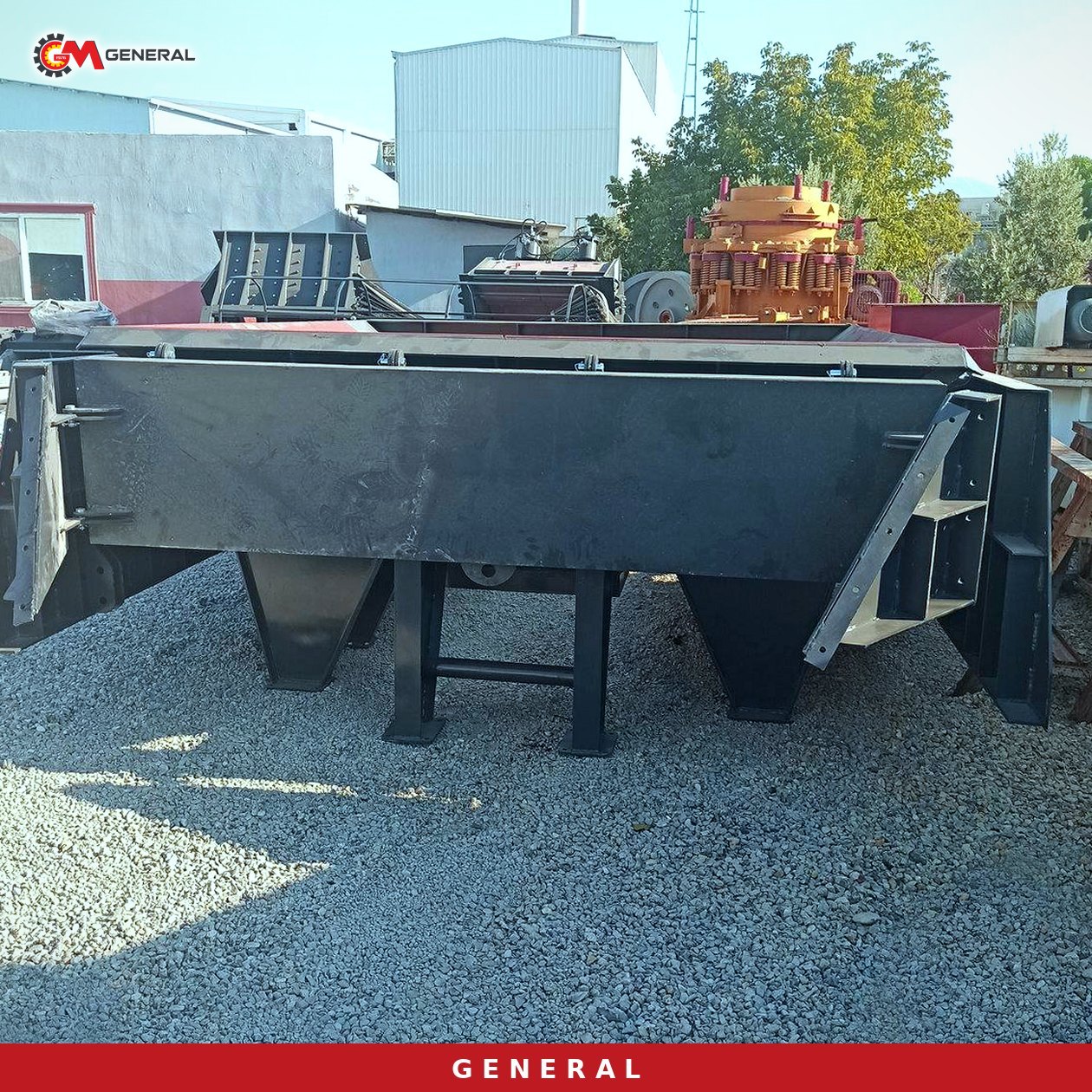
Shipments to the Middle East usually go by road to the port and then by sea; the final leg from Gulf ports to the site is again by road. The primary crusher, large feeder and screen bodies are the heaviest parts: the GNRK 130 weighs about 42,500 kg and the GNRK 140 about 47,000 kg. Crane capacity, site access road and assembly area must be defined in advance for these weights.
Operating decisions on a hot, arid site
High summer temperatures, wind-blown sand and limited water are the daily reality of stationary lines in the Middle East. The decisions below affect output as much as machine selection; which of them apply is decided per site, and they are measures selectable per project.
Power and automation
In quarries far from the grid the line runs on generators, and starting currents then define generator size. In the automation of a stationary crushing plant the PLC starts equipment in sequence from the stockpile side toward the feeder, and frequency drives balance feeder speed against crusher current. This prevents starting on a loaded belt and stops large motors from starting at the same moment. Placing electrical panels in a shaded, well-ventilated cabin is a simple decision that reduces faults in hot regions.
Water and dust
When water is limited, dust suppression relies on fine misting focused on transfer points; enclosing belt transfers and covering the screen tower cut dust at the source. Filter service intervals on engine air intakes should be shortened.
Planning file to prepare before requesting a quotation:
- Largest run-of-mine lump size and blasting pattern
- Rock type and sample test results (abrasiveness, compressive strength)
- Share of fines, clay and marl in the feed
- Product list and approximate share of each fraction
- Daily operating hours and target annual output
- Power source: grid or generator
- Site topography and usable bench levels
- Water source and available quantity
Frequently asked questions
Have you delivered a stationary line in the Middle East before?
Yes. For the GNR PDK 02 stationary crusher in Saudi Arabia we configured a 250 t/h line for desert conditions. Higher-tonnage lines follow the same logic with a larger primary and twin screens.
Two parallel lines or one large line for 500 t/h?
A single large line with one primary needs less equipment and fewer operators; two parallel lines keep half of the output running during maintenance. The decision depends on the quarry's maintenance routine and product basket.
Can the line be expanded later?
Expansion is possible if the main conveyors, screen tower and foundations are designed from the start for the next capacity level. Leaving space for a second secondary crusher in the first layout is therefore a sensible step.
What determines the price?
Number of stages, crusher types, screen decks, total conveyor length, automation scope and the amount of steel structure determine the price. We prepare a project-specific quotation based on your planning file.
Conclusion
A stationary line above 300 t/h in the Middle East produces steadily for years when it is planned with correct rock data, an adequate feed station, a surge pile and twin screens. The fixed crushing plants and crusher feeders we have built in Izmir since 1976 carry ISO 9001 and CE certification and a 1-year warranty (wear parts excluded). Contact us with your quarry data and we will refine the line configuration together.
Definitions of technical terms: Glossary