EN — English
 TR — Türkçe
 DE — Deutsch
 RU — Русский
 FR — Français
 ES — Español
 AR — العربية
 SR — Српски

Tunisia Limestone Quarry Mobile Stone Crushing Plant 80-150 TPH
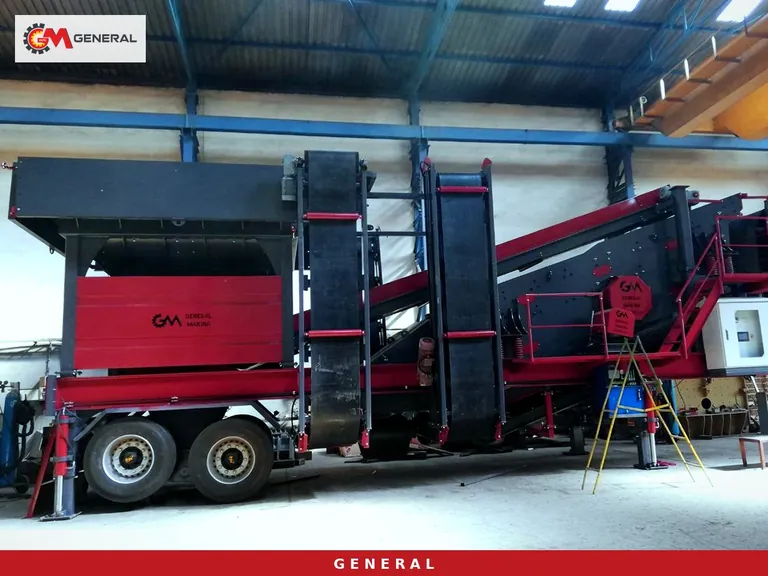
Choosing a crusher for a limestone quarry in Tunisia usually starts with one question: can a single chassis turn out 80-150 tonnes of chippings and road base per hour, or should the quarry build a line piece by piece as it grows? Limestone is one of the rocks an impact crusher handles most comfortably. Yet marl and clay seams inside the face, summer dust and quarry sites far from the grid make it harder to reach the catalogue tonnage in the field. This article compares our real models that cover this capacity band, with their figures, and walks through the site information that actually changes the choice in Tunisia.
Tunisian limestone is worked across a wide area, from the hilly districts of the north and centre to the Sahel coast, and goes into aggregate, road sub-base, lime and cement raw material. No two faces are alike: some are massive and clean, others thinly bedded and clayey. Treat the recommendations below as a starting point; the final configuration is fixed only after a laboratory test on a sample taken from your own quarry.
What Tunisian limestone asks of an impact crusher, and where it pushes back
An impact (HSI) crusher breaks rock by throwing it with the blow bars on its rotor against breaker plates; it relies on free impact rather than compression. In limestone, a brittle rock with low silica, this principle brings two gains: a high reduction ratio and a cubical particle. Our product pages state a reduction of up to 20:1 in limestone for the primary impactor and typically around 10:1 for the secondary impactor. Getting the same product with jaw and cone crushers usually means adding one more crushing stage.
What pushes back is rarely the rock itself; it is the foreign material mixed into the muckpile:
- Marl and clay partings: once wet, they smear the crusher mouth and screen meshes. In the field this is most often the real reason capacity drops.
- Siliceous layers and chert nodules: found in some limestone formations, they speed up blow bar wear noticeably. Have the silica content of your sample measured.
- Overburden soil: if soil that falls into the pile after blasting is not removed, product cleanliness suffers and acceptance as concrete aggregate is put at risk.
These three points explain why pre-screening and the by-pass arrangement weigh so heavily in model selection.
Turning the 80-150 TPH target into site numbers
The hourly capacity in a catalogue is a nominal range valid for a given feed size and closed-circuit setting. Real output settles somewhere inside that range depending on block size after blasting, moisture, clay content and the required product split. It is therefore sounder to define the target as "daily tonnes and product mix" rather than a single number.
A simple planning formula does the job: required hourly capacity = daily target tonnes ÷ (shift hours × availability). Hypothetical example: a quarry that wants 1,000 tonnes of saleable product a day and expects the plant to run 80% of a 10-hour shift needs 1,000 ÷ (10 × 0.8) = 125 TPH. That lands in the upper half of the 80-150 TPH band. If the quarry plans a second shift later, the same machine runs at a lower load and therefore with less wear.
The second question is the product mix. A quarry selling mostly road base and one supplying 5-12 and 12-19 mm chippings to ready-mix plants need different crusher settings and screen decks at the same tonnage. Sharing the proportions from your sales book at quotation stage shows from the start which fraction will become the bottleneck.
Two routes: General 800 on one chassis or a staged line of single-chassis units
There are two realistic approaches for this capacity band. The figures below come from the technical data on the relevant product pages; values a unit does not provide on its own are shown as "—" in the table.
General 800: crushing, screening and generator on one trailer
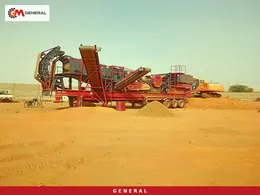
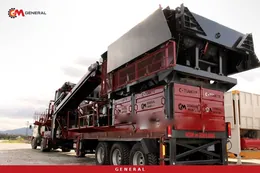
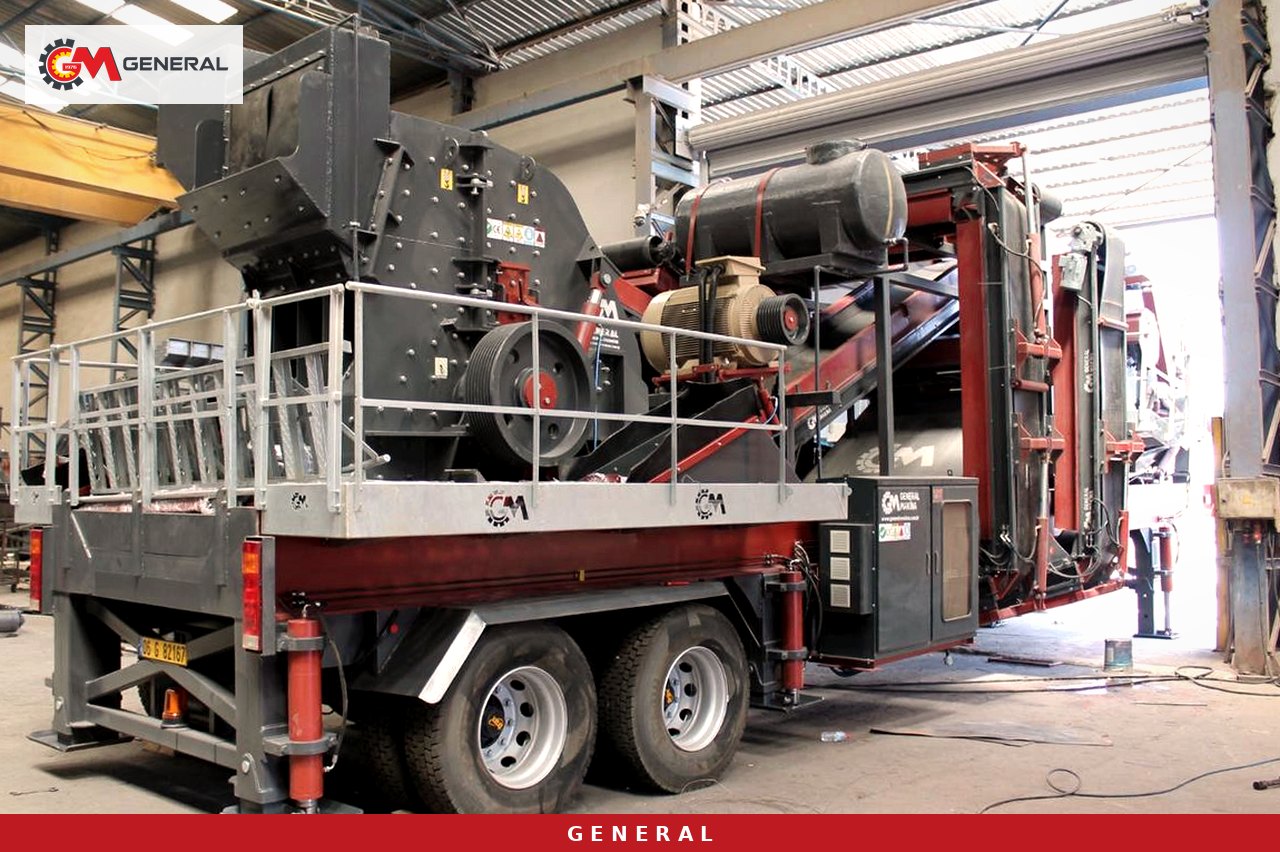
The General 800 is a closed-circuit wheeled plant that places the PDK 1280 primary impact crusher, a 3-deck vibrating screen measuring 1300×4000 mm and a return conveyor on the same chassis. Its 80-150 TPH capacity and 600 mm maximum feed match the headline target exactly. It separates 0-5 / 5-12 / 12-19 / 19-40 mm fractions in one pass and can work on an off-grid site with its 450 kVA generator. Folding hydraulic conveyors and support legs mean no concrete foundation is needed. Because it is designed for limestone and low-abrasive stone, it is the first candidate for a typical Tunisian limestone quarry.
Staged line: GNR 90 jaw + M-DMK 01 secondary impactor
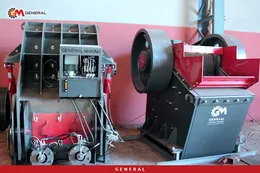
If blasting produces large blocks, or you want to expand capacity later, a line built from two single-chassis units is worth considering. The GNR 90 mobile primary jaw unit handles 70-180 TPH with a 1000×3800 mm feeder and a GNRK 90 jaw crusher; the series accepts 0-1100 mm feed and delivers 0-250 mm product. Behind it, the M-DMK 01 secondary impactor takes 0-350 mm material down to 0-50 mm; its capacity is 120-180 TPH and its motor 160 kW. That capacity margin also absorbs the oversize returning from the screen. A separate vibrating screen is added to the line to split fractions; its size is chosen from the product list.
When does the pre-screening DMK come in?
If the material is already down to 0-100 mm, for example when an old stockpile is reprocessed or primary crushing is done on another line, the two-chamber mobile DMK with pre-screen can be considered. It works in the 40-300 TPH range and delivers 0-30 mm product; its integrated vibrating pre-screen routes ready-sized fines around the crusher.
| Unit | Crusher | Capacity (TPH) | Max. feed (mm) | Product | Screening | Power / weight |
|---|---|---|---|---|---|---|
| General 800 | PDK 1280 primary impactor | 80-150 | 600 | 0-5 / 5-12 / 12-19 / 19-40 mm | 1300×4000 mm, 3-deck | 450 kVA generator / 35,000 kg |
| GNR 90 (primary) | GNRK 90 jaw | 70-180 | 1100 | 0-250 mm | — | / 25,000 kg |
| M-DMK 01 (secondary) | Secondary impactor | 120-180 | 350 | 0-50 mm | By-pass screen on feeder | 160 kW / 32,000 kg |
| Pre-screening DMK | Two-chamber secondary impactor | 40-300 | 100 | 0-30 mm | Integrated vibrating pre-screen | (/) |
In short: if you want a plant that travels on one trailer, sets up quickly and covers the whole band on its own, choose the General 800; if you face large blast blocks, plan staged growth or want to use the units on separate sites, the staged line comes forward. If the target goes beyond 150 TPH, the General 01 (120-180 TPH, 700 mm feed) can join the comparison. You can review other wheeled options on the wheeled mobile crushing plants page and single-chassis units on the single-chassis mobile crusher units page.
Clay seams, by-pass and blow bars: managing wear in limestone
What tires a crusher most in a limestone quarry is passing material through it that needs no crushing. On the M-DMK series, the screen on the feeder table and the by-pass conveyor send soily fines to a separate stockpile before they enter the crusher; on the pre-screening DMK, the integrated vibrating screen does the same job. The crusher then works on coarse rock only, and blow bars and breaker plates wear more slowly. On the General 800, feed comes from a hopper with a vibrating feeder; in a quarry with high clay content, extra measures such as grizzly pre-screening are assessed per project.
Quarry discipline matters as much as hardware. Stripping overburden separately before blasting, stockpiling material from clayey levels apart from clean rock, and checking screen meshes at the start of each shift in rainy periods prevent most of the capacity loss.
Choose the blow bar alloy to match the quarry feed
The guidance on our product pages is clear: high-chrome blow bars for clean limestone; manganese or martensitic alloy where river material is mixed in or where metal such as bucket teeth or drill bits may enter the feed. On the pre-screening DMK, the blow bars are reversible; when one face is worn they are turned to get a second life. The warranty is 1 year and does not cover wear parts. Planning a set of spare blow bars and breaker plates with the first order therefore keeps the plant from standing idle while parts are shipped through the port.
From port to quarry: shipping, power and the hot season
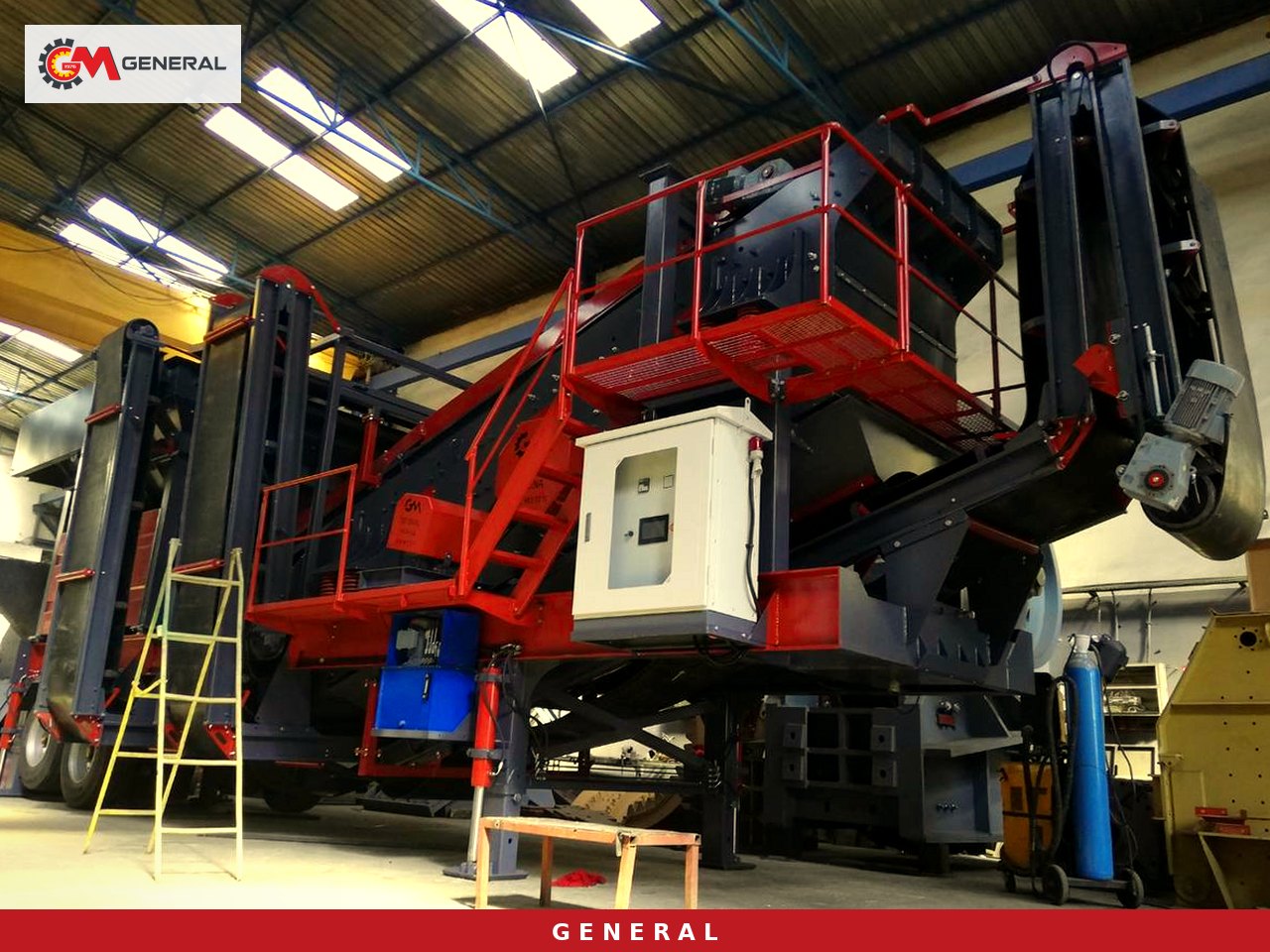
A plant shipped by sea from Türkiye to Tunisia normally lands at one of the ports such as Radès, Sfax, Bizerte or Gabès; the choice depends on the quarry location and the road route. The General 800 has a transport size of 3600×15500×4500 mm and weighs 35,000 kg. These values should be checked in advance against vessel type, port handling equipment and the bridges and bends on the road to the quarry. The wheeled chassis leaves the port behind a tractor unit; at the quarry, the support legs are lowered and the conveyors unfolded to start up.
At quarries with a weak grid or none at all, the General 800 runs on its own 450 kVA generator. In a staged line, the motor ratings of the units (for example 160 kW for the M-DMK 01), feeders, conveyors and screen are calculated together and the generator or grid connection is sized per project.
At quarries in central and southern Tunisia, summer dust and heat strain engine and hydraulic cooling, air filters and the electrical cabinet. Measures that can be selected per project include water-spray dust suppression at transfer points, covered belt conveyors, air conditioning for the cabinet and a filter change interval suited to the site. Which ones are needed depends on site location and buyers' expectations on product cleanliness. Confirm current quarry permit and environmental conditions with the local authority.
Information to collect at the quarry before requesting a quote
- Rock sample and test results: compressive strength, abrasiveness, silica and clay content.
- Largest block size after blasting (the 600 mm limit is decisive for the General 800).
- Daily target tonnes and shift pattern.
- Product list and proportions: road base, chipping fractions, manufactured sand.
- Power situation: is there a grid, how far is it from the quarry, is a generator needed?
- Site layout: feed ramp, stockpile area, haul road gradient inside the quarry.
- Arrival port and road route to the quarry.
With this information, the configuration is prepared by matching it directly to your quarry's rock rather than on paper. For a broader model comparison for limestone, see our article on high-efficiency mobile crusher solutions for limestone.
Frequently asked questions
Which products does the General 800 deliver from Tunisian limestone?
Its 3-deck screen separates 0-5, 5-12, 12-19 and 19-40 mm fractions in one pass; the discharge setting is in the 0-100 mm range. Exact screen apertures are fixed at order stage according to the sample result and your sales list.
Is an impact crusher still the right choice for clayey limestone?
Yes, provided clay and soil can be removed before they enter the crusher. If the sample shows high silica, a jaw primary followed by a cone or cubicizer secondary may give a lower wear cost; the decision follows the test result.
Can I run the plant without grid electricity?
The General 800 can run off-grid on its 450 kVA generator. In a staged line, total power is calculated from the units and the generator is selected accordingly.
What determines price and delivery time?
The chosen configuration, generator and screen equipment, extra measures such as dust suppression, the spare parts package, and sea and road freight. A figure given before these items are clear would be misleading; when you send your quarry data with the request, a project-specific quotation is prepared.
Conclusion
For a limestone quarry in Tunisia aiming at 80-150 TPH, the shortest route is often the General 800. Where there are large blast blocks, staged growth or a need to use the units on separate sites, a line made of the GNR 90 and the M-DMK 01 offers a more flexible start. In both cases success depends on removing clay and soil before they reach the crusher and on matching the blow bar alloy to the quarry feed. We have been manufacturing in İzmir since 1976; our plants carry CE and ISO 9001 certification, and North Africa is one of our export regions. Send your sample results and target tonnage via our contact page and we will prepare a configuration and quotation for your quarry.
Definitions of technical terms: Glossary