EN — English
 TR — Türkçe
 DE — Deutsch
 RU — Русский
 FR — Français
 ES — Español
 AR — العربية
 SR — Српски

Gulf Countries Stationary Aggregate Crushing Plant Design 500 TPH
A stationary line producing 500 tonnes of aggregate per hour in the Gulf countries usually supplies not one quarry's customers but the concrete, asphalt and fill demand of an entire region. The rock range is wide, from the limestone plateaus of inland Saudi Arabia to the gabbro and basalt of the ophiolite belt in Oman and the United Arab Emirates, so the same capacity label can describe two plants that have almost nothing in common. This article walks through how the design file for a stationary crushing plant is built on the engineering desk: which hours the capacity is defined against, how the mass balance is closed stage by stage, how the feed station and concrete foundations are sized, and where the hot, dusty climate enters the drawing.
Defining 500 TPH correctly: nominal, design and peak capacity
The "500 TPH" on the first page of a design file can mean three different things, and no machine should be selected until it is clear which one is meant. Nominal capacity is the flow the line delivers continuously in its main products under average feed conditions. Design capacity is the margin added to belts, chutes and screens to absorb feed fluctuation and the material returning from screen to crusher. Peak capacity is the load that reaches the feeder in bursts of a few minutes when truck and loader cycles overlap; it is absorbed by hopper volume, not by the crusher.
To move from an annual target to an hourly figure, use this formula: hourly capacity = annual production target ÷ (operating days per year × operating hours per day × availability ratio). The smaller each term in the denominator becomes, the larger the hourly capacity needed for the same annual tonnage. Several Gulf countries restrict outdoor work around midday in summer, so the investor should confirm the shift calendar against local rules and enter that figure into the formula realistically. Write an optimistic calendar and the line will be 500 TPH on paper while missing its annual target on site.
Rock type sets the flowsheet: two design families in the Gulf
The Gulf aggregate map splits roughly in two. Limestone and dolomite dominate the coastal plains and inland plateaus, while along the Hajar mountains and in the western part of the Arabian shield hard, siliceous rocks such as gabbro, basalt and granite come to the fore. The flowsheet cannot be fixed before the abrasiveness of the specific quarry is measured: the Bond abrasion index and silica content are design inputs determined in the laboratory on a sample. The crusher types diverge according to these two values.
Limestone and dolomite: a line built on impact crushing
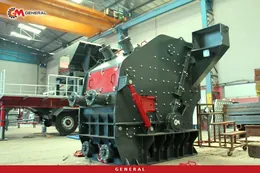
The GNR PDK series primary impact crusher gives up to 20:1 reduction in limestone in a single stage, which cuts the number of stages in the line. For a 500 TPH main flow, the GNR PDK03 (1600×2000 mm rotor, 1300 mm feed, 500-900 t/h, 500 kW) is the selection that leaves capacity headroom. The GNR PDK01 (1400×1500 mm rotor, 1000 mm feed, 250-500 t/h, 315 kW) works at the top end of its range and is considered when blasting can keep block size small. In the secondary stage, the GNR DMK05 (1400×2000 mm rotor, 800 mm feed, 250-500 t/h, 500 kW) turns primary product into cubical chippings. If manufactured sand is required, the GNR 150 tertiary crusher (150 mm feed, 200-300 t/h, 250 kW) processes the fraction retained on the screen.
Gabbro, basalt and granite: a line built on compression crushing
Blow bars wear out quickly in high-silica rock, so the first two stages are built with jaw and cone crushers. The GNRK 140 jaw crusher (1400×1100 mm opening, 500-600 t/h, 200 kW, 47,000 kg) is the model that handles a 500 TPH primary flow on its own; the largest acceptable block is roughly 0.8-0.9 times the opening width. The GNRK 130 (1300×1000 mm opening, 400-500 t/h, 160 kW) is only sufficient when the grizzly by-pass keeps a large share of the fines away from the crusher. The General cone crusher works in the secondary and tertiary stages; since its model-based capacity table is issued per project, the number and size of cones are fixed at quotation stage according to the quarry sample. If the concrete and asphalt specification demands particle shape, a GNR K110 cubicizer (210 mm feed, 160-250 t/h, 160 kW) is added as the final stage; if the entire flow is to be shaped, two units are planned in parallel.
| Stage | Limestone / dolomite line | Capacity (t/h) | Gabbro / basalt / granite line | Capacity (t/h) |
|---|---|---|---|---|
| Feeding | GNR 140 grizzly feeder (2×9.2 kW) | 350-600 | GNR 140 grizzly feeder (2×9.2 kW) | 350-600 |
| Primary | GNR PDK03 (500 kW) | 500-900 | GNRK 140 jaw (200 kW) | 500-600 |
| Secondary | GNR DMK05 (500 kW) | 250-500 | General cone crusher | — |
| Tertiary / shaping | GNR 150 tertiary (250 kW) | 200-300 | GNR K110 cubicizer, 2 units (160 kW/unit) | 160-250 (per unit) |
| Screening | Vibrating twin screen | 100-500 | Vibrating twin screen | 100-500 |
Mass balance: closing every stage separately
Once the flowsheet is drawn, input and output tonnage is calculated for every crusher and screen. The item most often skipped is circulating load: in closed circuit, oversize returns to the crusher, so the tonnage the crusher sees is larger than the tonnage the line produces. If part of the cone crusher product cannot pass the target screen aperture, that share rides back into the crusher on every pass; the cone is therefore sized not on the line's 500 TPH but on this flow enlarged by recirculation.
Screen area is sized with the same logic. A single-body GNR 2470 (2400×7000 mm, 30 kW) offers a large area, yet in a 500 TPH flow the fine fractions can blind the surface. The vibrating twin screen runs two bodies together, doubles the screening area and screens without choking in the 100-500 t/h range. In quarries where sand and 0-5 mm product will make up most of the sales, drawing the fine screening deck as a separate stage relieves the main screen. Belts are chosen in the 500-1200 mm width range and the 50-1000 t/h capacity band; under an impact crusher, EP 125 – 4-ply rubber is used instead of the standard EP 100.
Feed station: hopper volume, grizzly and truck cycle
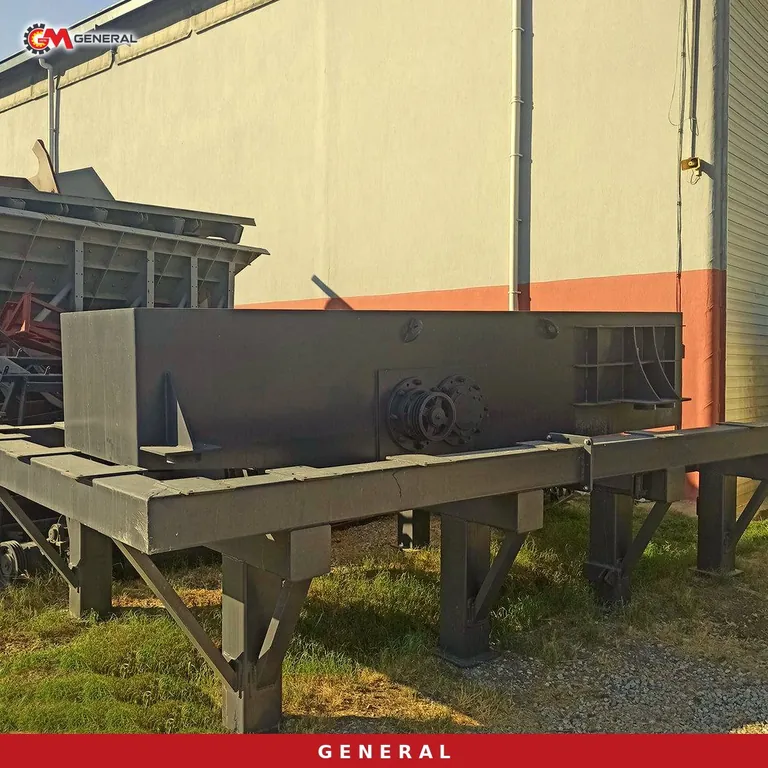
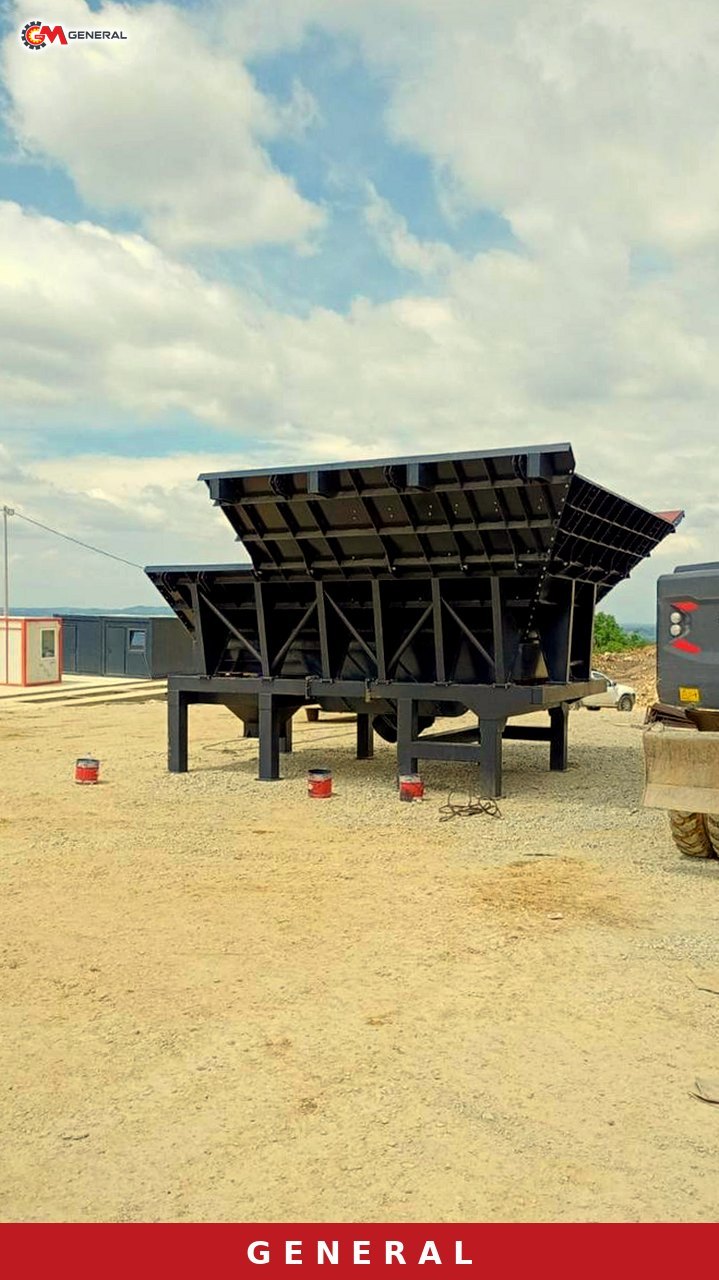
The feed station, the first link of a 500 TPH line, is the structure that takes the heaviest impacts. Within the GNR series vibrating grizzly feeder range, only the GNR 140 (1400 mm width, 5000 mm length, 350-600 t/h, 2×9.2 kW) meets this capacity alone. The GNR 110 (200-300 t/h) is an option only when two parallel primary branches are designed, one per branch. The feeder accepts run-of-mine rock up to 1500 mm and is matched with a hopper in the 15-100 m³ range. You can compare all options on the feeders and hoppers page.
Because hopper volume is the buffer that damps peak load, it is considered together with truck body size and loader cycle: the volume arriving in a single dump must stay below what the hopper can comfortably swallow, otherwise material spills over the sides and the feeder is overloaded. The grizzly by-pass gains extra value in Gulf limestone quarries; the fines and soil share after blasting can be high, and if that share is separated before it ever enters the primary crusher, tonnage to the crusher drops and liners wear more slowly. Where feed is clayey and sticky, grizzly gaps can blind, so the Wobbler feeder alternative comes onto the table.
Concrete foundations, steel structure and layout
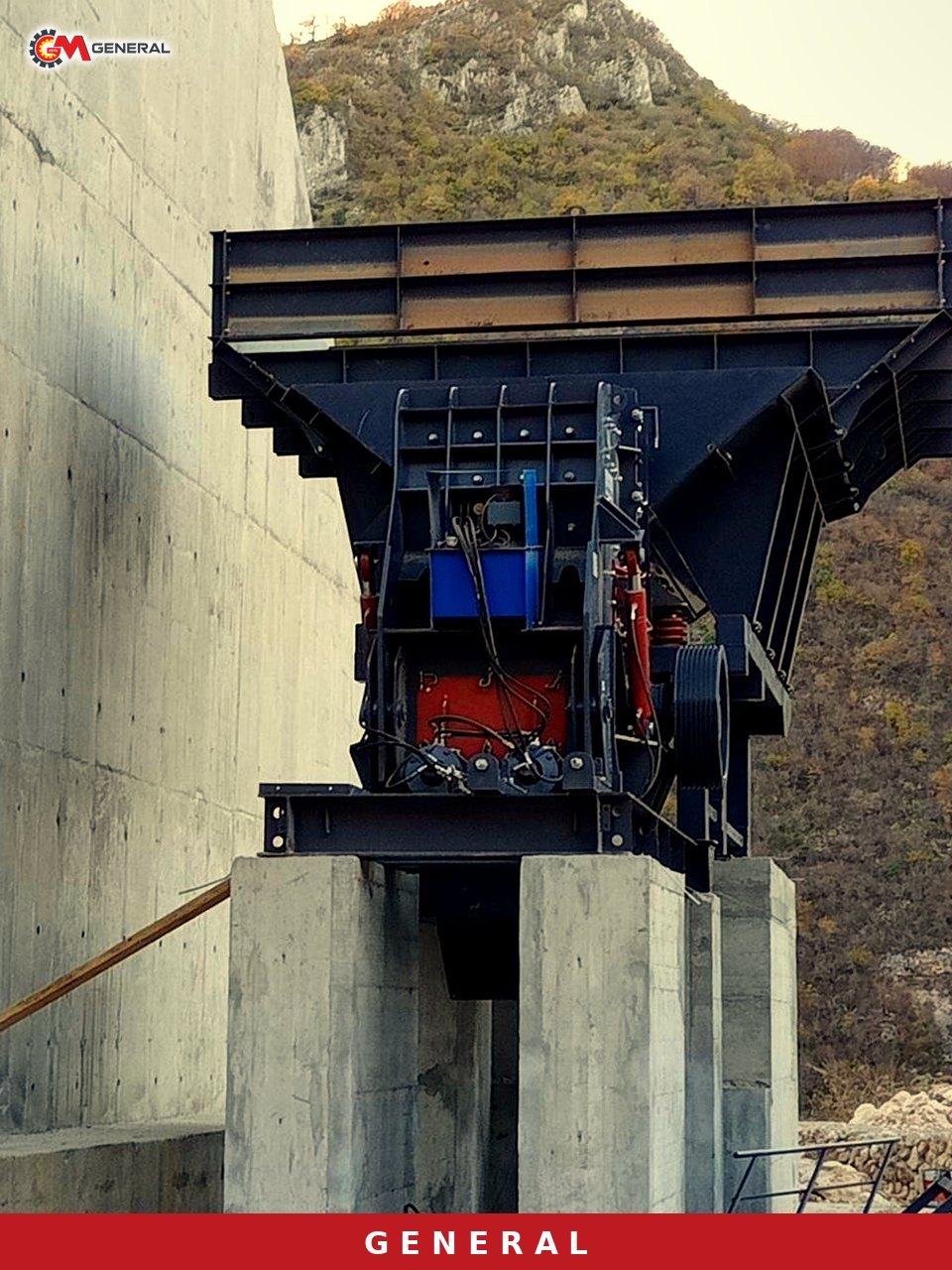
The design item that most clearly separates a stationary plant from a mobile one is that the machines sit on concrete foundations. Crusher plinths are designed by a civil engineer according to the load and anchoring plan supplied by the manufacturer. The foundation of a 47,000 kg jaw crusher such as the GNRK 140 must carry the static weight as well as the repeated forces generated by the swinging jaw. No plinth is drawn without a ground survey: the Gulf coastline can have saline, loose soils known as sabkha, and on such ground the foundation solution and concrete class are assessed separately.
In the layout, stacking crushers one below another by using level differences reduces the number and length of belts. A surge stockpile placed between primary product and the secondary stage is the most valuable buffer in the design: when feeding stops at the face, the secondary and screening stages keep running for a while, and when the secondary has a fault, primary product continues to flow to stock. Stockpile areas, the truck loading point and the weighbridge are positioned so that vehicle traffic does not cross.
How the hot, dusty climate enters the design
On a Gulf site, climate is not an operating issue to be solved after commissioning but a design input that belongs in the drawing stage. Cooling conditions for motors, gearboxes and hydraulic units, the location and shading of electrical panels, and the choice of air filtration and sealing in a high-dust environment should be discussed before the quotation. The measures below should be treated not as standard equipment but as options that can be added to the project according to quarry conditions:
- Dust suppression nozzles at crusher discharge points and belt transfer chutes; where water is limited, nozzles go only at critical points.
- Belt covers on conveyors carrying fine product, rubber skirts at transfer points.
- A dust cover for the screen body, especially on the fine screening deck producing 0-5 mm.
- A dust-sealed, air-conditioned control room for electrical panels.
- PLC sequential start and interlocks: the feeder stops automatically when the crusher stops.
- Stockpiles positioned according to the prevailing wind and watered site roads.
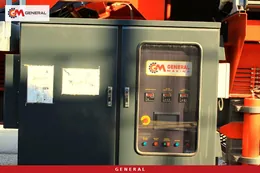
On the control side, the automation and control system runs sequential start and interlocks via PLC, while the SCADA screen shows the line live. For a Gulf operation aiming to work with few people on site during hot hours, being able to watch the whole line from the control cabin is one of the design's productivity items. On the wear side, GNRK jaw plates are standard manganese steel (Mn13/Mn18), with Mn18/Mn22 chosen for high-silica rock; in an impact line, high-chrome blow bars are preferred for clean limestone.
Frequently asked questions
Have you delivered a stationary plant in the Gulf?
Yes, the GNR PDK 02 stationary crusher in Saudi Arabia was installed for 250 t/h in desert conditions; details are on the project page. We make no reference claims for other Gulf countries; we redo the design for every quarry.
One line or two parallel lines for 500 TPH?
A single line means fewer machines, fewer belts and smaller civil works. Two parallel branches keep roughly half of production running while one stage is under maintenance. If parts access is limited at a remote site and dispatch cannot tolerate stoppages, two branches each built with a GNR 110 feeder and a GNRK 110 jaw crusher (1100×850 mm opening, 200-350 t/h, 110/132 kW) are worth evaluating.
Can the line be expanded beyond 500 TPH later?
It can, but the growth margin must be left in the first drawing. The GNR PDK03's upper limit reaching 900 t/h, or the GNRK 140's upper value of 600 t/h, only makes sense with a layout that reserves space for a second secondary crusher and an extra screen; belts and chutes should also be selected with that margin in mind.
What information should I send for a quote?
Rock type and any laboratory results, maximum block size, required fractions and their ratios, annual target and operating calendar, whether grid power or a generator will be used, and the port of delivery. Price is determined by the number of stages, crusher types, screen and belt quantities, steel structure and automation scope.
Conclusion
When designing a 500 TPH stationary aggregate plant in the Gulf countries, the right sequence is: define capacity against the operating calendar, choose the impact or compression family from rock tests, close the mass balance with circulating load, size the feed station for peak load, design the plinths from the ground survey and add climate measures to the drawing from the start. General Makina, building crushing and screening lines in Izmir since 1976, ships ISO 9001 and CE certified equipment with a 1-year warranty (wear parts excluded) to export regions that include the Middle East. Send your quarry data via our contact page or WhatsApp, and we will prepare a project-specific quote with a flowsheet and model list.
Definitions of technical terms: Glossary