EN — English
 TR — Türkçe
 DE — Deutsch
 RU — Русский
 FR — Français
 ES — Español
 AR — العربية
 SR — Српски

Egypt Ready-Mix Suppliers: Aggregate Crushing Plant 120-180 Ton Per Hour
For a ready-mix company in Egypt, buying a crusher is not just about placing another machine in front of the batching plant. It means stopping the purchase of aggregate from third parties and producing it from your own quarry or a leased site, so that the sand and coarse aggregate in every mix design come under your own control. This article explains which crushing and screening configuration Egyptian ready-mix suppliers with a 120-180 ton per hour target should choose for each rock type, which figures to compare during the decision, and what to clarify before asking for a quotation. All technical values come from our product pages; we give no information about any specific quarry or project in Egypt and recommend confirming site-specific values together through samples and the applicable specification.
From batching output to crusher tonnage: where the calculation starts
Ready-mix capacity is expressed in m³ per hour, crushing capacity in tons per hour. The bridge between them is the aggregate content of the mix design. The formula is simple: aggregate demand (t/h) = concrete actually produced (m³/h) × aggregate per m³ (t/m³). A hypothetical example: a plant running at 100 m³/h whose recipe uses 1.9 tons of sand and gravel per m³ draws roughly 190 tons of aggregate in a peak hour. Take the real ratio from your own laboratory mix designs; the sand-to-coarse balance shifts noticeably between C25 and C40.
The second thing to plan for is operating hours. A batching plant works in waves: morning pours and large site orders create peaks, the afternoon is slower. A crusher, by contrast, fills the stockpile area at a steady pace throughout the shift. A crushing and screening plant in the 120-180 TPH band, backed by enough stockpile bays and loader capacity, can therefore supply a batching plant whose instantaneous demand looks higher on paper. Size the line on total daily tonnage and the number of days you want in stock, not on the peak hour.
Rock types found in Egyptian quarries and what they mean for crusher choice
Aggregate sources in Egypt cover a wide range. Limestone and dolomite quarries are common on the plateaus framing the Nile valley and in areas close to the Suez corridor, while the Eastern Desert towards the Red Sea and the Sinai are known for granite, basalt and similar hard, silica-rich rock. Basalt quarries also exist around Cairo. Even within one region, however, the deposit changes, so base the crusher decision not on a region name but on tests of a sample from your own face: compressive strength, abrasiveness, clay and dust content.
Limestone and dolomite: the case for impact crushing
In low-abrasion calcareous rock an impact crusher gives a high reduction ratio and cubical grains in a single stage. For ready-mix that translates into better workability and fewer flaky particles. The point to watch is that impact crushing can generate a lot of fines in the 0-5 mm class; if the dust content of the sand exceeds the specification limit, washing or air classification becomes part of the discussion.
Granite and basalt: jaw primary and the secondary decision
In hard, siliceous rock the blow bars of an impact rotor wear quickly. Here the first stage is a jaw crusher, and the second stage offers two paths. A cone crusher works by compression and extends the life of wear metal in abrasive rock. An impact secondary gives higher reduction and a more cubical product, but its wear cost rises with the silica content of the stone. The choice is a balance between the wear-parts budget and the grain-shape requirement.
Three wheeled plant layouts for the 120-180 TPH band
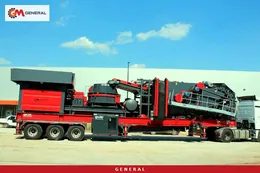
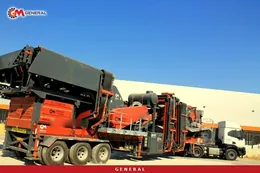
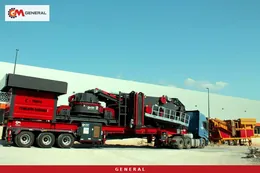
Three of our wheeled models answer this tonnage directly. All three share the same 120-180 t/h output band; what separates them is the crusher arrangement and therefore the rock they suit. You can compare the full family on the wheeled mobile crushing and screening plants page.
| Model | Crusher arrangement | Suited rock | Maximum feed | Product fractions | Screen | Generator | Weight | Transport dimensions |
|---|---|---|---|---|---|---|---|---|
| General 01 | GPS 1210 impact (primary + secondary in one body) | Limestone, dolomite, mixed feed | 700 mm | 0-5 / 5-12 / 12-19 / 19-40 mm | 1600×5000 mm, 4 decks | 550 kVA | 55,000 kg | 4300×18500×4500 mm |
| General 944 | GPJ 90 jaw + GM430 cone | Granite, basalt, quartz-bearing rock | 800 mm | 0-5 / 5-12 / 12-19 mm | 1600×5000 mm, 3-deck horizontal | 550 kVA | 70,000 kg | 4130×20350×4500 mm |
| General 950 | GPJ 90 jaw + DMK01 impact | Granite, basalt; cubical product first | 800 mm | 0-5 / 5-12 / 12-19 mm | 1600×5000 mm, 3-deck horizontal | 600 kVA | 70,000 kg | 4130×20350×4500 mm |
The General 01 combines primary and secondary work in a single impact body, which makes it the simplest investment for calcareous quarries; its four-deck screen also separates 19-40 mm coarse aggregate onto its own pile. For a supplier working hard rock, the General 944 puts wear control first with its cone secondary, while the General 950 prioritises grain shape with its impact secondary. Both share the same dimensions and weight, so transport and layout planning stay identical; only the character of the secondary changes.
A fixed line beside the batching plant or a plant that moves between quarries?
Some Egyptian ready-mix companies operate one large batching yard; others set up temporary batching plants next to job sites in different cities. The crusher decision should follow that operating model. If aggregate will come from a single quarry at the same spot for years, look at stationary crushing and screening lines built on concrete foundations: with no chassis transport limit, the feed opening, number of screen decks and stockpile conveyors can be scaled to the need. Because capacity and equipment lists for fixed lines are drawn per project, we do not quote a single figure here.
If the quarry location changes every few years, or you need to move to a new face before the old one is exhausted, a wheeled plant makes more sense. The transport dimensions in the table show in advance which road permits you will need. Shipments from Türkiye to Egypt go by sea through a port; we recommend planning the port, customs and inland haulage route together with your own logistics provider.
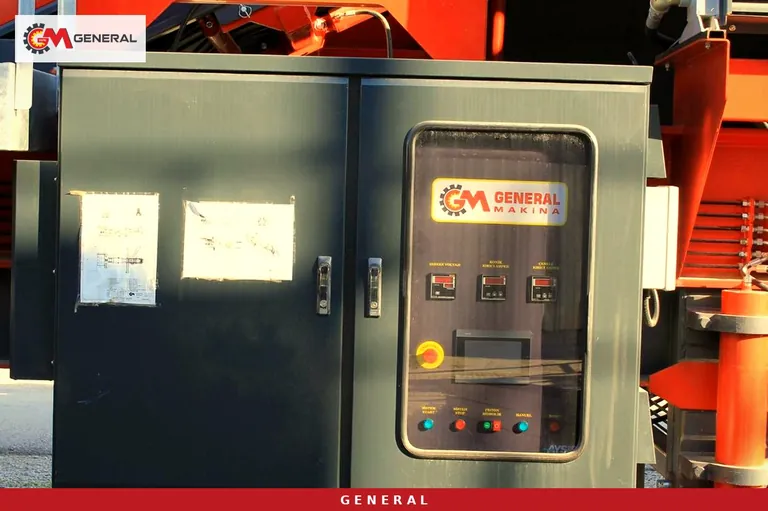
Egypt's hot, dusty climate also shapes daily operation. At quarries far from the grid, the plant runs on its own generator, whose air filters and radiator cores need frequent checks because of dust. Water dust suppression at conveyor transfer points and covered belts are measures that can be selected per project. The control panel should be placed where it is protected from sun and dust, and if an operator cabin is needed, shade and ventilation should be part of the plan. For sequential start-up, feeder speed control based on crusher current and remote alarm tracking, see the automation and control system options.
How fraction consistency shows up in the batching mixer
What a ready-mix producer expects from a crusher is not tonnage alone but the same grading curve every day. When the dust content of 0-5 mm sand fluctuates, water demand changes, admixture dosing drifts and slump is lost. When flaky grains increase in 12-19 mm gravel, pumped concrete becomes harder to discharge. Screen mesh openings, screen inclination and crusher setting should therefore be fixed to the mix design from day one and followed with weekly sieve analyses.
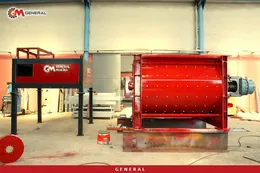
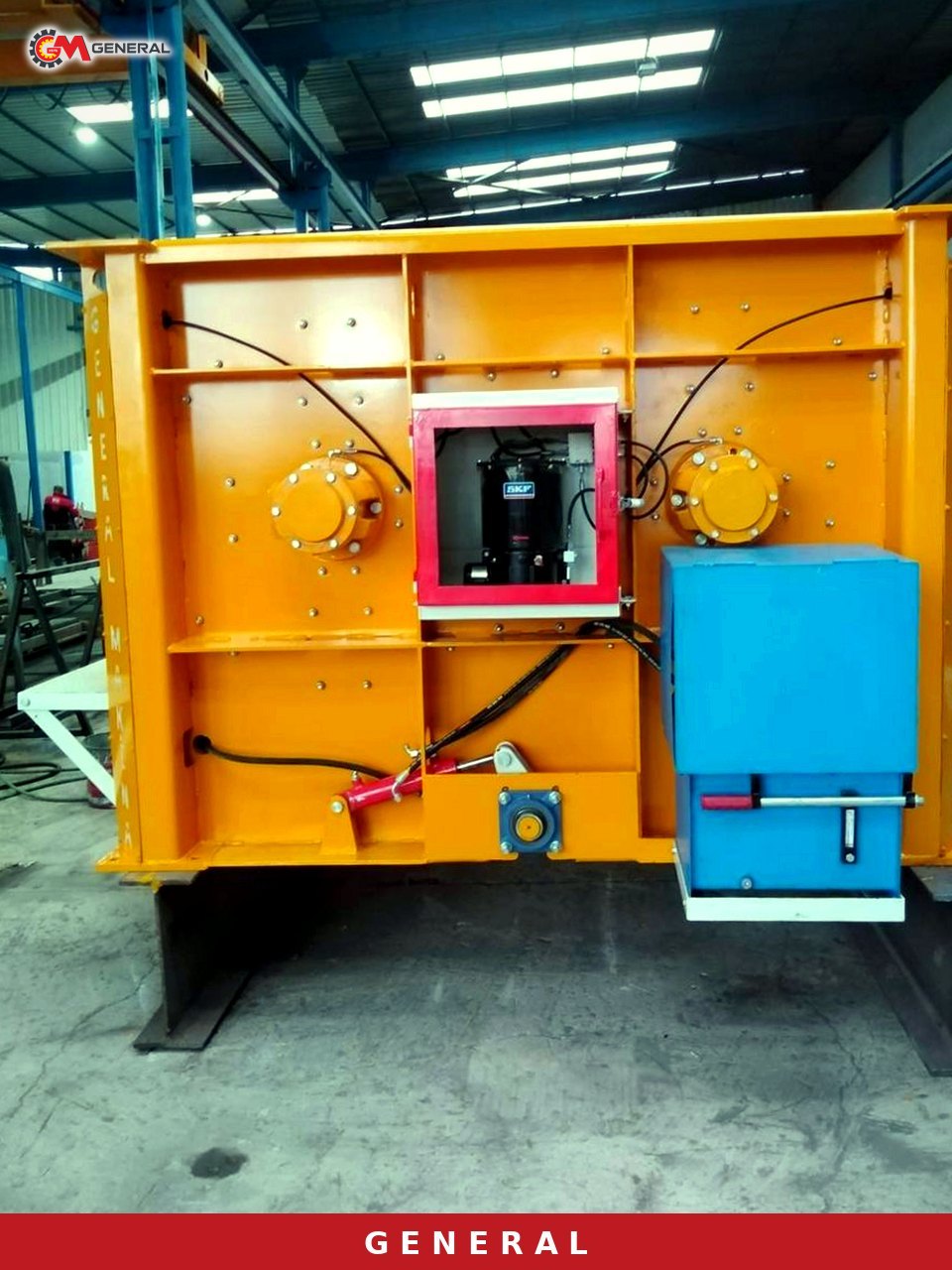
Consistent aggregate also matters on the mixer side. In our twin-shaft mixer the mixing arms are Hardox, the liner is Ni-Hard and automatic lubrication is standard; even so, the abrasiveness and grading of the stone directly affect liner life. For mixer types and wear materials, see the concrete mixer types page.
Information to prepare before requesting a quotation
A sound quotation depends on sound input. The short list of what an Egyptian ready-mix supplier should send us:
- A rock sample from the quarry or existing lab results: compressive strength, abrasiveness, clay and dust content.
- Largest block size after blasting (it must not exceed the 700 mm feed limit of the General 01 or the 800 mm limit of the 944 and 950).
- The fractions in your mix designs and the daily tonnage of each.
- Daily operating hours and the number of days you want to hold in stock.
- Whether grid power is available on site; if not, the preference for generator operation.
- How many years the quarry location will stay fixed: the answer to stationary line versus wheeled plant.
- The aggregate specification to be met and any washing requirement.
Price is driven by the crusher arrangement, number of screen decks, generator, automation level, choices such as washing or dust measures, and the transport scope. That is why we prepare a project-specific quotation from the information above rather than a fixed price.
Frequently asked questions
Can a single wheeled plant produce both sand and gravel?
Yes. All three models in the table separate 0-5, 5-12 and 12-19 mm fractions; the General 01 also delivers 19-40 mm separately with its four-deck screen. If the dust content of the sand exceeds the specification, a washing unit is evaluated separately.
Is the General 01 suitable for a basalt quarry?
No. The General 01 is a single-body impact plant and is economical in low-abrasion rock such as limestone and dolomite. For basalt and granite we recommend the General 944 or General 950 with jaw primary.
Can the crusher be linked to the same automation as the batching plant?
The crushing line and the batching plant run on separate panels, but since both sides offer PLC-based control and remote monitoring, production and alarm records can be arranged for tracking from one point. We define the scope in the project.
How are price and delivery time determined?
They are given in a written quotation once the model, options and transport scope are clear. Our warranty covers 1 year, wear parts excluded, and every plant is supplied with ISO 9001 and CE documentation.
Conclusion
For an Egyptian ready-mix company targeting 120-180 TPH of aggregate, the decision comes down to three questions: is the rock calcareous or hard, is the quarry location permanent or changing, and which fractions does the mix design need in what quantities. The General 01 for limestone, the General 944 or General 950 for hard rock, and a stationary line for a long-life single quarry are the natural candidates. To review your sample results with our team, which has built crushing plants and concrete batching plants in Izmir since 1976, request a quotation through our contact page.
Definitions of technical terms: Glossary