EN — English
 TR — Türkçe
 DE — Deutsch
 RU — Русский
 FR — Français
 ES — Español
 AR — العربية
 SR — Српски

Feed Size Planning for a 150-300 TPH Aggregate Crushing Plant
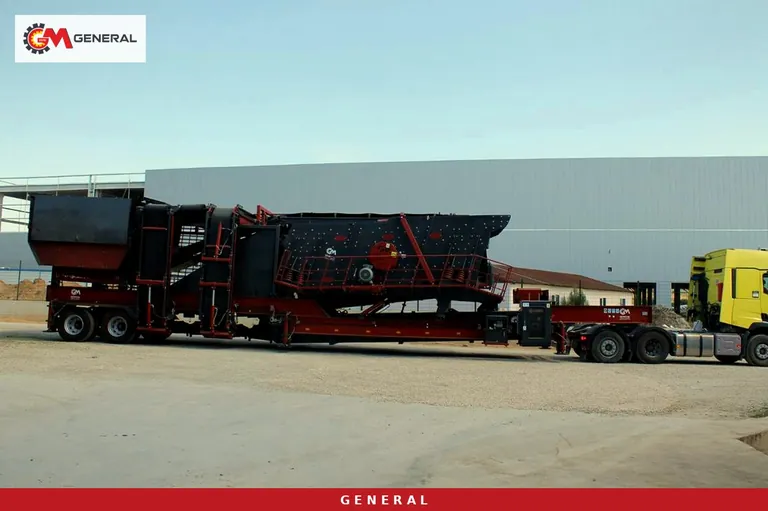
Most of the capacity lost in a crushing line is lost before the rock enters the crusher, at the point where its size meets the equipment. In an aggregate crushing plant targeting 150-300 TPH, the largest block coming out of the blast, the hopper mouth, the feeder width, the grizzly bar spacing and the primary crusher opening form one connected chain. If any link is too narrow, the plant runs below its nameplate tonnage: blocks bridging the crusher mouth, oversize stones hanging on the grizzly, pieces that the second stage cannot take. This article is for investors and plant engineers who want to plan feed size step by step, from the quarry face to the secondary inlet, and choose the primary stage around that plan.
The feed size chain from quarry face to secondary stage
A common design mistake is choosing the primary crusher on hourly tonnage alone. Every machine works within two separate limits: the tonnage it can carry and the largest particle it can accept. The real capacity of a line is set by whichever limit is reached first.
Writing the chain out in order makes the job clear. Blasting produces the size distribution of the run-of-mine rock. Trucks or loaders tip it into the hopper; the hopper mouth and feeder pan must be wide enough for the largest block to move forward without turning and jamming. The grizzly section removes fines and soil, and the coarse rock goes to the primary crusher. The primary product must, in turn, stay below the largest size the second stage accepts. Each link defines the inlet of the next one. Enlarging one link while the others stay the same only moves the problem one step down the line.
Blasting and oversize block management
The first person to set feed size is not the plant engineer but the drill and blast crew. Hole spacing, burden and charge weight directly shape the coarse tail of the run-of-mine material. Two blast patterns in the same quarry can deliver completely different loads to the primary crusher.
Measuring the run-of-mine distribution
A solid start is to record the size of the largest blocks after several blasts, using photos and tape measurements taken on the muckpile. For an accurate curve, on-pile measurement or image analysis can be commissioned. Rock hardness and abrasiveness also need laboratory testing of samples. Without this data, any crusher choice rests on a guess.
Blocks that will not fit the mouth
No blast removes oversize completely. Blocks larger than the primary crusher opening have to be separated at the face and broken with a hydraulic breaker or secondary blasting. Sending them to the hopper leads to bridging in the crusher mouth and a stopped line. Our guide on preventing blockage and overload in crushers covers what to do when a jam happens and which settings help avoid it.
Hopper and feeder width
The hopper absorbs the difference between the trucks' tipping rhythm and the crusher's steady draw. General Makina feeders can be built with 15-100 m³ hoppers, and every model accepts feed up to 1500 mm. That 1500 mm figure is the feeder's limit; the crusher mouth is usually reached first. So the feeder is selected for the largest rock the crusher will accept, yet the pan must be wide enough for that rock to travel on its side without catching.
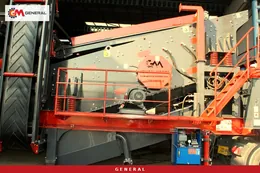
Two models fit the 150-300 TPH range. The GNR 90 feeder, with a 1000×3750 mm pan, carries 140-210 t/h; the GNR 110, with a 1100×4750 mm pan, carries 200-300 t/h. If the top of your plan is 300 t/h, the GNR 110 leaves more margin in tonnage and in how rock spreads across the pan. Details are on the vibrating grizzly feeder page, and other options are grouped in the feeders and hoppers category.
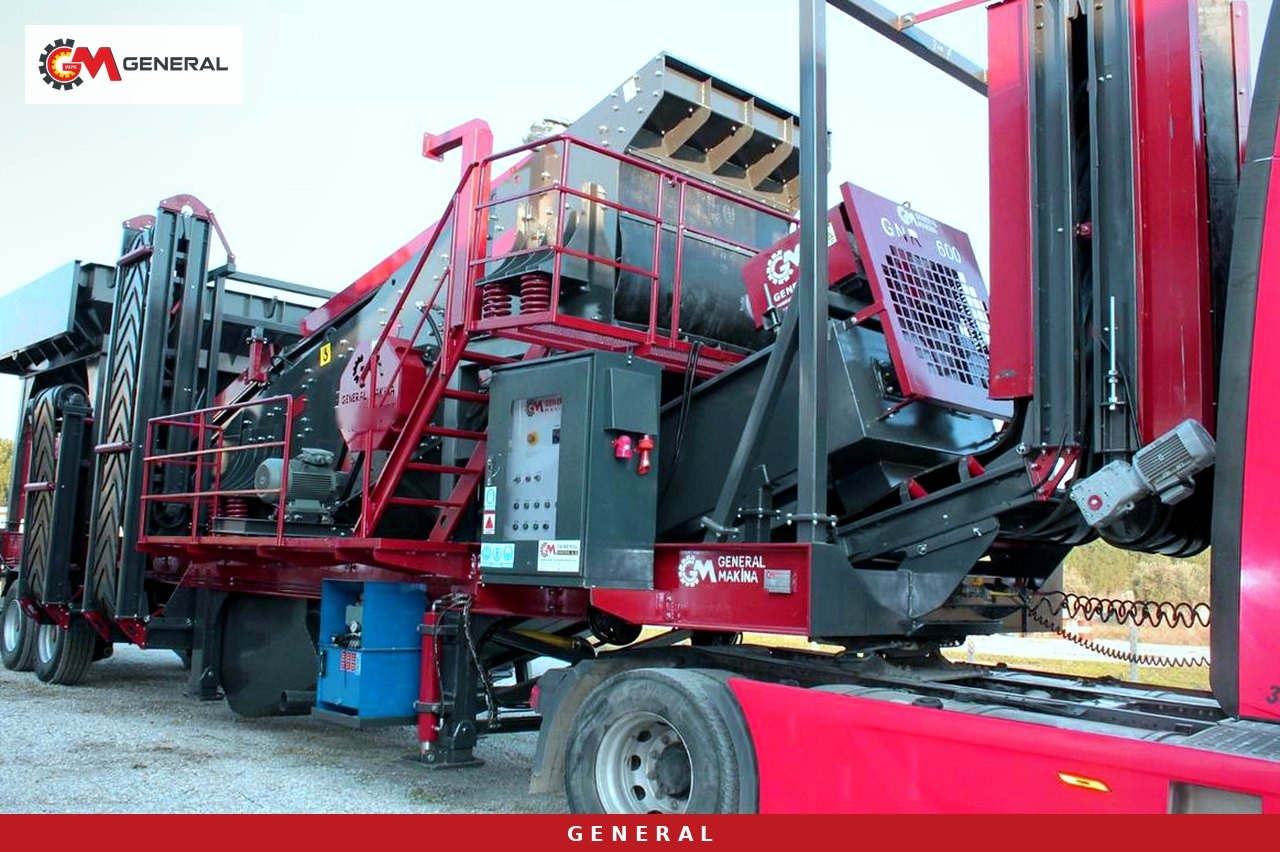
Sticky, clay-bearing feed is a separate case. Fixed grizzly gaps blind in this material and pre-screening stops working. In such quarries the GWB1136 wobbler feeder (1100 mm wide, 3600 mm long, 18.5 kW), with self-cleaning disc shafts, is worth considering.
Grizzly bar spacing and what sets it
The grizzly gap is set to pass material that is already at the size the primary crusher would produce. A gap close to the crusher setting lets rock that needs no crushing bypass the machine, so only stone that really has to be reduced goes in. If the gap is too tight, the crusher fills with fines, tonnage drops and liners wear for nothing. If it is too wide, oversize escapes onto the by-pass conveyor and overloads the second stage or the screen.
If the by-pass material contains soil, it should be handled separately from the aggregate. Two common answers are a dedicated conveyor to a waste pile or a separate screen that recovers the clean fraction. Where the grizzly section on the feeder is not enough, a G-type grizzly screen can be placed ahead of the primary. The ELKG-1930 runs with a 1200×3000 mm deck and an 11.5 kW motor; its bars are austenitic manganese castings with adjustable spacing.
Primary crusher choice and the largest particle sent downstream
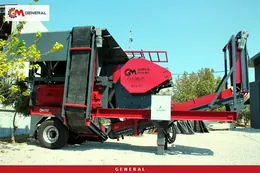
There are two routes for the primary stage. In abrasive rock such as granite, basalt and quartzite, a compression-type jaw crusher is the right choice. In low-abrasion material such as limestone and dolomite, an impact crusher gives a higher reduction in a single body. The table below brings together models that fit a 150-300 t/h target.
| Stage | Model | Opening or size (mm) | Max. feed (mm) | Capacity (t/h) | Motor (kW) |
|---|---|---|---|---|---|
| Feeder | GNR 90 | 1000×3750 | 1500 | 140-210 | 2×4 |
| Feeder | GNR 110 | 1100×4750 | 1500 | 200-300 | 2×7.5 |
| Jaw primary | GNRK 90 | 900×650 | — | 60-225 | 75/90 |
| Jaw primary | GNRK 110 | 1100×850 | — | 200-350 | 110/132 |
| Impact primary+secondary | GPS-1413 | Rotor 1400×1250 | 800 | 125-320 | 250 |
| Cubic secondary (Kubitzer) | GNR MK110 | Rotor 1550×1800 | 350 | 160-250 | 200 |
| Cone secondary | General cone | — | 250 (up to 300) | Project-specific | — |
Jaw line for hard rock
The GNRK 110, with an 1100×850 mm opening and 200-350 t/h capacity, covers the whole range in one machine. Its discharge setting ranges from 150 to 225 mm. The point to watch is that a jaw crusher product always carries a coarse tail larger than the setting. Since the cone crusher accepts at most 250 mm (300 mm depending on conditions), a sieve analysis of the primary product has to be compared with that limit. If the analysis shows particles above it, the fix is to run the setting at the low end of its range or to install a screen between primary and secondary that removes the coarse fraction. See the jaw crusher and cone crusher pages for model details.
The GNRK 90 (900×650 mm, 60-225 t/h) is enough for the lower half of the range but cannot reach 300 t/h on its own. Its 70-180 mm discharge range makes it easier to send a finer feed to the second stage. That makes it a balanced choice for quarries starting at 150-200 t/h with no expansion plan.
Two stages in one body for limestone
The GPS-1413 impact crusher takes 800 mm feed and works at 125-320 t/h. Because it handles primary and secondary duty in the same body, it reduces the need for a separate second crusher in a limestone line. In high-silica granite and basalt its impact parts wear quickly, so it is not recommended there. For cubic product in a basalt line, the GNR MK110 (350 mm feed, 160-250 t/h) can serve as the secondary, provided the primary product stays below 350 mm.
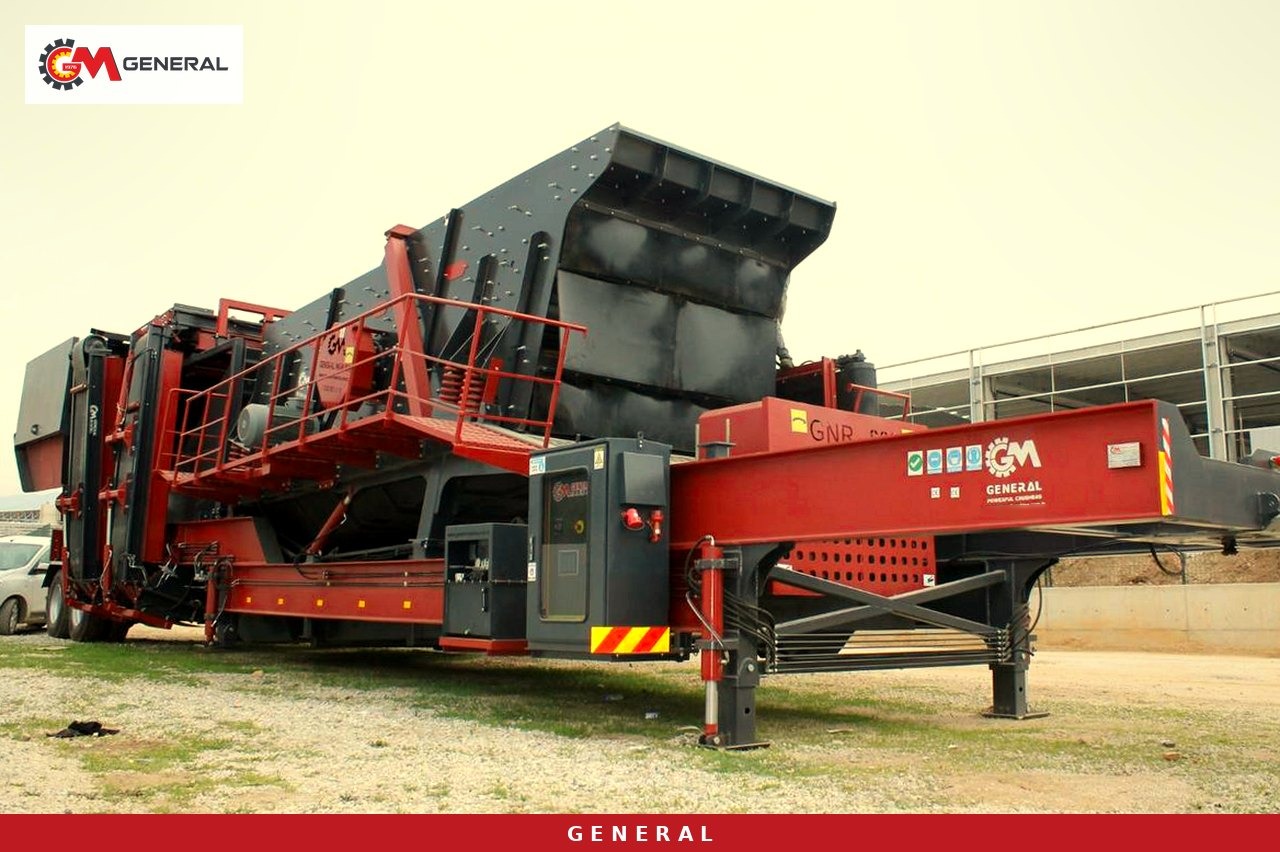
Feed checklist before commissioning
Preparing the following at quotation stage speeds up a correct model proposal and cuts surprises at start-up:
- Largest block dimensions and muckpile photos from the last few blasts.
- Rock type plus laboratory hardness and abrasiveness results.
- Soil and clay content of the run-of-mine, and seasonal moisture changes.
- Truck body volume and trips per hour (this sets hopper volume).
- Target product fractions and the daily demand for each.
- The crusher type planned for the second stage and its maximum feed size.
- Availability of a hydraulic breaker or secondary blasting at the face.
For a long-life quarry, building the whole line as a stationary plant allows a larger feed opening and more screen decks; options are on the stationary crushing plants page.
Frequently asked questions
If the feeder accepts 1500 mm, does the primary crusher take that size too?
No. 1500 mm is what the feeder can carry. The largest rock that can enter the crusher is set by the crusher opening, which is why the plan always works backwards from the crusher mouth.
When should I change the grizzly spacing?
When you change the primary discharge setting and when the fines content of the run-of-mine rises noticeably. Regular sampling from the by-pass conveyor shows whether the gap is right.
Can I start at 150 t/h and grow to 300 t/h later?
Yes, but the feeder and primary crusher should be selected for that growth from day one. A GNR 110 feeder with a GNRK 110 crusher covers the upper limit; the line is then expanded by adding a second stage and screens.
Can a grizzly feeder be used on clay-bearing feed?
If the clay content is low and the material is dry, yes. In wet, sticky material the bar gaps blind; a wobbler feeder or washed pre-screening should be considered instead.
From plan to quotation
A feed size plan is worked in two directions from the crusher mouth: back to the quarry face and forward to the second stage. When the largest block, hopper and feeder width, grizzly gap and primary product match, the line gets close to its catalogue tonnage. Send us your run-of-mine measurements, rock test results and target fractions, and we will define the feeder, primary and secondary combination for your 150-300 TPH crushing and screening plant together. For a quotation, reach us through our contact page.
Definitions of technical terms: Glossary