EN — English
 TR — Türkçe
 DE — Deutsch
 RU — Русский
 FR — Français
 ES — Español
 AR — العربية
 SR — Српски

Ivory Coast Ready-Mix Aggregate Crushing Plant 120-180 TPH
For a ready-mix producer around Abidjan, the real bottleneck is rarely the batching plant itself. It is the steady supply of aggregate into the bins. However good the mixer is, the mix design drifts when the 12-19 mm bin runs empty or when the fines content of the sand changes from one week to the next: slump moves, and more cement goes into every cubic metre to hold the same strength. This article sizes a 120-180 TPH crushing and screening plant for Côte d'Ivoire from the batching plant's point of view: which rock, which model, what kind of stockpile layout and which route the plant takes to site.
Aggregate sources around Abidjan: granite, gneiss and natural sand
Much of the southern half of the country sits on old crystalline basement rock, which is why granite, gneiss and migmatite quarries are common. These rocks are hard, and with a potentially high silica content they are abrasive. They give sound, clean coarse aggregate for concrete, but they push wear cost to the top of the list when the crusher is chosen.
Sand is a different story. Concrete sand around Abidjan has long come from river and lagoon sources, where grading, clay and silt content and organic matter can vary from batch to batch, and extraction depends on administrative permits. Producing manufactured sand at a granite quarry gives the batching plant a more predictable 0-5 mm product and a second source that is not exposed to permit risk. Confirm the requirements for sand extraction and quarry permits with the relevant Ivorian authority; this article covers the machinery side.
We do not guess at the rock of any particular quarry. Before the quotation, testing a sample for uniaxial compressive strength, Los Angeles abrasion and, where possible, an abrasiveness index settles whether the second stage should be a cone or an impact crusher. Once those three results are on the table, the model discussion usually closes in a single meeting.
What the batching plant mixer expects from aggregate
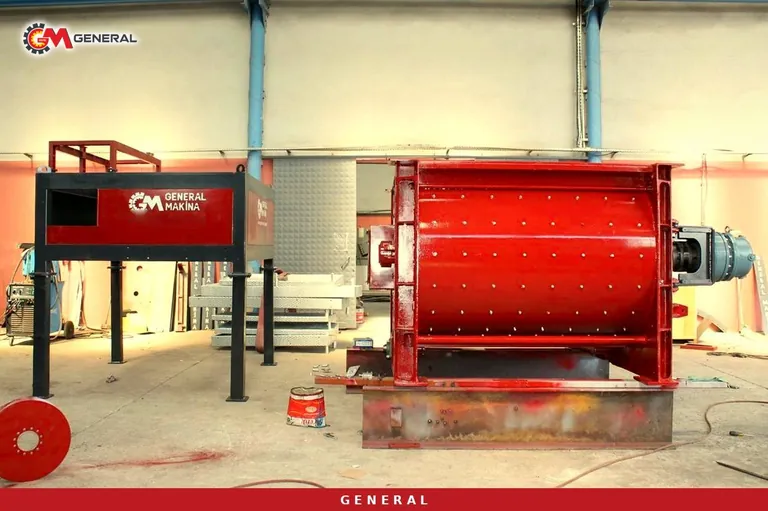
A twin-shaft mixer homogenises the batch by forcing it with Hardox arms inside a 20 mm st52 shell lined with Ni-Hard. This machine is sensitive to particle shape. Flat, flaky particles reduce workability, call for more cement paste and speed up wear on arms and liners. When we judge the crusher output going to the batching plant, we look at the following:
- Cubical particles in the 5-12 and 12-19 mm fractions, with the flakiness index inside the specification limit.
- Controlled dust content in the 0-5 mm manufactured sand, with washing or air classification where needed.
- Enough stock in every bin that none runs dry, even on the heaviest pouring day.
- Fraction limits that do not drift from shift to shift, which means checking the screen meshes regularly.
Mixer size sets how strict these criteria have to be. Our twin-shaft range comes in 1, 2, 3 and 4.5 m³ compacted concrete versions, with motors from 2×18.5 kW to 2×90 kW. A large-batch mixer stalls faster when one bin empties. As the batching plant grows, the stock buffer of the crushing line has to grow with it.
Wheeled plants that cover 120-180 TPH
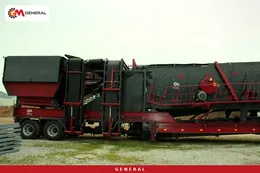
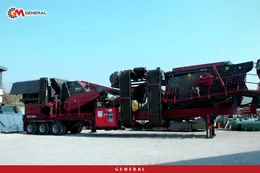
Three of our wheeled crushing and screening plants cover this range on a single chassis. The fourth row is a shaping unit added to the line to close the sand gap. All figures are catalogue values from the product pages.
| Model | Capacity | Crushers | Max. feed | Product fractions | Screen | Generator | Weight |
|---|---|---|---|---|---|---|---|
| General 944 | 120-180 t/h | GPJ 90 jaw + GM430 cone | 800 mm | 0-5 / 5-12 / 12-19 mm | 1600×5000 mm, 3-deck | 550 kVA | 70,000 kg |
| General 950 | 120-180 t/h | GPJ 90 jaw + DMK01 impact | 800 mm | 0-5 / 5-12 / 12-19 mm | 1600×5000 mm, 3-deck | 600 kVA | 70,000 kg |
| General 01 | 120-180 t/h | GPS 1210 impact (primary + secondary) | 700 mm | 0-5 / 5-12 / 12-19 / 19-40 mm | 1600×5000 mm, 4-deck | 550 kVA | 55,000 kg |
| GNR-MVSI 900 (add-on unit) | 90-180 t/h | VSI 900 vertical shaft | 50 mm | 0-3 / 3-5 / 5-12 mm | 1600×5000 mm, 3-deck | 850 kVA | 42,000 kg |
General 944 for granite and gneiss
In abrasive basement rock our first choice is the General 944. The GPJ 90 jaw accepts run-of-mine feed up to 800 mm, and the GM430 cone second stage crushes by compression. Compression crushing involves less sliding between metal and rock than impact crushing, which is where the longer liner change intervals in granite come from. The 1600×5000 mm three-deck screen splits the product into 0-5, 5-12 and 12-19 mm. These three products feed three bins of a four-bin batching plant directly; in most plants the fourth bin stays for natural sand or a coarser chipping.
General 950 when particle shape comes first
Same chassis, same GPJ 90 jaw; the difference is the DMK01 impact crusher in the second stage. Impact crushing gives more cubical particles and a higher reduction ratio, but blow bar consumption rises in granite. The 950 can make sense where silica content is moderate or the specification sets a tight flakiness limit. Both plants share the same weight and transport dimensions (70,000 kg, 4130×20350×4500 mm), so the choice between them does not change the transport plan; the sample test decides.
General 01 for softer rock and four products
If limestone, weathered rock or a low-silica stone is to be processed, the General 01 does primary and secondary work in one body with a single GPS 1210 impact crusher. It takes 700 mm feed, produces four fractions including 19-40 mm on its four-deck screen and, at 55,000 kg, is the lightest of the three. We do not recommend it for hard granite: when one impact crusher handles all the reduction, wear cost climbs quickly.
GNR-MVSI 900 to close the manufactured sand gap
If the batching plant wants to depend less on natural sand, fine chippings from the main plant go to a GNR-MVSI 900. The unit accepts feed up to 50 mm, works in the 90-180 t/h range and produces 0-3, 3-5 and 5-12 mm. Its 850 kVA power unit is a separate fuel and maintenance item and belongs in the quotation. Granite manufactured sand can come out dusty, so we assess the need for washing or dust removal together with the sample result.
The stockpile between crushing line and batching bins
The crusher and the mixer do not run to the same rhythm. A crushing line works best all day at one setting and a steady tonnage. The batching plant follows the pouring schedule: loaded in the morning, possibly idle in the afternoon. Open stockpiles and an aggregate bin absorb the difference.
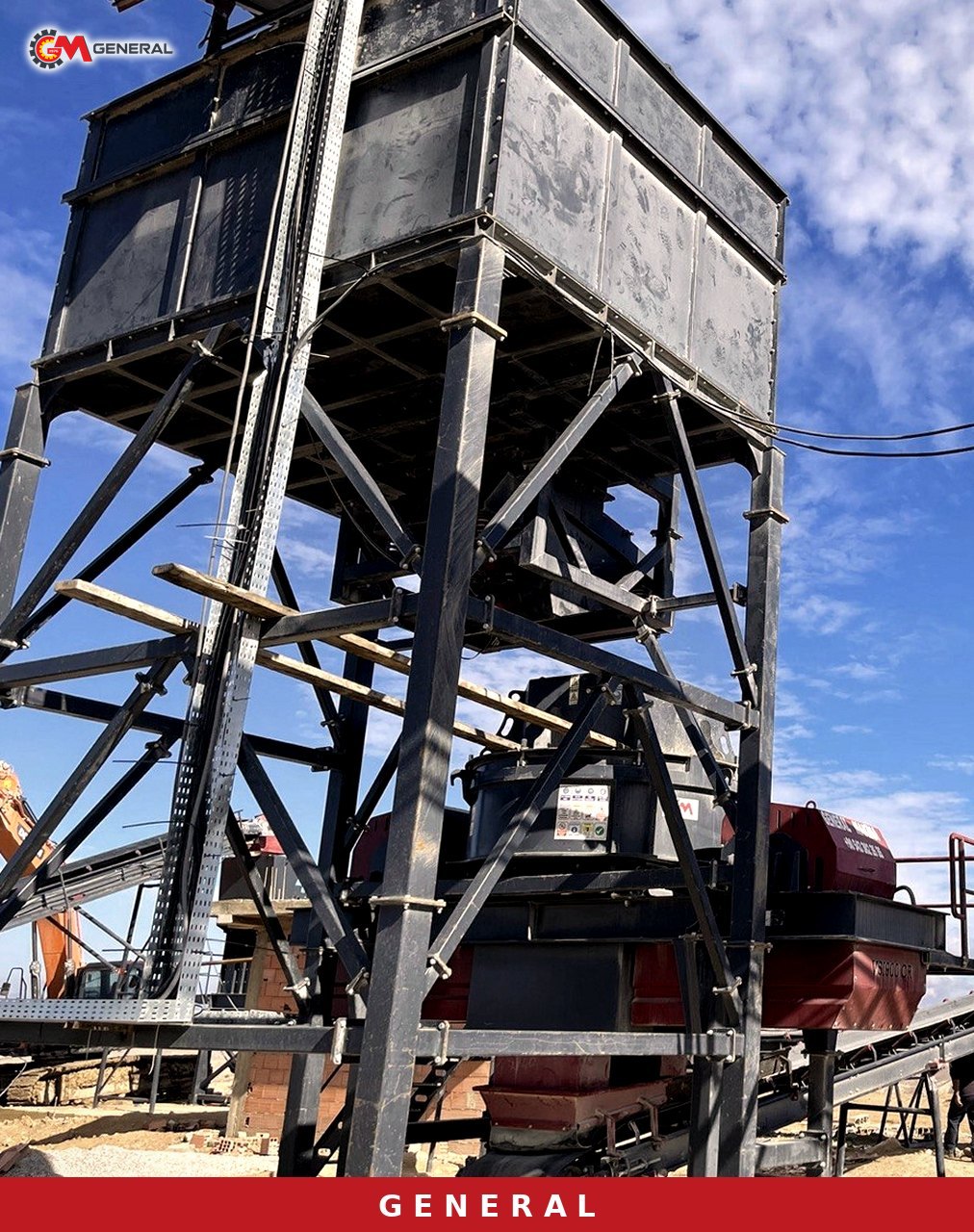
Our aggregate bins are built with 2 to 8 compartments, 10-50 m³ per compartment and 20-500 m³ of total storage. Pneumatic gates and a load-cell weighing belt manage dosing. There is a per-compartment vibromotor option against sand bridging in humid weather, and in Abidjan's climate that option deserves attention. For comparison, the bin on the Titan 100 stationary batching plant is 4×25 m³ and on the Magnum 120 it is 4×30 m³.
A simple formula helps here: required stock (t) = daily aggregate consumption of the batching plant (t) × number of buffer days. The number of buffer days depends on the crusher's planned maintenance time, quarry access in the rainy season and transport delays. A hypothetical example: a plant using 1,500 t of aggregate per day keeps 4,500 t of open stock for a three-day buffer, split by fraction share. The sand portion should rest for at least a day so that its moisture settles.
Site conditions: moisture, power and the road from the port
Wet feed in the rainy seasons
Southern Côte d'Ivoire has two rainy seasons, and in the humid tropical climate the run-of-mine material often arrives wet and clayey. This affects the crushing line in two direct ways. Screen meshes blind and fines stick to the belts. And the variable moisture of the manufactured sand makes water correction at the batching scale harder.
Countermeasures are chosen per project; we do not present them as standard equipment. Setting the pre-screening gap on the grizzly feeder to remove clay, using polyurethane or self-cleaning screen media and keeping the sand stockpile covered or on a drained base are the measures that make the most difference on site. On the batching side, a moisture probe with water correction completes the chain.
Generator power at an off-grid quarry
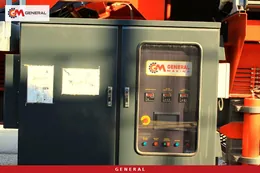
Most quarries are far from the grid. The General 944 and General 01 are specified with a 550 kVA generator, the General 950 with 600 kVA. In hot, humid weather, ventilating the generator enclosure, changing air filters often and fitting a water separator in the fuel line cut the most common stoppages. Heaters against condensation in the electrical panels and regular checks of the seals belong on the maintenance list for this climate as well.
From Izmir to the port of Abidjan or San Pedro
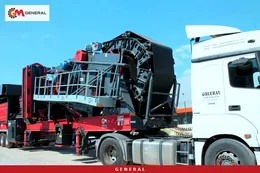
The wheeled plants travel as a single chassis. Transport dimensions are 4130×20350×4500 mm for the General 944 and 950, and 4300×18500×4500 mm for the General 01. These sizes do not fit a standard container: sea freight needs ro-ro or flat-rack, and the road leg from port to quarry needs a permitted long-vehicle arrangement. Checking bridges, bends and weight limits on the route with a local haulier in advance protects the installation schedule.
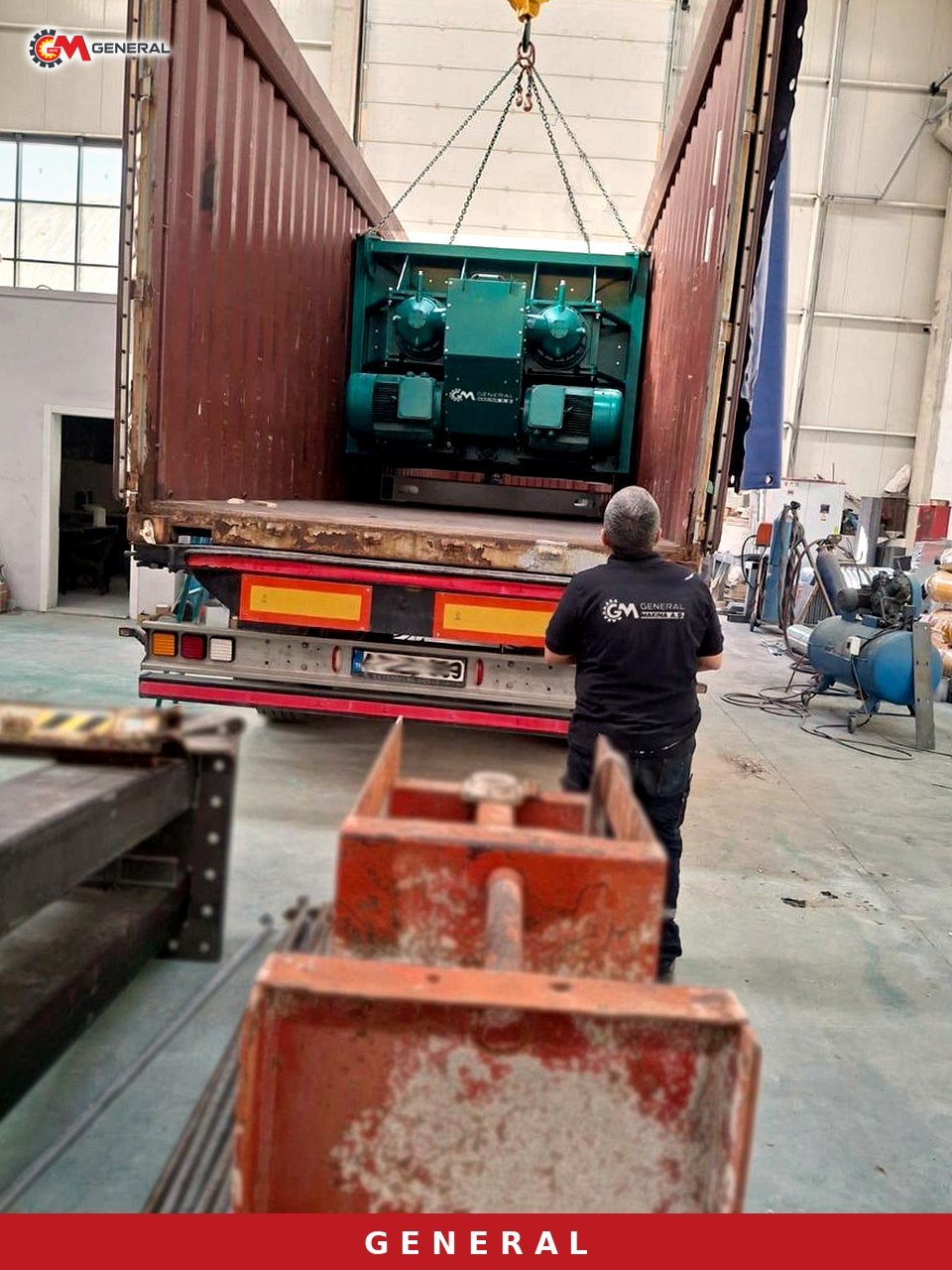
Batching plant equipment ships differently. The mixer, bin sections and conveyors are dismantled and loaded into open-top or standard containers. The photo below shows that job at the factory.
For customs, import duties and port procedures, we recommend that the buyer work with a customs broker in Côte d'Ivoire. We give no figures for these items; current information should come from the relevant authority.
What to collect from the quarry and the batching plant before a quote
A correct configuration needs data from both sides. Filling in the list below shortens the quotation process noticeably:
- A rock sample and test results (compressive strength, Los Angeles value, abrasiveness where possible).
- The largest run-of-mine lump size and clay content; the typical block size if blasting is used.
- Mixer type and volume at the batching plant, number of bin compartments and their volumes.
- The fractions used in the concrete mix designs and the target sand-to-coarse ratio.
- Daily operating hours, shift pattern and target monthly tonnage.
- Whether grid power is available on site; if not, the generator preference.
- Port of delivery (Abidjan or San Pedro) and the road route to the quarry.
The main price drivers are the model, the type of second-stage crusher, an additional VSI unit, the generator, the screen media and the shipping method. Our plants carry ISO 9001 and CE certification, with a 1-year warranty excluding wear parts. For an overview of line layouts, see the concrete batching plants and wheeled mobile crushing plants pages.
Frequently asked questions
Can the General 950 be chosen instead of the General 944 for a granite quarry?
It can, but blow bar consumption in the impact second stage is higher in granite. If the specification is very strict on particle shape and the sample test shows moderate abrasiveness, the 950 is worth considering. Otherwise the cone-equipped 944 is better balanced on operating cost.
Can a single plant supply every fraction the batching plant needs?
The General 944 and 950 give three products (0-5, 5-12, 12-19 mm); the General 01 gives four, including 19-40 mm. If no natural sand will be used at all, adding a GNR-MVSI 900 for sand quality may be necessary.
Can manufactured sand be used on its own as concrete sand?
That depends on the dust content and the mix design. If granite manufactured sand comes out with too many fines, it needs washing or dust removal; in some mixes it is blended with natural sand. No decision should be made before a laboratory trial mix.
How are price and delivery time set?
They are fixed in the quotation according to the selected model, add-on units, generator and shipping method. We do not quote figures in this article.
Final assessment
When planning an aggregate line for ready-mix in Côte d'Ivoire, starting from the batching plant's bin layout and the rock test result narrows the model choice on its own: the General 944 for abrasive granite, the General 950 where particle shape comes first, the General 01 for softer rock and the GNR-MVSI 900 as an add-on where sand is short. Send your quarry and batching plant details through our contact page or on WhatsApp, and we will prepare the plant layout and quotation from that data.
Definitions of technical terms: Glossary