EN — English
 TR — Türkçe
 DE — Deutsch
 RU — Русский
 FR — Français
 ES — Español
 AR — العربية
 SR — Српски
Crushing screening plant noise exposure management
Noise that is not measured cannot be managed
Crushing screening plant noise exposure management does not begin by holding a sound level meter at one spot and reading a figure. The quantity being managed is not instantaneous sound pressure but the worker's exposure normalised to an eight-hour shift. In the same plant, a fitter who spends twenty minutes beside a screen and an operator who sits eight hours in a control cabin have entirely different exposures, whatever number the meter happens to show at any instant. The first step is therefore not a reading at all but a task map showing who stands where, and for how long.
What the action values and the limit value trigger
Regulation separates three thresholds. The lower exposure action value sits at 80 dB(A) daily exposure and 135 dB(C) peak sound pressure; once it is crossed, the employer must make hearing protection available and inform and train workers on the risk and on correct use. The upper exposure action value sits at 85 dB(A) and 137 dB(C); there the use of protection becomes mandatory, a technical and organisational programme to reduce exposure must run, and the area is marked and access restricted. The exposure limit value sits at 87 dB(A) and 140 dB(C) and must not be exceeded under any circumstances.
The critical distinction: where protector attenuation counts
When action values are assessed, the attenuation provided by hearing protectors is not taken into account, so issuing earmuffs does not bring an area below an action value. When compliance with the limit value is assessed, protector attenuation is taken into account. That single distinction is the mechanism that stops earmuffs from substituting for engineering work. Where daily exposure varies markedly from day to day, a weekly exposure level may be used instead of the daily one, but the weekly level cannot exceed the limit value either.
| Threshold | Daily exposure | Peak sound pressure | Duty triggered |
|---|---|---|---|
| Lower action value | 80 dB(A) | 135 dB(C) | Protection made available, information and training given |
| Upper action value | 85 dB(A) | 137 dB(C) | Protection mandatory, reduction programme, area marked |
| Exposure limit value | 87 dB(A) | 140 dB(C) | Must not be exceeded; assessed with protector attenuation counted |
Mapping: from source inventory to task-based calculation
A usable noise map has three layers. The first is the source inventory: crusher body, screen frame and media, feeder, conveyor pulleys, compressor, generator and the point where material drops into the hopper are each listed separately. The second is area measurement; the plant is divided into a grid and a reading is taken in every cell under typical production conditions. The third is the task-based calculation: how many minutes each task spends in each area is written down, and those durations are combined with the area levels to produce a personal eight-hour exposure.
Measuring an empty plant is a common mistake. The level read while a crusher spins unloaded sits far below the level read with the feed full and the screen loaded. A single reading is equally insufficient: when rock hardness, feed size or screen media type changes, the table has to be rebuilt.
| Source | Dominant mechanism | Control at source |
|---|---|---|
| Material dropping into the hopper | Impact energy from free fall height | Shorten the drop, line the impact face with rubber |
| Screen frame and media | Radiation from plate vibration | Damping treatment, rubber or polyurethane screen surface |
| Crusher body | Transfer of impact energy into the structure | Body damping, enclosed feed arrangement |
| Conveyor pulleys and idlers | Rotating parts and scraper contact | Balancing, alignment, idler replacement |
| Compressor and generator | Engine and exhaust radiation | Acoustic enclosure, silencer |
Source first, path second, person last
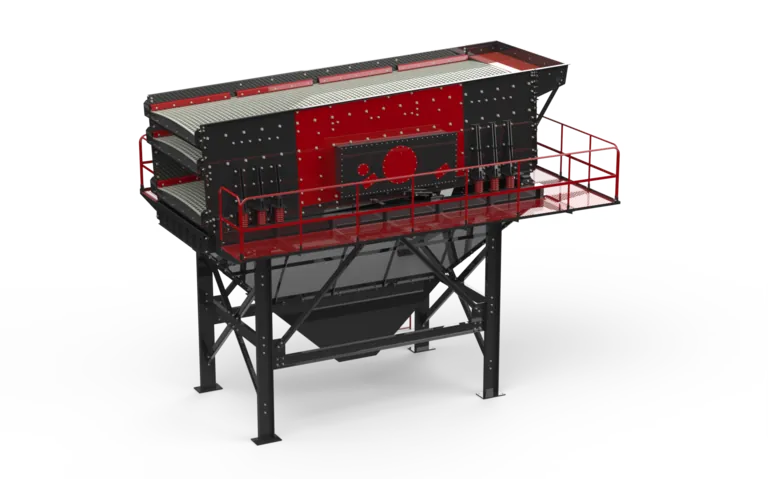
The order of control is not arbitrary. The most effective intervention lies at the source: cutting the free fall height of material, lining impact surfaces with rubber, choosing rubber or polyurethane over steel on the screen deck, applying damping to structural plate. Path measures come next: enclosures and barriers around the machine, an acoustically treated operator cabin, and sound seals on that cabin's doors and windows. Organisational measures follow: shortening the time spent in noisy zones, planning maintenance for periods when production is stopped, and using remote monitoring so fewer visits to the zone are needed. Personal protection is the last link and never replaces the earlier ones. Because deck surface choice affects throughput and noise at the same time, a vibrating screen configuration is best settled by production and safety together.
Over-protection is a hazard of its own
A protector with very high attenuation can push the level reaching the ear so far down that speech, warning signals and changes in machine sound become inaudible. On a yard where loaders are manoeuvring, that is a direct accident risk. Protection is selected against the measured exposure; the highest attenuation available is not automatically the right choice.
Records, verification and repetition
Results are recorded together with the production condition under which they were taken: which rock, which feed size, which throughput, which screen media. After every control measure, the same point is measured again, otherwise nobody knows whether the measure worked. Health surveillance and audiometric testing are read alongside those records. Related field topics are gathered under occupational safety.
Frequent questions
We issued earmuffs. Is the duty discharged?
No. Protector attenuation does not count when action values are assessed, so handing out earmuffs does not bring the area below a threshold. The technical and organisational reduction programme runs regardless.
How often should measurement be repeated?
Alongside a fixed schedule, every change is a trigger: a new machine, a different feed material, a change of screen media type, a capacity increase or a layout change.
Is measurement taken inside the cabin?
Yes. An operator's exposure is calculated from the level inside the cabin, and that level climbs quickly once sealing degrades, which is why door gaskets and glazing edges are inspected on a routine.
Definitions of technical terms: Glossary