EN — English
 TR — Türkçe
 DE — Deutsch
 RU — Русский
 FR — Français
 ES — Español
 AR — العربية
 SR — Српски
Crusher Blockage
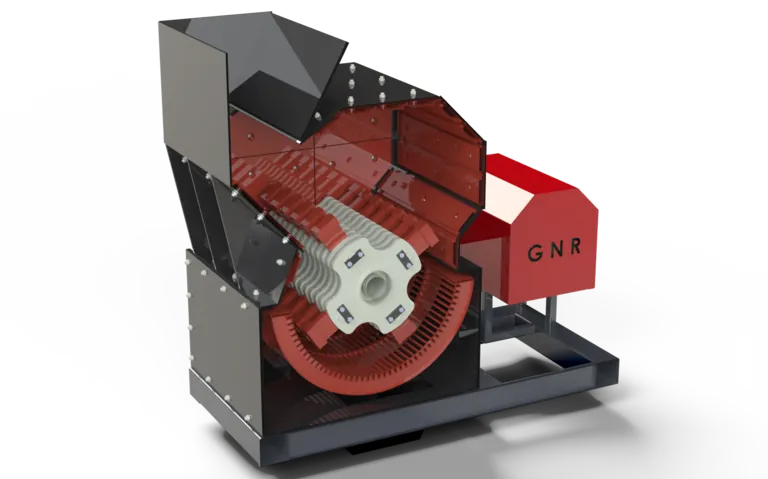
A blockage is lost production — and a safety risk if cleared the wrong way. Causes fall into three groups.
1. Tramp iron
Bucket teeth or drill bits entering the chamber lock the crusher. General cone crushers carry hydraulic cylinder protection: the system releases pressure and opens the setting so the uncrushable passes without damaging the chamber.
2. Overfeeding and oversize
Feeding larger than the rated maximum, or unscreened feed, packs the chamber. Every model has its maximum feed size in the catalogue; respect it.
3. Wrong setting (CSS)
Tightening CSS refines the product but raises chamber load; with moist material a tight setting multiplies blockage risk. Change settings gradually and watch the product curve.
Safe clearing sequence
(1) Stop the feed, (2) run the crusher empty — if it will not clear, isolate and lock out (LOTO), (3) inspect from above; any manual removal only under lockout, (4) on hydraulically protected models open the setting to discharge the piece.
Respecting the feed limit: real numbers
"Overfeeding" is not an abstract warning; every model has a printed opening size. From the GNRK jaw series — the opening is the physical limit of acceptable feed:
| Model | Ağız Ölçüsü(mm) | Çıkış Ölçüleri(mm) | Motor(kw) d/dak | Volan Devri(d/dak) | Ağırlık(kg) | Kapasite(t/s) | Grubu |
|---|---|---|---|---|---|---|---|
| GNRK 60 | 610 x 380 | 40-130 | 30 /37 - 1500 | 330 | 6000 | 20-80 | Primer |
| GNRK 90 | 900 x 650 | 70-180 | 75 /90- 1500 | 293 | 11400 | 60-225 | Primer |
| GNRK 900 | 900 x 200 | 11--55 | 30 - 1500 | 330 | 5960 | 50 - 75 | Sekonder |
| GNRK 110 | 1100 x 850 | 150-225 | 110/132 - 1500 | 228 | 33000 | 200 - 350 | Primer |
| GNRK 130 | 1300 x 1000 | 125-250 | 160 - 1500 | 215 | 42500 | 400 - 500 | Primer |
Two operating habits that reduce blockage
First, drive the feeder speed from the crusher ammeter: a needle living in the upper band means a packed chamber — slow the feed. Second, stop the crusher empty at shift end: a chamber stopped full starts blocked.
Why to log blockages
A blockage repeating at the same point is a process signal, not an equipment fault: screen leakage, wrong blast fragmentation or grizzly opening should be fixed upstream. A simple date-time-material log makes the root cause visible within a week.
Post-blockage checklist
After the piece is discharged, do not return straight to full load. In order: visually inspect chamber and wear parts; re-measure the setting — the jam load may have shifted it; check belt tension and coupling on the drive side; run the first minutes empty, then at reduced feed. Stop and re-inspect on abnormal vibration or sound. A blockage repeating at the same point is a process signal: screen leakage, wrong blast fragmentation or grizzly opening should be fixed upstream — a simple date-time-material log makes the root cause visible within a week.
Maintenance recommendations depend on the model and operating conditions — contact us for a plan specific to your machine.
Definitions of technical terms: Glossary