EN — English
 TR — Türkçe
 DE — Deutsch
 RU — Русский
 FR — Français
 ES — Español
 AR — العربية
 SR — Српски

Conveyor Speed vs Capacity in a 200-300 TPH Crushing and Screening Plant
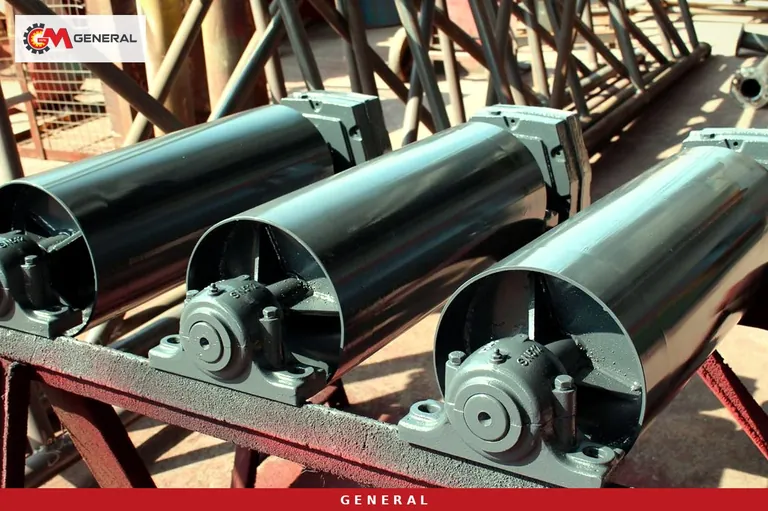
In a line crushing 200-300 tonnes of rock per hour, the conveyors are usually the last equipment anyone thinks about. The crusher and the screen get long discussions, while the link between them is settled with "we'll run a belt there". Yet on commissioning day the first point to overflow is rarely the crusher. It is usually the belt under the primary or the transfer chute feeding the screen. Four things decide how much a belt conveyor can carry: the load cross-section on the belt, belt speed, the bulk density of the material and the incline of the conveyor. This article puts numbers on the share speed has in that equation and uses data from General models in the 200-300 TPH range to explain which choice is made at each belt position, and why. Capacity figures come from our product pages; the worked examples are hypothetical and labelled as such.
Four multipliers behind the tonnage figure
The theoretical capacity of a belt conveyor comes from a one-line product:
Q (t/h) = 3600 × A (m²) × v (m/s) × ρ (t/m³) × k
A is the cross-sectional area of the material pile on the troughed belt. v is belt speed, ρ is loose bulk density and k is the incline correction factor: 1 for a horizontal belt, dropping below 1 as the angle rises. Speed is a linear multiplier in the formula. With everything else fixed, a 30 percent increase in speed lifts theoretical tonnage by 30 percent. That is why operators look at speed first when capacity gets tight: changing the cross-section means removing the belt, while changing speed often needs only a pulley or a gearbox ratio.
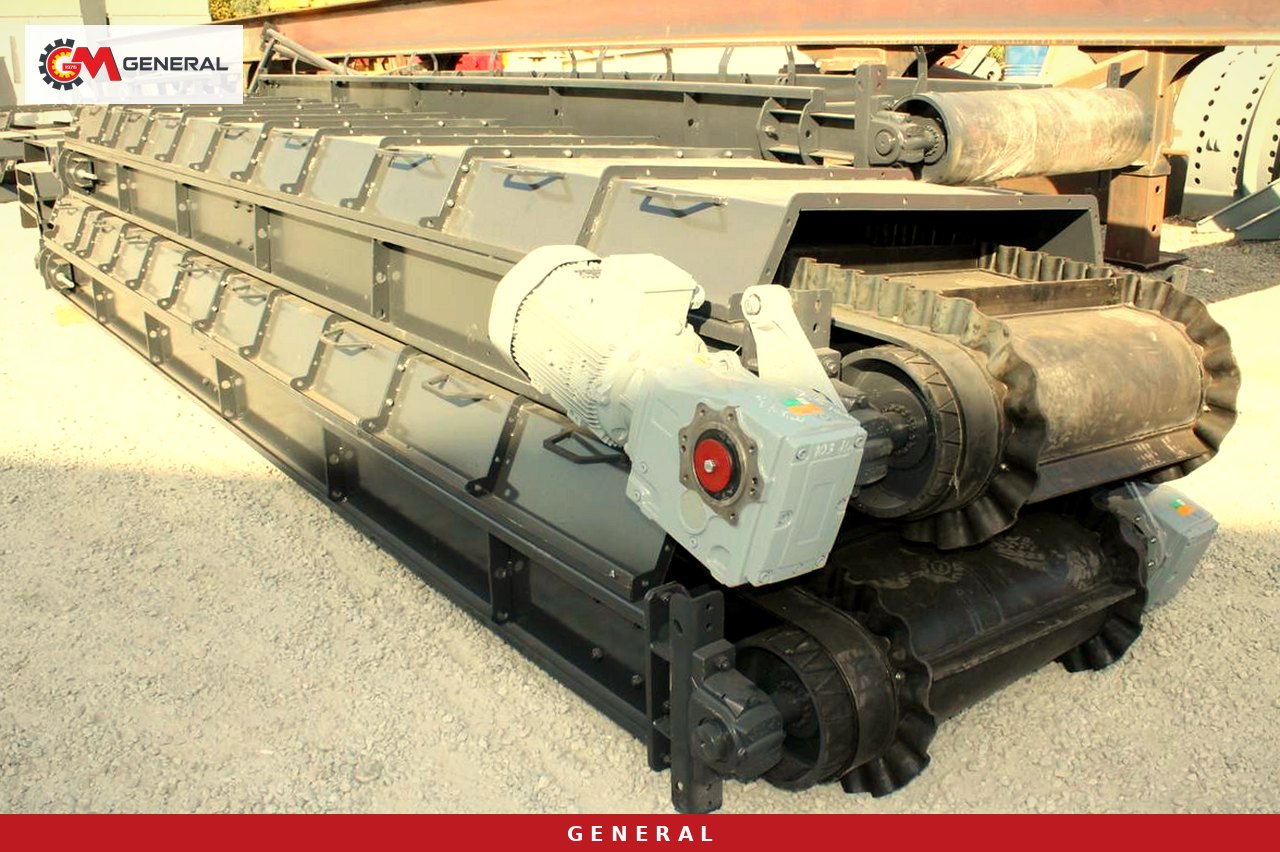
General Makina builds belt conveyors in 500, 600, 700, 800, 900, 1000 and 1200 mm widths, to any required length, for 50-1000 TPH. A range that wide shows that a belt of a given width can carry very different tonnages depending on speed, incline and trough angle. Catalogue width alone is not enough to say "this belt carries 300 tonnes". All belt options are collected on our conveyor systems page.
Cross-section grows faster than width
Cross-sectional area grows roughly with the square of belt width. A wider belt gives the pile a wider base and also more height before the load reaches the trough edges. Moving from 800 mm to 1000 mm therefore adds more cross-section than the width ratio suggests. Speed, on the other hand, has a practical ceiling on site; we cover that ceiling below under transfer points, dust and idlers.
Incline factor and chevron belting
As the angle increases, material starts to slide back on the belt, the top of the pile flattens and the maximum tonnage falls. At steep angles that a flat belt cannot hold, a chevron belt is needed; General conveyors are available with flat, chevron and cleated belting. A chevron belt saves the angle, but it does not bring the k factor back to 1. Steep conveyors such as stockpile or silo loading belts are therefore sized with a wider capacity margin.
Worked example: one cross-section at three speeds
The values below do not come from a real plant. They were chosen only to show how the ratio behaves. Take a cross-section of 0.040 m², a loose bulk density of 1.6 t/m³ for crushed rock and k = 1 for a horizontal belt. The last column shows the load on each metre of belt while the line carries 300 TPH: q (kg/m) = Q ÷ (3.6 × v).
| Belt speed (m/s) | Theoretical capacity (t/h) | Load per metre at 300 t/h (kg/m) |
|---|---|---|
| 1.5 | 346 | 55.6 |
| 2.0 | 461 | 41.7 |
| 2.5 | 576 | 33.3 |
Two points follow from the table. First, a 300 TPH line at 1.5 m/s has roughly a 15 percent margin on paper. If the belt runs uphill and we take k as 0.9, the theoretical figure falls to 311 t/h and the margin almost disappears. Second, carrying the same tonnage at a higher speed reduces the load per metre. At 2.5 m/s the belt runs with a thinner pile and edge spillage becomes less likely; in exchange, every stone has to be accelerated to a higher speed at each transfer point.
Design works from peak tonnage, not the average. Primary crusher output swings with the truck load tipped into the hopper and the block structure of the rock. With a line average of 250 TPH, a belt can see more than 300 TPH for several minutes. Whether you leave the margin for that surge through extra speed or extra width decides the wear bill in the years that follow.
Belt positions and model data in a 200-300 TPH line
Not every belt in a plant does the same job. The table below lists General models suited to a 200-300 TPH line crushing limestone or medium-hard rock, and the condition each one places on the belt beneath it. The figures come from the technical tables on our product pages. The same logic applies to stationary crushing plants.
| Stage | Model | Capacity (t/h) | Size data | Belt-side consequence |
|---|---|---|---|---|
| Feeding | GNR 110 grizzly feeder | 200~300 | Width 1100 mm, feed up to 1500 mm | Fines from the by-pass join the main belt |
| Primary | GNRK 110 jaw crusher | 200-350 | Mouth 1100×850 mm, discharge setting 150-225 mm | Conveyor feed limit 0-250 mm; impact idlers |
| Secondary | GNR DMK03 impact crusher | 250-300 | Rotor 1100×1500 mm, feed up to 800 mm | EP 125, 4-ply belt under impact crusher |
| Tertiary | GNR 150 tertiary crusher | 200-300 | Rotor 1200×1500 mm, feed up to 150 mm | Load on the return belt varies |
| Screening | GNR 2060 screen, 2000×6000 mm, 18.5 kW | 100-400 (conventional series) | 1-4 decks | One stockpile belt per product fraction |
| Secondary in hard rock | Cone crusher | — | Feed in the 50-250 (300) mm range | — |
The belt under the primary
This is the heaviest duty in the line. The discharge setting of the GNRK 110 jaw crusher runs from 150 to 225 mm; opened to the upper limit, flat and elongated pieces approach the 0-250 mm feed limit of General conveyors. In this position a belt one width step larger is a sounder choice than more speed: large pieces hit the trough edge less, and impact idlers and scrapers last longer. In most plants the fines falling through the by-pass of the grizzly feeder join the same belt. Leaving that extra tonnage out of the belt calculation is a common commissioning mistake.
Under the impact crusher and on the return belt
An impact crusher such as the GNR DMK03 throws out fast, sharp-edged stone. In this position General Makina uses an EP 125, 4-ply belt instead of the standard EP 100. On the return belt that carries screen oversize back to the crusher, tonnage does not stay constant: as screen cloths wear or the crusher setting drifts, the recirculating load rises. This belt is sized for the worst recirculation case, not nominal tonnage, and here too speed is the last adjustment to reach for.
The same reasoning holds when a cone crusher is chosen for the secondary stage in hard rock such as basalt and granite. The model-by-model capacity table for the cone crusher is supplied per project, so the related cells in the table are left empty.
What higher speed costs on site
When speed goes up, theoretical tonnage rises, but everything around the belt changes too. Material falling from the transfer chute has to reach belt speed. The faster the belt, the longer the distance a stone slides on the rubber before it settles; rubber-lagged impact idlers and skirt rubbers in the loading zone need replacing more often.
The second effect is dust. Fines thrown off the discharge pulley of a fast belt travel further through the air. On dry, hot sites this increases the need for dust suppression and enclosed transfers. These are not standard on every line; they are measures that can be selected per project.
The third effect is trajectory at the discharge point. On a belt feeding a vibrating screenhigher speed makes material land in the screen feed box from further away and harder. The first section of the screen deck runs idle or cloth wear moves forward. On a stockpile belt, thrown material changes the shape of the cone and increases segregation: coarse particles collect at the toe of the pile and fines in the centre.
Idler spacing, belt grade and frame
On General belt conveyors, carrying idlers are ø76 mm and spaced at a maximum of 1 m; return idlers are spaced at 3 m. Higher speed means more idler revolutions per minute. Bearing life is used up by revolutions, not hours, so idler replacement on a fast belt is scheduled more often. Frame plate is 4 mm on 600-900 mm belts and 5 mm on 1000-1200 mm belts. The bolted modular design makes site work easier if width or length has to change later.
The drive side: how speed is changed
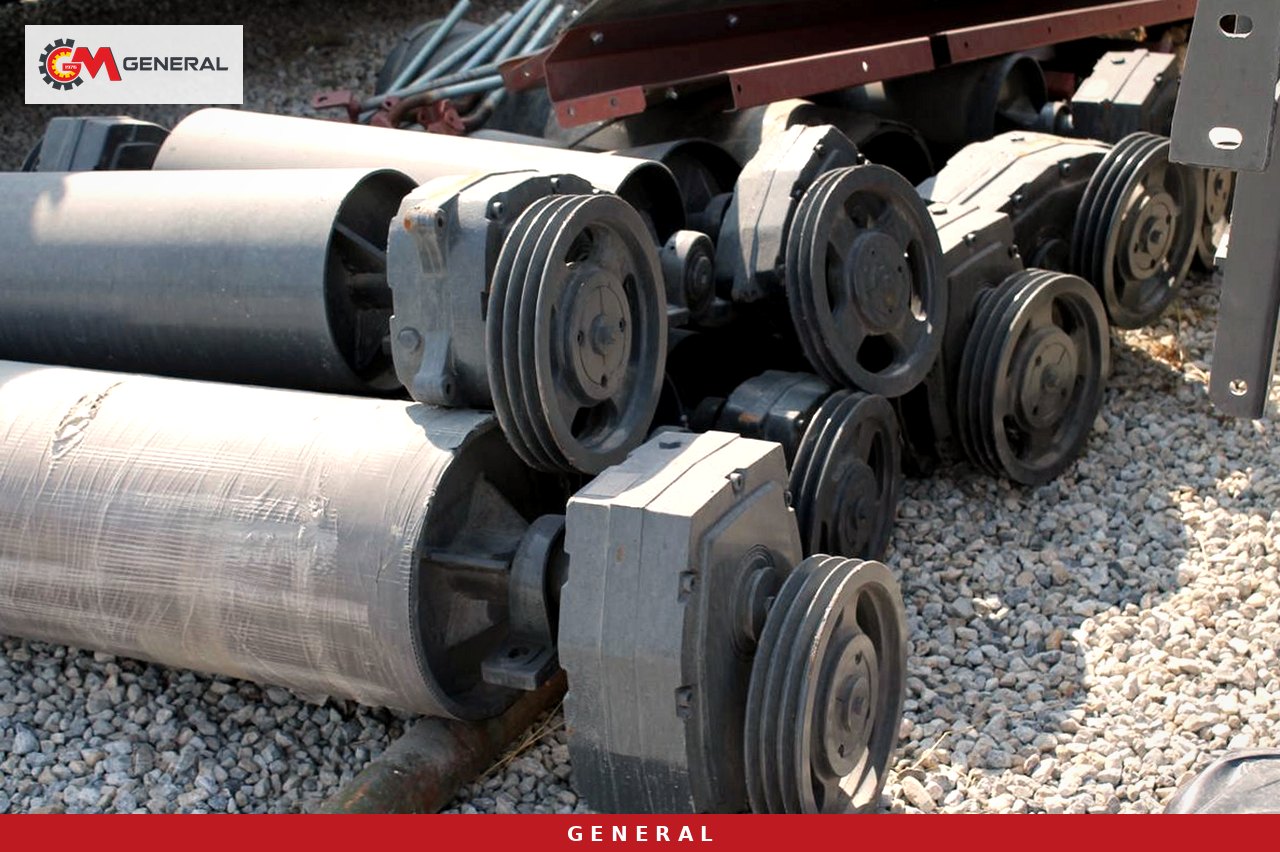
General conveyors offer two drives: a geared motor and a shaft-mounted belt-and-pulley drive. The drive pulley is rubber-lagged and the bearings are SNH type. With a belt-and-pulley drive, belt speed is set by changing pulley diameters; with a geared motor, the gearbox ratio or drum diameter changes. A frequency inverter for stepless speed control is an option that can be selected per project.
Check motor power before changing speed. Carrying the same tonnage faster lowers the pull at the drum. If you raise speed and tonnage together, power demand grows with both multipliers. A speed increase that does not fit the existing motor shows up as drum slip on the first loaded start.
Options include a speed counter, a backstop gearbox, a pull-cord emergency switch and PLC-controlled automatic lubrication. In the speed and capacity relationship, the most useful item is the speed counter: if the tail pulley lags behind the drive pulley, the belt is slipping, and this can be caught before a blockage starts. On an inclined belt, the backstop stops the loaded belt from running back during a power cut and burying the lower transfer point.
Commissioning and monthly measurement list
On site, measurements tell you more about belt speed and capacity than the paper calculation does:
- Calculate belt speed from drive pulley rpm and pulley diameter, then confirm it with a mark on the belt and a stopwatch.
- In plants with a belt scale, log the 15-minute tonnage; without one, stop the belt, weigh the material on a 1 m section and find tonnage with q × v × 3.6.
- On the belt under the primary, watch under load whether the largest pieces strike the trough edge and skirt rubber.
- Look for spillage marks at transfer chutes, build-up under idlers and material sticking to the return run.
- Check the belt grade under the impact crusher (EP 125, 4-ply) and look for cuts on the surface.
- On inclined belts, stop under load and restart; there should be no roll-back or drum slip.
- Mark where material from the screen feed belt strikes the screen feed box.
- Measure return belt tonnage once a week; an increase points to a screen cloth or crusher setting problem.
Frequently asked questions
Can I lift a 200 TPH line to 300 TPH by speeding up the belts?
On the belt side this may be possible, but line tonnage is set by the crusher and the screen. The GNRK 110 works at 200-350 TPH and the GNR 110 feeder at 200~300 TPH; a faster belt does not change the capacity of those machines. First check whether the crusher, screen and transfer chutes suit the new tonnage.
Should I choose a wider belt or a faster belt?
Width is preferred under the primary and wherever large, sharp pieces are carried. On long horizontal belts carrying fine, even material, a measured speed increase can be cheaper. The decision rests on top size, incline and peak load.
Does a chevron belt increase capacity?
No. A chevron belt stops material sliding back at steep angles and makes the conveyor usable where a flat belt cannot climb. The incline factor in the capacity calculation still stays below 1.
What information should I send for a quotation?
Average and peak tonnage, material type and approximate bulk density, top size, belt length, height difference or incline and your drive preference are enough. Price and delivery plan are prepared from this data and the scope of the whole line.
Build the calculation around your site
Belt speed is a direct multiplier in the capacity formula, but in a 200-300 TPH line it does not carry the same weight on every belt. Width matters under the primary, belt grade under the impact crusher, the incline factor and backstop on inclined belts, and a measured speed increase on long horizontal belts. General Makina has manufactured in Izmir since 1976; equipment is ISO 9001 and CE certified with a 1-year warranty (wear parts excluded). To engineer your belt line together with feeder, crushers and screens, send your target tonnage and site data through our contact page.
Definitions of technical terms: Glossary