EN — English
 TR — Türkçe
 DE — Deutsch
 RU — Русский
 FR — Français
 ES — Español
 AR — العربية
 SR — Српски

Conveyor belt maintenance and tracking
In a crushing and screening plant the equipment that generates the most fault reports is usually not the crusher but the conveyors. Conveyor belt maintenance and tracking is also the job most often done backwards: when a belt drifts, the first reflex is to loosen the nearest idler bolt, while the real cause normally sits several metres upstream.
Conveyor belt maintenance and tracking starts with the structure
A belt takes the shape of the structure it runs on. If the frame is not level across, if the bay diagonals are unequal, or if the pulleys do not sit square to the belt centreline, no amount of idler adjustment will hold. Diagnosis therefore always follows the same order: structure, then pulleys, then idlers, and only then the belt itself. Break that order and the work stops being adjustment and turns into chasing.
The first contact rule
Belt training rests on one principle: the belt moves toward the side of the idler or pulley that it contacts first. When a roller is skewed, one end sits slightly ahead of the other; the belt reaches that end first, friction rises on that side, and the belt steers there. Correction follows the same logic — the leading end on the drift side goes back, or the opposite end comes forward.
Three practical rules apply. Keep adjustments small. After each one, let the belt run at least three full revolutions before judging the effect. If you overshoot, move that same idler back instead of touching others, otherwise the whole run becomes a set of adjustments chasing each other and never settles.
| Symptom | Likely cause | Verification | Correction |
|---|---|---|---|
| Belt drifts the same way at the same point on every revolution | The belt itself: an out-of-square splice or a deformed carcass | Mark the splice and see whether the drift travels with it | Remake the splice |
| Belt drifts constantly in one zone of the run | Idler set or structure out of square in that zone | Measure the diagonals of the frame bays | Correct the structure first, then the idler skew |
| Belt tracks empty but drifts under load | Material is not landing on the belt centreline | Watch where the load trace sits relative to the centreline | Redirect the loading chute |
| Belt drifts on the return run | Buildup on a return idler or the tail pulley | Feel the pulley face by hand with the belt stopped | Clean the buildup and reset the scraper |
| Belt slips on the drive pulley | Insufficient tension or worn pulley lagging | Look for slip marks between belt and pulley | Increase tension until slip stops, renew the lagging |
The take-up is not a tracking device
The job of the take-up is to hold enough tension to stop slip at the drive pulley, not to steer the belt. An over-tensioned belt loses its ability to conform to pulley crown and training idlers, so tracking becomes harder while bearing and splice life get shorter. Confusing tension with training is the fastest way to make two problems worse at once.
Buildup is a false crown
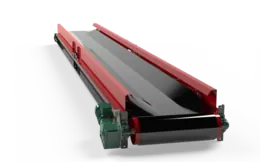
Material packed onto a pulley or roller face increases the diameter at that point and makes the belt climb toward it; the effect is identical to a crown nobody designed. That is why the first hands-on check in any tracking investigation is the return idlers and the tail pulley face. It also explains why scraper maintenance is a tracking topic: a head scraper working badly will produce a return-side tracking fault within days. On a conveyor belt the scraper, the points where carryback collects and the access needed to clean them should be planned together.
The splice: nothing holds if it is not square
A belt cut or joined out of square will wander even with perfect idlers. Diagnosis is simple: mark the splice and watch whether the drift travels with it. A drift fixed at one place along the run points to the structure; a drift that walks around with the belt points at the belt.
Empty and loaded are separate tests
Training always starts with an empty belt. Once it is stable, the belt is run at full load and watched again. A drift that only appears under load is usually a loading point issue rather than an alignment issue: if material does not land on the centreline and close to belt speed, the belt moves the way the load pushes it.
An adjustment that is not recorded did not happen
In most plants tracking work is handed over verbally, so one shift skews an idler and the next shift skews it back. The cure is a single sheet recording which point was adjusted, in which direction, by how much and with what result. When the same location keeps reappearing on that sheet, what needs correcting there is not an idler but a frame bay.
Frequently asked questions
Is training done with the belt running?
Observation is done running; adjustment is done with the equipment stopped and isolated. Loosening bolts on a moving belt is not an acceptable method.
Will a training idler fix a drifting belt permanently?
A training idler is a corrective aid. It hides a structural fault rather than removing it, and no frame with unequal diagonals was ever repaired by adding rollers.
When should idlers be replaced?
Any roller that has stopped turning, changed its sound or developed a flat worn face gets replaced; a seized roller will cut into the bottom cover in a short time.
Conveyors look like the cheapest equipment in the plant yet account for a large share of its downtime; other articles under maintenance and wear deal with wear part life and planned stoppages.
Definitions of technical terms: Glossary