EN — English
 TR — Türkçe
 DE — Deutsch
 RU — Русский
 FR — Français
 ES — Español
 AR — العربية
 SR — Српски

Zambia Copperbelt Mines Crushing and Screening Plant 250-450 TPH
Setting up a crushing plant at a mine on Zambia's Copperbelt, around Kitwe, Chingola, Mufulira or Luanshya, is a different job from choosing equipment for an aggregate quarry. Part of what leaves the crusher goes to the concentrator, part goes to haul roads and fill inside the pit, and the feed itself changes through the year from dry, hard blocks to wet, clayey oxide ore. For a line handling 250-450 TPH, this article compares three real configurations with their model figures, explains how shipping to a landlocked country shapes the choice, and lists the site data to gather before asking for a quote.
We do not comment on the licence, expansion plan or tender of any particular mine. Product size, tonnage and environmental conditions should be taken from the mine operator's technical specification and the requirements of the relevant Zambian authority.
Two different products expected from a Copperbelt crusher
At a copper mine the primary crusher usually works for two separate customers. The first is the concentrator: the mill or leach circuit dictates the top size and fines content it will accept. The second is the mine itself: haul roads used by heavy dump trucks, slope fills, site pads and concrete work need a steady supply of crushed, screened rock. Both streams can come from the same crusher, but the screen layout, stockpile arrangement and quality control are separate.
Deposits in the region typically come with host rocks such as shale, quartzite and dolomite, and near-surface zones can be weathered and clayey. That general picture says nothing about the hardness of a given pit. The Bond abrasion index, uniaxial compressive strength, moisture and clay content must be measured on samples, and the model choice confirmed only after those results are in.
A method that works on site: design the ore line and the road-material line separately on paper, then check which equipment can be shared. That way the concentrator's size limit is never relaxed for the sake of aggregate fractions, and aggregate production does not stop while an ore campaign is running.
Three routes to a 250-450 TPH target
Derive the tonnage from the shift plan first: hourly capacity = daily tonnage target ÷ (number of shifts × shift length × availability). Availability covers stoppages such as liner changes, planned maintenance and truck waiting time. Choosing it optimistically makes a crusher look adequate on paper and short on site. If the result lands near 250 TPH, one unit may be enough; if it approaches 450 TPH, either a crusher with a larger opening or two parallel lines should be considered.
A) Mobile jaw unit with wobbler feeder
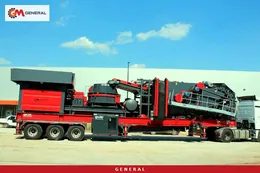
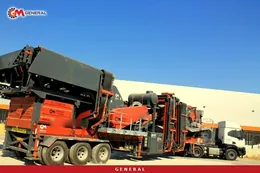
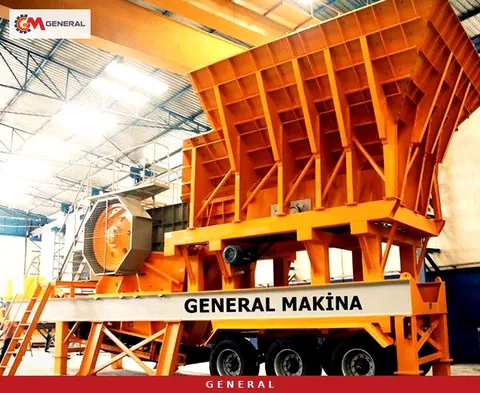
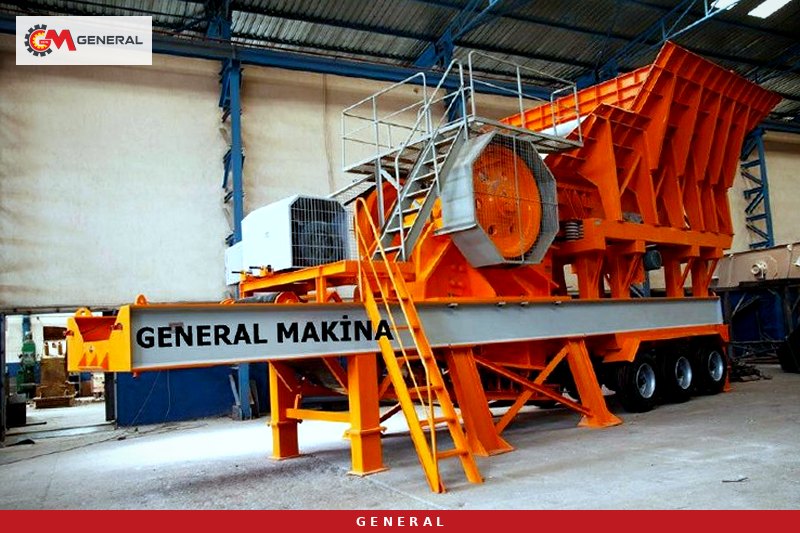
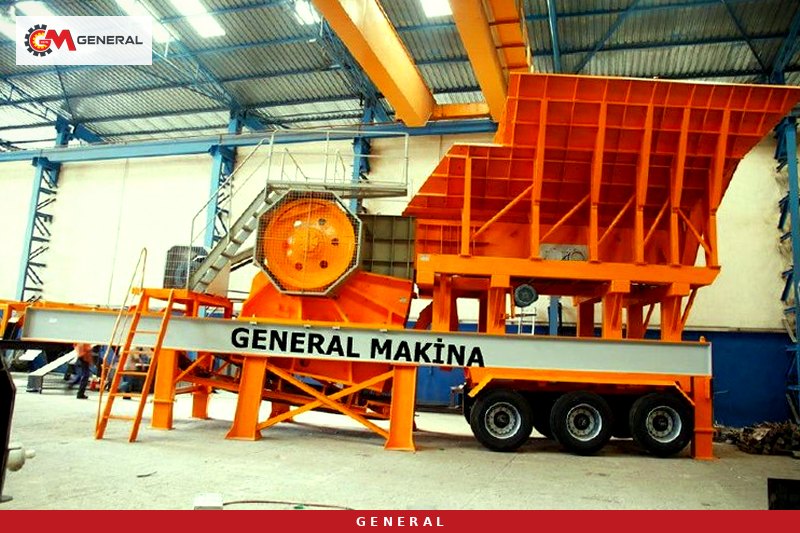
The mobile jaw crushing unit with wobbler feeder covers the whole range on a single chassis with a capacity of 250-450 t/h. Its feeder, built from rotating elliptical shafts, tumbles the rock as it moves forward, so surface clay and fines are separated before they reach the jaw. At a Copperbelt pit where sticky material comes from the oxide zone, this means production continues on the days a grizzly feeder would blind. Feed and product sizes are confirmed in the order specification.
B) Two portable primary crushers in parallel
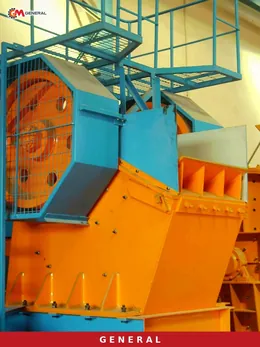
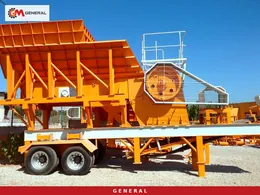
The GNR 110, the largest unit in the portable primary jaw crusher with feeder hopper series, delivers 180-300 t/h with its GNRK 110 crusher. Run two units in parallel and the nominal total is 360-600 t/h; while one is under maintenance, the other keeps ore moving, if at a reduced rate. The unit accepts 0-1100 mm feed, produces 0-250 mm and is set up on hydraulic legs without a foundation. Moving the crusher closer to the loading point as the face advances shortens the truck cycle.
C) Stationary line on concrete foundations
When the pit life is long and the crusher location is permanent, stationary crushing plants allow a larger opening and more screen decks. Among the GNRK series jaw crushers the GNRK 110 works at 200-350 t/h and the GNRK 130 at 400-500 t/h. For abrasive ore, a cone crusher is recommended as the second stage: in secondary duty it gives 6:1-8:1 reduction, takes 50-250 mm feed and produces material in the 0-60 mm range.
| Configuration | Crusher | Opening / feeder (mm) | Capacity (t/h) | Weight (kg) |
|---|---|---|---|---|
| A: Mobile jaw unit with wobbler feeder | Jaw (primary) | — | 250-450 | — |
| B: Portable GNR 110, single unit | GNRK 110 | 1100×4750 feeder | 180-300 | 55,000 |
| B: Two portable GNR 110 units | 2 × GNRK 110 | 1100×4750 feeder (each) | 360-600 (total) | 2 × 55,000 |
| C: Stationary line, GNRK 110 | GNRK 110 | 1100×850 opening | 200-350 | 33,000 (crusher) |
| C: Stationary line, GNRK 130 | GNRK 130 | 1300×1000 opening | 400-500 | 42,500 (crusher) |
The table covers the primary stage only. Model-specific capacity for the secondary cone crusher is given per project, based on sample results and the target product.
Rainy season, oxide clay and feeder choice
Zambia's year divides into a distinct wet and dry season. Material that flows freely over a grizzly in the dry months can smear the bar gaps in the wet months and cut the flow to the crusher. The feeder decision should therefore be based on the material of the hardest month, not the average.
- If clay content is low and the feed is dry and blocky, a vibrating grizzly feeder (for example GNR 140: 350-600 t/h, 2×9.2 kW) bypasses fines and lightens the crusher's load.
- If sticky material comes from the oxide zone, the GWB1136 wobbler feeder (75-600 t/h, 18.5 kW, feed up to 1500 mm) keeps working without blinding.
- If clay content is high and the specification demands clean aggregate, a separate washing stage is considered.
- The tendency of wet ore to bridge in the hopper should be observed on samples and the hopper geometry discussed accordingly.
Dust is also a seasonal issue. In the dry months transfer points need water-spray dust suppression, belt covers and more frequent cleaning of generator air filters. These are project-dependent options and appear as separate items in the quotation.
Reaching Kitwe or Chingola: shipping, weight and installation
Zambia has no coastline. A machine leaving Izmir reaches a port in a neighbouring country by sea and continues to the Copperbelt by road or rail. The route decides how the machine is split into loads and which weight can travel on a single vehicle.
Weight in the portable primary series varies considerably by model: GNR 60 15,000 kg, GNR 90 25,000 kg, GNR 110 55,000 kg. A single-chassis unit is towed by one truck, but heavy-load permits, bridge limits and border crossings must be checked in advance for the chosen route. In a stationary line the crusher, feeder, screen and conveyors ship as separate items, and the concrete foundation is prepared on site with a local civil team.
On the energy side there are two options: connect to the mine's power grid or run on a generator. With grid access, a stationary line and electrically driven equipment simplify operation. If the face moves often, a generator-powered portable unit is more flexible. Generator size is calculated from the total connected load of the selected equipment.
Jaw plate life and spare parts planning
The main wear part of a jaw crusher is the jaw plate. Plates are cast from austenitic manganese steel (Mn13/Mn18) and work-harden at the surface under impact. In pits with plenty of quartzite and siliceous host rock, plate life shortens; wear should be measured and recorded in the first months, and the interval for later orders set from those measurements.
At a remote site the cost of downtime is often larger than the part itself. One set of jaw plates, grizzly bars, feeder wear plates and conveyor idlers should be kept ready on site, and the new order placed when the current set is halfway worn. The same method applies to the mantle and concave liners of the cone crusher. Our machines carry a 1-year warranty; wear parts are excluded, so the wear budget should be planned separately within operating cost.
Site data for the quotation file
An accurate quote for the Copperbelt cannot be prepared until we receive the following:
- Daily and hourly tonnage target and shift pattern
- Largest expected block size after blasting
- Laboratory results for oxide and fresh rock samples: abrasion index, compressive strength, moisture, clay
- Top size accepted by the concentrator and the required aggregate fractions
- Energy source: grid voltage or generator preference
- Access route to site and heavy-load restrictions
- How often the pit face relocates (for the stationary vs portable decision)
Our machines are ISO 9001 and CE certified. With this data, the quotation is prepared as a configuration diagram and equipment list. For an overview of smaller units, see the portable rock crushers page.
Frequently asked questions
Can 450 TPH of copper ore be handled by one mobile unit?
Our mobile jaw unit with wobbler feeder works in the 250-450 t/h range. If you will run close to the upper limit continuously, two portable GNR 110 units or a stationary GNRK 130 line should also be compared.
Should I choose a grizzly feeder or a wobbler?
Decide on the material that comes from the pit in the rainy season. A grizzly feeder is enough for dry, low-clay feed; a wobbler runs without blinding on sticky oxide ore.
Can a portable unit be expanded later?
Secondary crusher and screen modules can be added behind the portable primary unit to grow the line step by step. Once a permanent crusher location is fixed, a cost and operating comparison with a stationary line is recommended.
What determines the price?
Crusher and feeder model, number of stages, screen decks, energy solution, wear-part selection and shipping route. We need the site data above before we can quote a figure.
Final word
Three things define a 250-450 TPH crushing plant on Zambia's Copperbelt: feeding that does not clog in the rainy season, a layout that follows the moving pit face, and shipping planned from the port to the site. Send your sample results and tonnage target through our contact page and we will prepare the matching configuration and equipment list.
Definitions of technical terms: Glossary