EN — English
 TR — Türkçe
 DE — Deutsch
 RU — Русский
 FR — Français
 ES — Español
 AR — العربية
 SR — Српски

Uganda Kampala Expressway Quartzite Crushing and Screening Plant 150-250 TPH
A contractor planning aggregate supply for the expressways around Kampala will often find that the most convenient quarry site in Uganda sits on quartzite. Quartzite is dense, sound and valuable for a road pavement, but its free quartz content consumes crusher metal far faster than limestone or andesite ever would. So when you specify a 150-250 TPH line, the first question is not "which model reaches that tonnage" but "which crusher sequence spends the least metal per tonne of quartzite". Below we read our catalogue data against how quartzite behaves, compare four real configurations and work through the shipping and power decisions that follow from Uganda being a landlocked country.
Why quartzite is a crushing problem of its own
Quartzite forms when sandstone recrystallises under heat and pressure, so the grains end up fused together by quartz cement. It breaks into sharp, hard, abrasive fragments. What decides crusher selection is not Mohs hardness but the free silica content of the feed and its Bond abrasion index. Our jaw crusher page gives the threshold: once silica exceeds 10% or Bond Ai exceeds 0.15, compression crushing is the right approach, and quartzite sits comfortably above that line.
Uganda's crystalline basement includes quartzite ridges alongside granite and gneiss. Even within one quarry, the quartzite can be cut by schist or clay-filled bands that change both product quality and crusher load. Once a site is chosen, take representative samples and have Los Angeles abrasion, Bond abrasion index and compressive strength tests carried out. Those results settle the crusher choice; do not place an order on a guessed rock classification.
The practical consequence: putting an impact crusher in the secondary stage on quartzite means accepting frequent changes of blow bars and liners. A jaw primary followed by cone secondary and tertiary stages is the sensible starting sequence for this rock. The wider comparison is covered in our article on choosing a mobile plant for hard, abrasive rock.
What an expressway specification asks of quartzite
An expressway does not consume one product but a family of products governed by different specifications. The screen apertures and crusher settings are fixed according to which product carries most of the tonnage. Confirm the limit values in the technical specification of the road authority and the supervising consultant.
Sub-base and base courses
Most of the tonnage goes here. Crushed quartzite's angular particles interlock well under compaction, but hitting the grading envelope also needs enough fines, and quartzite generates relatively few of them. That gap is closed by tuning the cone setting and the screen arrangement together.
Asphalt chippings and bitumen adhesion
Quartzite is silica-rich and acidic in character, and its bond with bitumen may be weaker than that of limestone. Stripping and adhesion tests are essential for wearing-course chippings, and any additives the specification allows should be weighed in the mix design. That is a laboratory decision rather than a crusher decision, yet clean, cubical chippings from the plant directly improve the test outcome.
Concrete for bridges, culverts and interchanges
Bridges and culverts along the expressway need concrete aggregate in smaller volumes but with tighter shape and cleanliness limits. Flaky particles raise the water demand of the mix. Quartzite can split along bedding planes into flat pieces; running the cone choke-fed increases inter-particle crushing and improves shape.
Four configurations for 150-250 TPH
Because the target range can exceed the upper limit of a single mobile unit, the options need to be weighed side by side. Every figure below is catalogue data from our product pages; unknown cells are shown as "—".
| Option | Crusher sequence | Capacity | Max. feed | Power | Verdict on quartzite |
|---|---|---|---|---|---|
| A: Single General 944 | GPJ 90 jaw + GM430 cone | 120-180 t/h | 800 mm | 550 kVA generator | Compression crushing; lower band of the range |
| B: Two General 944 in parallel | 2 × (GPJ 90 + GM430) | 240-360 t/h nominal combined | 800 mm | 2 × 550 kVA | Covers the full range; one unit runs while the other is serviced |
| C: Stationary line | GNR 110 feeder + GNRK 110 jaw + General cone + GNR 2060 screen | Primary 200-350 t/h; cone sized per project | Feeder 1500 mm | — | Tertiary cone can be added; suits a long-life quarry |
| D: GNR-MC110 | GPJ 110 jaw + DMK03 impactor | 200-300 t/h | 900 mm | 750 kVA | Impact secondary wears quickly in quartzite |
The mobile route: one or two General 944 units
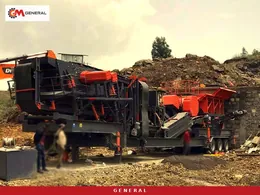
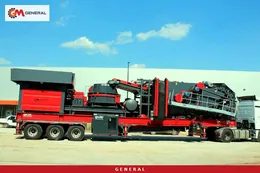
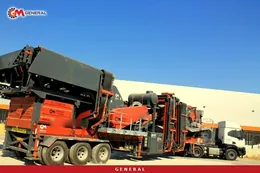
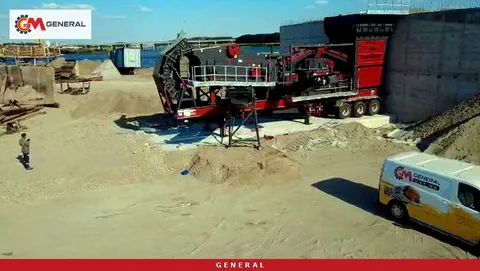
The General 944 places a GPJ 90 primary jaw ahead of a GM430 cone on one wheeled chassis, and its product page explicitly lists quartz among the rocks it is built for. A 1600×5000 mm three-deck horizontal screen separates 0-5, 5-12 and 12-19 mm fractions, with an output setting of 0-100 mm. One unit works in the 150-180 t/h band; for demand approaching 250 TPH, two units in parallel give both capacity and redundancy, and they can also be split between two expressway sections or two quarries. Other wheeled options are listed under wheeled mobile crushing plants.
The stationary route: GNRK 110 primary with cone secondary
If expressway construction will last several years from a single quarry, a stationary line gives a lower cost per tonne. The GNR 110 vibrating grizzly feeder (1100×4750 mm, 200-300 t/h, 2×7.5 kW) delivers run-of-mine rock evenly and its by-pass grizzly strips soil before it reaches the crusher. Behind it, the GNRK 110 jaw crusher with a 1100×850 mm opening, a 110/132 kW motor and 200-350 t/h capacity, covers the whole range on its own. The cone model table for the secondary and tertiary stages is issued per project once sample tests are in. Layout options are shown under fixed crushing plants.
Option D is in the table on purpose: at 200-300 t/h the GNR-MC110 fits the target on capacity, but its secondary is an impact crusher. That sequence excels on limestone and drives up wear-part cost on quartzite. It is worth revisiting only if the quarry turns out to yield a less abrasive rock.
Wear-part economics: cost per tonne
On quartzite, wear parts shape the budget more than the machine price does. The right yardstick is cost per tonne crushed, not part price. A simple formula: wear cost per tonne = (liner set cost + changeover labour + downtime loss) ÷ tonnes crushed over the liner life. Hypothetical example: if a set costing 100 units, plus 20 units of labour and 30 units of downtime, crushes 75,000 tonnes, the result is 0.002 units per tonne; a pricier alloy that lasts twice as long can come out at close to half that figure under the same formula.
The principles on our spare-parts page translate to quartzite as follows:
- For jaw plates, Mn18 or Mn22 austenitic manganese steel is preferred for high-silica feed; it work-hardens at the surface under impact.
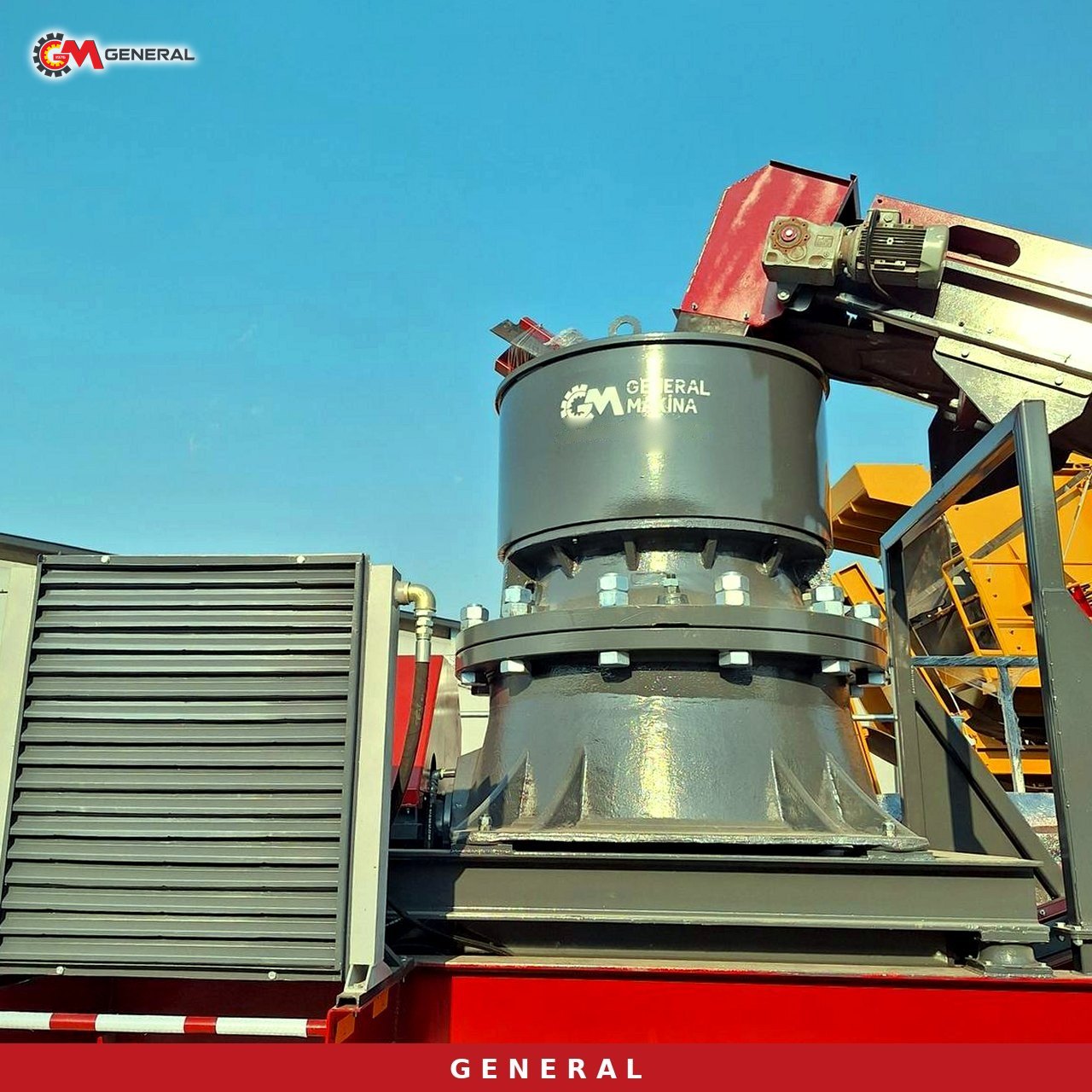
- Manganese steel is standard for cone mantles and concaves; high-chrome liners are also considered for high silica.
- Ceramic-reinforced MMC parts can last roughly 2-3 times as long as high-chrome in abrasive duty; dearer at purchase, they cut the number of stoppages.
- Measure and record the liner wear profile at every change, and schedule the next change from that record.
The stage setting of the cone also affects metal consumption: a crusher pushed beyond a 6:1-8:1 reduction ratio in the secondary stage, or about 10:1 in the tertiary, wears faster. Details are on the cone crusher page.
From the port to Kampala: shipping and on-site power
Uganda has no coastline, so a plant leaving Izmir usually reaches the Kampala area by road from Mombasa in Kenya or Dar es Salaam in Tanzania. The route, customs and transit documents and heavy-load permits should be planned with the contractor's logistics provider and confirmed with the relevant authorities.
For the mobile option the planning inputs are fixed: the General 944 is a single wheeled chassis measuring 4130×20350×4500 mm and weighing 70,000 kg. A stationary line ships as separate components in containers and on flat racks, and needs concrete foundations, erection and electrical works on site, which is the main reason its installation schedule runs longer.
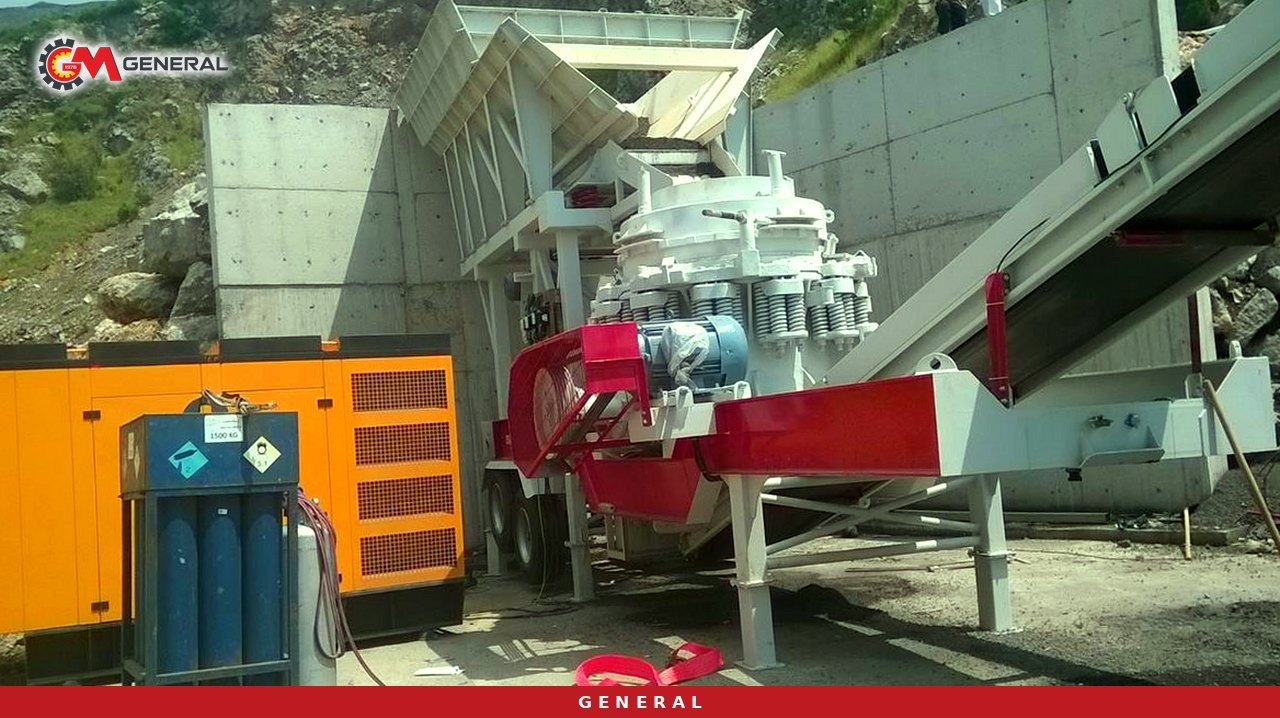
If grid power can reach a quarry near Kampala, a stationary line can run from the mains; ask the distribution company about connection capacity and lead time. At off-grid quarries the mobile unit runs on its own generator: 550 kVA for the General 944 and 750 kVA for the GNR-MC110 are the catalogue figures. Fuel logistics, generator servicing and a stock of spare filters belong in the operating plan.
Rainy seasons, laterite cover and silica dust
Uganda sees two wet periods a year, and many quarries have red laterite and clay overburden above the sound rock. In wet weeks that cover finds its way into the feed. The feeder's by-pass grizzly removes soil before it enters the crusher, but very sticky material can blind the bar gaps. At such a quarry, plan stripping discipline, a separate stockpile and, if needed, a washing step from the outset.
Crushing quartzite releases dust containing respirable crystalline silica, an occupational health risk that must be taken seriously. Measures that can be selected for the project include water-spray dust suppression at transfer points, covered conveyors and screens, filtered ventilation in the operator cabin and proper respiratory protection on site. On hot, dusty days, generator and engine air filters need checking more often.
What to prepare before requesting a quote
- Los Angeles abrasion, Bond Ai and compressive strength results for quartzite samples from the quarry.
- A product list with separate fractions and tonnages for sub-base, base, asphalt chippings and concrete aggregate.
- Daily operating hours and number of shifts, from which the required hourly capacity is calculated.
- The largest run-of-mine lump size and the thickness of the laterite/clay cover.
- Whether grid power is available at the quarry.
- Whether the plant will move to another site after the project.
- The preferred discharge port and road route.
Frequently asked questions
Is an impact crusher ever used on quartzite?
It is not recommended for the primary or secondary stage; jaw and cone crushers, which work by compression, consume far less metal. An impactor or VSI can be considered only for a low-tonnage shaping or sand stage, with the wear cost calculated first.
Can a single General 944 produce 250 TPH?
No. Its catalogue capacity is 120-180 t/h. For demand approaching 250 TPH, either two units are installed in parallel or a stationary line with a GNRK 110 primary is chosen.
What warranty and certificates apply?
General Makina has been manufacturing in Izmir since 1976; the machines carry ISO 9001 and CE certification. The warranty runs for one year, with wear parts excluded.
What determines price and delivery time?
Price depends on the configuration (mobile or stationary, number of stages), screen decks, generator, alloy choice and shipping scope. Delivery time varies with the order content; both are given in a written quotation once sample results and the product list are clear.
Next step
For quartzite feeding the Kampala expressways, the right line is not the highest tonnage in the catalogue but the jaw-and-cone sequence that spends the least metal per tonne. One or two General 944 units suit a contractor who wants mobile flexibility; a stationary line with a GNRK 110 primary is the strong starting point for a job that stays at one quarry for several years. Send your sample results and product list through our contact page and we will prepare a configuration and quotation for your quartzite.
Definitions of technical terms: Glossary