EN — English
 TR — Türkçe
 DE — Deutsch
 RU — Русский
 FR — Français
 ES — Español
 AR — العربية
 SR — Српски

Ethiopia Dam & Expressway Crushing and Screening Plant 250-375 TPH
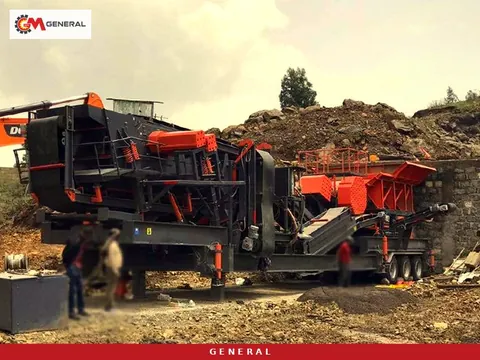
In Ethiopia a dam site and an expressway site may draw stone from the same quarry, yet they never ask for the same product. Dam concrete needs clean, tightly graded coarse aggregate and a lot of sand; an expressway needs separate fractions for sub-base, base course and asphalt chippings, delivered to a point that keeps moving as the road advances. When you pick a crushing and screening plant for 250-375 TPH, the first question is therefore not "which machine" but "who is the plant producing for, and how many years will it stay in one place". This article covers how highland basalt shapes crusher choice, which real models meet the target range, the fixed-versus-mobile decision between dam and road work, and how a shipment through Djibouti is planned all the way to site.
Dam concrete versus road pavement: one quarry, two specifications
On a dam the crusher's real customer is the batching plant. Mass concrete and facing concrete call for aggregate with low dust content, sound particle shape and fractions that do not mix in the stockpile. A large share of dam concrete is fine material, so sand output is often the plant's bottleneck. Some dam specifications also want aggregate coarser than 19-40 mm as a separate fraction; if so, the screening and stockpile layout has to be drawn for it from day one.
Expressway work asks for a wider product range with looser tolerances. Sub-base and base course need crushed, well-graded material, while the asphalt wearing course needs cubical, clean chippings. For the road contractor the decisive figure is how far each tonne travels: as the alignment grows longer, haulage can cost more than crushing. In both cases, confirm the actual fractions and quality limits against the employer's specification and laboratory results before ordering any machine.
Highland basalt and the choice of crusher
Large parts of the Ethiopian highlands are covered by volcanic rock, above all basalt; limestone, sandstone and granite quarries also exist in some regions. Basalt is hard and abrasive. An impact crusher gives a high reduction ratio and good particle shape in this stone, but blow bars and plates wear fast. Jaw and cone crushers, which work by compression, protect the metal for longer. As our own product pages state, the large impact-primary models perform best on limestone and low-abrasion stone, while a jaw + cone arrangement is the wiser choice for hard basalt and granite.
Not all basalt in the region behaves alike. Vesicular, weathered basalt and massive, fresh basalt differ clearly in how they wear liners and how they break. Have quarry samples tested for abrasiveness, compressive strength and Los Angeles abrasion; the results decide both the crusher type and the wear-part metallurgy.
Four routes to 250-375 TPH
The one model that covers the full target range on its own is the General 03; the other options either meet the lower part of the band or are built as two units or a fixed line. Every value in the table below comes from our product pages; unknown cells are shown as "—".
| Configuration | Primary / secondary | Capacity | Max. feed | Screen | Power unit |
|---|---|---|---|---|---|
| General 03 (single chassis) | GPS 1415 impactor | 250-375 t/h | 900 mm | 2400×5000 mm, 4-deck | 750 kVA |
| General 02 (single chassis) | GPS 1413 impactor | 250-300 t/h | 1000 mm | 2000×5000 mm, 4-deck | 660 kVA |
| GNR-MC110 (two chassis) | GPJ 110 jaw / DMK03 impactor | 200-300 t/h | 900 mm | 2000×6000 mm, 4-deck | 750 kVA |
| 2 × General 944 | GPJ 90 jaw / GM430 cone | 2 × 120-180 t/h | 800 mm | 2 × 1600×5000 mm, 3-deck | 2 × 550 kVA |
| Fixed line | GNRK 110 jaw / cone crusher | GNRK 110: 200-350 t/h | — | per project | grid or generator |
Limestone or softer stone: General 03 and General 02
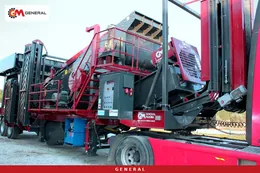
The General 03 achieves heavy reduction in one stage with its GPS 1415 primary impactor, and its 2400×5000 mm four-deck screen splits 0-5, 5-12, 12-19 and 19-40 mm fractions at the same time. Its four-axle chassis is built to the international transport standard. The General 02 stays in the lower part of the band at 250-300 TPH but has the widest inlet in the family, 1000 mm, which pays off where blasting leaves large blocks. Both are strong on low-abrasion stone; in basalt neither should be chosen without pricing in wear.
Hard basalt: jaw first, then cone or a twin line
The GNR-MC110 splits a GPJ 110 primary jaw and a DMK03 secondary impactor across two chassis: the primary chassis measures 3000×13500 mm at 55,000 kg, the secondary 4200×18300 mm at 55,000 kg. Because the primary group can run alone, a road job can start with base material and add the secondary later for chippings. Where metal life comes first, two General 944 units together give 240-360 TPH; the GM430 cone secondary keeps wear low in basalt, and while one unit is under maintenance the other keeps producing.
The dam site stays put, the expressway moves
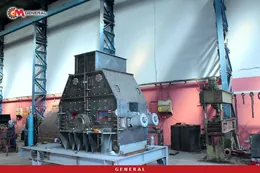
A dam is fed from the same aggregate quarry for years. That makes fixed crushing plants a serious option: a GNRK 110 jaw crusher with a 1100×850 mm opening and a 110/132 kW motor delivers 200-350 TPH; with a GNR 140 vibrating feeder (350-600 TPH) ahead of it and a cone crusher plus a 2400×6000 mm GNR 2460 screen behind it, a complete line takes shape. A fixed plant needs foundations and erection, but on long jobs such as a dam it offers many fractions and high, uninterrupted capacity. If dam concrete runs short of sand, a vertical shaft sand unit such as the 90-180 TPH GNR-MVSI 900 can be added at the end of the line; it produces 0-3, 3-5 and 5-12 mm fractions.
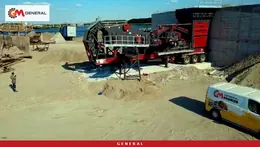
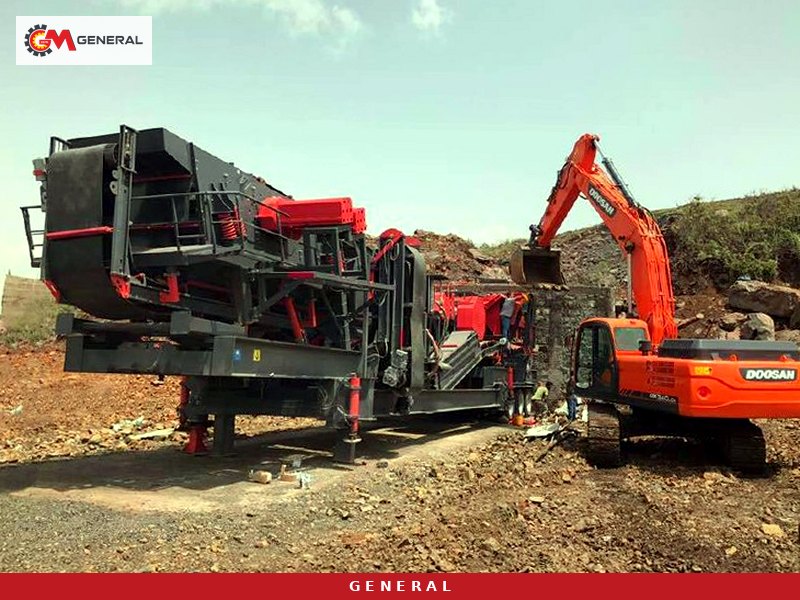
An expressway, by contrast, advances. Keeping the crusher near the middle of the alignment shortens haulage, which is why wheeled mobile crushing plants are the natural choice for a road contractor. Hydraulic legs and folding conveyors remove the need for foundation work, and the plant moves from one quarry to the next quickly. In practice many contractors try to serve both jobs with one plant; that is possible, but the sand and clean coarse aggregate demand of dam concrete may push the plant towards the fixed side.
From Djibouti to the highlands: shipping, altitude and rain
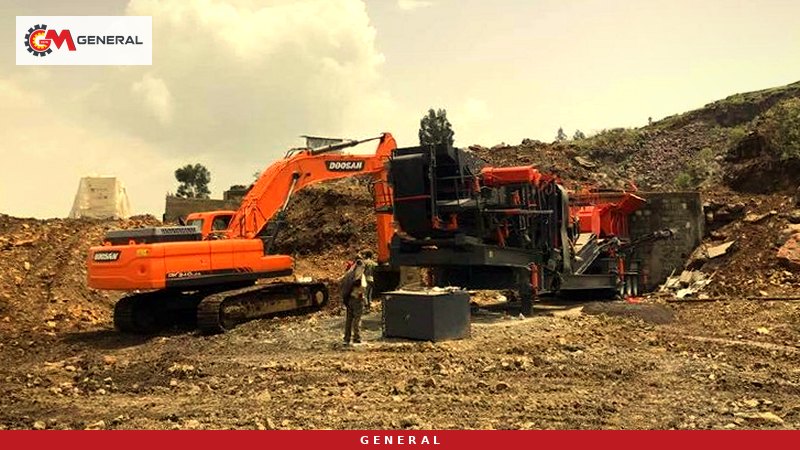
Ethiopia is landlocked, and most machinery arrives by road through the port of Djibouti. A wheeled plant's advantage on that journey is that it can be towed on its own chassis. The General 02 has transport dimensions of 4340×20600×4500 mm and weighs 76,000 kg; check these figures against bridge and axle limits on the route together with your haulier. The GNR-MC110, which splits its weight over two chassis, can make things easier on roads where a single heavy load runs into permit trouble.
Altitude and power
Many highland sites sit at high altitude. In thin air, diesel engines and generators deliver less power; the derating must be calculated from the engine maker's altitude curve. The General 03 and GNR-MC110 run with a 750 kVA power unit, the General 02 with 660 kVA and the General 944 with 550 kVA. State the site altitude in your enquiry so that generator selection can be checked against it. On a dam site close to the grid, electric operation is also worth considering.
Rainy season and dust
During the long rainy season, quarry feed turns clayey and sticky. The by-pass section of a grizzly feeder separates soil before it reaches the crusher; where mud blinds the grizzly bars, a wobbler feeder with elliptical shafts is the better measure. In the dry season dust takes over: water-spray dust suppression at transfer points and covered conveyors are measures that can be selected per project. Shorten air-filter change intervals in dusty months.
What to pin down before requesting a quote
- Project type: dam, expressway or both; how many years the plant will stay at one spot.
- Rock type and test results: abrasiveness, compressive strength, Los Angeles abrasion value.
- Largest block size after blasting and expected clay content.
- Specified fractions: concrete aggregate, sand, sub-base, base course and asphalt chippings, each listed separately.
- Hourly and daily target output, number of shifts.
- Site altitude, availability of grid power, water source.
- Route from Djibouti to site, bridge and axle restrictions.
- Need for an extra sand unit if sand is short.
To see our work in similar rock, look at the 150 t/h basalt crushing and screening project in Jijiga Ethiopia.
Frequently asked questions
Can a single General 03 serve both the dam and the expressway?
On capacity, 250-375 TPH can cover the combined demand of both jobs. If the stone is hard basalt, though, wear cost on the impact primary rises, and if dam concrete needs extra sand a vertical shaft unit must be added at the end. The decision should rest on test results and the fraction list.
Why do you recommend jaw and cone crushers for basalt?
Crushing by compression wears the metal less in abrasive stone. That is why the General 944, with its GPJ 90 jaw and GM430 cone, is designed for long part life in basalt; two units together give 240-360 TPH.
Which warranty and certificates apply?
Our machines carry ISO 9001 and CE certification, with a 1-year warranty excluding wear parts. General Makina has been manufacturing in Izmir since 1976.
What determines price and delivery?
The model, crusher combination, number of screen decks, generator, any extra sand unit and the shipping method set the price. We give the exact figure in a project-specific quote prepared from the checklist above.
Conclusion
In Ethiopia, dam work calls for a long-term, sand-heavy, fixed line, while expressway work calls for a wheeled plant that moves and crushes hard basalt economically. On limestone the General 03 covers the whole target range on one chassis; in basalt the GNR-MC110 or two General 944 units make a sounder calculation. Send us a quarry sample, the fraction list and the site altitude through our contact page and we will prepare the matching configuration and quote.
Definitions of technical terms: Glossary