EN — English
 TR — Türkçe
 DE — Deutsch
 RU — Русский
 FR — Français
 ES — Español
 AR — العربية
 SR — Српски

Saudi Arabia Manufactured Sand VSI Crushing and Screening Plant 90-180 TPH
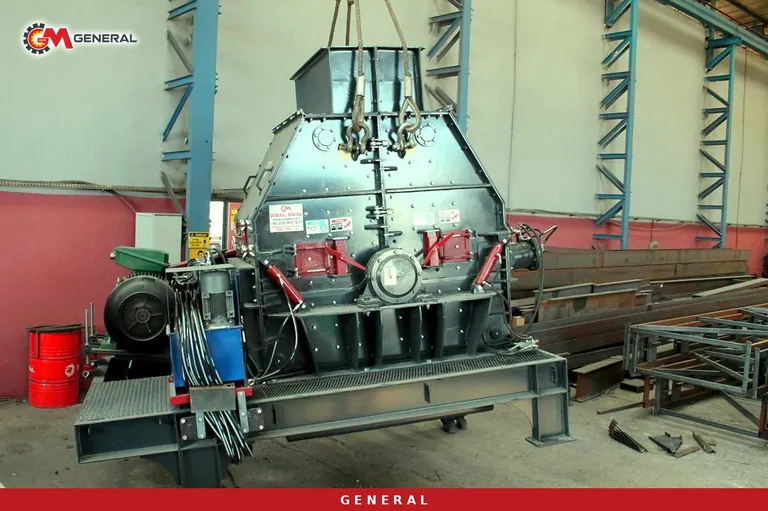
For anyone running a ready-mix plant, a precast yard or an asphalt plant in Saudi Arabia, sand is a shortage in the middle of plenty. Desert sand is everywhere, but those wind-rounded, almost single-sized fine grains push up water and cement demand when they go into a concrete mix on their own, and they cannot fill the grading curve. That is why quarry owners turn to their own rock: the dust piling up under a cone crusher, the stockpile of crusher fines, or the 5-20 mm material left on top of the screen all become manufactured sand once they pass through a vertical shaft impactor (VSI) – cubic, with broken-off corners and the same grading in every batch. This article is written for an investor targeting 90-180 TPH of manufactured sand. It covers which crushing mode suits which rock, the real models that meet this range, feed preparation, the washing decision on a site where water is scarce, and the details that keep a rotor running in a hot, dusty operation.
All capacity, feed size, power and weight values in this text are model data from our product pages. Confirm your project's sand specification, quarry permits and water permits with the relevant authority and the project documents.
Read the specification before choosing a machine: three criteria for the sand
Technical specifications on large Saudi construction sites usually refer to international standards for aggregates; ASTM C33 and BS EN 12620 are the two references you will meet most often. Read which one applies from the project's own documents. For manufactured sand, three criteria change the machine choice.
The first is particle shape. Flaky and elongated particles reduce the workability of concrete; this is where a VSI has its clearest advantage over a tertiary impact crusher, because it shapes the material more than it reduces it. The second is the fines content: if the finest dust fraction exceeds the limit allowed in the specification, the sand is either washed or trimmed with air or screen classification. The third is the grading curve: if fractions such as 0-3, 3-5 and 5-12 mm can be stockpiled separately and blended at the batching plant in the required ratio, meeting the specification becomes much easier. You will meet these three criteria again in every model and equipment choice below.
From western granite to Najd limestone: the rock decides the VSI operating mode
In the west of the Arabian Peninsula, across the shield region running along the Red Sea coast, granite, gneiss and volcanic basalt (the harrat fields) are common. In the central and eastern regions, sedimentary limestone and dolomite quarries dominate. This split directly determines which mode the sand maker runs in and how large the wear-parts budget will be. Always take a sample of your own quarry rock and have abrasiveness and crushability tests carried out; a regional generalisation is only the first filter in machine selection.
Siliceous, abrasive rock: rock-on-rock mode
For material with a high silica content, such as granite, basalt and quartz-rich gravel, the autogenous (rock-on-rock) mode of the VSI is preferred. The rotor accelerates the material to about 80 m/s and throws it against a rock bed that forms by itself inside the housing; breakage and shaping happen as stone hits stone, so the metal surfaces wear less. For these rocks, ceramic or tungsten-carbide reinforced parts are used on the rotor tips. On siliceous rock the hammers and plates of a tertiary impact crusher are consumed quickly, so for quarries in the western region the VSI becomes the economical choice at the sand stage.
Limestone and dolomite: anvil mode or tertiary impact crusher
On low-abrasion limestone there are two options. The VSI can run in anvil mode to achieve a higher reduction, or a GNR series tertiary impact crusher can be used. The tertiary crusher accepts feed up to 150 mm and produces 0-5 mm manufactured sand and fine chippings. The GNR 100 (1200×1000 mm rotor, 90-160 t/h, 160 kW) and GNR 130 (1200×1300 mm rotor, 130-200 t/h, 200 kW) fit the 90-180 TPH range. If the particle shape requirement is very strict, a VSI can be chosen as the final stage on limestone as well.
Real model options for 90-180 TPH of manufactured sand
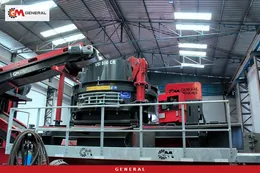
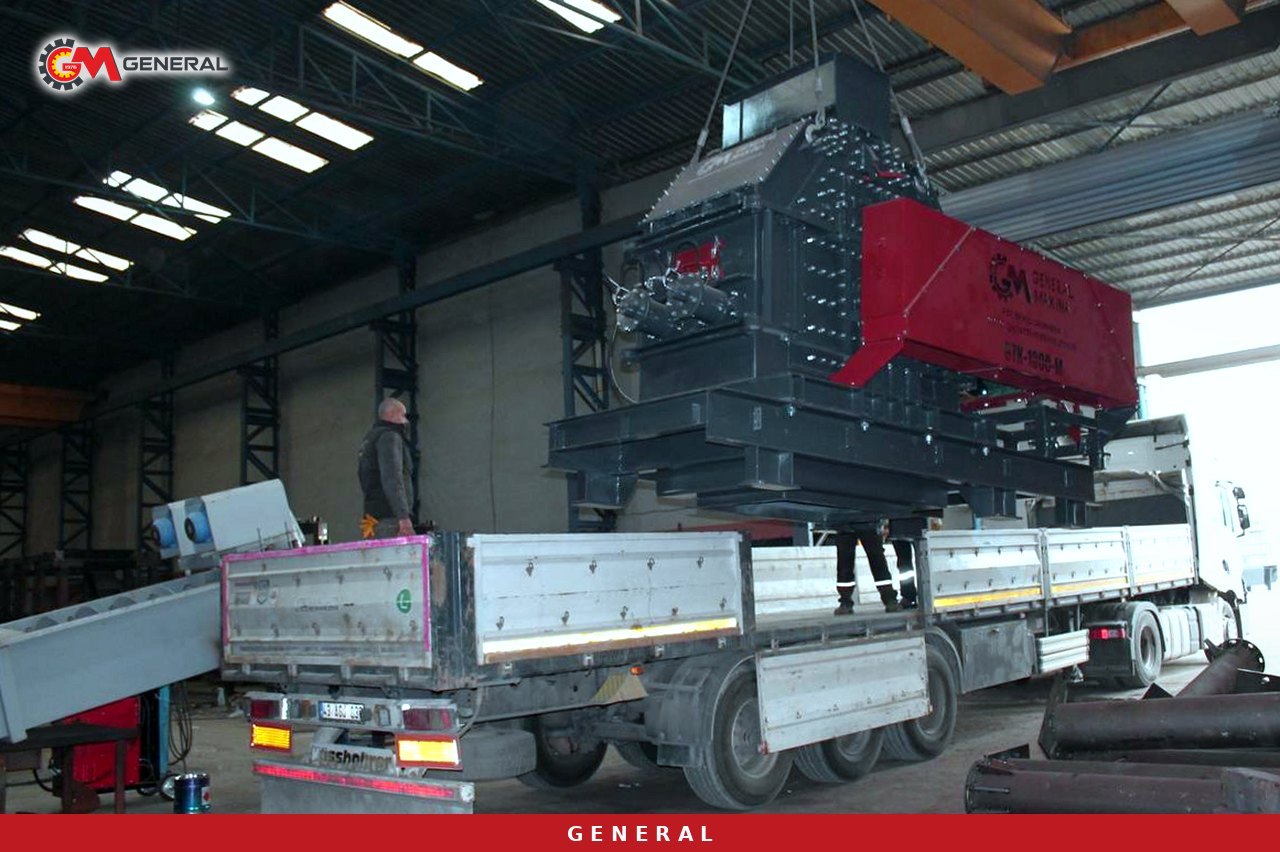
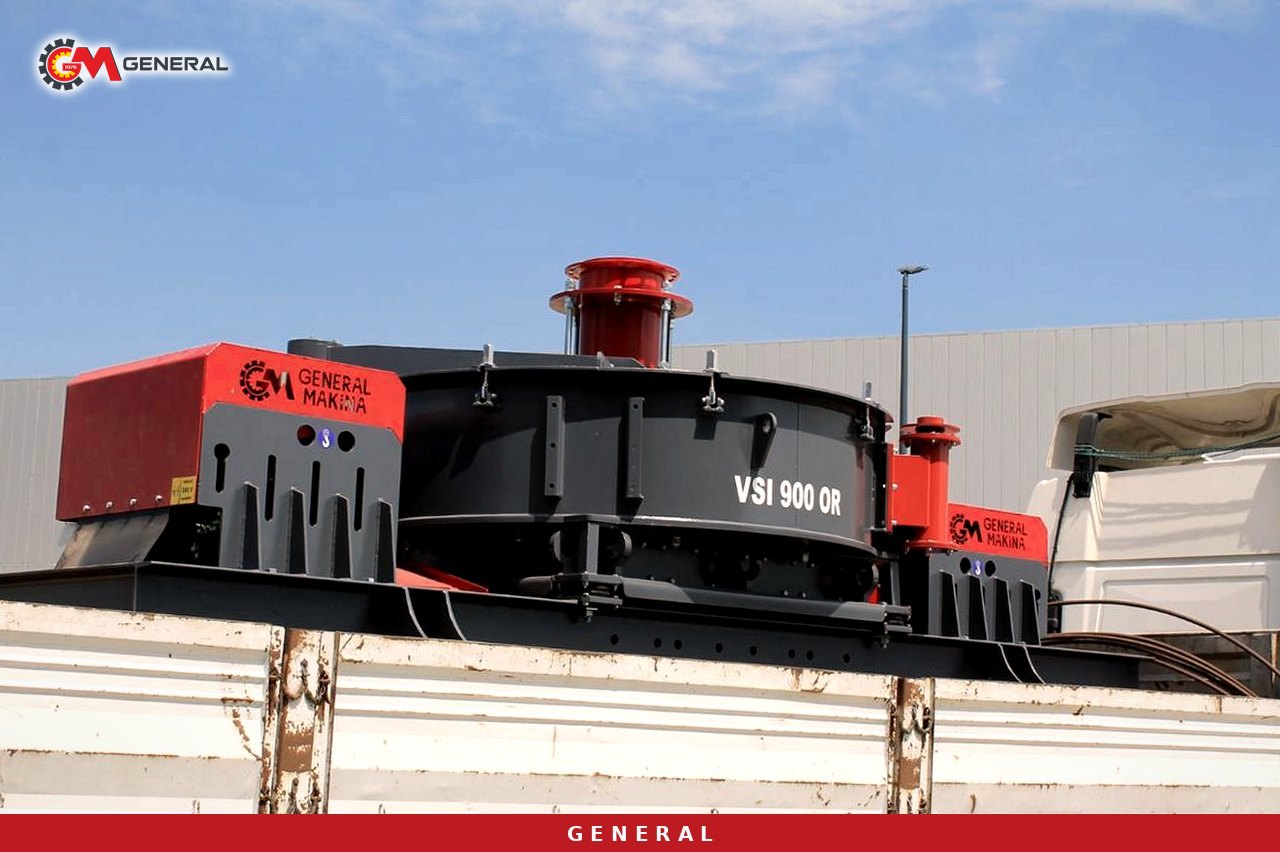
Two VSI units cover the target range on their own: the GNR-MVSI 900 on a wheeled chassis and the GNR 900 vertical shaft impactor installed on a foundation. The GNR 800 can be considered for the lower end of the range, and the mobile tertiary sand maker for turning surplus screen oversize into sand. The values below are given only for the model they belong to.
| Model | Installation | Capacity (t/h) | Max. feed (mm) | Product | Power | Weight |
|---|---|---|---|---|---|---|
| GNR-MVSI 900 | Wheeled mobile, screen and generator on the same chassis | 90-180 | 50 | 0-20 mm; 0-3 / 3-5 / 5-12 mm fractions | 850 kVA generator | 42,000 kg |
| GNR 900 vertical shaft impactor | Stationary, on foundation | 80-210 | 50-55 | Manufactured sand and cubic fine aggregate | 2×200 kW | — |
| GNR 800 vertical shaft impactor | Stationary, on foundation | 55-160 | 40-50 | Manufactured sand and cubic fine aggregate | 132-160 kW | — |
| Mobile tertiary sand maker (VSI) | Single chassis, towed | 60-250 | 200 | 0-10 mm manufactured sand | — | — |
| GNR 130 tertiary crusher | Stationary, on foundation | 130-200 | 150 | 0-5 mm sand and fine chippings | 200 kW | — |
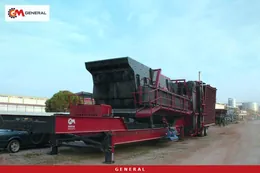
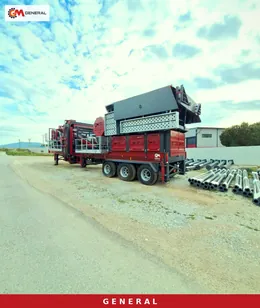
The GNR-MVSI 900 is a crushing and screening unit that covers the 90-180 TPH range on its own and carries its own three-deck 1600×5000 mm horizontal screen. With a transport dimension of 4100 × 16200 × 4500 mm it moves by road, and on a site without grid power it runs on its 850 kVA generator. It is the right choice for contractors who work project by project and move to another region when a job is finished.
If the quarry location and life are fixed, the stationary GNR series vertical shaft impactor comes to the fore. With 80-210 t/h, the GNR 900 leaves headroom above the top of the target; on a site with grid electricity it runs on 2×200 kW motors, and the screens and conveyors are engineered together with the rest of the line. For limestone sites, the GNR series tertiary crusher enters the same table as an alternative. You can compare the whole crusher family on the stone crushers and crushing machines page.
Upstream and downstream of the sand maker: feed preparation and the washing decision
A VSI's performance depends on what the crushers ahead of it send in. The GNR-MVSI 900 accepts a maximum feed of 50 mm and the GNR 900 a maximum of 50-55 mm; rock above this limit wears out rotor tips and table parts quickly and increases vibration. Dust mixed into the feed wastes crushing energy and raises the fines content of the product.
Adding a sand stage to an operating quarry
In a quarry that already has primary and secondary crushers, the shortest route is to split off the 5-20 mm range from the screen undersize of the cone or impact crusher and send it to the VSI. For surplus oversize (coarse chippings), the mobile tertiary sand maker, which accepts 0-200 mm feed, turns unsold stock into 0-10 mm manufactured sand. In this layout it is recommended that the material going to the VSI first passes over a screen to remove the 0-3 mm dust, so that rotor capacity is actually spent on producing sand.
Washed or dry? A site where water arrives by tanker
At many Saudi quarries water is either hauled from far away or expensive, so the first choice is a dry line. If the rock is clean and clay-free, the VSI discharge is screened into fractions and excess fines are removed separately. The GNR ME1650, with 120-180 t/h dry screening capacity and no washing unit, is an 18,000 kg single-chassis option for this job. If the quarry rock contains a clay band or overburden, washing is unavoidable: the screw sand washer washes 0-50 mm feed in the 50-250 t/h range, with typical discharge moisture of 15-30%; when a hydrocyclone and dewatering screen are added, moisture drops to 8-20% and the hydrocyclone recovers the fine sand. For this reason, include the water demand and the recirculation pond in the quotation stage. All sand washing and dry screening units are on the mobile sand washing and dry screening plants page. Clay content is measured with a methylene blue value or sand equivalent test; base the decision on that test result.
Running a VSI on a hot, dusty site: the details that keep the rotor going
High summer temperatures, wind-borne fine dust and remote sites are common conditions for every sand line in Saudi Arabia. They are managed less by the machine itself than by the equipment around it and the maintenance routine. The measures below can be selected per project; which of them go into the quotation has to be clarified through the specification and a site visit.
- Dust suppression: water spraying or misting at the VSI inlet and outlet and at conveyor transfer points; enclosed belt covers and transfer chutes on dry lines.
- Air intakes: pre-filtered air intakes on generators and motors, with filters checked frequently according to the dust load on site.
- Rotor balance: replace tip parts in sets and check vibration after every change; an unbalanced rotor ruins bearings in a short time.
- Rock bed: in rock-on-rock mode, check the bed profile inside the housing regularly and renew worn plates on time.
- Shade and cooling: a canopy and suitable cooling for the electrical panel and control cabin, with cables routed along sun-resistant paths.
- Spare parts: keep a consumables set of rotor tips, anvils and wear plates ready on site.
The machine is manufactured in our factory under an ISO 9001 quality system and carries the CE mark. The warranty is 1 year; wear parts such as rotor tips, anvils and plates are excluded, because their life depends directly on the rock being fed.
The Saudi site file to prepare before requesting a quote
Sending the following information together shortens the process of getting the right configuration and quotation:
- Quarry location (western shield region or central-eastern limestone belt) and a rock sample or test report.
- Saleable sand target: tonnes per hour, daily operating hours, required fractions (0-3, 3-5, 5-12 mm, etc.).
- The aggregate standard referenced by the project and its fines limit.
- Existing crushers and the size range of the material that will go to the VSI.
- Power source: grid or generator; if generator, its rating.
- Water situation: source, quantity and whether washing is required.
- Whether the site will be mobile or stationary, and the expected quarry life.
- Preferred delivery port (Red Sea or Arabian Gulf coast) and the site access road.
Our earlier delivery to Saudi Arabia, the GNR PDK 02 stationary crusher (250 t/h in desert conditions) shows how the primary crushing side was configured under the same climate; a sand stage can be added behind a line of this type.
Frequently asked questions
Can I feed desert sand into a VSI to get manufactured sand?
No. A VSI needs coarse material to break in order to produce sand; it cannot shape desert sand that is already fine and rounded. Manufactured sand is produced from quarry rock, from feed reduced below 50 mm. Desert sand can, however, be blended with manufactured sand to the extent the specification allows.
Can a single GNR-MVSI 900 reach 180 TPH?
The unit's capacity range is 90-180 t/h. The actual value varies with rock hardness, feed grading and the required fractions. If you want to run continuously at the top of the range, a stationary GNR 900 (80-210 t/h) or a two-unit setup can be considered.
Should I choose rock-on-rock or anvil mode?
On abrasive rock such as granite and basalt, rock-on-rock mode reduces metal wear. On softer rock such as limestone, and where more reduction is needed, anvil mode is suitable. The final decision is based on sample testing.
What determines the quotation amount?
The model itself, mobile or stationary installation, the need for a generator, screening and washing equipment, the scope of dust suppression and the shipping method determine the amount. Once you send this information with your site file, a project-specific quotation is prepared.
Conclusion
For 90-180 TPH of manufactured sand in Saudi Arabia, the right line starts with the quarry's rock and the site's water. Rock-on-rock VSI on the siliceous rock of the west, anvil mode or a tertiary crusher on the limestone of the centre and east; the GNR-MVSI 900 for project-based work and the GNR 900 for a permanent quarry. Send your sand specification, sample results and site details through our contact page and our engineers will prepare the right configuration and quotation for you.
Definitions of technical terms: Glossary