EN — English
 TR — Türkçe
 DE — Deutsch
 RU — Русский
 FR — Français
 ES — Español
 AR — العربية
 SR — Српски

The Role of Primary, Secondary and Tertiary Crushers in Mobile Plants
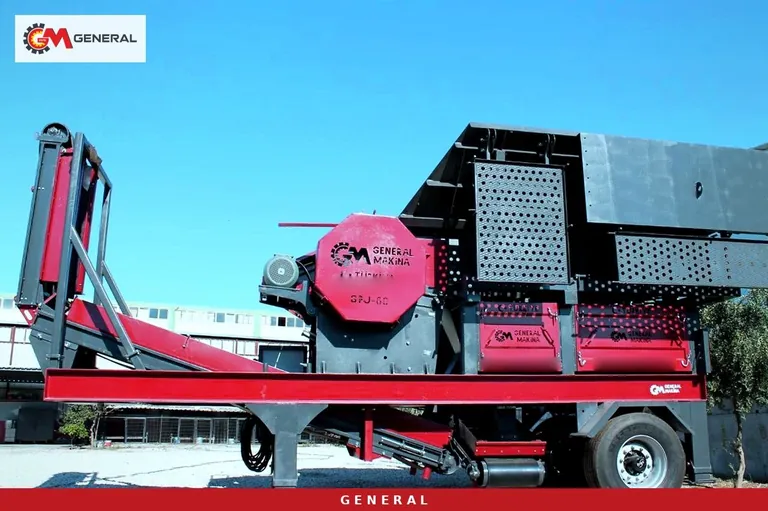
In a stationary plant the primary, secondary and tertiary crushers sit on separate foundations; conveyor length sets the distance between them and space is rarely the deciding factor. On a mobile plant the picture is reversed. Every stage shares the same axles, the same transport envelope and, in most cases, the same generator. The real question on a mobile line is therefore not "which crusher works at which stage" but "which stage rides on which chassis, and how are the stages linked on site". This article does not repeat the definitions of the stages. Instead it looks at how General Makina distributes the stages across the chassis of its wheeled models, and how that distribution affects capacity, transport and later expansion, using the values published on the product pages.
The chassis is a budget: weight, length and power
Three limits act at the same time on a mobile crushing and screening plant: weight (every crusher, hopper and screen adds to the axle load), the transport envelope (the plant has to fit road dimensions) and power (the generator feeds every motor on that chassis).
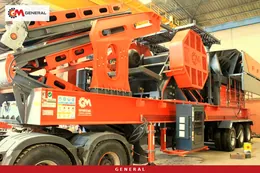
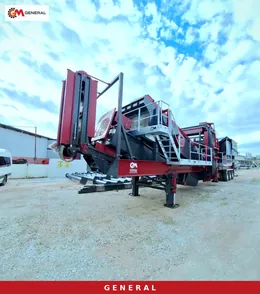
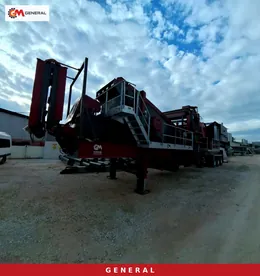
The figures show how this budget is spent. The single-crusher General 800 weighs 35,000 kg, has transport dimensions of 3600×15500×4500 mm and carries a 450 kVA generator. The General 944, which carries a jaw primary and a cone secondary together, rises to 70,000 kg and 4130×20350×4500 mm, with a 550 kVA generator. Adding a second crusher to the chassis doubles the weight and adds almost five metres of length. Height stays at 4500 mm on both models. Beyond a certain point one chassis is no longer enough and the line is split in two.
Four layout architectures
Across General Makina's mobile stone crushers family, the stages are arranged on the chassis in four different ways. Which one suits you depends on how abrasive the rock is, which products you need and how often you move site.
1. Two stages in one crusher
The General 01 performs primary and secondary work in a single body, using the two crushing chambers of its GPS 1210 impact crusher. It takes 700 mm feed, produces 120-180 t/h and delivers four fractions through a 1600×5000 mm four-deck screen. Because it carries no separate secondary crusher, its weight stays at 55,000 kg. The trade-off: in abrasive rock the whole reduction load falls on the same impact parts.
2. One primary crusher in closed circuit
The General 800 (PDK 1280) and General 02 (GPS 1413) each carry a single primary impact crusher; the General 03 (GPS 1415) follows the same single-primary architecture. The secondary duty is handled not by a second machine but by the closed circuit: oversize that cannot pass the screen goes back to the same rotor on the return conveyor and circulates until it reaches the target size. In this layout the General 02 accepts 1000 mm blocks and delivers 250-300 t/h. In low-abrasion rock such as limestone the impact primary gives high reduction, so the need for a second crusher shrinks.
3. Two crushers on one chassis
The General 640 (GPJ 60 jaw + GNR 50 impact), General 944 (GPJ 90 jaw + GM430 cone) and General 950 (GPJ 90 jaw + DMK01 impact) run primary and secondary with two separate crushers on a single chassis. The jaw breaks the large block by compression; the second crusher gives the product its size and shape.
4. Stages on separate chassis
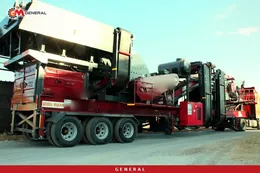
The GNR-MC110 puts the GPJ 110 jaw primary on one chassis, and the GS1215/DMK03 impact secondary plus a 2000×6000 mm four-deck screen on a second chassis. Each chassis weighs 55,000 kg. The family's highest jaw-primary capacity, 200-300 t/h, is reached by splitting the weight over two platforms.
| Model | Primary | Secondary | Tertiary | Chassis | Feed | Capacity | Generator | Weight |
|---|---|---|---|---|---|---|---|---|
| General 640 | GPJ 60 jaw | GNR 50 impact | — | 1 | 500 mm | 60-100 t/h | 300 kVA (optional) | 38,000 kg |
| General 800 | PDK 1280 impact | Closed circuit, same rotor | — | 1 | 600 mm | 80-150 t/h | 450 kVA | 35,000 kg |
| General 01 | GPS 1210, two stages in one body | — | 1 | 700 mm | 120-180 t/h | 550 kVA | 55,000 kg | |
| General 944 | GPJ 90 jaw | GM430 cone | — | 1 | 800 mm | 120-180 t/h | 550 kVA | 70,000 kg |
| General 950 | GPJ 90 jaw | DMK01 impact | — | 1 | 800 mm | 120-180 t/h | 600 kVA | 70,000 kg |
| General 02 | GPS 1413 impact | Closed circuit, same rotor | — | 1 | 1000 mm | 250-300 t/h | 660 kVA | 76,000 kg |
| GNR-MC110 | GPJ 110 jaw (chassis 1) | GS1215 / DMK03 impact (chassis 2) | — | 2 | 900 mm | 200-300 t/h | 750 kVA | 2 × 55,000 kg |
| GNR-MVSI 900 | — | — | VSI 900 vertical shaft | 1 | 50 mm | 90-180 t/h | 850 kVA | 42,000 kg |
The "Tertiary" column is empty for every main plant: the third stage is a separate machine that arrives with its own chassis and generator.
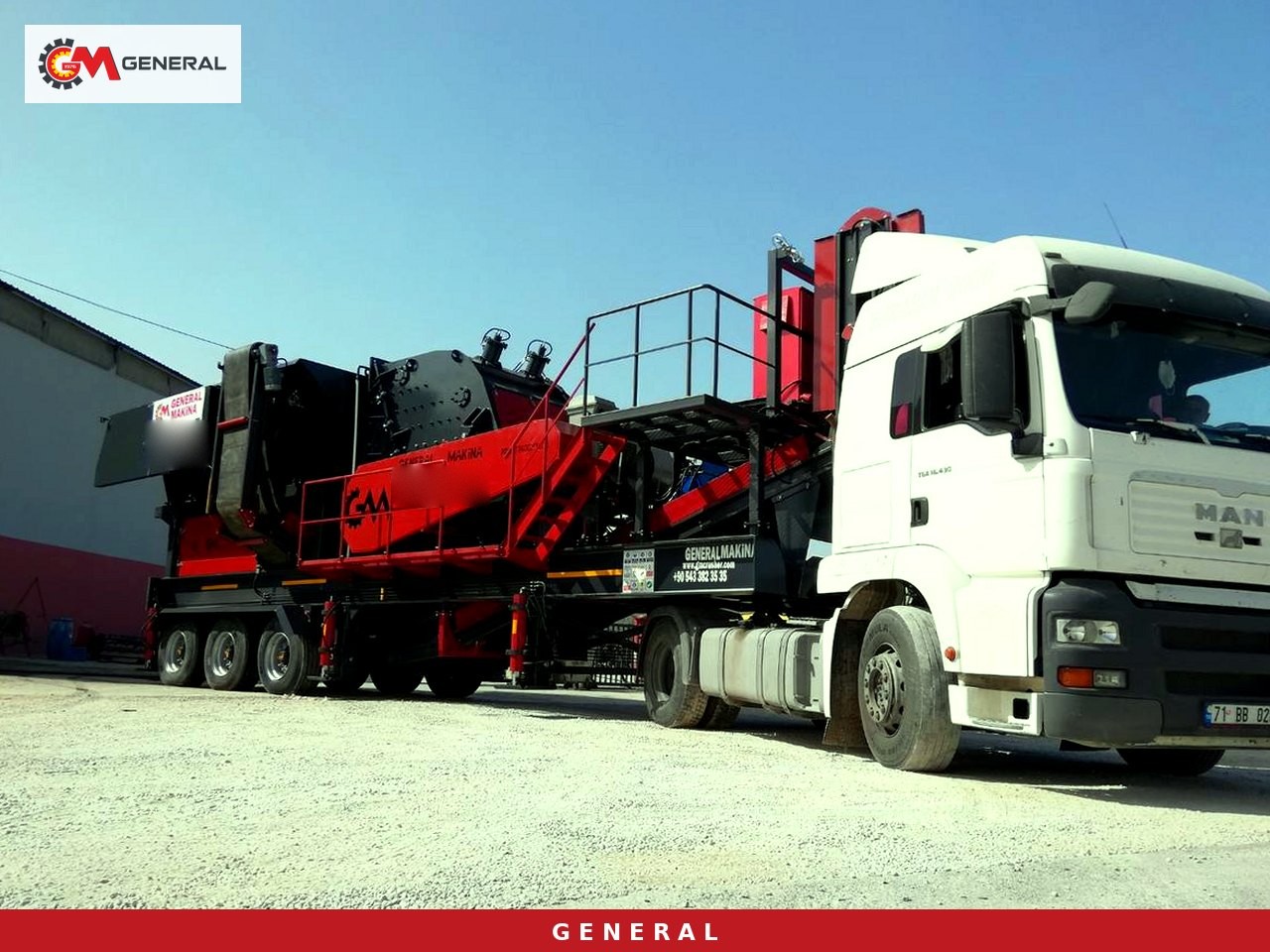
The primary stage: the heaviest end of the chassis
On a mobile plant the hopper, vibrating feeder and primary crusher form one module that occupies one end of the chassis. The feed size decides which blocks can come straight from the face. The gap between the 500 mm of the General 640 and the 1000 mm of the General 02 directly changes how much time the excavator spends sorting oversize at the face.
The type of primary also shapes the rest of the chassis. With a jaw primary there are two routes: the secondary crusher goes on the same chassis (640, 944, 950) or on a separate one (MC110). An impact primary can cover the secondary duty itself through the closed circuit, so it gets by with a shorter, lighter chassis. Why one principle wins over the other in hard, abrasive rock is covered in detail in our jaw vs impact crusher comparison.
A grizzly feeder with by-pass is worth even more on a mobile chassis. On the General 01 the grizzly separates fines before they ever enter the crusher. Because that fraction never passes through the crusher, both the jaw or rotor parts and the generator on that chassis are relieved of that tonnage.
The primary can also come alone on its own chassis. In the portable rock crushers range, the GNR 90 mobile primary jaw unit handles only the first stage, with 70-180 t/h capacity and a weight of 25,000 kg.
The secondary stage: same chassis or a separate unit?
Comparing the General 944 with the General 950 holds the key. Both carry a GPJ 90 jaw primary, both take 800 mm feed, both produce 120-180 t/h; weight (70,000 kg) and dimensions (4130×20350×4500 mm) are identical. The only difference is the secondary: a GM430 cone on the 944, a DMK01 impact crusher on the 950, with the generator going from 550 kVA to 600 kVA. In other words, the choice of secondary does not change the size of the chassis; it changes how the plant answers the rock. The compression principle of the cone extends the life of metal parts in high-silica rock; the impact principle of the DMK01 gives higher reduction and a cubical grain.
The reason for moving the secondary onto a separate chassis is weight and timing. On the twin-chassis GNR-MC110 the primary group can run on its own. An operator can buy the primary chassis first, produce coarse material, and add the secondary chassis when demand appears. On single-chassis plants the stages arrive together and leave together.
On lines built from portable units, the secondary is usually chosen one size above the primary. For example, when an M-DMK 02 secondary (150-250 t/h, 200 kW, 38,000 kg) follows a GNR 90 primary (70-180 t/h), the extra capacity in the secondary also absorbs the oversize returning from the screen. The M-DMK series accepts 0-350 mm feed, and its by-pass conveyor removes soil-laden fines before they enter the crusher.
Why does the tertiary stage come on its own chassis?
The first reason is the feed window. The GNR-MVSI 900 accepts at most 50 mm feed and delivers 0-20 mm product, split into 0-3, 3-5 and 5-12 mm groups. Such a narrow window requires at least one crushing and screening step in front of it that has already reduced the material. The coarse fraction or screen oversize from the main plant becomes the raw material of the tertiary unit.
The second reason is power. With 850 kVA the MVSI 900 has the highest generator in the mobile group, more than the 750 kVA of the twin-chassis MC110. Rather than loading that power demand onto the primary-secondary chassis, the tertiary on its own chassis brings its own energy.
The third reason is changing demand. When the need for sand ends, the tertiary unit is sent to another site without touching the main plant.
Depending on the goal, there are three tertiary options:
- Manufactured sand and fine aggregate: GNR-MVSI 900, 90-180 t/h, 50 mm feed.
- Turning coarse screen oversize into sand: mobile VSI tertiary unit, 0-200 mm feed, 0-10 mm product, 60-250 t/h.
- Cubical shape in coarse aggregate: GNR MK100 mobile cubitzer, up to 250 mm feed, 90-130 t/h, 132 kW; used on basalt lines to reduce flaky grains.
Linking the stages on site
Stages on separate chassis are linked in one of two ways. The first is a direct conveyor: the discharge belt of one unit feeds the hopper of the next. This needs no loader but locks the stages together; if one link in the chain stops, those before it must stop too. The second is an intermediate stockpile: the primary discharges onto a pile, and the secondary or tertiary is fed from that pile by a wheel loader. The stockpile lets the stages run independently, but it needs a loader and operator all the time.
With a direct link, start-up order matters: stockpile conveyor, screen, crusher, and finally the feeder; shutdown runs in reverse. Sequential start-up and blockage protection are the job of the automation panel. When units on separate chassis come with their own panels, the operator manages the sequence unless a cabled interlock is installed between the chassis; settle this at the quotation stage.
Three things should be marked out on site in advance: the loader route from the face to the primary hopper, level ground where the chassis will sit on their hydraulic legs, and a separate stockpile area for each fraction. The single-chassis 944 alone is 20350 mm long; the two chassis of an MC110 plus an added tertiary unit, with conveyors in between, need a far longer strip.
Checklist: before deciding how to split the stages
- Measure the largest piece coming from the face and compare it with the primary feed size (between 500 mm and 1000 mm).
- Establish how abrasive the rock is: cone secondary for high-silica rock, impact stage for limestone.
- Write down the product list: only crushed stone, or manufactured sand as well? If sand is needed, plan a separate tertiary chassis from day one.
- Check whether a specification sets a cubicity requirement; if so, allow for a cubitzer or VSI stage.
- Pin down how many times a year you will move and the route; this settles single versus twin chassis.
- List the power demand (kVA) of each unit separately; plan grid or generator supply and refuelling accordingly.
- Define the growth plan: if primary comes first and secondary and tertiary later, choose a modular layout.
To estimate which model fits your target tonnage, see our guide on choosing a mobile crusher for 100-300 t/h.
Frequently asked questions
Is there a mobile plant that carries all three stages on one chassis?
In General Makina's wheeled family a single chassis carries at most two crushers (General 640, 944 and 950), while the General 01 combines two stages in one crusher body. The tertiary stage is added to the line on a separate chassis, as the GNR-MVSI 900 or the mobile VSI tertiary unit.
Is a single primary impact crusher enough without a secondary crusher?
In low-abrasion rock such as limestone it usually is: the closed circuit sends oversize back to the rotor, and the General 800 and General 02 deliver up to four fractions. In high-silica granite or basalt, a 944-type layout with jaw primary and cone secondary is the better starting point.
Can I add a tertiary stage to my existing mobile line later?
Yes. The precondition is feed size: at most 50 mm for the GNR-MVSI 900, 0-200 mm for the mobile VSI tertiary unit. The screen setting of the main plant is adjusted to that window.
How does the price of a twin-chassis plant compare with a single-chassis one?
Price is set by the crusher types, screen size, generator power, number of chassis and transport scope together. Two chassis mean two separate transports, but they also allow staged investment. For an exact figure, request a quotation with your material, tonnage and product list.
Conclusion
In low-abrasion rock, a single impact crusher with closed circuit; in hard rock, jaw plus cone or impact secondary on one chassis; at high tonnage, twin chassis; and for sand or shape, a separate tertiary unit: these are the right starting points. Share your rock, target products and site plan, and request a quotation through our contact page so we can define the right stage layout together.
Definitions of technical terms: Glossary