EN — English
 TR — Türkçe
 DE — Deutsch
 RU — Русский
 FR — Français
 ES — Español
 AR — العربية
 SR — Српски

UAE Gabbro Aggregate Crushing Plant 300-500 TPH
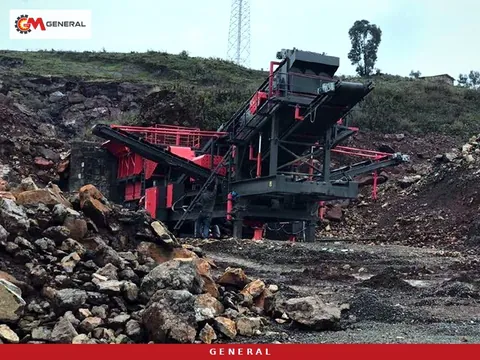
In the east of the United Arab Emirates, quarries cut into the Fujairah and Ras Al Khaimah flanks of the Hajar Mountains work a rock that behaves like neither granite nor limestone: gabbro. Dark, coarse-grained and dense, this plutonic rock yields the sound particle that asphalt and concrete specifications ask for, yet the same toughness burns through wear parts and power when the wrong crusher is chosen. This article walks through the crusher chain for a gabbro quarry targeting 300-500 TPH, three line layouts that can be built from real model data, and the precautions the Gulf site itself calls for.
Every capacity, feed opening and motor figure below comes from our product pages. Results specific to your quarry can only come from sample testing and from the block-size distribution after blasting. Licensing, environmental permits and tender conditions should be confirmed with the relevant Emirate authority and the project specification.
How gabbro breaks differently from granite and limestone
Gabbro is an igneous rock made mostly of plagioclase and pyroxene. It is usually poorer in free quartz than granite, so on paper it gets labelled "low abrasion". The quarry floor tells another story: the rock is tough and dense, has few natural fractures and needs a lot of energy to break. Large blocks tend to bridge in the primary mouth, and particles broken by impact can come out flakier than expected.
Two laboratory values drive the decision: free silica content and the Bond abrasion index (Ai). The threshold stated on our jaw crusher page is to move to compression crushers once silica exceeds 10% or Ai exceeds 0.15. Even when gabbro stays below that line, its toughness means a jaw at the primary stage and a cone at the secondary stage give more predictable part life in most quarries. An impactor comes into play only at the last stage, for shaping, and only if the tests allow it.
Rock changes within a single pit. In the ophiolite sequence of the Hajar belt, gabbro can sit alongside peridotite and dolerite dykes, while weathered zones produce clayey fines. Working with several samples from different benches instead of one lets you size the line for the hardest material it will meet.
From Hajar quarries to the port: the Emirates site context
Hard-rock quarrying in the Emirates is concentrated largely in the mountainous eastern belt; the dense construction zones on the west coast receive their aggregate from this belt by road or by sea. For a quarry around Fujairah or Ras Al Khaimah, this means the plant has to be designed around dispatch rhythm as well as product quality. When the truck fleet or ship loading runs irregularly, the stockyard acts as a buffer, and the length and number of stockpile conveyors after the screen are chosen for that buffer.
Equipment travels from Izmir by sea to Gulf ports and then by road to the quarry. Stationary line components ship in containers and as break-bulk, while wheeled plants travel on their own chassis. Checking bridge, height and axle limits along the port-to-quarry route with the haulage company in advance removes the risk of delays, especially for heavy crusher bodies.
Grid power is not always ready on newly opened benches. Starting on generators and switching to the grid for long-term production is a common path; specifying the electrical panel and motors to suit both scenarios from the start avoids replacing the panel later.
The tonnage chain: where each machine sits between 300 and 500 TPH
A line's real capacity equals its narrowest stage. In a tough rock like gabbro, that narrow stage is usually secondary crushing and screening: even if the primary mouth looks adequate, a downstream stage that cannot carry the reduction swells the recirculating load and cuts saleable tonnage.
Feeding and primary: GNRK 110 or GNRK 130?
The chain starts with a vibrating grizzly feeder. The GNR 140 model runs at 350~600 t/h with a width of 1400 mm, a length of 5000 mm and 2x9.2 kW motors. Maximum feed size across the series is 1500 mm, and the grizzly by-pass section separates soily fines from weathered zones before the primary, so clay never enters the crusher mouth.
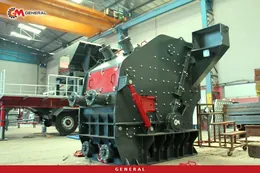
Two candidates stand out for the primary. Among the GNRK series jaw crushers the GNRK 110 (1100×850 mm opening, 110/132 kW, 33,000 kg) delivers 200–350 t/h and covers the lower end of the range. The GNRK 130 (1300×1000 mm opening, 160 kW, 42,500 kg) handles the upper end alone at 400–500 t/h. Since maximum feed is about 0.8–0.9 times the opening width, the blast pattern should be planned around that limit. Jaw plates are standard Mn13/Mn18 manganese steel; if the samples show high silica, the alloy moves to Mn18/Mn22.
Secondary and tertiary: why the cone crusher sits at the centre
The primary product is reduced in two stages by the General cone crusher. A standard-liner secondary gives 6:1–8:1 reduction and a short-head tertiary about 10:1; feed ranges from 50–250 mm (up to 300 mm) and product from 0–60 mm (up to 75 mm). Because power ranges between 90 and 500 kW, the model, capacity and CSS table are prepared per project. For a 500 TPH target, two parallel cones at the secondary stage are also considered instead of one large unit. Hydraulic CSS adjustment changes product size during operation, and hydraulic cylinder protection shields the body when uncrushable material enters.
Choke-feeding the cone matters even more in gabbro: with the chamber kept full, particles also break against each other, cubicity improves and the mantle and concave wear more evenly. To achieve this, we recommend a small surge bin or surge pile ahead of the secondary.
Three line layouts built from real models
The table below brings together equipment suitable for a gabbro line, using product page values. The cone crusher cell is left blank because its capacity is given per project.
| Equipment | Stage | Capacity (t/h) | Main dimension | Power |
|---|---|---|---|---|
| GNR 140 vibrating feeder | Feeding + by-pass | 350~600 | 1400×5000 mm | 2x9.2 kW |
| GNRK 110 jaw crusher | Primary | 200–350 | 1100×850 mm opening | 110/132 kW |
| GNRK 130 jaw crusher | Primary | 400–500 | 1300×1000 mm opening | 160 kW |
| General cone crusher | Secondary / tertiary | — | Feed 50–250 mm | 90–500 kW range |
| Twin vibrating screen | Screening | 100–500 | GNR 2470: 2400×7000 mm | 30 kW (GNR 2470) |
| General 944 wheeled plant | Jaw primary + cone | 120-180 | 800 mm feed | 550 kVA generator |
| Mobile Pre-Screening DMK | Shaping | 40-300 | 0-100 mm feed | — |
Layout 1: stationary line for the upper end (400–500 TPH)
This line, made up of the GNR 140 feeder, GNRK 130 primary, one or two secondary cones, a twin screen and a short-head tertiary cone, is erected on concrete foundations. Fixed crushing plants are not bound by chassis transport limits, so they can use a larger feed opening and more screen decks, with output reaching 8 or more products. The twin vibrating screen offers 100–500 t/h with its double deck surface and keeps efficiency at high flow without breaking the bed-depth rule (3-4 times the aperture at discharge).
Layout 2: staged stationary line for the lower end (300–350 TPH)
Behind the same GNR 140 feeder go a GNRK 110 primary and a single secondary cone. For operators who want to split the investment in two phases, foundations and steel structure can be drawn to leave room for a larger primary later. Early-year sales volume and the quarry reserve decide this together.
Layout 3: mobile start with two General 944 units
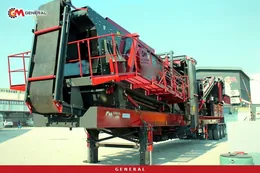
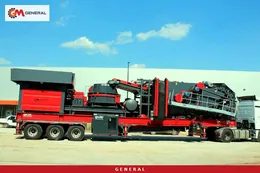
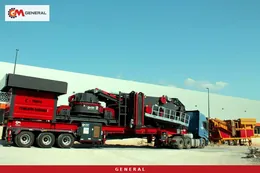
The General 944 combines a GPJ 90 jaw primary with a GM430 cone secondary on one wheeled chassis: 120-180 t/h, 800 mm feed, a 1600×5000 mm three-deck screen, 0-5 / 5-12 / 12-19 mm fractions, a 550 kVA generator and 70,000 kg weight. Two units working in parallel approach the lower end of the range; 500 TPH needs a stationary line. This route makes sense for opening new benches or starting production before the quarry layout is fixed. For other options see the mobile crushing plants page.
Cubical chips and manufactured sand: tuning the final stage
Asphalt specifications limit flaky and elongated particles; in gabbro chips that limit is usually won or lost at the tertiary stage. A short-head cone running choke-fed with the right CSS produces cubical particles. A practical way to set adjustment frequency is to take an undersize sample every shift in the first weeks and then space the interval out.
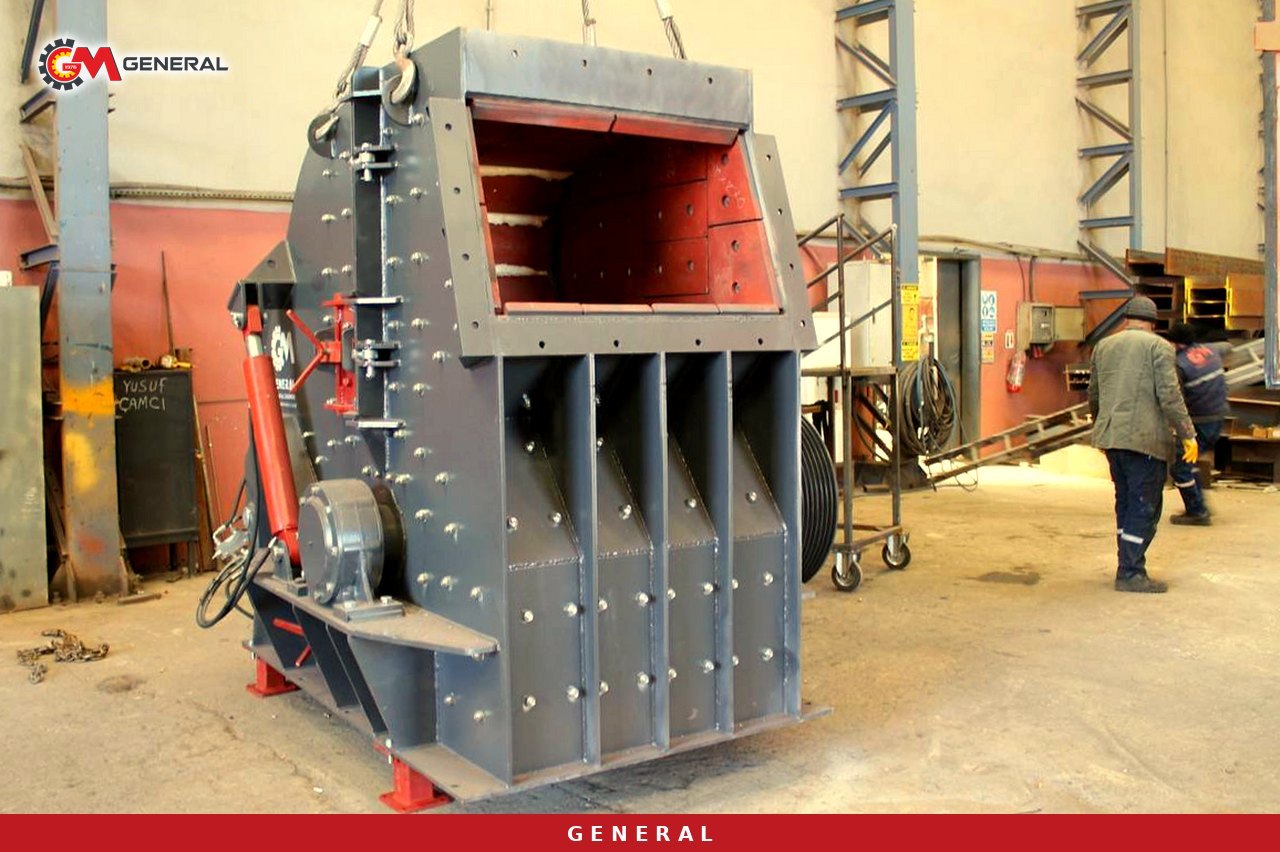
If the abrasion test allows it, an impact stage can be added for shaping. The Mobile Pre-Screening DMK accepts 0-100 mm feed, delivers 0-30 mm final product and runs at 40-300 t/h. Its integrated vibrating pre-screen sends ready-sized fines past the crusher, both crushing chambers are manganese-lined and the blow bars can be used on both sides. Where samples show high silica, staying with the cone is the better choice.
On the manufactured sand side, the real issue is managing fines. If the concrete specification limits dust and clay content, a washing or air classification step in the screening plan should be discussed at quotation stage.
Site checklist for desert heat and coastal humidity
In Hajar quarries, daytime heat, wind-blown fine dust and salty air along the Gulf of Oman coast strain the same line from different directions. The items below are measures that can be selected per project, not standard equipment on General Makina models:
- Radiator capacity suited to hot climates and pre-cleaner air filters for generators and motors.
- Water-spray dust suppression at crusher discharges and conveyor transfer points.
- Enclosed or covered conveyors on wind-exposed belt runs.
- A shaded, ventilated room with dust seals for the electrical panel.
- A paint system against salty air and bolt corrosion checks on sites near the coast.
- A maintenance schedule placing liner and jaw plate changes in the cooler hours, with spare wear parts kept on site.
Frequently asked questions
Can an impact crusher be used as the gabbro primary?
We do not recommend it. Gabbro's toughness makes blow bar life unpredictable in a primary impact rotor. Using a jaw at the primary stage and a cone at the secondary, and adding an impact stage for shaping only when tests allow, is the safer path.
Can 500 TPH come from a single wheeled plant?
Not for gabbro. Our wheeled option for hard, abrasive rock is the General 944, which delivers 120-180 t/h. Around 300 TPH can be approached with two parallel units; for 400–500 TPH, a stationary line with a GNRK 130 primary is the right solution.
Which values should I request from the sample test?
Bond abrasion index, free silica content, Los Angeles abrasion value, flakiness index and specific gravity form the basic list. Adding the largest block size after blasting and the clay content of the fines makes crusher and screen selection clear.
What determines price and delivery schedule?
Line layout, number of cone crushers, generator or grid choice, volume of steel structure and the way equipment is shipped to the Gulf port are decisive. Once these are clear, a project-specific quotation and schedule are prepared; figures only make sense on that basis.
Decision summary and next step
For a gabbro quarry in the Emirates, a 400–500 TPH target is met with a GNRK 130 stationary line, 300–350 TPH with a staged GNRK 110 line, and a fast start with two General 944 units. In all three, keeping the secondary and tertiary stages on cone crushers makes part cost predictable in tough rock. For a quotation, prepare the following:
- Test results from samples taken at different benches.
- Target product list and the approximate share of each fraction.
- Daily operating hours and the targeted saleable tonnage.
- Power source: generator, grid or a transition between the two.
- Port of discharge and route restrictions to the quarry.
General Makina has manufactured crushing and screening equipment in Izmir since 1976; it holds ISO 9001 and CE certification and gives a 1-year warranty on its machines, excluding wear parts. Send your gabbro quarry data through our contact page and our engineers will prepare the matching line layout and quotation.
Definitions of technical terms: Glossary